Outline So far, we studied schema design. CS 235: How to - - PDF document

outline
SMART_READER_LITE
LIVE PREVIEW

Outline So far, we studied schema design. CS 235: How to - - PDF document

Outline So far, we studied schema design. CS 235: How to manipulate data? Relational algebra Introduction to Databases Elegant theoretical framework Not so elegant in practice SQL Svetlozar Nestorov Relational


slide-1
SLIDE 1

1

CS 235: Introduction to Databases

Svetlozar Nestorov Lecture Notes #7

Outline

  • So far, we studied schema design.
  • How to manipulate data?
  • Relational algebra

– Elegant theoretical framework – Not so elegant in practice – SQL

  • Relational operators

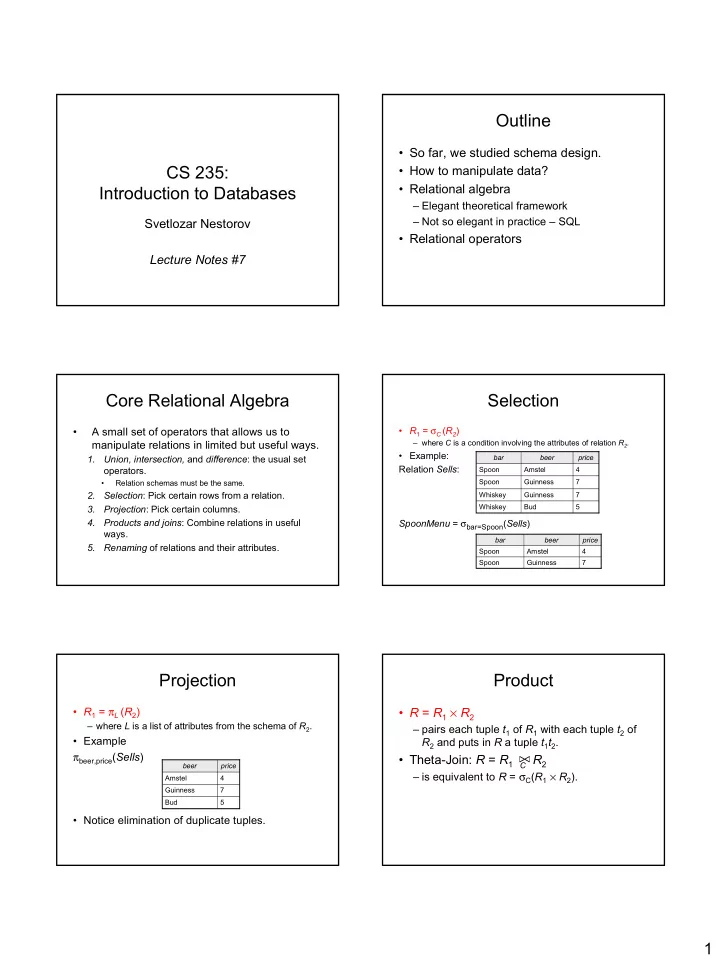
Core Relational Algebra

  • A small set of operators that allows us to

manipulate relations in limited but useful ways.

1. Union, intersection, and difference: the usual set

  • perators.
  • Relation schemas must be the same.

2. Selection: Pick certain rows from a relation. 3. Projection: Pick certain columns. 4. Products and joins: Combine relations in useful ways. 5. Renaming of relations and their attributes.

Selection

  • R1 = σC (R2)

– where C is a condition involving the attributes of relation R2.

  • Example:

Relation Sells: SpoonMenu = σbar=Spoon(Sells)

5 Bud Whiskey 7 Guinness Whiskey 7 Guinness Spoon 4 Amstel Spoon price beer bar 7 Guinness Spoon 4 Amstel Spoon price beer bar

Projection

  • R1 = πL (R2)

– where L is a list of attributes from the schema of R2.

  • Example

πbeer,price(Sells)

  • Notice elimination of duplicate tuples.

5 Bud 7 Guinness 4 Amstel price beer

Product

  • R = R1 × R2

– pairs each tuple t1 of R1 with each tuple t2 of R2 and puts in R a tuple t1t2.

  • Theta-Join: R = R1

C R2

– is equivalent to R = σC(R1 × R2).

slide-2
SLIDE 2

2

Example

Sells = Bars = BarInfo = Sells

Sells.bar=Bars.nameBars

5 Bud Whiskey 7 Guinness Whiskey 7 Guinness Spoon 4 Amstel Spoon price beer bar Rush Whiskey Wells Spoon addr name Whiskey Whiskey Spoon Spoon name 5 7 7 4 price Rush Bud Whiskey Rush Guinness Whiskey Wells Guinness Spoon Wells Amstel Spoon addr beer bar

Natural Join

  • R = R1

R2

– Equivalent to:

1. theta-join of R1 and R2 with the condition that all attributes

  • f the same name be equated.

2.

  • ne column for each pair of equated attributes is projected
  • ut.
  • What is the formula?
  • Example:

– Suppose the attribute name in relation Bars was changed to bar, to match the bar name in Sells. – BarInfo = Sells Bars

Natural Join Example

  • BarInfo = Sells Bars

5 7 7 4 price Rush Bud Whiskey Rush Guinness Whiskey Wells Guinness Spoon Wells Amstel Spoon addr beer bar

Renaming

  • ρS(A1,…,An) (R) produces a relation identical

to R but named S and with attributes, in

  • rder, named A1,…,An.
  • Example:

ρR(bar,addr) (Bars) =

  • The name of the second relation is R.

Rush Whiskey Wells Spoon addr bar

Combining Operations

  • Any algebra is defined as:

– basis arguments – ways of constructing expressions

  • For relational algebra:

– Arguments = variables standing for relations + finite, constant relations. – Expressions constructed by applying one of the operators + parentheses.

  • Query = expression of relational algebra.

Operator Precedence

  • The normal way to group operators is:

1. Unary operators σ, π, and ρ have highest precedence. 2. Next highest are the multiplicative operators, , C , and ×. 3. Lowest are the additive operators, ∪, ∩, and —.

  • But there is no universal agreement, so we always put

parentheses around the argument of a unary operator, and it is a good idea to group all binary operators with parentheses enclosing their arguments.

  • Example:

Group R ∪ σS T as R ∪ (σ(S ) T ).

slide-3
SLIDE 3

3

Expressions and Schemas

  • If ∪, ∩, — applied, schemas are the same, so the result

has the same schema.

  • Projection: use the attributes listed in the projection.
  • Selection: no change in schema.
  • Product R × S: use attributes of R and S.

– But if they share an attribute A, prefix it with the relation name, as R.A, S.A.

  • Theta-join: same as product.
  • Natural join: use attributes from each relation; common

attributes are merged anyway.

  • Renaming: whatever it says.

Example 1

  • Find the bars that are either on Wells

Street or sell Bud for less than $6.

Sells(bar, beer, price) Bars(name, addr)

Example 2

  • Find the bars that sell two different beers

at the same price.

Sells(bar, beer, price)

Linear Notation for Expressions

  • Invent new names for intermediate relations, and

assign them values that are algebraic expressions.

  • Renaming of attributes implicit in schema of new

relation.

Example

  • Find the bars that are either on Wells

Street or sell Bud for less than $6.

Sells(bar, beer, price) Bars(name, addr) R1(name) := πname(σ addr = Wells(Bars)) R2(name) := πbar(σ beer=Bud AND price<6(Sells)) R3(name) := R1 ∪ R2