Outline Background: What is an Online Problem? Maximizing Revenue - - PDF document

outline
SMART_READER_LITE
LIVE PREVIEW

Outline Background: What is an Online Problem? Maximizing Revenue - - PDF document

9/5/20 Outline Background: What is an Online Problem? Maximizing Revenue for the Analyzing Online Algorithms: Competitive Analysis Online Dial a Ride Problem Online Dial-A-Ride Problem Related Open Problems Ananya Das Christman


slide-1
SLIDE 1

9/5/20 1

Maximizing Revenue for the Online Dial-A-Ride Problem

Ananya Das Christman Middlebury College

1

Outline

  • Background: What is an Online Problem?
  • Analyzing Online Algorithms: Competitive Analysis
  • Online Dial a Ride Problem
  • Related Open Problems

2

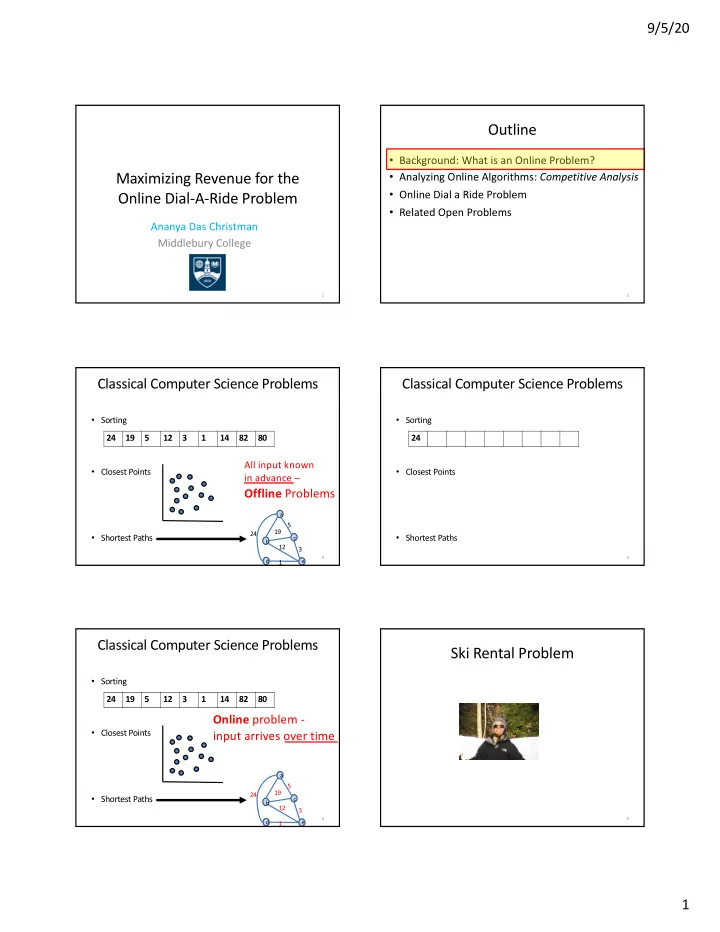
Classical Computer Science Problems

  • Sorting
  • Closest Points
  • Shortest Paths

24 19 5 12 3 1 14 82 80

a b c d e

24 3 5 19 12 1

All input known in advance –

Offline Problems

3

Classical Computer Science Problems

  • Sorting
  • Closest Points
  • Shortest Paths

24 19 5 12 3 1 14 82 80

4

Classical Computer Science Problems

  • Sorting
  • Closest Points
  • Shortest Paths

24 19 5 12 3 1 14 82 80

a b c d e

24 3 5 19 12 1

Online problem - input arrives over time

5

Ski Rental Problem

6

slide-2
SLIDE 2

9/5/20 2

Ski Rental Problem

7

Ski Rental Problem

8

Ski Rental Problem

Rent or Buy?

9

Offline Ski Rental Problem

  • Ski resort – cheap but owner often shuts down in the middle of

the season to go to Florida…

  • Cost to Rent: $1 /day, Cost to Buy: $10
  • Input: d = number of days resort will stay open
  • Goal: Decide whether to Rent or Buy to achieve cheapest cost

Alg-Check_d(input: d): if (d < 10) Rent (Cost = d) else Buy (Cost = 10)

Optimal Algorithm

10

Online Ski Rental Problem

Everyday for a ski season, you decide: Rent – or – Buy? Input (# days open) arrives over time Need a “good” Online Algorithm

11

Outline

  • Background: What is an Online Problem?
  • Analyzing Online Algorithms: Competitive Analysis
  • Online Dial a Ride Problem
  • Related Open Problems

12

slide-3
SLIDE 3

9/5/20 3

Optimistic Algorithm for Ski Rental

Worst input? Ø Resort closes on Day 2 Optimist-Alg: If open on first day: BUY

Day 1 Day 2 … Day 90 Total Cost Optimist-Alg (ON) $10 X X X $10 OPT $1 X X X $1

13

Pessimistic Algorithm for Ski Rental

Worst input? Ø Resort stays open all season

Day 1 Day 2 … Day 90 Total Cost Pessimist-Alg (ON) $1 $1 $1 $1 $90 OPT $10

  • $10

Pessimist-Alg: while (open): RENT

14

Cautious-Optimist for Ski Rental

Worst input? Ø Resort closes on Day 5

Day 1 Day 2 Day 3 Day 4 Day 5 … Day 90 Total Cost Cautious-Alg (ON) $1 $1 $1 $10 X X X $13 OPT $1 $1 $1 $1 X X X $4

Pessimist-Alg: while (open): RENT Cautious-Optimist: For the first 3 days: RENT If still open on day 4, BUY

15

How to Analyze an Online Algorithm?

  • Compare its cost to the optimal offline cost,

given the worst possible input.

16

  • Compare its cost to the optimal offline cost,

given the worst possible input.

  • Compare using ratio:

!"#$(&') !"#$(&)*)

  • If

!"#$(&') !"#$(&)*) ≤ , then ON is ,-competitive

competitive ratio

Competitive Analysis

How to Analyze an Online Algorithm?

17

Optimist Competitive Ratio

Worst input? Ø Resort closes on Day 2 Optimist-Alg: If open on first day: BUY

Day 1 Day 2 … Day 90 Total Cost Optimist-Alg (ON) $10 X X X $10 OPT $1 X X X $1

!"#$(&') !"#$(&)*) = 10 1

18

slide-4
SLIDE 4

9/5/20 4

Pessimist Competitive Ratio

Worst input? Ø Resort stays open all season

Day 1 Day 2 … Day 90 Total Cost Pessimist-Alg (ON) $1 $1 $1 $1 $90 OPT $10

  • $10

Pessimist-Alg: while (open): RENT !"#$(&') !"#$(&)*) = 90 10

19

Cautious-Optimist Competitive Ratio

Worst input? Ø Resort closes on Day 5

Day 1 Day 2 Day 3 Day 4 Day 5 … Day 90 Total Cost Cautious-Alg (ON) $1 $1 $1 $10 X X X $13 OPT $1 $1 $1 $1 X X X $4

Pessimist-Alg: while (open): RENT Cautious-Optimist: For the first 3 days: RENT If still open on day 4, BUY !"#$(&') !"#$(&)*) = 13 4 = 3.25

20

Day 1 Day 2 … Day 9 Day 10 Day 11 … Day 90 Total Cost New-Cautious (ON) $1 $1 $1 $1 $10 X X

  • $19

OPT $10

  • X

X

  • $10

New-Cautious-Optimist Competitive Ratio

New-Cautious-Optimist: For the first 9 days, RENT If open on the 10th day, BUY !"#$(&') !"#$(&)*) = 19 10 = 1.9 Worst input? Ø Resort closes on Day 11

21

Generalized Competitive Ratio

Generalized-Algorithm: Let b = cost to buy skis For the first b-1 days, RENT If open on the bth day, BUY

For any !: "#$%('()

"#$%('*+) < 2

22

Day 1 Day 2 … Day b-1 Day b Day b+1 … Day 90 Total Cost Generalized (ON) $1 $1 $1 $1 $b X X X $(b-1) + b OPT $b

  • X

X X $b

Worst input? Ø Resort closes on Day b+1

Generalized Competitive Ratio

!"#$ %& = ( − 1 + ( = 2( − 1 !"#$ %-. = (

!"#$(%&) !"#$ %-. < 2 − 1 ( %& is: (2 − 2

3 4 – competitive

Best ratio for any online algorithm! (no other number of rental days yields a better ratio)

23

Day 1 Day 2 … Day b-1 Day b Day b+1 … Day 90 Total Cost Generalized (ON) $1 $1 $1 $1 $b X X X $(b-1) + b OPT $b

  • X

X X $b

Outline

  • Background: What is an Online Problem?
  • Analyzing Online Algorithms: Competitive Analysis
  • Online Dial a Ride Problem
  • Related Open Problems

25

slide-5
SLIDE 5

9/5/20 5

Offline Dial-A-Ride

source-1 destination-1 source-2 destination-2 driver source-3 destination-3

[N. Wilson; Joint Automatic Control Conference, 1971]

26

Online Dial-A-Ride

source-1 destination-1 source-2 destination-2 source-3 destination-3

revenue1 = $10 revenue2 = $30 revenue3 = $50

Goal: Serve requests to maximize total revenue within time limit

[N. Ascheuer, S. Krumke, and J. Rambau; STACS 2000]

Time Limit = 24

27

Applications

29

OFFline vs ONline

OFFline ~ “Reservation Service”: Receives all requests in advance

Source Destination Time Revenue Oak Street Airport 9am $15 Maple Ave Grocery 3pm $10 Pine Street Airport 12pm $5 Elm Rd. 2nd Street 2:30pm $50 1st Street Main Street 6:30pm $12

30

OFFline vs ONline

ONline ~ Uber: Receives each request only when it is released Revenue = $15

32

OFFline vs ONline

ONline ~ Uber: Receives each request only when it is released Revenue = $15 $12

5 min

33

slide-6
SLIDE 6

9/5/20 6

OFFline vs ONline

ONline ~ Uber: Receives each request only when it is released Revenue = $15 $12 $17

5 min 7 min

Accept

34

OFFline vs ONline

ONline ~ Uber: Receives each request only when it is released Revenue = $15 $12 $17 $100

5 min 7 min 7 min

Accept

35

Online-Dial-A-Ride

Node (Location) Edge (Road)

a b c d e

Model with a complete weighted Graph

36

Online-Dial-A-Ride with Revenue

Input:

  • Complete Weighted Graph
  • Initial Location of Server (origin)
  • Requests: (source, destination, release time, revenue)
  • Time Limit (T)
  • rigin

Time Limit T = 24

Goal: Serve requests to Maximize Total Revenue within T Offline version is NP-hard1

a b c d e

$11 $15 $12 $20

37

  • 1. Christman, Chung, Jaczko, Westvold [ATMOS 2017]

Worst Input?

  • Every request takes a long time to serve
  • After each request we serve, we have to move for a long time

38

V max

(where max is the maximum edge weight in the graph)

V max

a b c d e

$11 $20

MOVE SERVE

Alternate between moving and serving, each for max time

Segmented-Best-Path (SBP) Algorithm1

  • 1. Let max be the maximum edge weight in the graph.
  • 2. Split the total time T into T/max “segments”,

each of length max.

  • 3. While there is still time remaining:

Alternate between: a) Find the request set with the highest revenue that can be served within time max; let S denote this set. Move to the source of the first request in S. (Wait until the end of the time segment) b) Serve the requests in set S. (Wait until the end of the time segment)

39

takes time ≤ max

  • 1. Christman, Chung, Jaczko, Li, Westvold, Xu, Yuen [IWOCA 2020]
slide-7
SLIDE 7

9/5/20 7

SBP Example

  • rigin

a b c d e T = 24, max = 6 $11

MOVE SERVE

5 2 5

$10

4 4 1 5

t=0 t=6

40

SBP Example

  • rigin

a b c d e T = 24, max = 6 $11

MOVE SERVE

4 4 5 2 5

$10

1 5

t=12

Revenue earned = $11

41

SBP Example

  • rigin

a b c d e T = 24, max = 6

MOVE SERVE

2

$10 $6

5 5 5 4 4 1

$11

t=12

Revenue earned = $11

42

SBP Example

  • rigin

a b c d e T = 24, max = 6

MOVE SERVE

2

$10 $6

5 5 5 4 4 1

$11

t=18

Revenue earned = $11

43

SBP Example

  • rigin

a b c d e T = 24, max = 6

MOVE SERVE

2

$10 $6

5 5 5 4 4 1

$11 Revenue earned = $11 + $6

44

SBP Example

  • rigin

a b c d e T = 24, max = 6

MOVE SERVE

2

$10 $6

5 5 5 4 4 1

$11

t=24

Revenue earned = $11 + $6 + $11 = $28

45

slide-8
SLIDE 8

9/5/20 8

SBP Example

  • rigin

a b c d e T = 24, max = 6

MOVE SERVE

2

$10 $6

5 5 5 4 4 1

$11

t=24

Revenue earned = $11 + $6 + $11 = $28 OPT = $11 + $6 + $11 + $10 = $38

46

SBP is 1/5-Competitive Proof

47

… SBP

T

… OPT

T

  • Consider the segments where SBP earns less than OPT

SBP is 1/5-Competitive Proof

Time segment (length = max)

  • Compare schedules of SBP and OPT, one segment at a time:

… SBP

T

… OPT

T

48

  • Consider the segments where SBP earns less than OPT
  • Create a modified schedule SBP (initially SBP = SBP) that will contain additional copies of requests
  • For now: assume all requests served by OPT during a segment are available to SBP

SBP is 1/5-Competitive Proof

Time segment (length = max)

  • Compare schedules of SBP and OPT, one segment at a time:

… SBP

T

… OPT

T

49

  • SBP serves in only every other time segment, OPT may serve the entire time
  • For a pair of consecutive segments, SBP misses at most ½ OPT’s revenue
  • Initially: revenue(SBP) revenue(SBP)

≤ 2 revenue(SBP)

SBP is 1/5-competitive

OPT … … SBP

· 2 T T

50

≤ =

  • SBP does not serve any requests that overlap

time segments

SBP is 1/5-Competitive Proof

OPT … … SBP

T T

51

slide-9
SLIDE 9

9/5/20 9

Overlapping Request

OPT

r*

  • Both r* and R can separately be served within a time segment
  • So SBP will serve a set with revenue at least max(r*, R)
  • So SBP misses at most ½ OPT

R

52

àrevenue(SBP) ≥ max(r*, R) ≥ ½ (r* + R) ≥ ½ revenue(OPT)

Overlapping Request

OPT

r*

  • Both r* and R can separately be served within a time segment
  • So SBP will serve a set with revenue at least max(r*, R)
  • So SBP misses at most ½ OPT
  • So far: revenue(SBP) 2 revenue(SBP)

≤ 4 revenue(SBP)

R

· 2

53

àrevenue(SBP) ≥ max(r*, R) ≥ ½ (r* + R) ≥ ½ revenue(OPT) ≤

SBP is 1/5-competitive

  • Recall: we assumed all requests served by OPT

during a segment are available to SBP

  • Need another factor of revenue(SBP) to

compensate when this assumption is removed revenue(SBP) ≤ 4 revenue(SBP) + revenue(SBP) ≤ 5 revenue(SBP)

54

SBP is 1/5-competitive

  • Recall: we assumed all requests served by OPT

during a segment are available to SBP

  • Need another factor of revenue(SBP) to

compensate when this assumption is removed revenue(SBP) ≤ 4 revenue(SBP) + revenue(SBP) ≤ 5 revenue(SBP) And: revenue(SBP) ≥ revenue(OPT) So: revenue(SBP) ≥ 1/5 revenue(OPT)

55

Uniform Revenue

  • Useful when all requests have equal priority
  • SBP is 1/4-competitive

56

Bipartite Graphs

SBP is k –competitive, where k is the ratio between the minimum and maximum edge weights in the input graph

sources destinations

57

slide-10
SLIDE 10

9/5/20 10

Outline

  • Background: What is an Online Problem?
  • Analyzing Online Algorithms: Competitive Analysis
  • Online Dial a Ride Problem
  • Related Open Problems

59

Summary of Results + Open Problems

Uniform Revenue Nonuniform Revenue Weighted General Graphs 1/4 1/5 Weighted Bipartite Graphs ⌈ k ⌉* ⌈ k ⌉* Competitive ratio of SBP for OLDARP *k is a fraction used to bound the minimum edge weight in the input graph

60

Can we achieve better ratios?

Segmented-Best-Path (SBP) Algorithm1

  • 1. Let max be the maximum edge weight in the graph.
  • 2. Split the total time T into T/max “segments”,

each of length max.

  • 3. While there is still time remaining:

Alternate between: a) Find the request set with the highest revenue that can be served within time max; let S denote this set. Move to the source of the first request in S. (Wait until the end of the time segment) b) Serve the requests in set S. (Wait until the end of the time segment) 61

  • 1. Christman, Chung, Jaczko, Li, Westvold, Xu, Yuen [IWOCA 2020]

Running time is exponential in the number of available requests Tradeoff? Efficiency vs. performance

Many Open Problems…

Serve all requests while minimizing route complexity A fleet of Uber drivers Ride-sharing

Thank You!

Anna Vasilchenko ’17

Aayam Poudel ’18

  • Dr. Barbara Anthony

Southwestern University

  • Dr. Christine Chung

Connecticut College

  • Dr. David Yuen

Will Forcier Lake Forest College ’13

Nick Jaczko Middlebury ‘19 Scott Westvold

63

Lambus Li Middlebury ‘20 Annika Xu Middlebury ‘20