Outline Modern architectures Spring 2006 Delay slots - - PDF document

outline
SMART_READER_LITE
LIVE PREVIEW

Outline Modern architectures Spring 2006 Delay slots - - PDF document

Outline Modern architectures Spring 2006 Delay slots Introduction to instruction scheduling List scheduling Code Scheduling Resource constraints Interaction with register allocation Scheduling across basic blocks


slide-1
SLIDE 1

1 Spring 2006

Code Scheduling

Kostis Sagonas 2 Spring 2006

Outline

  • Modern architectures
  • Delay slots
  • Introduction to instruction scheduling
  • List scheduling
  • Resource constraints
  • Interaction with register allocation
  • Scheduling across basic blocks
  • Trace scheduling
  • Scheduling for loops
  • Loop unrolling
  • Software pipelining

Kostis Sagonas 3 Spring 2006

Simple Machine Model

  • Instructions are executed in sequence

– Fetch, decode, execute, store results – One instruction at a time

  • For branch instructions, start fetching from a

different location if needed

– Check branch condition – Next instruction may come from a new location given by the branch instruction

Kostis Sagonas 4 Spring 2006

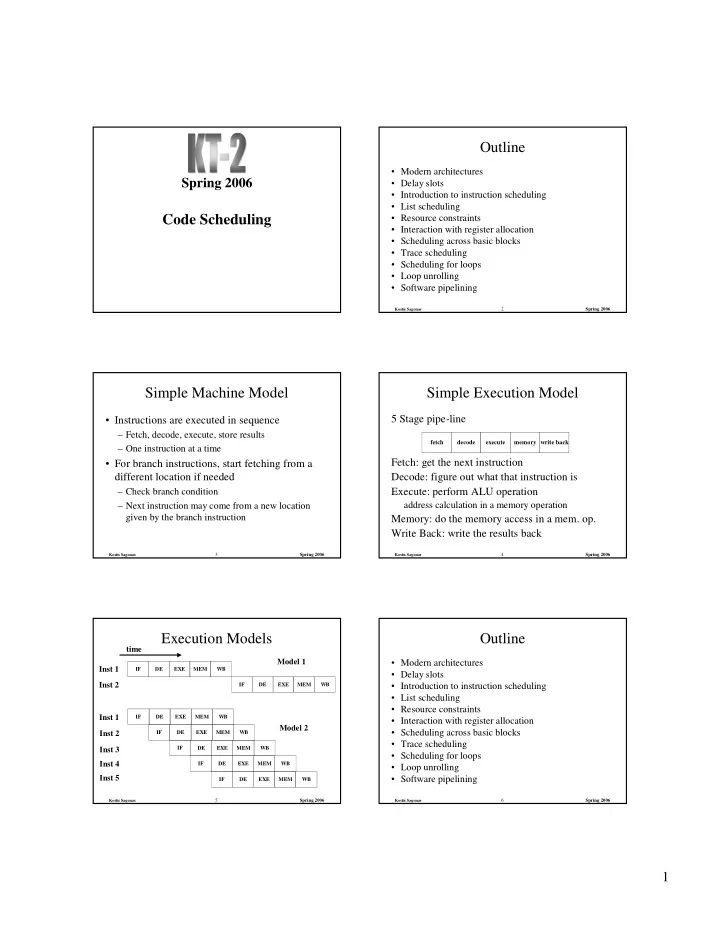
Simple Execution Model

5 Stage pipe-line Fetch: get the next instruction Decode: figure out what that instruction is Execute: perform ALU operation

address calculation in a memory operation

Memory: do the memory access in a mem. op. Write Back: write the results back

fetch decode execute memory write back

Kostis Sagonas 5 Spring 2006

Execution Models

IF DE EXE MEM WB IF DE EXE MEM WB

Inst 1 Inst 2 time Model 1

IF DE EXE MEM WB IF DE EXE MEM WB IF DE EXE MEM WB IF DE EXE MEM WB IF DE EXE MEM WB

Inst 1 Inst 2 Inst 3 Inst 4 Inst 5 Model 2

Kostis Sagonas 6 Spring 2006

Outline

  • Modern architectures
  • Delay slots
  • Introduction to instruction scheduling
  • List scheduling
  • Resource constraints
  • Interaction with register allocation
  • Scheduling across basic blocks
  • Trace scheduling
  • Scheduling for loops
  • Loop unrolling
  • Software pipelining
slide-2
SLIDE 2

2

Kostis Sagonas 7 Spring 2006

Handling Branch Instructions

Problem: We do not know the location of the next instruction until later

– after DE in jump instructions – after EXE in conditional branch instructions

IF DE EXE MEM WB

Branch

IF DE EXE MEM WB

Next Inst

IF DE EXE MEM WB IF DE EXE MEM WB

??? ??? What to do with the middle 2 instructions?

Kostis Sagonas 8 Spring 2006

Handling Branch Instructions

What to do with the middle 2 instructions?

  • 1. Stall the pipeline in case of a branch until we

know the address of the next instruction

– wasted cycles

IF DE EXE MEM WB IF DE EXE MEM WB

Branch Next inst

Kostis Sagonas 9 Spring 2006

Handling Branch Instructions

What to do with the middle 2 instructions?

  • 2. Delay the action of the branch

– Make branch affect only after two instructions – Following two instructions after the branch get executed regardless of the branch

IF DE EXE MEM WB IF DE EXE MEM WB IF DE EXE MEM WB IF DE EXE MEM WB

Branch Next seq inst Next seq inst Branch target inst

Kostis Sagonas 10 Spring 2006

Branch Delay Slot(s)

MIPS has a branch delay slot

– The instruction after a conditional branch gets executed even if the code branches to target – Fetching from the branch target takes place only after that

ble r3, foo Branch delay slot

What instruction to put in the branch delay slot?

Kostis Sagonas 11 Spring 2006

Filling the Branch Delay Slot

Simple Solution: Put a no-op Wasted instruction, just like a stall

noop ble r3, lbl Branch delay slot

Kostis Sagonas 12 Spring 2006

Filling the Branch Delay Slot

  • moved instruction executes iff branch executes

– So, get the instruction from the same basic block as the branch – don’t move a branch instruction!

  • instruction needs to be moved over the branch

– branch does not depend on the result of the instr.

prev_instr prev_instr

Move an instruction from above the branch

ble r3, lbl Branch delay slot

slide-3
SLIDE 3

3

Kostis Sagonas 13 Spring 2006

Filling the Branch Delay Slot

Move an instruction dominated by the branch instruction

ble r3, lbl Branch delay slot lbl: dom_instr dom_instr

Kostis Sagonas 14 Spring 2006

Filling the Branch Delay Slot

Move an instruction from the branch target

– Instruction dominated by target – No other ways to reach target (if so, take care of them) – If conditional branch, the moved instruction should not have a lasting effect if the branch is not taken ble r3, lbl instr Branch delay slot lbl: instr

Kostis Sagonas 15 Spring 2006

Load Delay Slots

Problem: Results of the loads are not available until end of MEM stage If the value of the load is used…what to do??

IF DE EXE MEM WB IF DE EXE MEM WB

Load Use of load

Kostis Sagonas 16 Spring 2006

Load Delay Slots

If the value of the load is used…what to do??

  • Always stall one cycle
  • Stall one cycle if next instruction uses the value

– Need hardware to do this

  • Have a delay slot for load

– The new value is only available after two instructions – If next instr. uses the register, it will get the old value

IF DE EXE MEM WB IF DE EXE MEM WB IF DE EXE MEM WB

Load ??? Use of load

Kostis Sagonas 17 Spring 2006

Example

r2 = *(r1 + 4) r3 = *(r1 + 8) r4 = r2 + r3 r5 = r2 - 1 goto L1

Kostis Sagonas 18 Spring 2006

Example

r2 = *(r1 + 4) r3 = *(r1 + 8) noop r4 = r2 + r3 r5 = r2 - 1 goto L1 noop

Assume 1 cycle delay on branches and 1 cycle latency for loads

slide-4
SLIDE 4

4

Kostis Sagonas 19 Spring 2006

Example

r2 = *(r1 + 4) r3 = *(r1 + 8) r5 = r2 - 1 r4 = r2 + r3 goto L1 noop

Assume 1 cycle delay on branches and 1 cycle latency for loads

Kostis Sagonas 20 Spring 2006

Example

r2 = *(r1 + 4) r3 = *(r1 + 8) r5 = r2 - 1 goto L1 r4 = r2 + r3

Assume 1 cycle delay on branches and 1 cycle latency for loads

Kostis Sagonas 21 Spring 2006

Example

r2 = *(r1 + 4) r3 = *(r1 + 8) r5 = r2 - 1 goto L1 r4 = r2 + r3

Final code after delay slot filling

Kostis Sagonas 22 Spring 2006

Outline

  • Modern architectures
  • Delay slots
  • Introduction to instruction scheduling
  • List scheduling
  • Resource constraints
  • Interaction with register allocation
  • Scheduling across basic blocks
  • Trace scheduling
  • Scheduling for loops
  • Loop unrolling
  • Software pipelining

Kostis Sagonas 23 Spring 2006

From a Simple Machine Model to a Real Machine Model

  • Many pipeline stages

– MIPS R4000 has 8 stages

  • Different instructions take different amount of

time to execute

– mult 10 cycles – div 69 cycles – ddiv 133 cycles

  • Hardware to stall the pipeline if an instruction

uses a result that is not ready

Kostis Sagonas 24 Spring 2006

Real Machine Model cont.

  • Most modern processors have multiple

execution units (superscalar)

– If the instruction sequence is correct, multiple

  • perations will take place in the same cycles

– Even more important to have the right instruction sequence

slide-5
SLIDE 5

5

Kostis Sagonas 25 Spring 2006

Instruction Scheduling

Goal: Reorder instructions so that pipeline stalls are minimized Constraints on Instruction Scheduling:

– Data dependencies – Control dependencies – Resource constraints

Kostis Sagonas 26 Spring 2006

Data Dependencies

  • If two instructions access the same variable,

they can be dependent

  • Kinds of dependencies

– True: write read – Anti: read write – Output: write write

  • What to do if two instructions are dependent?

– The order of execution cannot be reversed – Reduces the possibilities for scheduling

Kostis Sagonas 27 Spring 2006

Computing Data Dependencies

  • For basic blocks, compute dependencies by

walking through the instructions

  • Identifying register dependencies is simple

– is it the same register?

  • For memory accesses

– simple: base + offset1 ?= base + offset2 – data dependence analysis: a[2i] ?= a[2i+1] – interprocedural analysis: global ?= parameter – pointer alias analysis: p1 ?= p

Kostis Sagonas 28 Spring 2006

  • Using a dependence DAG, one per basic block
  • Nodes are instructions, edges represent

dependencies

Representing Dependencies

3 1 2 4

2 2 2

1: r2 = *(r1 + 4) 2: r3 = *(r1 + 8) 3: r4 = r2 + r3 4: r5 = r2 - 1

Edge is labeled with latency:

v(i j) = delay required between initiation times of i and j minus the execution time required by i

Kostis Sagonas 29 Spring 2006

Example

1: r2 = *(r1 + 4) 2: r3 = *(r2 + 4) 3: r4 = r2 + r3 4: r5 = r2 - 1

3 1 2 4

2 2 2 3

Kostis Sagonas 30 Spring 2006

Another Example

1: r2 = *(r1 + 4) 2: *(r1 + 4) = r3 3: r3 = r2 + r3 4: r5 = r2 - 1

3 1 2 4

2 2 1 1

slide-6
SLIDE 6

6

Kostis Sagonas 31 Spring 2006

Control Dependencies and Resource Constraints

  • For now, let’s worry only about basic blocks
  • For now, let’s look at simple pipelines

Kostis Sagonas 32 Spring 2006

Example

Results available in 1 cycle 1 cycle 1 cycle 3 cycles 4 cycles 1 cycle 3 cycles

1 2

1: LA r1,array 2: LD r2,4(r1) 3: AND r3,r3,0x00FF 4: MULC r6,r6,100 5: ST r7,4(r6) 6: DIVC r5,r5,100 7: ADD r4,r2,r5 8: MUL r5,r2,r4 9: ST r4,0(r1)

Kostis Sagonas 33 Spring 2006

Example

Results available in 1: LA r1,array 1 cycle 2: LD r2,4(r1) 1 cycle 3: AND r3,r3,0x00FF 1 cycle 4: MULC r6,r6,100 3 cycles 5: ST r7,4(r6) 6: DIVC r5,r5,100 4 cycles 7: ADD r4,r2,r5 1 cycle 8: MUL r5,r2,r4 3 cycles 9: ST r4,0(r1)

1 2 3 4 5 st st

Kostis Sagonas 34 Spring 2006

Example

Results available in 1: LA r1,array 1 cycle 2: LD r2,4(r1) 1 cycle 3: AND r3,r3,0x00FF 1 cycle 4: MULC r6,r6,100 3 cycles 5: ST r7,4(r6) 6: DIVC r5,r5,100 4 cycles 7: ADD r4,r2,r5 1 cycle 8: MUL r5,r2,r4 3 cycles 9: ST r4,0(r1)

1 2 3 4 st st 5 6 7 st st st

Kostis Sagonas 35 Spring 2006

Example

Results available in 1: LA r1,array 1 cycle 2: LD r2,4(r1) 1 cycle 3: AND r3,r3,0x00FF 1 cycle 4: MULC r6,r6,100 3 cycles 5: ST r7,4(r6) 6: DIVC r5,r5,100 4 cycles 7: ADD r4,r2,r5 1 cycle 8: MUL r5,r2,r4 3 cycles 9: ST r4,0(r1)

1 2 3 4 st st 5 6 st st st 7 8

Kostis Sagonas 36 Spring 2006

Example

Results available in 1: LA r1,array 1 cycle 2: LD r2,4(r1) 1 cycle 3: AND r3,r3,0x00FF 1 cycle 4: MULC r6,r6,100 3 cycles 5: ST r7,4(r6) 6: DIVC r5,r5,100 4 cycles 7: ADD r4,r2,r5 1 cycle 8: MUL r5,r2,r4 3 cycles 9: ST r4,0(r1)

1 2 3 4 st st 5 6 st st st 7 8 9

14 cycles!

slide-7
SLIDE 7

7

Kostis Sagonas 37 Spring 2006

Outline

  • Modern architectures
  • Delay slots
  • Introduction to instruction scheduling
  • List scheduling
  • Resource constraints
  • Interaction with register allocation
  • Scheduling across basic blocks
  • Trace scheduling
  • Scheduling for loops
  • Loop unrolling
  • Software pipelining

Kostis Sagonas 38 Spring 2006

List Scheduling Algorithm

  • Idea

– Do a topological sort of the dependence DAG – Consider when an instruction can be scheduled without causing a stall – Schedule the instruction if it causes no stall and all its predecessors are already scheduled

  • Optimal list scheduling is NP-complete

– Use heuristics when necessary

Kostis Sagonas 39 Spring 2006

List Scheduling Algorithm

  • Create a dependence DAG of a basic block
  • Topological Sort

READY = nodes with no predecessors Loop until READY is empty Schedule each node in READY when no stalling READY += nodes whose predecessors have all been scheduled

Kostis Sagonas 40 Spring 2006

Heuristics for selection

Heuristics for selecting from the READY list

  • 1. pick the node with the longest path to a leaf in the

dependence graph

  • 2. pick a node with the most immediate successors
  • 3. pick a node that can go to a less busy pipeline

(in a superscalar implementation)

Kostis Sagonas 41 Spring 2006

Heuristics for selection

Pick the node with the longest path to a leaf in the dependence graph Algorithm (for node x)

– If x has no successors dx = 0 – dx = MAX( dy + cxy) for all successors y of x Use reverse breadth-first visiting order

Kostis Sagonas 42 Spring 2006

Heuristics for selection

Pick a node with the most immediate successors Algorithm (for node x):

– fx = number of successors of x

slide-8
SLIDE 8

8

Kostis Sagonas 43 Spring 2006

Example

Results available in 1: LA r1,array 1 cycle 2: LD r2,4(r1) 1 cycle 3: AND r3,r3,0x00FF 1 cycle 4: MULC r6,r6,100 3 cycles 5: ST r7,4(r6) 6: DIVC r5,r5,100 4 cycles 7: ADD r4,r2,r5 1 cycle 8: MUL r5,r2,r4 3 cycles 9: ST r4,0(r1)

Kostis Sagonas 44 Spring 2006

Example

1 6 8 2 7 9 1 1 3 4 1 4 5 3 3 1: LA r1,array 2: LD r2,4(r1) 3: AND r3,r3,0x00FF 4: MULC r6,r6,100 5: ST r7,4(r6) 6: DIVC r5,r5,100 7: ADD r4,r2,r5 8: MUL r5,r2,r4 9: ST r4,0(r1)

Kostis Sagonas 45 Spring 2006

Example

1 6 8 2 7 9 1 1 3 4 1 4 5 3 3 d=0 d=0 d=0 d=0 d=3 d=3 d=7 d=4 d=5 f=1 f=0 f=0 f=1 f=1 f=1 f=2 f=0 f=0

READY = { }

Kostis Sagonas 46 Spring 2006

Example

1 6 8 2 7 9 1 1 3 4 1 4 5 3 3 d=0 d=0 d=0 d=0 d=3 d=3 d=7 d=4 d=5 f=1 f=0 f=0 f=1 f=1 f=1 f=2 f=0 f=0

READY = { } 1, 3, 4, 6 6, 1, 4, 3

Kostis Sagonas 47 Spring 2006

Example

1 6 8 2 7 9 1 1 3 4 1 4 5 3 3 d=0 d=0 d=0 d=0 d=3 d=3 d=7 d=4 d=5 f=1 f=0 f=0 f=1 f=1 f=1 f=2 f=0 f=0

READY = { 6, 1, 4, 3 } 6

Kostis Sagonas 48 Spring 2006

Example

1 6 8 2 7 9 1 1 3 4 1 4 5 3 3 d=0 d=0 d=0 d=0 d=3 d=3 d=7 d=4 d=5 f=1 f=0 f=0 f=1 f=1 f=1 f=2 f=0 f=0

READY = { 1, 4, 3 } 6 1 1

slide-9
SLIDE 9

9

Kostis Sagonas 49 Spring 2006

Example

1 6 8 2 7 9 1 1 3 4 1 4 5 3 3 d=0 d=0 d=0 d=0 d=3 d=3 d=7 d=4 d=5 f=1 f=0 f=0 f=1 f=1 f=1 f=2 f=0 f=0

READY = { 4, 3 } 6 1 2

Kostis Sagonas 50 Spring 2006

Example

1 6 8 2 7 9 1 1 3 4 1 4 5 3 3 d=0 d=0 d=0 d=0 d=3 d=3 d=7 d=4 d=5 f=1 f=0 f=0 f=1 f=1 f=1 f=2 f=0 f=0

READY = { 2, 4, 3 } 6 1 2

Kostis Sagonas 51 Spring 2006

Example

1 6 8 2 7 9 1 1 3 4 1 4 5 3 3 d=0 d=0 d=0 d=0 d=3 d=3 d=7 d=4 d=5 f=1 f=0 f=0 f=1 f=1 f=1 f=2 f=0 f=0

READY = { 2, 4, 3 } 6 1 2

Kostis Sagonas 52 Spring 2006

Example

1 6 8 2 7 9 1 1 3 4 1 4 5 3 3 d=0 d=0 d=0 d=0 d=3 d=3 d=7 d=4 d=5 f=1 f=0 f=0 f=1 f=1 f=1 f=2 f=0 f=0

READY = { 4, 3 } 6 1 2 7

Kostis Sagonas 53 Spring 2006

Example

1 6 8 2 7 9 1 1 3 4 1 4 5 3 3 d=0 d=0 d=0 d=0 d=3 d=3 d=7 d=4 d=5 f=1 f=0 f=0 f=1 f=1 f=1 f=2 f=0 f=0

READY = { 7, 4, 3 } 6 1 2 7

Kostis Sagonas 54 Spring 2006

Example

1 6 8 2 7 9 1 1 3 4 1 4 5 3 3 d=0 d=0 d=0 d=0 d=3 d=3 d=7 d=4 d=5 f=1 f=0 f=0 f=1 f=1 f=1 f=2 f=0 f=0

READY = { 7, 4, 3 } 6 1 2 4

slide-10
SLIDE 10

10

Kostis Sagonas 55 Spring 2006

Example

1 6 8 2 7 9 1 1 3 4 1 4 5 3 3 d=0 d=0 d=0 d=0 d=3 d=3 d=7 d=4 d=5 f=1 f=0 f=0 f=1 f=1 f=1 f=2 f=0 f=0

READY = { 7, 3 } 6 1 2 4 5

Kostis Sagonas 56 Spring 2006

Example

1 6 8 2 7 9 1 1 3 4 1 4 5 3 3 d=0 d=0 d=0 d=0 d=3 d=3 d=7 d=4 d=5 f=1 f=0 f=0 f=1 f=1 f=1 f=2 f=0 f=0

READY = { 7, 3, 5 } 6 1 2 4 7

Kostis Sagonas 57 Spring 2006

Example

1 6 8 2 7 9 1 1 3 4 1 4 5 3 3 d=0 d=0 d=0 d=0 d=3 d=3 d=7 d=4 d=5 f=1 f=0 f=0 f=1 f=1 f=1 f=2 f=0 f=0

READY = { 7, 3, 5 } 6 1 2 4 7

Kostis Sagonas 58 Spring 2006

Example

1 6 8 2 7 9 1 1 3 4 1 4 5 3 3 d=0 d=0 d=0 d=0 d=3 d=3 d=7 d=4 d=5 f=1 f=0 f=0 f=1 f=1 f=1 f=2 f=0 f=0

READY = { 3, 5 } 6 1 2 4 7 8, 9

Kostis Sagonas 59 Spring 2006

Example

1 6 8 2 7 9 1 1 3 4 1 4 5 3 3 d=0 d=0 d=0 d=0 d=3 d=3 d=7 d=4 d=5 f=1 f=0 f=0 f=1 f=1 f=1 f=2 f=0 f=0

READY = { 3, 5, 8, 9 } 6 1 2 4 7 3 3

Kostis Sagonas 60 Spring 2006

Example

1 6 8 2 7 9 1 1 3 4 1 4 5 3 3 d=0 d=0 d=0 d=0 d=3 d=3 d=7 d=4 d=5 f=1 f=0 f=0 f=1 f=1 f=1 f=2 f=0 f=0

READY = { 5, 8, 9 } 6 1 2 4 7 3 5

slide-11
SLIDE 11

11

Kostis Sagonas 61 Spring 2006

Example

1 6 8 2 7 9 1 1 3 4 1 4 5 3 3 d=0 d=0 d=0 d=0 d=3 d=3 d=7 d=4 d=5 f=1 f=0 f=0 f=1 f=1 f=1 f=2 f=0 f=0

READY = { 5, 8, 9 } 6 1 2 4 7 3 5

Kostis Sagonas 62 Spring 2006

Example

1 6 8 2 7 9 1 1 3 4 1 4 5 3 3 d=0 d=0 d=0 d=0 d=3 d=3 d=7 d=4 d=5 f=1 f=0 f=0 f=1 f=1 f=1 f=2 f=0 f=0

READY = { 8, 9 } 6 1 2 4 7 3 5 8

Kostis Sagonas 63 Spring 2006

Example

1 6 8 2 7 9 1 1 3 4 1 4 5 3 3 d=0 d=0 d=0 d=0 d=3 d=3 d=7 d=4 d=5 f=1 f=0 f=0 f=1 f=1 f=1 f=2 f=0 f=0

READY = { 8, 9 } 6 1 2 4 7 3 5 8

Kostis Sagonas 64 Spring 2006

Example

1 6 8 2 7 9 1 1 3 4 1 4 5 3 3 d=0 d=0 d=0 d=0 d=3 d=3 d=7 d=4 d=5 f=1 f=0 f=0 f=1 f=1 f=1 f=2 f=0 f=0

READY = { 9 } 6 1 2 4 7 3 5 8 9

Kostis Sagonas 65 Spring 2006

Example

1 6 8 2 7 9 1 1 3 4 1 4 5 3 3 d=0 d=0 d=0 d=0 d=3 d=3 d=7 d=4 d=5 f=1 f=0 f=0 f=1 f=1 f=1 f=2 f=0 f=0

READY = { 9 } 6 1 2 4 7 3 5 8 9

Kostis Sagonas 66 Spring 2006

Example

1 6 8 2 7 9 1 1 3 4 1 4 5 3 3 d=0 d=0 d=0 d=0 d=3 d=3 d=7 d=4 d=5 f=1 f=0 f=0 f=1 f=1 f=1 f=2 f=0 f=0

READY = { } 6 1 2 4 7 3 5 8 9

slide-12
SLIDE 12

12

Kostis Sagonas 67 Spring 2006

Example

Results available in 1: LA r1,array 1 cycle 2: LD r2,4(r1) 1 cycle 3: AND r3,r3,0x00FF 1 cycle 4: MULC r6,r6,100 3 cycles 5: ST r7,4(r6) 6: DIVC r5,r5,100 4 cycles 7: ADD r4,r2,r5 1 cycle 8: MUL r5,r2,r4 3 cycles 9: ST r4,0(r1)

9 cycles

6 1 2 4 7 3 5 8 9 1 2 3 4 st st 5 6 st st st 7 8 9

14 cycles vs.

Kostis Sagonas 68 Spring 2006

Outline

  • Modern architectures
  • Delay slots
  • Introduction to instruction scheduling
  • List scheduling
  • Resource constraints
  • Interaction with register allocation
  • Scheduling across basic blocks
  • Trace scheduling
  • Scheduling for loops
  • Loop unrolling
  • Software pipelining

Kostis Sagonas 69 Spring 2006

Resource Constraints

  • Modern machines have many resource

constraints

  • Superscalar architectures:

– can run few parallel operations – but have constraints

Kostis Sagonas 70 Spring 2006

Resource Constraints of a Superscalar Processor

Example:

– 1 integer operation ALUop dest, src1, src2 # in 1 clock cycle In parallel with – 1 memory operation LD dst, addr # in 2 clock cycles ST src, addr # in 1 clock cycle

Kostis Sagonas 71 Spring 2006

List Scheduling Algorithm with Resource Constraints

  • Represent the superscalar architecture as multiple

pipelines

– Each pipeline represents some resource

Kostis Sagonas 72 Spring 2006

List Scheduling Algorithm with Resource Constraints

  • Represent the superscalar architecture as multiple

pipelines

– Each pipeline represents some resource

  • Example

– One single cycle ALU unit – One two-cycle pipelined memory unit

ALUop MEM 1 MEM 2

slide-13
SLIDE 13

13

Kostis Sagonas 73 Spring 2006

List Scheduling Algorithm with Resource Constraints

  • Create a dependence DAG of a basic block
  • Topological Sort

READY = nodes with no predecessors Loop until READY is empty Let n READY be the node with the highest priority Schedule n in the earliest slot that satisfies precedence + resource constraints Update READY

Kostis Sagonas 74 Spring 2006

1 6 8 2 7 9 1 2 1 1 1 4 5 2 3

Example

1: LA r1,array 2: LD r2,4(r1) 3: AND r3,r3,0x00FF 4: LD r6,8(sp) 5: ST r7,4(r6) 6: ADD r5,r5,100 7: ADD r4,r2,r5 8: MUL r5,r2,r4 9: ST r4,0(r1)

ALUop MEM 1 MEM 2

READY = { 1, 6, 4, 3 }

d=0 d=0 d=0 d=0 d=2 d=1 d=2 d=3 d=4 f=1 f=0 f=0 f=1 f=1 f=1 f=2 f=0 f=0

1 1

Kostis Sagonas 75 Spring 2006

Example

1: LA r1,array 2: LD r2,4(r1) 3: AND r3,r3,0x00FF 4: LD r6,8(sp) 5: ST r7,4(r6) 6: ADD r5,r5,100 7: ADD r4,r2,r5 8: MUL r5,r2,r4 9: ST r4,0(r1)

ALUop MEM 1 MEM 2

2

1 6 8 2 7 9 1 2 1 1 1 4 5 2 3 d=0 d=0 d=0 d=0 d=2 d=1 d=2 d=3 d=4 f=1 f=0 f=0 f=1 f=1 f=1 f=2 f=0 f=0

1 READY = { 6, 4, 3 }

Kostis Sagonas 76 Spring 2006

Example

1: LA r1,array 2: LD r2,4(r1) 3: AND r3,r3,0x00FF 4: LD r6,8(sp) 5: ST r7,4(r6) 6: ADD r5,r5,100 7: ADD r4,r2,r5 8: MUL r5,r2,r4 9: ST r4,0(r1)

ALUop MEM 1 MEM 2

READY = { 2, 6, 4, 3 }

1 6 8 2 7 9 1 2 1 1 1 4 5 2 3 d=0 d=0 d=0 d=0 d=2 d=1 d=2 d=3 d=4 f=1 f=0 f=0 f=1 f=1 f=1 f=2 f=0 f=0

1 2 2 2

Kostis Sagonas 77 Spring 2006

Example

1: LA r1,array 2: LD r2,4(r1) 3: AND r3,r3,0x00FF 4: LD r6,8(sp) 5: ST r7,4(r6) 6: ADD r5,r5,100 7: ADD r4,r2,r5 8: MUL r5,r2,r4 9: ST r4,0(r1)

1 6

ALUop MEM 1

2

MEM 2

READY = { 6, 4, 3 } 2

1 6 8 2 7 9 1 2 1 1 1 4 5 2 3 d=0 d=0 d=0 d=0 d=2 d=1 d=2 d=3 d=4 f=1 f=0 f=0 f=1 f=1 f=1 f=2 f=0 f=0

6

Kostis Sagonas 78 Spring 2006

Example

1: LA r1,array 2: LD r2,4(r1) 3: AND r3,r3,0x00FF 4: LD r6,8(sp) 5: ST r7,4(r6) 6: ADD r5,r5,100 7: ADD r4,r2,r5 8: MUL r5,r2,r4 9: ST r4,0(r1)

1 6

ALUop MEM 1

2

MEM 2

READY = { 4, 3 } 7 2

1 6 8 2 7 9 1 2 1 1 1 4 5 2 3 d=0 d=0 d=0 d=0 d=2 d=1 d=2 d=3 d=4 f=1 f=0 f=0 f=1 f=1 f=1 f=2 f=0 f=0

slide-14
SLIDE 14

14

Kostis Sagonas 79 Spring 2006

Example

1: LA r1,array 2: LD r2,4(r1) 3: AND r3,r3,0x00FF 4: LD r6,8(sp) 5: ST r7,4(r6) 6: ADD r5,r5,100 7: ADD r4,r2,r5 8: MUL r5,r2,r4 9: ST r4,0(r1)

1 6

ALUop MEM 1

4 4 2

MEM 2

READY = { 4, 7, 3 } 2

1 6 8 2 7 9 1 2 1 1 1 4 5 2 3 d=0 d=0 d=0 d=0 d=2 d=1 d=2 d=3 d=4 f=1 f=0 f=0 f=1 f=1 f=1 f=2 f=0 f=0

4

Kostis Sagonas 80 Spring 2006

Example

1: LA r1,array 2: LD r2,4(r1) 3: AND r3,r3,0x00FF 4: LD r6,8(sp) 5: ST r7,4(r6) 6: ADD r5,r5,100 7: ADD r4,r2,r5 8: MUL r5,r2,r4 9: ST r4,0(r1)

1 6

ALUop

4

MEM 1

4 2

MEM 2

READY = { 7, 3 } 5 2

1 6 8 2 7 9 1 2 1 1 1 4 5 2 3 d=0 d=0 d=0 d=0 d=2 d=1 d=2 d=3 d=4 f=1 f=0 f=0 f=1 f=1 f=1 f=2 f=0 f=0

Kostis Sagonas 81 Spring 2006

Example

1: LA r1,array 2: LD r2,4(r1) 3: AND r3,r3,0x00FF 4: LD r6,8(sp) 5: ST r7,4(r6) 6: ADD r5,r5,100 7: ADD r4,r2,r5 8: MUL r5,r2,r4 9: ST r4,0(r1)

1 6 7

ALUop

4

MEM 1

4 2

MEM 2

READY = { 7, 3, 5 } 2

1 6 8 2 7 9 1 2 1 1 1 4 5 2 3 d=0 d=0 d=0 d=0 d=2 d=1 d=2 d=3 d=4 f=1 f=0 f=0 f=1 f=1 f=1 f=2 f=0 f=0

7

Kostis Sagonas 82 Spring 2006

Example

1: LA r1,array 2: LD r2,4(r1) 3: AND r3,r3,0x00FF 4: LD r6,8(sp) 5: ST r7,4(r6) 6: ADD r5,r5,100 7: ADD r4,r2,r5 8: MUL r5,r2,r4 9: ST r4,0(r1)

1 6

ALUop

4

MEM 1

4 2

MEM 2

READY = { 3, 5 } 8, 9 2

1 6 8 2 7 9 1 2 1 1 1 4 5 2 3 d=0 d=0 d=0 d=0 d=2 d=1 d=2 d=3 d=4 f=1 f=0 f=0 f=1 f=1 f=1 f=2 f=0 f=0

7

Kostis Sagonas 83 Spring 2006

7

Example

1: LA r1,array 2: LD r2,4(r1) 3: AND r3,r3,0x00FF 4: LD r6,8(sp) 5: ST r7,4(r6) 6: ADD r5,r5,100 7: ADD r4,r2,r5 8: MUL r5,r2,r4 9: ST r4,0(r1)

1 6

ALUop

4

MEM 1

4 2

MEM 2

READY = { 3, 5, 8, 9 } 2

1 6 8 2 7 9 1 2 1 1 1 4 5 2 3 d=0 d=0 d=0 d=0 d=2 d=1 d=2 d=3 d=4 f=1 f=0 f=0 f=1 f=1 f=1 f=2 f=0 f=0

3 3

Kostis Sagonas 84 Spring 2006

Example

1: LA r1,array 2: LD r2,4(r1) 3: AND r3,r3,0x00FF 4: LD r6,8(sp) 5: ST r7,4(r6) 6: ADD r5,r5,100 7: ADD r4,r2,r5 8: MUL r5,r2,r4 9: ST r4,0(r1)

1 6 3 7

ALUop

4

MEM 1

4 2

MEM 2

READY = { 5, 8, 9 } 2

1 6 8 2 7 9 1 2 1 1 1 4 5 2 3 d=0 d=0 d=0 d=0 d=2 d=1 d=2 d=3 d=4 f=1 f=0 f=0 f=1 f=1 f=1 f=2 f=0 f=0

5 5

slide-15
SLIDE 15

15

Kostis Sagonas 85 Spring 2006

Example

1: LA r1,array 2: LD r2,4(r1) 3: AND r3,r3,0x00FF 4: LD r6,8(sp) 5: ST r7,4(r6) 6: ADD r5,r5,100 7: ADD r4,r2,r5 8: MUL r5,r2,r4 9: ST r4,0(r1)

1 6 3 7

ALUop

4 5

MEM 1

4 2

MEM 2

READY = { 8, 9 } 2

1 6 8 2 7 9 1 2 1 1 1 4 5 2 3 d=0 d=0 d=0 d=0 d=2 d=1 d=2 d=3 d=4 f=1 f=0 f=0 f=1 f=1 f=1 f=2 f=0 f=0

8 8

Kostis Sagonas 86 Spring 2006

Example

1: LA r1,array 2: LD r2,4(r1) 3: AND r3,r3,0x00FF 4: LD r6,8(sp) 5: ST r7,4(r6) 6: ADD r5,r5,100 7: ADD r4,r2,r5 8: MUL r5,r2,r4 9: ST r4,0(r1)

1 6 3 7 8

ALUop

4 5

MEM 1

4 2

MEM 2

READY = { 9 } 2

1 6 8 2 7 9 1 2 1 1 1 4 5 2 3 d=0 d=0 d=0 d=0 d=2 d=1 d=2 d=3 d=4 f=1 f=0 f=0 f=1 f=1 f=1 f=2 f=0 f=0

9 9

Kostis Sagonas 87 Spring 2006

Example

1: LA r1,array 2: LD r2,4(r1) 3: AND r3,r3,0x00FF 4: LD r6,8(sp) 5: ST r7,4(r6) 6: ADD r5,r5,100 7: ADD r4,r2,r5 8: MUL r5,r2,r4 9: ST r4,0(r1)

1 6 3 7 8

ALUop

4 5 9

MEM 1

4 2

MEM 2

READY = { } 2

1 6 8 2 7 9 1 2 1 1 1 4 5 2 3 d=0 d=0 d=0 d=0 d=2 d=1 d=2 d=3 d=4 f=1 f=0 f=0 f=1 f=1 f=1 f=2 f=0 f=0

Kostis Sagonas 88 Spring 2006

Outline

  • Modern architectures
  • Delay slots
  • Introduction to instruction scheduling
  • List scheduling
  • Resource constraints
  • Interaction with register allocation
  • Scheduling across basic blocks
  • Trace scheduling
  • Scheduling for loops
  • Loop unrolling
  • Software pipelining

Kostis Sagonas 89 Spring 2006

Register Allocation and Instruction Scheduling

  • If register allocation is performed before

instruction scheduling

– the choices for scheduling are restricted

Kostis Sagonas 90 Spring 2006

Example

1: LD r2,0(r1) 2: ADD r3,r3,r2 3: LD r2,4(r5) 4: ADD r6,r6,r2 1 4 2 3 3 1 3 1 1 1

2 4

ALUop

1 3

MEM 1

1 3

MEM 2

slide-16
SLIDE 16

16

Kostis Sagonas 91 Spring 2006

Example

1: LD r2,0(r1) 2: ADD r3,r3,r2 3: LD r2,4(r5) 4: ADD r6,r6,r2

Anti-dependence How about using a different register?

1 4 2 3 3 1 3 1 1 1

Kostis Sagonas 92 Spring 2006

Example

1: LD r2,0(r1) 2: ADD r3,r3,r2 3: LD r4,4(r5) 4: ADD r6,r6,r4 1 4 2 3 3 3

2 4

ALUop

1 3

MEM 1

1 3

MEM 2

Kostis Sagonas 93 Spring 2006

Register Allocation and Instruction Scheduling

  • If register allocation is performed before

instruction scheduling

– the choices for scheduling are restricted

  • If instruction scheduling is performed before

register allocation

– register allocation may spill registers – will change the carefully done schedule!!!

Kostis Sagonas 94 Spring 2006

Outline

  • Modern architectures
  • Delay slots
  • Introduction to instruction scheduling
  • List scheduling
  • Resource constraints
  • Interaction with register allocation
  • Scheduling across basic blocks
  • Trace scheduling
  • Scheduling for loops
  • Loop unrolling
  • Software pipelining

Kostis Sagonas 95 Spring 2006

Scheduling across basic blocks

  • Number of instructions in a basic block is small

– Cannot keep a multiple units with long pipelines busy by just scheduling within a basic block

  • Need to handle control dependencies

– Scheduling constraints across basic blocks – Scheduling policy

Kostis Sagonas 96 Spring 2006

Moving across basic blocks

Downward to adjacent basic block A B C A path to B that does not execute A?

slide-17
SLIDE 17

17

Kostis Sagonas 97 Spring 2006

Moving across basic blocks

Upward to adjacent basic block A B C A path from C that does not reach A?

Kostis Sagonas 98 Spring 2006

Control Dependencies

if ( . . . ) a = b op c if ( . . . ) d = *(a1)

Constraints in moving instructions across basic blocks

if (c != 0 ) a = b / c

Not allowed if e.g.

if(valid_address(a1)) d = *(a1)

Not allowed if e.g.

Kostis Sagonas 99 Spring 2006

Outline

  • Modern architectures
  • Delay slots
  • Introduction to instruction scheduling
  • List scheduling
  • Resource constraints
  • Interaction with register allocation
  • Scheduling across basic blocks
  • Trace scheduling
  • Scheduling for loops
  • Loop unrolling
  • Software pipelining

Kostis Sagonas 100 Spring 2006

Trace Scheduling

  • Find the most common trace of basic blocks

– Use profile information

  • Combine the basic blocks in the trace and

schedule them as one block

  • Create compensating (clean-up) code if the

execution goes off-trace

Kostis Sagonas 101 Spring 2006

Trace Scheduling

D B C A H F G E

Kostis Sagonas 102 Spring 2006

Trace Scheduling

D B C A H F G E

slide-18
SLIDE 18

18

Kostis Sagonas 103 Spring 2006

Trace Scheduling

D B A H G E

Kostis Sagonas 104 Spring 2006

Trace Scheduling

D B A H G E

Kostis Sagonas 105 Spring 2006

Trace Scheduling

D B A H G E

Kostis Sagonas 106 Spring 2006

Large Basic Blocks via Code Duplication

  • Creating large extended basic blocks by

duplication

  • Schedule the larger blocks

D B C A E B C A D E D E

Kostis Sagonas 107 Spring 2006

Outline

  • Modern architectures
  • Delay slots
  • Introduction to instruction scheduling
  • List scheduling
  • Resource constraints
  • Interaction with register allocation
  • Scheduling across basic blocks
  • Trace scheduling
  • Scheduling for loops
  • Loop unrolling
  • Software pipelining

Kostis Sagonas 108 Spring 2006

Scheduling for Loops

  • Loop bodies are typically small
  • But a lot of time is spend in loops due to their

iterative nature

  • Need better ways to schedule loops
slide-19
SLIDE 19

19

Kostis Sagonas 109 Spring 2006

Loop Example

Machine:

– One load/store unit

  • load 2 cycles
  • store 2 cycles

– Two arithmetic units

  • add 2 cycles
  • branch 2 cycles (no delay slot)
  • multiply 3 cycles

– Both units are pipelined (initiate one op each cycle)

Kostis Sagonas 110 Spring 2006

Loop Example

Source Code

for i = 1 to N A[i] = A[i] * b

Assembly Code

loop: ld r6, (r2) mul r6, r6, r3 st r6, (r2) add r2, r2, 4 ble r2, r5, loop

Kostis Sagonas 111 Spring 2006

Loop Example

Assembly Code

loop: ld r6, (r2) mul r6, r6, r3 st r6, (r2) add r2, r2, 4 ble r2, r5, loop

Schedule (9 cycles per iteration)

ld st ld st mul ble mul ble mul add add

Kostis Sagonas 112 Spring 2006

Outline

  • Modern architectures
  • Delay slots
  • Introduction to instruction scheduling
  • List scheduling
  • Resource constraints
  • Interaction with register allocation
  • Scheduling across basic blocks
  • Trace scheduling
  • Scheduling for loops
  • Loop unrolling
  • Software pipelining

Kostis Sagonas 113 Spring 2006

Loop Unrolling

Oldest compiler trick of the trade: Unroll the loop body a few times Pros:

– Creates a much larger basic block for the body – Eliminates few loop bounds checks

Cons:

– Much larger program – Setup code (# of iterations < unroll factor) – Beginning and end of the schedule can still have unused slots

Kostis Sagonas 114 Spring 2006

Loop Example

Schedule (8 cycles per iteration)

ld st ld st ld st ld st mul mul ble mul mul ble mul mul add add add add

loop: ld r6, (r2) mul r6, r6, r3 st r6, (r2) add r2, r2, 4 ble r2, r5, loop loop: ld r6,(r2) mul r6, r6, r3 st r6,(r2) add r2, r2, 4 ld r6,(r2) mul r6, r6, r3 st r6,(r2) add r2, r2, 4 ble r2, r5, loop

slide-20
SLIDE 20

20

Kostis Sagonas 115 Spring 2006

Loop Unrolling

  • Rename registers

– Use different registers in different iterations

Kostis Sagonas 116 Spring 2006

Loop Example

loop: ld r6, (r2) mul r6, r6, r3 st r6, (r2) add r2, r2, 4 ld r6, (r2) mul r6, r6, r3 st r6, (r2) add r2, r2, 4 ble r2, r5, loop loop: ld r6, (r2) mul r6, r6, r3 st r6, (r2) add r2, r2, 4 ld r7, (r2) mul r7, r7, r3 st r7, (r2) add r2, r2, 4 ble r2, r5, loop

Kostis Sagonas 117 Spring 2006

Loop Unrolling

  • Rename registers

– Use different registers in different iterations

  • Eliminate unnecessary dependencies

– again, use more registers to eliminate true, anti and

  • utput dependencies

– eliminate dependent-chains of calculations when possible

Kostis Sagonas 118 Spring 2006

Loop Example

loop: ld r6, (r2) mul r6, r6, r3 st r6, (r2) add r2, r2, 4 ld r7, (r2) mul r7, r7, r3 st r7, (r2) add r2, r2, 4 ble r2, r5, loop loop: ld r6, (r1) mul r6, r6, r3 st r6, (r1) add r2, r1, 4 ld r7, (r2) mul r7, r7, r3 st r7, (r2) add r1, r2, 4 ble r1, r5, loop

Kostis Sagonas 119 Spring 2006

Loop Example

loop: ld r6, (r1) mul r6, r6, r3 st r6, (r1) add r2, r1, 4 ld r7, (r2) mul r7, r7, r3 st r7, (r2) add r1, r2, 4 ble r1, r5, loop loop: ld r6, (r1) mul r6, r6, r3 st r6, (r1) add r2, r1, 4 ld r7, (r2) mul r7, r7, r3 st r7, (r2) add r1, r2, 4 ble r1, r5, loop

Kostis Sagonas 120 Spring 2006

Loop Example

loop: ld r6, (r1) mul r6, r6, r3 st r6, (r1) add r2, r1, 4 ld r7, (r2) mul r7, r7, r3 st r7, (r2) add r1, r2, 4 ble r1, r5, loop loop: ld r6, (r1) mul r6, r6, r3 st r6, (r1) add r2, r1, 4 ld r7, (r2) mul r7, r7, r3 st r7, (r2) add r1, r1, 8 ble r1, r5, loop

slide-21
SLIDE 21

21

Kostis Sagonas 121 Spring 2006

Loop Example

loop: ld r6, (r1) mul r6, r6, r3 st r6, (r1) add r2, r1, 4 ld r7, (r2) mul r7, r7, r3 st r7, (r2) add r1, r1, 8 ble r1, r5, loop

Schedule (4.5 cycles per iteration)

ld ld st st ld ld st st mul mul ble mul mul ble mul mul add add add add

Kostis Sagonas 122 Spring 2006

Outline

  • Modern architectures
  • Delay slots
  • Introduction to instruction scheduling
  • List scheduling
  • Resource constraints
  • Interaction with register allocation
  • Scheduling across basic blocks
  • Trace scheduling
  • Scheduling for loops
  • Loop unrolling
  • Software pipelining

Kostis Sagonas 123 Spring 2006

Software Pipelining

  • Try to overlap multiple iterations so that the

slots will be filled

  • Find the steady-state window so that:

– all the instructions of the loop body are executed – but from different iterations

Kostis Sagonas 124 Spring 2006

Loop Example

Assembly Code

loop: ld r6, (r2) mul r6, r6, r3 st r6, (r2) add r2, r2, 4 ble r2, r5, loop

Schedule

ld6 ld5 ld5 mul5 ld4 ld4 mul4 mul4 mul4 ld st ld st mul ble mul ble mul add add ld1 st1 ld1 st1 mul1 ble1 mul1 ble1 mul1 add1 add1 ld2 st2 ld2 st2 mul2 ble2 mul2 ble2 mul2 add2 add2 ld3 st3 ld3 st3 mul3 mul3 mul3 add3 add3

Kostis Sagonas 125 Spring 2006

Loop Example

ld3 st1 st ld3 mul2 ble mul2 mul1 add1 add

Assembly Code

loop: ld r6, (r2) mul r6, r6, r3 st r6, (r2) add r2, r2, 4 ble r2, r5, loop

Schedule (2 cycles per iteration)

Kostis Sagonas 126 Spring 2006

Loop Example

4 iterations are overlapped

– values of r3 and r5 don’t change – 4 regs for &A[i] (r2) – each addr. incremented by 4*4 – 4 regs to keep value A[i] (r6) – Same registers can be reused after 4 of these blocks generate code for 4 blocks,

  • therwise need to move

ld3 st1 st ld3 mul2 ble mul2 mul1 add1 add

loop: ld r6, (r2) mul r6, r6, r3 st r6, (r2) add r2, r2, 4 ble r2, r5, loop

slide-22
SLIDE 22

22

Kostis Sagonas 127 Spring 2006

Software Pipelining

  • Optimal use of resources
  • Need a lot of registers

– Values in multiple iterations need to be kept

  • Issues in dependencies

– Executing a store instruction in an iteration before branch instruction is executed for a previous iteration (writing when it should not have) – Loads and stores are issued out-of-order (need to figure-out dependencies before doing this)

  • Code generation issues

– Generate pre-amble and post-amble code – Multiple blocks so no register copy is needed