Outline Lyman Briggs College: An Innovative Living Learning The - - PDF document

outline
SMART_READER_LITE
LIVE PREVIEW

Outline Lyman Briggs College: An Innovative Living Learning The - - PDF document

7/2/2012 Outline Lyman Briggs College: An Innovative Living Learning The National Picture for STEM Community for STEM Education LBC Graduation results Ryan Sweeder, Aaron McCright Lyman Briggs College Description Lyman Briggs


slide-1
SLIDE 1

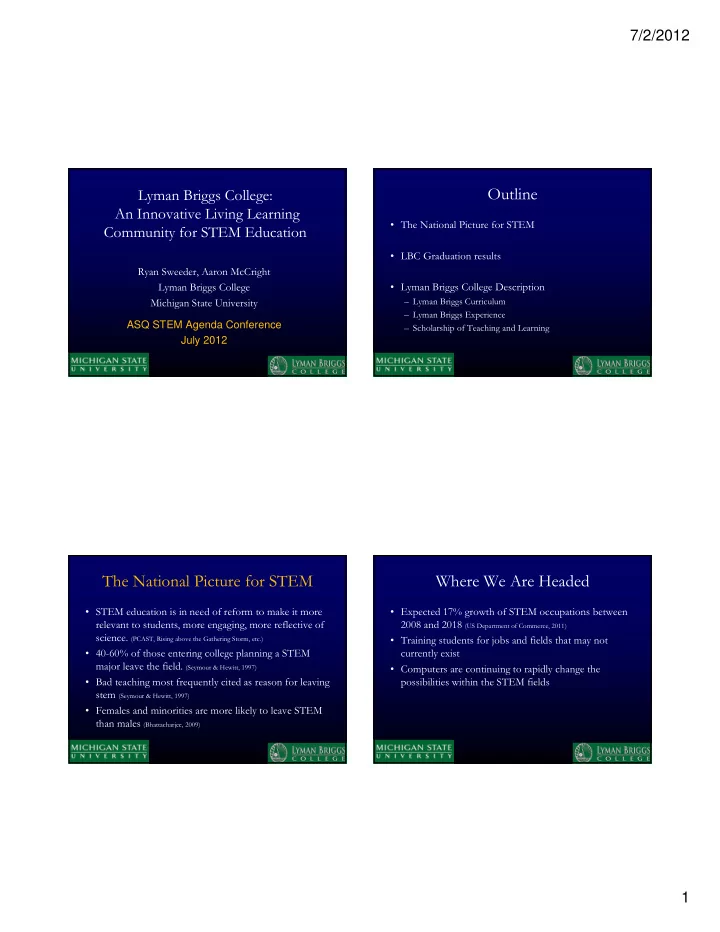
7/2/2012 1 Lyman Briggs College: An Innovative Living Learning Community for STEM Education

Ryan Sweeder, Aaron McCright Lyman Briggs College Michigan State University ASQ STEM Agenda Conference July 2012

Outline

  • The National Picture for STEM
  • LBC Graduation results
  • Lyman Briggs College Description

– Lyman Briggs Curriculum – Lyman Briggs Experience – Scholarship of Teaching and Learning

The National Picture for STEM

  • STEM education is in need of reform to make it more

relevant to students, more engaging, more reflective of

  • science. (PCAST, Rising above the Gathering Storm, etc.)
  • 40-60% of those entering college planning a STEM

major leave the field. (Seymour & Hewitt, 1997)

  • Bad teaching most frequently cited as reason for leaving

stem (Seymour & Hewitt, 1997)

  • Females and minorities are more likely to leave STEM

than males (Bhattacharjee, 2009)

Where We Are Headed

  • Expected 17% growth of STEM occupations between

2008 and 2018 (US Department of Commerce, 2011)

  • Training students for jobs and fields that may not

currently exist

  • Computers are continuing to rapidly change the

possibilities within the STEM fields

slide-2
SLIDE 2

7/2/2012 2

Lyman Briggs College Results

* Most recent class with 6-yr graduation data

Class of 2006*

  • 86.4% of starting students graduate
  • 72.3% graduate from a “STEM college”
  • Equal % of male and female students leave MSU
  • Higher % of female students remain in the sciences
  • Where graduates go:

– 40% continue to graduate school – 40% continue to professional school – 20% enter the workforce

* Most recent class with 6-yr graduation data

Outline

  • The National Picture
  • LBC Graduation results
  • Lyman Briggs College Description

– Lyman Briggs Curriculum – Lyman Briggs Experience – Scholarship of Teaching and Learning

slide-3
SLIDE 3

7/2/2012 3

What is Lyman Briggs?

  • A Living-Learning Community

founded in 1967 to bridge CP Snow’s Two Cultures

  • Students interested in studying math

and science

  • A small college within MSU
  • Offering 38 majors
  • Over 30 faculty spanning astrophysics

to zoology

Who are our students?

  • 625 students in the entering class

– No additional requirements for LBC (beyond MSU acceptance) – Slightly higher average HSGPA and ACT

  • 56% female, 20% minority (2006)
  • All intend to study within STEM

disciplines

– Over 60% enter with plans to be a health professional (doctor, nurse, dentist, etc.)

  • Approximately 1900 total students

Where do Lyman Briggs students live?

  • Holmes Hall

– 1250 students (largest residence hall at MSU) – 100% LBC students – Classrooms – Faculty Offices – Laboratories – Academic Help-Rooms – Cafeteria – Convenience Store – Learning Lounges

The Lyman Briggs Curriculum

Student year Usual Courses taken through LBC Courses taken

  • utside LBC

1st Intro to HPS Biology I General Chemistry I&II Mathematics (Calculus or other appropriate) 1-3 General education courses 2nd Biology II Physics I&II Organic chemistry 2-6 general education 3rd 1-2 HPS upper level courses 4-7 major or general education courses 4th 0-1 HPS upper level courses, senior seminar (Capstone Course) 5-8 major or general education courses

slide-4
SLIDE 4

7/2/2012 4

Students leaving after LBC introductory science courses.

Lyman Briggs Classes

  • Smaller class sizes (Kokkelenberg, 2008)
  • Inquiry driven labs (Bransford, 2000)
  • Reformed teaching practices, e.g. active, student-

centered learning (Sawada, 2002)

  • Provide relevance to real-world applications (Gutwill-Wise,

2001)

Student response

LBC characteristic % respondents indicating: “great deal” or “moderate amount”

  • f quality added to their LBC

experience % of Male (N=137) % of Female (N=309) Smaller class sizes* 96.8 83.8 98.2 Inquiry-based labs 73.3 72.3 73.8 Intro STEM classes leading to success 82.8 77.9 85.0 Interaction with faculty

  • utside class

88.6 85.5 90.0 * Statistically different between male and female (p=.001) for Pearson’s Correlation 26% response rate (N=446 of 1715 total students) on 2012 survey

The Lyman Briggs Experience

slide-5
SLIDE 5

7/2/2012 5

Undergraduate Research Seminar College Courses Study Abroad Honors College Learning Assistant Volunteer Major Courses General Education Courses LBC Symposium Graduation Student Organization Attend a conference REU program Field Trip Work Study

Creating a Culture

  • Expectation of research

– LBC Research Symposium – Course based research – Faculty led research

  • Expectation for teaching quality and excellence in

learning

– Learning Assistants – Study Abroad

Undergraduate Research Seminar College Courses Study Abroad Honors College Learning Assistant Volunteer Major Courses General Education Courses LBC Symposium Graduation Student Organization Attend a conference REU program Field Trip Work Study

% of senior respondents 80% 38% 54% 49% 27% 24% 26%*

* % of all students

Student Response

Activity % of students who participated (N=115) % of Male (N=36) % of Female (N=79) Research with prof.

  • utside a course

48.7 55.6 45.6 Study Abroad 38.3 36.1 39.2 Work as Learning Assistant 24.3 25 24.1 * 25% response rate (N=115 of 459 senior students) on 2012 survey

slide-6
SLIDE 6

7/2/2012 6

Academic Advising

– Curriculum development – Assist with internship, research & part-time employment – Career development – Connect students with resources on campus – Provide additional support when needed – Study abroad

Scholarship of Teaching and Learning

  • Take a scholarly approach to teaching

– How People Learn (Bransford, 2000)

  • Take a scholarly approach to evaluating teaching

– Reflective teaching portfolios – Reformed Teaching Observation Protocol, RTOP (Sawada,

2002)

– Student Assessment of Learning Gains, SALG (Seymour, 2000)

Community of SoTL Researchers

Biology Physics Mathematics Luckie Smith Fata-Hartley Cheruvelil Murphy Urquhart Kortemeyer Oshea Zeleke Gerhardt Chemistry HPS Sweeder McCright Pennock Bellon Westfall † SoTL research is valued equally to other research for RPT within LBC

Key Aspects

  • Dedicated faculty / staff
  • Administrative support

– Recognition of the value provided on investment

  • Creation of a culture expecting success
  • High expectations of students

– Provide support for less prepared students

slide-7
SLIDE 7

7/2/2012 7

Acknowledgements

  • LBC Administration
  • LBC Faculty / Staff
  • Sean Valles
  • Jubin Cheruvelil
  • Kathleen Jeffery

NSF-DUE S-STEM #1022754