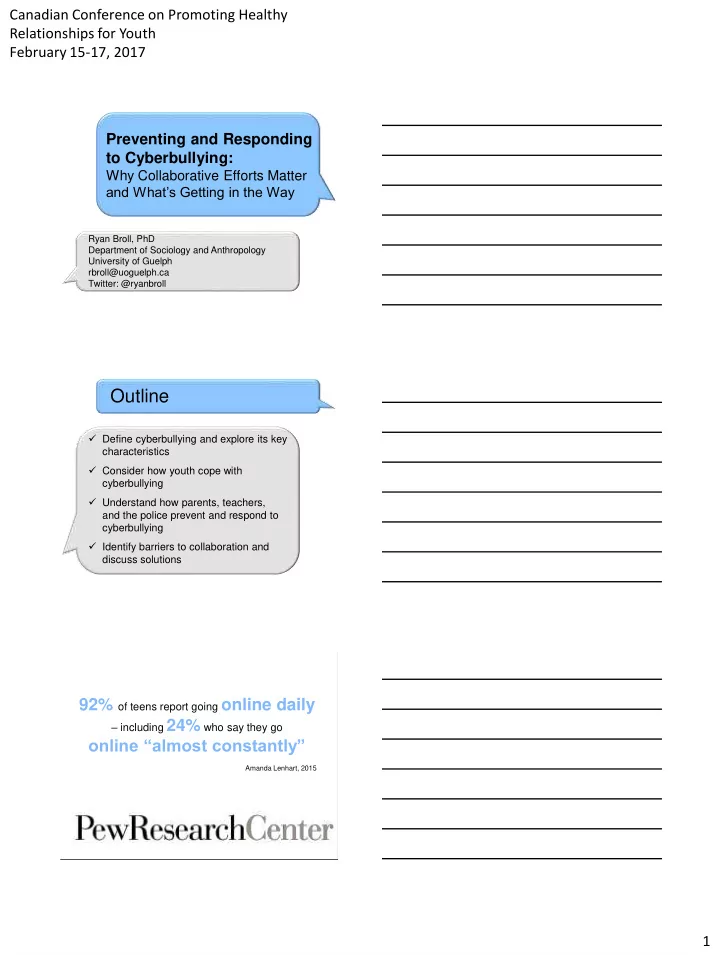
Outline Define cyberbullying and explore its key characteristics - - PDF document

outline
SMART_READER_LITE
LIVE PREVIEW

Outline Define cyberbullying and explore its key characteristics - - PDF document

Canadian Conference on Promoting Healthy Relationships for Youth February 15-17, 2017 Preventing and Responding to Cyberbullying: Why Collaborative Efforts Matter and Whats Getting in the Way Ryan Broll, PhD Department of Sociology and


slide-1
SLIDE 1

Canadian Conference on Promoting Healthy Relationships for Youth February 15-17, 2017 1 Preventing and Responding to Cyberbullying:

Why Collaborative Efforts Matter and What’s Getting in the Way

Ryan Broll, PhD Department of Sociology and Anthropology University of Guelph rbroll@uoguelph.ca Twitter: @ryanbroll

Outline

 Define cyberbullying and explore its key characteristics  Consider how youth cope with cyberbullying  Understand how parents, teachers, and the police prevent and respond to cyberbullying  Identify barriers to collaboration and discuss solutions

92% of teens report going online daily

– including 24% who say they go

  • nline “almost constantly”

Amanda Lenhart, 2015

slide-2
SLIDE 2

Canadian Conference on Promoting Healthy Relationships for Youth February 15-17, 2017 2

Repeated behaviours performed by one or more people through electronic media for the purpose of harming a less powerful individual.

What is cyberbullying?

Cyberbullying may be…

Spreading rumours Hurtful or threatening comments Creating website, profile, blog

Impersonation

Posting harmful material Spreading images/ videos

Photoshopping images

How common is it?

  • f youth cyberbully others
  • f youth are cyberbullied

cyberbullying is less common than traditional bullying

18% 24% ~35%

slide-3
SLIDE 3

Canadian Conference on Promoting Healthy Relationships for Youth February 15-17, 2017 3

Youth who are cyberbullied are 2 times more likely to have attempted suicide Youth who cyberbully others are 1.5 times more likely to have attempted suicide

How do cyberbullied youth cope?

Nearly half of youth do not tell

anybody when they are cyberbullied

Strict privacy controls Change u/n, p/w, email Confront cyberbully

Telling an adult?

26%

tell a parent Why don’t young people an adult?

13%

tell a teacher

  • 1. They believe it will stop on its own
  • 2. Seeking help is something “kids” do, they want to

be an adult

  • 3. They are worried they will lose access to

technology

  • 4. They do not think they will be taken seriously
slide-4
SLIDE 4

Canadian Conference on Promoting Healthy Relationships for Youth February 15-17, 2017 4

How do three groups of adults – parents,

teachers, and the police – prevent and

respond to cyberbullying?

Do they work together? Why or why not?

Strategies:

 Be friends  Restrict and monitor

technology Challenges:

✗ Lack technological savvy ✗ Difficulty controlling

  • thers’ behaviour

What do parents do? “Information Router”

Strategies:

 Prevention and

awareness campaigns

 Codes of conduct

Challenges:

✗ Lack technological savvy ✗ Must remain ‘nurturing’

What do teachers do?

slide-5
SLIDE 5

Canadian Conference on Promoting Healthy Relationships for Youth February 15-17, 2017 5

Strategies:

 Low-tech  Existing laws (when

necessary)

 Resource  ‘Scare’ cyberbullies

Challenges:

✗ Resource deficiencies ✗ Jurisdictional issues ✗ Legal-structural

constraints

What do the police do? “Knowledge Brokers”

⚠ Desired outcomes differ ⚠ Definitions of cyberbullying vary ⚠ Mistrust exists ⚠ Disagreement about timelines to

resolution

⚠ Contested role of parents

Barriers to collaboration

  • 1. Focus on prevention.

What can we do?

slide-6
SLIDE 6

Canadian Conference on Promoting Healthy Relationships for Youth February 15-17, 2017 6

  • 2. Create opportunities for continued

professional development and education.

What can we do?

  • 3. Remain mindful of others.

What can we do?

  • 4. Consider other relevant partners where

appropriate (expand the network).

What can we do?

slide-7
SLIDE 7

Canadian Conference on Promoting Healthy Relationships for Youth February 15-17, 2017 7

What can we do? ???

Ryan Broll, PhD University of Guelph Email: rbroll@uoguelph.ca Twitter: @ryanbroll Thank you ฀