SLIDE 1 CSci 5271 Introduction to Computer Security Day 11: OS security: higher assurance
Stephen McCamant
University of Minnesota, Computer Science & Engineering
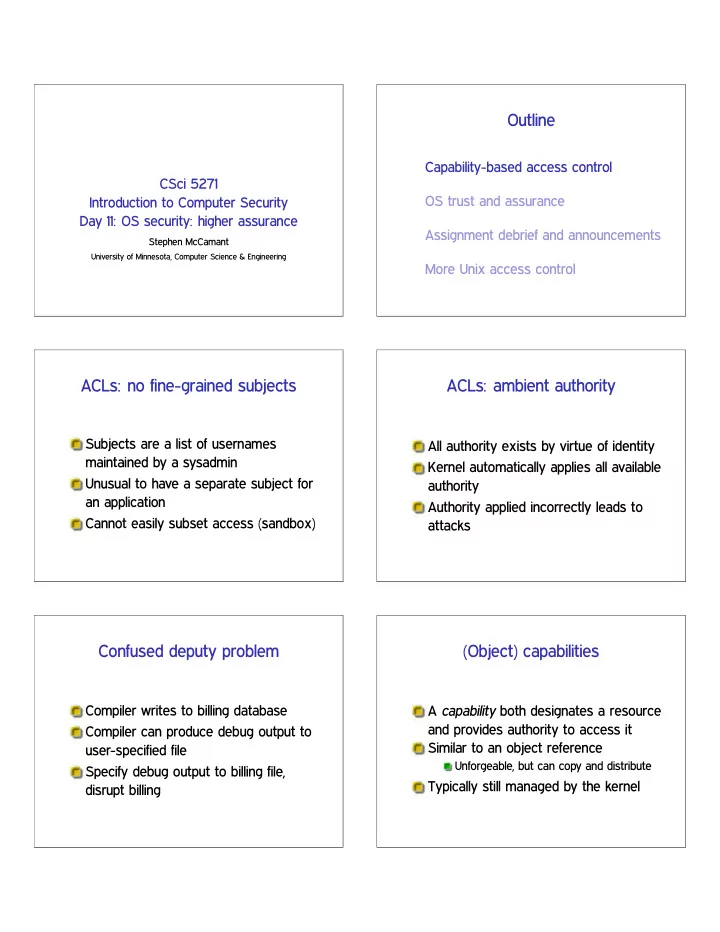
Outline
Capability-based access control OS trust and assurance Assignment debrief and announcements More Unix access control
ACLs: no fine-grained subjects
Subjects are a list of usernames maintained by a sysadmin Unusual to have a separate subject for an application Cannot easily subset access (sandbox)
ACLs: ambient authority
All authority exists by virtue of identity Kernel automatically applies all available authority Authority applied incorrectly leads to attacks
Confused deputy problem
Compiler writes to billing database Compiler can produce debug output to user-specified file Specify debug output to billing file, disrupt billing
(Object) capabilities
A capability both designates a resource and provides authority to access it Similar to an object reference
Unforgeable, but can copy and distribute
Typically still managed by the kernel
SLIDE 2
Capability slogans (Miller et al.)
No designation with authority Dynamic subject creation Subject-aggregated authority mgmt. No ambient authority Composability of authorities Access-controlled delegation Dynamic resource creation
Partial example: Unix FDs
Authority to access a specific file Managed by kernel on behalf of process Can be passed between processes
Though rare other than parent to child
Unix not designed to use pervasively
Distinguish: password capabilities
Bit pattern itself is the capability
No centralized management
Modern example: authorization using cryptographic certificates
Revocation with capabilities
Use indirection: give real capability via a pair of middlemen ❆ ✦ ❇ via ❆ ✦ ❋ ✦ ❘ ✦ ❇ Retain capability to tell ❘ to drop capability to ❇ Depends on composability
Confinement with capabilities
❆ cannot pass a capability to ❇ if it cannot communicate with ❆ at all Disconnected parts of the capability graph cannot be reconnected Depends on controlled delegation and data/capability distinction
OKL4 and seL4
Commercial and research microkernels Recent versions of OKL4 use capability design from seL4 Used as a hypervisor, e.g. underneath paravirtualized Linux Shipped on over 1 billion cell phones
SLIDE 3
Joe-E and Caja
Dialects of Java and JavaScript (resp.) using capabilities for confined execution E.g., of JavaScript in an advertisement Note reliance on Java and JavaScript type safety
Outline
Capability-based access control OS trust and assurance Assignment debrief and announcements More Unix access control
Trusted and trustworthy
Part of your system is trusted if its failure can break your security Thus, OS is almost always trusted Real question: is it trustworthy? Distinction not universally observed: trusted boot, Trusted Solaris, etc.
Trusted (I/O) path
How do you know you’re talking to the right software? And no one is sniffing the data? Example: Trojan login screen
Or worse: unlock screensaver with root password Origin of “Press Ctrl-Alt-Del to log in”
Minimizing trust
Kernel ✦ microkernel ✦ nanokernel Reference monitor concept TCB size: measured relative to a policy goal Reference monitor ✒ TCB
But hard to build monitor for all goals
How to gain assurance
Use for a long time Testing Code / design review Third-party certification Formal methods / proof
SLIDE 4 Evaluation / certification
Testing and review performed by an independent party Goal: separate incentives, separate accountability Compare with financial auditing Watch out for: form over substance, misplaced incentives
Orange book OS evaluation
Trusted Computer System Evaluation Criteria
- D. Minimal protection
- C. Discretionary protection
C2 adds, e.g., secure audit over C1
B1❁B2❁B3: stricter classic MLS
Common Criteria
International standard and agreement for IT security certification Certification against a protection profile, and evaluation assurance level EAL 1-7 Evaluation performed by non-government labs Up to EAL 4 automatically cross-recognized
Common Criteria, Anderson’s view
Many profiles don’t specify the right things OSes evaluated only in unrealistic environments
E.g., unpatched Windows XP with no network attacks
“Corruption, Manipulation, and Inertia”
Pernicious innovation: evaluation paid for by vendor Labs beholden to national security apparatus
Formal methods and proof
Can math come to the rescue? Checking design vs. implementation Automation possible only with other tradeoffs
E.g., bounded size model
Starting to become possible: machine-checked proof
Proof and complexity
Formal proof is only feasible for programs that are small and elegant If you honestly care about assurance, you want your TCB small and elegant anyway Should provability further guide design?
SLIDE 5 Some hopeful proof results
seL4 microkernel (SOSP’09 and
7.5 kL C, 200 kL proof, 160 bugs fixed, 25 person years
CompCert C-subset compiler (PLDI’06 and ongoing) RockSalt SFI verifier (PLDI’12)
Outline
Capability-based access control OS trust and assurance Assignment debrief and announcements More Unix access control
Exercise set 1 comments
Net risk reduction: this is a formula, know how to compute it ❵❣r❡♣ ✩✉s❡r♥❛♠❡❵: I should have said two good ways to change the code Solving ✶✸ ✁ ① ✑ ✶✵ ✭mod ✷✸✷✮
Silly function
st❛t✭♣❛t❤♥❛♠❡✱ ✫❢✮❀ st❛t✭✧✴✇❤❛t✴❡✈❡r✧✱ ✫✇❡✮❀ ✐❢ ✭❢✳st❴❞❡✈ ❂❂ ✇❡✳st❴❞❡✈ ✫✫ ❢✳st❴✐♥♦ ❂❂ ✇❡✳st❴✐♥♦✮ ④ r❡t✉r♥❀ ⑥ r❢❞ ❂ ♦♣❡♥✭♣❛t❤♥❛♠❡✱ ❖❴❘❉❖◆▲❨✮❀ ❜✉❢ ❂ ♠❛❧❧♦❝✭❢✳st❴s✐③❡ ✲ ✶✮❀ r❡❛❞✭r❢❞✱ ❜✉❢✱ ❢✳st❴s✐③❡ ✲ ✶✮❀ ❝❧♦s❡✭r❢❞✮❀ st❛t✭♣❛t❤♥❛♠❡✱ ✫❢✮❀ ✐❢ ✭❢✳st❴❞❡✈ ❂❂ ✇❡✳st❴❞❡✈ ✫✫ ❢✳st❴✐♥♦ ❂❂ ✇❡✳st❴✐♥♦✮ ④ r❡t✉r♥❀ ⑥ ✇❢❞ ❂ ♦♣❡♥✭♣❛t❤♥❛♠❡✱ ❖❴❲❘❖◆▲❨ ⑤ ❖❴❚❘❯◆❈✮❀ ✇r✐t❡✭✇❢❞✱ ❜✉❢✱ ❢✳st❴s✐③❡✲✶✮❀ ❝❧♦s❡✭✇❢❞✮❀
Reversing the stack
✈♦✐❞ ❢✉♥❝✭❝❤❛r ✯str✮ ④ ❝❤❛r ❜✉❢❬✶✷✽❪❀ str❝♣②✭❜✉❢✱ str✮❀ ❞♦❴s♦♠❡t❤✐♥❣✭✮❀ r❡t✉r♥❀ ⑥
Payment app
✈♦✐❞ ♣❛②♠❡♥t✭❝❤❛r ✯♥❛♠❡✱ ✐♥t ❛♠♦✉♥t❴❣❜♣✱ ❝❤❛r ✯♣✉r♣♦s❡✮ ④ ✐♥t ❛♠♦✉♥t❴✉s❞ ❂ ✭❛♠♦✉♥t❴❣❜♣✯✶✺✻✮✴✶✵✵❀ ❝❤❛r ♠❡♠♦❬✸✷❪❀ str❝♣②✭♠❡♠♦✱ ✧P❛②♠❡♥t ❢♦r✿ ✧✮❀ str❝❛t✭♠❡♠♦✱ ♣✉r♣♦s❡✮❀ ✇r✐t❡❴❝❤❡❝❦✭♥❛♠❡✱ ❛♠♦✉♥t❴✉s❞✱ ♠❡♠♦✮❀ ⑥
SLIDE 6
Big- and little-endian
Overwriting ✵①✶✷✸✹✺✻✼✽ with ✧✳✳✳❆❆❆❆❆❭✵✧:
✵①✵✵✸✹✺✻✼✽ ✵①✹✶✵✵✺✻✼✽ ✵①✹✶✹✶✵✵✼✽ ✵①✹✶✹✶✹✶✵✵ ✵①✹✶✹✶✹✶✹✶
Big- and little-endian
Overwriting ✵①✶✷✸✹✺✻✼✽ with ✧✳✳✳❆❆❆❆❆❭✵✧:
✵①✶✷✸✹✺✻✵✵ ✵①✶✷✸✹✵✵✹✶ ✵①✶✷✵✵✹✶✹✶ ✵①✵✵✹✶✹✶✹✶ ✵①✹✶✹✶✹✶✹✶
Zip function
❝❤❛r ✯③✐♣✭❝❤❛r ✯❛✱ ❝❤❛r ✯❜✮ ④ ❝❤❛r ✯r❡s✉❧t❀ ✐♥t ❧❡♥✱ ✐❀ ❧❡♥ ❂ str❧❡♥✭❛✮❀ r❡s✉❧t ❂ ♠❛❧❧♦❝✭✷✯❧❡♥✮❀ ❢♦r✭✐ ❂ ✵❀ ✐ ❁❂ ❧❡♥❀ ✐✰✰✮ ④ r❡s✉❧t❬✷✯✐❪ ❂ ❛❬✐❪❀ r❡s✉❧t❬✷✯✐✰✶❪ ❂ ❜❬✐❪❀ ⑥ r❡t✉r♥ r❡s✉❧t❀ ⑥
BCVS vulnerabilities
Type 1: Buffer overflows and similar
Some easy to spot, but hard to exploit
Type 2: Logic errors in running programs, file accesses, etc.
Usually easier to exploit once found
BCVS exploiting overflows
Make sure control flow reaches the return Compensate for collateral damage Find your shellcode Writing shellcode
BCVS design changes
Avoid unnecessary changes to benign functionality
Restricting length or character sets of arguments Though, what is the benign functionality?
Not a great candidate for privilege separation
SLIDE 7
Lattice model notation
Element in lattice is a pair of:
Clearance level, totally ordered by ✔ Set of compartments, partially ordered by ✒
Different notations:
TA ✦ ✭TA, ❄✮ Faculty//5271//8271 ✦ ✭Faculty, ❢✺✷✼✶❀ ✽✷✼✶❣✮
Midterm exam Monday
Usual class time and location Covers up through today’s lecture Mix of short-answer and exercise-like questions Open books/notes/printouts, no computers or other electronics
Outline
Capability-based access control OS trust and assurance Assignment debrief and announcements More Unix access control
Special case: ✴t♠♣
We’d like to allow anyone to make files in ✴t♠♣ So, everyone should have write permission But don’t want Alice deleting Bob’s files Solution: “sticky bit” 01000
Special case: group inheritance
When using group to manage permissions, want a whole tree to have a single group When 02000 bit set, newly created entries with have the parent’s group
(Historic BSD behavior)
Also, directories will themselves inherit 02000
“POSIX” ACLs
Based on a withdrawn standardization More flexible permissions, still fairly Unix-like Multiple user and group entries
Decision still based on one entry
Default ACLs: generalize group inheritance Command line: ❣❡t❢❛❝❧, s❡t❢❛❝❧
SLIDE 8
ACL legacy interactions
Hard problem: don’t break security of legacy code
Suggests: “fail closed”
Contrary pressure: don’t want to break functionality
Suggests: “fail open”
POSIX ACL design: old group permission bits are a mask on all novel permissions
“POSIX” “capabilities”
Divide root privilege into smaller (✘35) pieces Note: not real capabilities First runtime only, then added to FS similar to setuid Motivating example: ♣✐♥❣ Also allows permanent disabling
Privilege escalation dangers
Many pieces of the root privilege are enough to regain the whole thing
Access to files as UID 0 ❈❆P ❉❆❈ ❖❱❊❘❘■❉❊ ❈❆P ❋❖❲◆❊❘ ❈❆P ❙❨❙ ▼❖❉❯▲❊ ❈❆P ▼❑◆❖❉ ❈❆P P❚❘❆❈❊ ❈❆P ❙❨❙ ❆❉▼■◆ (♠♦✉♥t)
Legacy interaction dangers
Former bug: take away capability to drop privileges Use of temporary files by no-longer setuid programs For more details: “Exploiting capabilities”, Emeric Nasi
Next time
Good luck on the midterm