Outline SI232 Introduction to Computer Class Survey / Role Call - - PDF document

outline
SMART_READER_LITE
LIVE PREVIEW

Outline SI232 Introduction to Computer Class Survey / Role Call - - PDF document

Outline SI232 Introduction to Computer Class Survey / Role Call Architecture What is: - a computer? - computer architecture? Spring 2006 - this class? Asst. Prof. Luke McDowell Course Admin


slide-1
SLIDE 1

1 SI232 Introduction to Computer Architecture Spring 2006

  • Asst. Prof. Luke McDowell

http://www.cs.usna.edu/~lmcdowel/courses/si232/S06/

Outline

  • Class Survey / Role Call
  • What is:
  • a computer?
  • computer architecture?
  • this class?
  • Course Admin

– Policy Letter – Syllabus

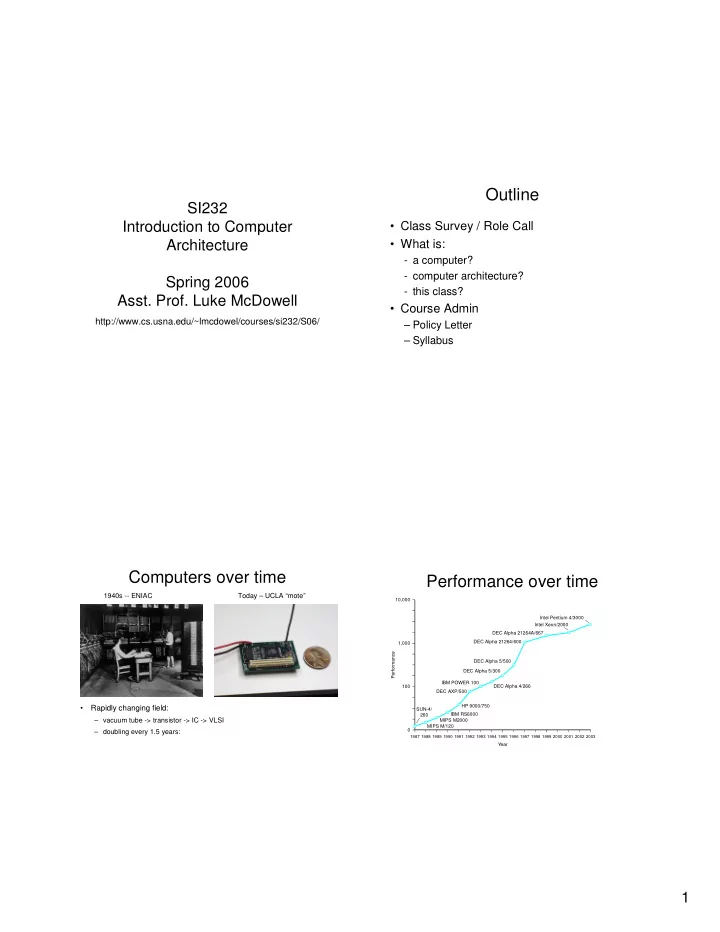
Computers over time

Today – UCLA “mote” 1940s -- ENIAC

  • Rapidly changing field:

– vacuum tube -> transistor -> IC -> VLSI – doubling every 1.5 years:

10,000 1,000 100

1987 1988 1989 1990 1991 1992

Year

1993 1994 1995 1996 1997 1998 1999 2000 2001 2002 2003

Performance DEC Alpha 21264/600 DEC Alpha 21264A/667 Intel Xeon/2000 Intel Pentium 4/3000 DEC Alpha 5/500 DEC Alpha 5/300 DEC Alpha 4/266 IBM POWER 100 DEC AXP/500 HP 9000/750 MIPS M/120 SUN-4/ 260 MIPS M2000 IBM RS6000

Performance over time

slide-2
SLIDE 2

2

What We’ll Learn

  • How do computers really work?
  • How to analyze performance (and not to!)
  • Issues affecting modern processors (caches,

pipelines, wire delay, parallelism…)

  • Constant tradeoffs:

– Speed vs. Capacity vs. Cost

  • Insight into complexity of easy/hard operations

Why learn this stuff?

  • You want to call yourself a “computer

scientist”

  • You want to build software people use

(need performance)

  • You need to make a purchasing decision
  • r offer “expert” advice

What is a computer?

Memory Processor Control Output Input Datapath Computer

What is a computer, continued

  • Our primary focus:

– implemented using millions of transistors – Impossible to understand by looking at each transistor – We need...

slide-3
SLIDE 3

3

Abstraction

  • An abstraction helps us cope

with complexity by:

  • Delving into the depths

reveals more information

swap(int v[], int k) {int temp; tem p = v[k]; v[k] = v[k+1]; v[k+1] = tem p; } swap: m uli $2, $5,4 add $2, $4,$2 lw $15, 0($2) lw $16, 4($2) sw $16, 0($2) sw $15, 4($2) jr $31 00000000101000010000000000011000 00000000100011100001100000100001 10001100011000100000000000000000 10001100111100100000000000000100 10101100111100100000000000000000 10101100011000100000000000000100 00000011111000000000000000001000 Binary machine language program (for MIP S) C compiler Assembler Assembly language program (for MIP S) High-level language program (in C)

What is Computer Architecture?

Instruction Set Architecture

  • A very important abstraction

– interface between hardware and low-level software – defines how a program interacts with the machine – standardizes instructions, machine language bit patterns, etc. – advantage: – disadvantage:

  • Modern instruction set architectures:

– 80x86/Pentium/K6, PowerPC, DEC Alpha, MIPS, SPARC, HP

Where we are headed

  • Today – Chapter 1
  • A specific instruction set architecture (Chapter 2)
  • Logic Design (Appendix B)
  • Arithmetic and how to build an ALU (Chapter 3)
  • Performance issues (Chapter 4)
  • Constructing a processor to execute our instructions

(Chapter 5)

  • Pipelining to improve performance (Chapter 6)
  • Memory: caches and virtual memory (Chapter 7)
  • I/O (Chapter 8)
  • A few advanced topics
slide-4
SLIDE 4

4

Classroom Pet Peeves Admin

  • Pet Peeves
  • Policy
  • Collaboration
  • Syllabus

Assignments

  • Get the textbook
  • Get a binder to keep track of notes
  • Read Chapter 1 (1.7 optional)
  • Homework #1 due next Wed

Success in SI232

  • In Class – Participate

– Ask & answer questions – Be prepared to interact – Take notes – provided slides are not enough!

  • On your own – Keep Up

– Review/finish exercises after class – Read the book – lecture won’t cover everything – See me for help and/or talk to friends