SLIDE 1 CSci 5271 Introduction to Computer Security Day 5: Low-level defenses and counterattacks
Stephen McCamant
University of Minnesota, Computer Science & Engineering
Outline
Exploiting other vulnerabilities Return address protections Announcements intermission BCECHO demo ASLR and counterattacks W✟X (DEP) Epilogue: BCVI Makefile
Null pointer dereference
Add offset to make a predictable pointer
On Windows, interesting address start low
Allocate data on the zero page
Most common in user-space to kernel attacks Read more dangerous than a write
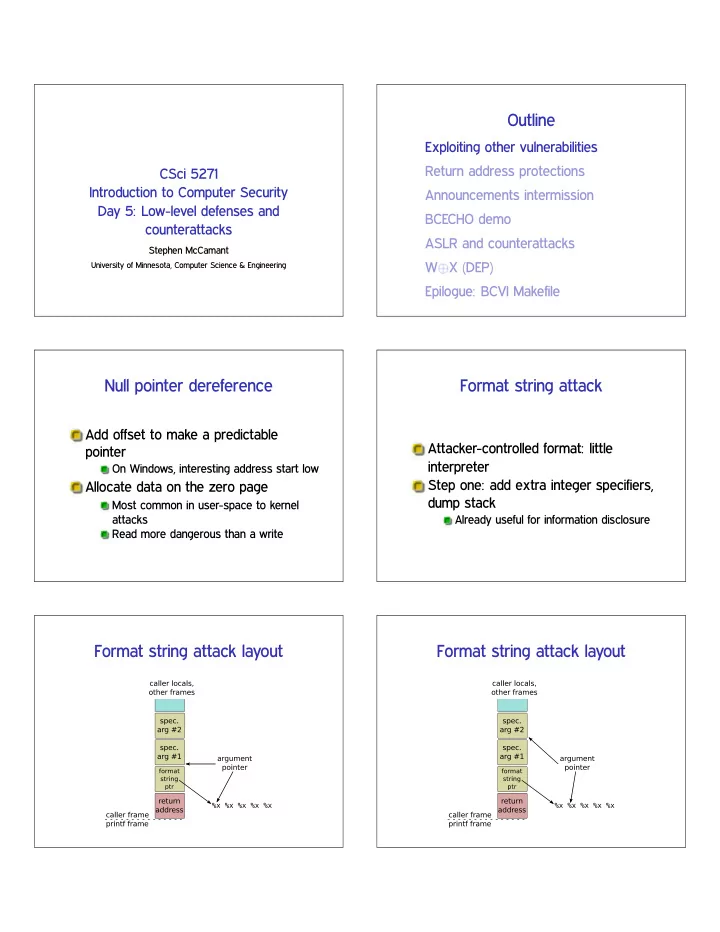
Format string attack
Attacker-controlled format: little interpreter Step one: add extra integer specifiers, dump stack
Already useful for information disclosure
Format string attack layout Format string attack layout
SLIDE 2 Format string attack: overwrite
✪♥ specifier: store number of chars written so far to pointer arg Advance format arg pointer to other attacker-controlled data Control number of chars written with padding On x86, use unaligned stores to create pointer
Outline
Exploiting other vulnerabilities Return address protections Announcements intermission BCECHO demo ASLR and counterattacks W✟X (DEP) Epilogue: BCVI Makefile
Canary in the coal mine
Photo credit: Fir0002 CC-BY-SA
Adjacent canary idea Terminator canary
Value hard to reproduce because it would tell the copy to stop StackGuard: 0x00 0D 0A FF
0: String functions newline: ❢❣❡ts(), etc.
carriage return: similar to newline?
Doesn’t stop: ♠❡♠❝♣②, custom loops
Random canary
Can’t reproduce because attacker can’t guess For efficiency, usually one per execution Ineffective if disclosed
SLIDE 3 XOR canary
Want to protect against non-sequential
XOR return address with value ❝ at entry XOR again with ❝ before return Standard choice for ❝: see random canary
Further refinements
More flexible to do earlier in compiler Rearrange buffers after other variables
Reduce chance of non-control overwrite
Skip canaries for functions with only small variables
Who has an overflow bug in an 8-byte array?
What’s usually not protected?
Backwards overflows Function pointers Adjacent structure fields Adjacent static data objects
Where to keep canary value
Fast to access Buggy code/attacker can’t read or write Linux/x86: ✪❣s✿✵①✶✹
Complex anti-canary attack
Canary not updated on ❢♦r❦ in server Attacker controls number of bytes
Complex anti-canary attack
Canary not updated on ❢♦r❦ in server Attacker controls number of bytes
ANRY BNRY CNRY DNRY ENRY FNRY search ✷✸✷ ✦ search ✹ ✁ ✷✽
SLIDE 4
Shadow return stack
Suppose you have a safe place to store the canary Why not just store the return address there? Needs to be a separate stack Ultimate return address protection
Outline
Exploiting other vulnerabilities Return address protections Announcements intermission BCECHO demo ASLR and counterattacks W✟X (DEP) Epilogue: BCVI Makefile
You may notice
We’re catching up with the readings Today: StackGuard, ASLR attacks Next time: CFI, Shacham ROP
Pre-proposals due tonight
Most groups formed? One PDF per group, include schedule choices Submit via Moodle by 11:55pm
Supplemental office hours tomorrow
Tomorrow (Thursday), 11am-noon in 4-225E Are my regular office hours at bad times?
HA1 reminders
Attack 2 due Friday, harder than attack 1 Keep backups if you need to reset VM Consider Moodle or email to both staff with questions
SLIDE 5
BCECHO
An even simpler buffer overflow example Can compile like BCVI, install setuid root Will use for attack demo purposes
Outline
Exploiting other vulnerabilities Return address protections Announcements intermission BCECHO demo ASLR and counterattacks W✟X (DEP) Epilogue: BCVI Makefile
Outline
Exploiting other vulnerabilities Return address protections Announcements intermission BCECHO demo ASLR and counterattacks W✟X (DEP) Epilogue: BCVI Makefile
Basic idea
“Address Space Layout Randomization” Move memory areas around randomly so attackers can’t predict addresses Keep internal structure unchanged
E.g., whole stack moves together
Code and data locations
Execution of code depends on memory location E.g., on 32-bit x86:
Direct jumps are relative Function pointers are absolute Data must be absolute
Relocation (Windows)
Extension of technique already used in compilation Keep table of absolute addresses, instructions on how to update Disadvantage: code modifications take time on load, prevent sharing
SLIDE 6
PIC/PIE (GNU/Linux)
“Position-Independent Code / Executable” Keep code unchanged, use register to point to data area Disadvantage: code complexity, register pressure hurt performance
What’s not covered
Main executable (Linux 32-bit PIC) Incompatible DLLs (Windows) Relative locations within a module/area
Entropy limitations
Intuitively, entropy measures amount of randomness, in bits Random 32-bit int: 32 bits of entropy ASLR page aligned, so at most ✸✷ ✲ ✶✷ ❂ ✷✵ bits of entropy Other constraints further reduce possibilities
Leakage limitations
If an attacker learns the randomized base address, can reconstruct other locations Any stack address ✦ stack unprotected, etc.
GOT hijack (M¨ uller)
Main program fixed, libc randomized PLT in main program used to call libc Rewire PLT to call attacker’s favorite libc functions E.g., turn ♣r✐♥t❢ into s②st❡♠
GOT hijack (M¨ uller)
♣r✐♥t❢❅♣❧t✿ ❥♠♣ ✯✵①✽✵✹✾✻✼✽ ✳✳✳ s②st❡♠❅♣❧t✿ ❥♠♣ ✯✵①✽✵✹✾✻✼❝ ✳✳✳ ✵①✽✵✹✾✻✼✽✿ ❁❛❞❞r ♦❢ ♣r✐♥t❢ ✐♥ ❧✐❜❝❃ ✵①✽✵✹✾✻✼❝✿ ❁❛❞❞r ♦❢ s②st❡♠ ✐♥ ❧✐❜❝❃
SLIDE 7 ret2pop (M¨ uller)
Take advantage of shellcode pointer already present on stack Rewrite intervening stack to treat the shellcode pointer like a return address
A long sequence of chained returns, one pop
ret2pop (M¨ uller) Outline
Exploiting other vulnerabilities Return address protections Announcements intermission BCECHO demo ASLR and counterattacks W✟X (DEP) Epilogue: BCVI Makefile
Basic idea
Traditional shellcode must go in a memory area that is
writable, so the shellcode can be inserted executable, so the shellcode can be executed
But benign code usually does not need this combination W xor X, really ✿✭❲ ❫ ❳✮
Non-writable code, ❳ ✦ ✿❲
E.g., read-only .text section Has been standard for a while, especially on Unix Lets OS efficiently share code with multiple program instances
Non-executable data, ❲ ✦ ✿❳
Prohibit execution of static data, stack, heap Not a problem for most programs
Incompatible with some GCC features no
Non-executable stack opt-in on Linux, but now near-universal
SLIDE 8
Implementing ❲ ✟ ❳
Page protection implemented by CPU
Some architectures (e.g. SPARC) long supported ❲ ✟ ❳
x86 historically did not
One bit controls both read and execute Partial stop-gap “code segment limit”
Eventual obvious solution: add new bit
NX (AMD), XD (Intel), XN (ARM)
One important exception
Remaining important use of self-modifying code: just-in-time (JIT) compilers
E.g., all modern JavaScript engines
Allow code to re-enable execution per-block
♠♣r♦t❡❝t, ❱✐rt✉❛❧Pr♦t❡❝t Now a favorite target of attackers
Counterattack: code reuse
Attacker can’t execute new code So, take advantage of instructions already in binary There are usually a lot of them And no need to obey original structure
Classic return-to-libc (1997)
Overwrite stack with copies of:
Pointer to libc’s s②st❡♠ function Pointer to ✧✴❜✐♥✴s❤✧ string (also in libc)
The s②st❡♠ function is especially convenient Distinctive feature: return to entry point
Chained return-to-libc
Shellcode often wants a sequence of actions, e.g.
Restore privileges Allow execution of memory area Overwrite system file, etc.
Can put multiple fake frames on the stack
Basic idea present in 1997, further refinements
Beyond return-to-libc
Can we do more? Oh, yes. Classic academic approach: what’s the most we could ask for? Here: “Turing completeness” How to do it: reading for Thursday
SLIDE 9
Outline
Exploiting other vulnerabilities Return address protections Announcements intermission BCECHO demo ASLR and counterattacks W✟X (DEP) Epilogue: BCVI Makefile
BCVI Makefile
❈❋▲❆●❙ ✿❂ ✲❣ ✲❲❛❧❧ ✲♠✸✷ ❭ ✲❢♥♦✲st❛❝❦✲♣r♦t❡❝t♦r ❭ ✲③ ❡①❡❝st❛❝❦ ✲③ ♥♦r❡❧r♦
BCVI Makefile
❈❋▲❆●❙ ✿❂ ✲❣ ✲❲❛❧❧ ✲♠✸✷ ❭ ✲❢♥♦✲st❛❝❦✲♣r♦t❡❝t♦r ❭ ✲③ ❡①❡❝st❛❝❦ ✲③ ♥♦r❡❧r♦ Standard non-security options
BCVI Makefile
❈❋▲❆●❙ ✿❂ ✲❣ ✲❲❛❧❧ ✲♠✸✷ ❭ ✲❢♥♦✲st❛❝❦✲♣r♦t❡❝t♦r ❭ ✲③ ❡①❡❝st❛❝❦ ✲③ ♥♦r❡❧r♦ Turn off canaries
BCVI Makefile
❈❋▲❆●❙ ✿❂ ✲❣ ✲❲❛❧❧ ✲♠✸✷ ❭ ✲❢♥♦✲st❛❝❦✲♣r♦t❡❝t♦r ❭ ✲③ ❡①❡❝st❛❝❦ ✲③ ♥♦r❡❧r♦ Allow execution on stack
BCVI Makefile
❈❋▲❆●❙ ✿❂ ✲❣ ✲❲❛❧❧ ✲♠✸✷ ❭ ✲❢♥♦✲st❛❝❦✲♣r♦t❡❝t♦r ❭ ✲③ ❡①❡❝st❛❝❦ ✲③ ♥♦r❡❧r♦ Leave GOT writable
SLIDE 10
More HA1 VM unprotection
Not in Makefile: disable ASLR Is done system-wide in VM For non-VM testing, can use s❡t❛r❝❤ ✐✸✽✻ ✲❘
More HA1 VM unprotection
Not in Makefile: disable /bin/sh privilege dropping Linux shells differ in whether they’ll run setuid Recompiled ❞❛s❤ with security check removed
Next time
Return-oriented programming (ROP)
And counter-defenses
Control-flow integrity (CFI)