Outline Outline Motivating applications Motivating applications - - PowerPoint PPT Presentation

outline outline
SMART_READER_LITE
LIVE PREVIEW

Outline Outline Motivating applications Motivating applications - - PowerPoint PPT Presentation

C OORDINATED P ATH F OLLOWING of MULTIPLE UNDERACTUATED VEHICLES WITH COMMUNICATION CONSTRAINTS Antnio M. Pascoal antonio@isr.ist.utl.pt Institute for Systems and Robotics (ISR) IST, Lisbon, Portugal Pre-CDC WORKSHOP San Diego, USA,


slide-1
SLIDE 1

António M. Pascoal antonio@isr.ist.utl.pt Institute for Systems and Robotics (ISR) IST, Lisbon, Portugal

Pre-CDC WORKSHOP San Diego, USA, Dec. 12, 2006
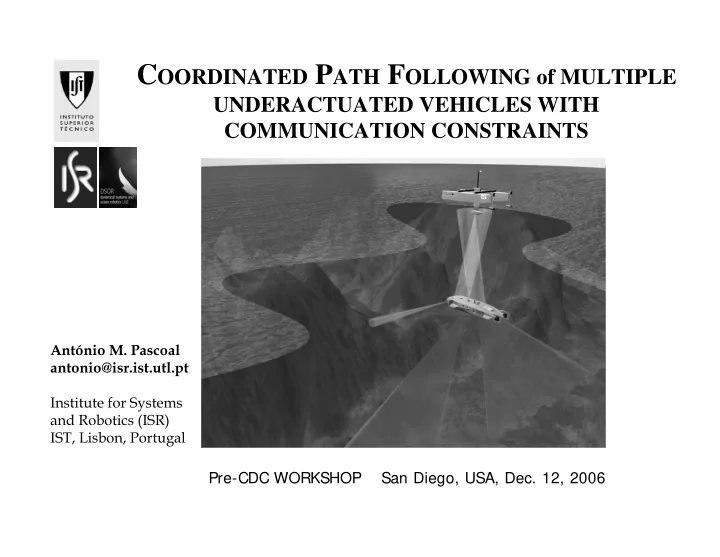
COORDINATED PATH FOLLOWING of MULTIPLE

UNDERACTUATED VEHICLES WITH COMMUNICATION CONSTRAINTS

slide-2
SLIDE 2

COORDINATED PATH FOLLOWING of MULTIPLE

UNDERACTUATED VEHICLES WITH COMMUNICATION CONSTRAINTS

Presentation based on the compilation of joint work with Aguiar, António

IST/ISR, PT

Ghabchelloo, Reza

IST/ISR, PT

Hespanha, João

UCSB, USA

Kaminer, Isaac

NPS, USA

Pascoal, António

IST/ISR, PT

Silvestre, Carlos

IST/ISR, PT

slide-3
SLIDE 3

Outline Outline

  • Motivating applications

Motivating applications

  • Coordinated path following (definition)

Coordinated path following (definition)

  • Coordinated path following (wheeled robots):

Coordinated path following (wheeled robots): fixed communication topologies fixed communication topologies

  • Coordinated path following

Coordinated path following

  • general set

general set-

  • up

up for path following for path following

  • underactuated

underactuated autonomous vehicles autonomous vehicles

  • switching

switching communication topologies communication topologies

slide-4
SLIDE 4

AUV ASC

Surface and underwater vehicles required to

  • perate in a master / slave configuration

Coordinated Motion Control Coordinated Motion Control

slide-5
SLIDE 5

Doppler log Scanning sonar low baud rate acoustic communication link (commands/data) high baud rate acoustic communication link (data)

Autonomous Surface Craft (ASC) Autonomous Underwater Vehicle (AUV) Support Ship Unit (SSHU)

Radio Link Radio Link Radio Link low baud rate acoustic communication link (emergency commands) DifferentialGPS

  • Mobile Station -

DifferentialGPS

  • Reference Station -

Shore Station Unit (SSTU)

GIB System (buoy 1 of 4) Radio Link

The ASIMOV concept (project ASIMOV, EC - 2000)

Coordinated Motion Control Coordinated Motion Control

slide-6
SLIDE 6

Two AUVS carrying out a joint survey operation

Coordinated Motion Control Coordinated Motion Control

slide-7
SLIDE 7

Coordinated Motion Control Coordinated Motion Control

The quest for mid The quest for mid-

  • water column hydrothermal vents, Azores, PT

water column hydrothermal vents, Azores, PT

AUV Fleet – Methane gradient “descent”

Deep water hydrothermal vent Methane plume

slide-8
SLIDE 8
  • Microsatellites

Microsatellites: imaging, remote sensing, : imaging, remote sensing, interferometry interferometry

  • Autonomous Underwater Vehicles (AUVs)

Autonomous Underwater Vehicles (AUVs): : coordinated bathymetric mapping, seafloor imaging coordinated bathymetric mapping, seafloor imaging

  • Autonomous Surface Vessels (ASVs)

Autonomous Surface Vessels (ASVs): : coordinated ocean surveying coordinated ocean surveying

  • AUVs and ASVs

AUVs and ASVs: coordinated control : coordinated control for fast for fast communications and reliable navigation communications and reliable navigation

Scientific Applications Scientific Applications

slide-9
SLIDE 9
  • Unmanned Air Vehicles(UAVs):

Unmanned Air Vehicles(UAVs):

  • Formation control

Formation control for increased aerodynamic for increased aerodynamic efficiency efficiency

  • Coordinated search and rescue operations

Coordinated search and rescue operations

  • Low cost small autonomous robots:

Low cost small autonomous robots: Exploration, mine detection, and neutralization Exploration, mine detection, and neutralization

  • Cooperative manipulation

Cooperative manipulation

Other applications Other applications

slide-10
SLIDE 10

How it all started at IST (1998) How it all started at IST (1998) -

  • ASIMOV

ASIMOV

Theoretical problems: key issues Theoretical problems: key issues Coordinated Path Following Coordinated Path Following while keeping inter while keeping inter-

  • vehicle

vehicle geometric constraints geometric constraints Motion control in the presence of severe acoustic Motion control in the presence of severe acoustic communication constraints communication constraints (multipath, failures, latency, (multipath, failures, latency, asynchronous comms, reduced bandwidth...) asynchronous comms, reduced bandwidth...)

Dream “Reality” (IST-NPS mission)

slide-11
SLIDE 11

Path Following

Inspired by the work of Inspired by the work of Claude Samson et al Claude Samson et al. for wheeled robots . for wheeled robots

  • A. Micaelli and C. Samson (1992). Path following and time-varying

feedback stabilization of a wheeled robot. In Proc. International Conference ICARCV’92, Singapore. . Use forward motion to make the robot track a

desired speed profile.

. Compute the closest point on the path. . Compute the Serret-Frenet (SF) frame at that point. . Use rotational motion to align the body-axis with the SF

frame and reduce the distance to closest point to zero.

slide-12
SLIDE 12

Path Following

“Nonlinear Path Following with Applications to the Control of Autonomous Underwater Vehicles,” L. Lapierre, D. Soetanto, and A. Pascoal, 42th IEEE Conference

  • n Decision and Control, Hawai, USA, Dec. 2003

Avoiding Singularities! Avoiding Singularities!

I mportant related work

  • R. Skjetne, T. I. Fossen,
  • P. V. Kokotovic.

Robust output maneuvering for a class of nonlinear systems. Automatica, 40(3):373—383, 2004.

“Rabbit” moving along the path

slide-13
SLIDE 13

Coordinated AUV / ASC behavior

(in R. Hindman and J. Hauser, Maneuver Modified Trajectory Tracking, Proceedings of MTNS’96, International Symposium on the Mathematical Theory of Networks and Systems, St. Louis, MO, USA, June 1992) Exploring an elegant concept introduced in Exploring an elegant concept introduced in

“Combined Trajectory Tracking and Path Following: an Application to the Coordinated Control of Autonomous Marine Craft,”

  • P. Encarnação and A. Pascoal, 40th IEEE

Conference on Decision and Control, Orlando, Florida, USA, Dec. 2001

Solution is too complex! Too much data exchanged between the vehicles

slide-14
SLIDE 14

Coordinated Path Following Coordinated Path Following

PATHS (HIGHWAYS TO BE FOLLOWED) Initial configuration

(a fresh start)

Reach (in-line) FORMATION at a desired speed

L

v

!

slide-15
SLIDE 15

Coordinated Path Following Coordinated Path Following

PATHS (HIGHWAYS TO BE FOLLOWED) Initial configuration

(a fresh start)

Reach (in-line) FORMATION at a desired speed

L

v

!

slide-16
SLIDE 16

Divide to Conquer Approach Divide to Conquer Approach

IN-LINE FORMATION

Each vehicle runs its own PATH FOLLOWING controller to steer itself to the path Vehicles TALK and adjust their SPEEDS in order to COORDINATE themselves (reach formation) Coordination error

slide-17
SLIDE 17

Coordination error (in-line formation): Path lengths and

Coordination state / error Coordination state / error

2

s

1

s

12 1 2

s s s = −

12

s

1

s

2

s

slide-18
SLIDE 18

Coordinated Path Following (using the Coordinated Path Following (using the “ “inter inter-

  • rabbit

rabbit” ” distance) distance)

  • L. Lapierre, D. Soetanto, and A. Pascoal
  • L. Lapierre, D. Soetanto, and A. Pascoal (2003). Coordinated

(2003). Coordinated Motion Control of Marine Robots. Motion Control of Marine Robots. Proc. 6th IFAC Conference

  • Proc. 6th IFAC Conference
  • n Manoeuvering and Control of Marine Craft (MCMC2003)
  • n Manoeuvering and Control of Marine Craft (MCMC2003),

, Girona, Spain. Girona, Spain.

  • R. Skjetne, I.
  • R. Skjetne, I.-
  • A. F. Ihle, and T. I. Fossen
  • A. F. Ihle, and T. I. Fossen (2003) Formation

(2003) Formation Control by Synchronizing Multiple Maneuvering Systems. Control by Synchronizing Multiple Maneuvering Systems.

  • Proc. 6th IFAC Conference on Manoeuvering and Control of
  • Proc. 6th IFAC Conference on Manoeuvering and Control of

Marine Craft (MCMC2003) Marine Craft (MCMC2003), Girona, Spain. , Girona, Spain.

  • M. Egerstedt and X. Hu
  • M. Egerstedt and X. Hu (2001) Formation Constrained Multi

(2001) Formation Constrained Multi-

  • Agent Control, IEEE Trans. on Robotics and auto., vol. 17, no.

Agent Control, IEEE Trans. on Robotics and auto., vol. 17, no. 6, Dec. 2001 6, Dec. 2001

They They do not address communication constraints do not address communication constraints explicitly. explicitly.

slide-19
SLIDE 19

Communication Constraints

What is the communications topology? (GRAPH) Non-bidirectional links directed graphs Bidirectional Links undirected graphs

vehicle link

  • R. Murray [2002], B. Francis [2003], A. Jadbabaie [2003]
slide-20
SLIDE 20

Communication Constraints

Communication Delays Temporary Loss of Comms Switching Comms Topology Asynchronous Comms

Links with Networked Control and Estimation Theory

slide-21
SLIDE 21

I n depth analysis I n depth analysis

slide-22
SLIDE 22

SINGLE VEHICLE, PATH FOLLOWING

“guide” (rabbit) moving along the path – “a mind

  • f its own” (control variable)

This will make the vehicle follow the path

  • 1. Drive the distance from Q to the rabbit to zero;
  • 2. Align the flow frame with the Serret-Frenet

(align total velocity with the tangent to the path).

t

v

slide-23
SLIDE 23

COORDINATED PATH FOLLOWING

More general formations and paths

Triangle formation In-line formation

slide-24
SLIDE 24

COORDINATED PATH FOLLOWING

Generalizable to multiple vehicles and other formation patterns, and paths

  • Coordination Error =

error between the “rabbits”

slide-25
SLIDE 25

COORDINATED PATH FOLLOWING

KEY INGREDIENTS:

PATH FOLLOWING for each vehicle

+

Inter-vehicle COORDENATION (driving the coordination errors to zero: speed adjustments based on VERY LITTLE INFO EXCHANGED) (space-time decoupling … maths work out!)

slide-26
SLIDE 26

Divide to Conquer Approach Divide to Conquer Approach

PATH FOLLOWING (each vehicle on its

  • wn) , PF

ALONG-PATH COORDINATION, CC

+

COORDINATED PATH FOLLOWING CPF But, they co-exist. Analyze in detail!

slide-27
SLIDE 27

Key results Key results

Coordination achieved with

fixed communication networks

(ICAR’05, CDC’05, IJACSP)

brief connectivity losses, general comm. losses,

and time delays (SIAM-to be submitted, CDC’06, MCMC’06)

slide-28
SLIDE 28

Fixed comm. networks

(ICAR’05, CDC’05, IJACSP)

Outline

Path following: single vehicle Coordination error &

path reparameterization

Coordination dynamics Communication constraints & graphs Coordination control

slide-29
SLIDE 29

Path following Path following (single vehicle)

(single vehicle)

Vehicle Vehicle: : wheeled robot wheeled robot (underactuated vehicle w/ (underactuated vehicle w/ no side no side-

  • slip)

slip) Control signal Control signal: : angular speed angular speed Stability Stability: : Semi Semi-

  • global

global asymptotic convergence to asymptotic convergence to the path. the path. Condition: Condition: Exponential convergence if Exponential convergence if

( ) v t dt

= ∞

m

v v ≥ >

slide-30
SLIDE 30

Path following Path following (kinematics) (kinematics)

  • Path following error

Path following error vector and kinematics vector and kinematics

path curvature at control signals exogenous signal

( )

c

c s P

( ( ) 1) cos ( ) sin ( )

e e c e e c e e c

x y c s ye x c s c s s r v s v s ψ ψ ψ = − + = − + = −

slide-31
SLIDE 31

Path following Path following (problem) (problem)

  • Problem:

Problem: Given a spatial path and a desired

Given a spatial path and a desired temporal profile for the speed, derive feedback temporal profile for the speed, derive feedback laws for and to drive to laws for and to drive to zero. zero. drives to zero (heading control) drives to zero (heading control)

N

s

  • N

, ,

e e e

x y ψ

dynamics: 1 1 ; r N v F J m = =

  • ,

, ,

e e e d

x y v v ψ −

d

v

slide-32
SLIDE 32

Path following, results Path following, results

MAIN result: MAIN result: existence of control laws that existence of control laws that solve the PF problem: error convergence solve the PF problem: error convergence is guaranteed is guaranteed

  • if is uniformly continuous and does

if is uniformly continuous and does not vanish asymptotically. not vanish asymptotically. OR OR

  • ( )

v t

( ) v t dt

= ∞

slide-33
SLIDE 33

Path following Path following (control strategy) (control strategy)

  • Lyap. func.
  • Lyap. func.
  • approach angle

approach angle

  • time derivative

time derivative for some and for some and

  • do back stepping to find

do back stepping to find

2 2 2

1 1 1 ( ( )) 2 2 2

p e e e e

V x y y ψ σ = + + −

1 2

( ) sign( )sin

e e e

k y y v y σ ε

= − +

N

2 2 2 1 2 3

( ) ( )

e p e e e

y V k x k v t k y ψ σ ε = − − + − − +

  • r

s

slide-34
SLIDE 34

Coordination state / coord. error Coordination state / coord. error

  • Use the

Use the RABBITS RABBITS to define the coordination error! to define the coordination error!

  • Coordination is achieved if the coordination states (CSs)

Coordination is achieved if the coordination states (CSs) are equal, are equal,

  • The CS is a geometrical variable: arc length (shifted

The CS is a geometrical variable: arc length (shifted paths), angle (circumferences), or even more general paths), angle (circumferences), or even more general

slide-35
SLIDE 35

Coordination State / Path Reparametrization Coordination State / Path Reparametrization

  • Paths parameterized by

Paths parameterized by Vehicles Vehicles i i and and j j are are coordinated if coordinated if

  • Define the function (arc

Define the function (arc length) length)

  • Define

Define The choice of The choice of ξ ξi

i must yield

must yield positive positive and and bounded bounded R

Ri

i

Shifted paths: Shifted paths: Circumferences: Circumferences:

i

ξ

i j

ξ ξ = ( )

i i i

s s ξ =

i i i

s R ξ ∂ = ∂ ; ( ) 1

i i i i

s R ξ ξ = =

, ( ) (radii)

i i i i i i

s R R R ξ ξ = =

1

ξ

2

ξ

1

ξ

2

ξ

slide-36
SLIDE 36

Coordination State / Path Reparametrization Coordination State / Path Reparametrization 45 45-

  • degree

degree example example Sinusoidal example Sinusoidal example

1 1 2 2 1 2

; 2 1; 2 s s R R ξ ξ = = = =

1 1 1 2 2 2 2 1 2 2 2

; 1; 1 cos x s x ds R R d ξ ξ ξ ξ = = = = = = +

slide-37
SLIDE 37

Coordination state dynamics Coordination state dynamics-

  • 1

1

  • The rabbit

The rabbit’ ’s dynamic for vehicle s dynamic for vehicle i i

  • Dynamics of coordination state

Dynamics of coordination state i

i

IMPORTANT: IMPORTANT: d

di

i is guaranteed to vanish at the path following

is guaranteed to vanish at the path following level level IF IF v vi

i does not blow up and

does not blow up and v vi

i does not tend to 0 (CAVEAT!)

does not tend to 0 (CAVEAT!)

The effect of the PF subdynamics appears as The effect of the PF subdynamics appears as a a “ “vanishing vanishing” ” disturbance in the Coo disturbance in the Coo subdynamics. subdynamics.

, 1 ,

(cos 1)

i i e i i e i

s v v k x ψ = + − +

  • 1

1 ( ) ( )

i i i i i i i i i

s v d R R ξ ξ ξ ξ = ⇒ = +

slide-38
SLIDE 38

Coordination state dynamics Coordination state dynamics-

  • 2

2

  • Objectives:

Objectives:

  • Making

Making from from desired speed of vehicle i equals desired speed of vehicle i equals

  • define the speed tracking error

define the speed tracking error

1 ( )

i i i i i

v d R ξ ξ = +

  • i

d =

( )

i i L

R v ξ

: 1 :

i i i L i i i i L

v R v d f F R v m dt η η = − = = +

  • coordination

formation spe d e

i j i L

v ξ ξ ξ − = =

slide-39
SLIDE 39

Coordination Coordination subsystem

subsystem

Complete Fleet of Vehicles

  • is a state

is a state-

  • driven varying matrix:

driven varying matrix: and and

  • Problem:

Problem: Derive control law for Derive control law for so that so that converge asymptotically to zero. converge asymptotically to zero.

C

Make d equal to 0. Bring it into the picture at a later stage CONTROL VARIABLE

1

L

C f d v η ξ η = = + +

  • ,

i i j

η ξ ξ −

f

1 ( )

ii i i

C R ξ =

1 2

( ) c C c ξ < ≤ ≤

Communication topology comes into play! use Graph theory

slide-40
SLIDE 40

Communication Constraints

V1 V2 V3 Node edge

Adjacency Matrix A =

1 1 1 1 V1 receives info from neighbours V2 and V3 V2 receives info from neighbour V1 V3 receives info from neighbour V1

Degree Matrix D =

2 1 1

slide-41
SLIDE 41

Communication Constraints

V1 V2 V3 Node edge Neighbour set 1= { V2 , V3} Neighbour set 2= { V1} Neighbour set 3= { V1}

Laplacian

1 1 2 1 3 2 2 1 3 3 1

2 1 1 1 1 1 1 ( ) ( ) L D A L ξ ξ ξ ξ ξ ξ ξ ξ ξ ξ ξ − − ⎛ ⎞ ⎜ ⎟ = − = − ⎜ ⎟ ⎜ ⎟ − ⎝ ⎠ − + − ⎛ ⎞ ⎛ ⎞ ⎜ ⎟ ⎜ ⎟ = − ⎜ ⎟ ⎜ ⎟ ⎜ ⎟ ⎜ ⎟ − ⎝ ⎠ ⎝ ⎠

  • Graph is connected

Properties:

1 L =

rank 1 2 L n ⇒ = − =

1 2 3

Lξ ξ ξ ξ = ⇒ = =

slide-42
SLIDE 42

Communication constraints Communication constraints

  • info available from a subset of the fleet: the

neighboring vehicles, sets

  • bi-directional or directional comm.
  • use graph Laplacian to model comm.

constraints declared by sets

i

N

i

N

L

slide-43
SLIDE 43

Coordination Coordination strategies

strategies

Complete Fleet of Vehicles (for )

  • Comm. graph is
  • Comm. graph is undirected

undirected and and connected connected

  • (MAIN results)

(MAIN results) either of the following control laws solve the either of the following control laws solve the CC problem CC problem

  • : underlying comm. graph Laplacian

: underlying comm. graph Laplacian

  • : positive diagonal matrices

: positive diagonal matrices

  • : saturation function

: saturation function

1

L

f C v η ξ η = = +

  • d =

1 1

( ) ( ) sat( ) f A BCL f LC C A AL f A L A C B A L η ξ η ξ η η ξ

− −

= − − = − + + − = − + − +

, A B

L

sat(.)

slide-44
SLIDE 44

Coordination Coordination strategies

strategies

vehicle i, decentralized form

i

i i i i i j j N i

f A BCL b f a R η ξ η ξ ξ

= − − = − −

Challenges: DONE!

1) when is varying 2) prove satisfies required conditions when putting together PF and CC

( ) C ξ

( )

i

v t

Switching comm. / failures / time delays are very important issues

next part of the talk

slide-45
SLIDE 45

Part I Part I-

  • summary (contributions)

summary (contributions)

  • Several solutions for coordination control

Several solutions for coordination control

  • Bi

Bi-

  • directional network ( varying)

directional network ( varying)

  • Non

Non-

  • bidirectional networks ( constant)

bidirectional networks ( constant)

  • PF

PF-

  • CC interconnected system: error

CC interconnected system: error trajectories are bounded and converge to trajectories are bounded and converge to zero asymptotically. Namely, zero asymptotically. Namely, v v( (t t) ) satisfies satisfies the required conditions. the required conditions.

( ) C ξ

( ) C C ξ =

slide-46
SLIDE 46

General Path Following algorithms Switching communications

Outline Outline

  • General under-actuated vehicle, PF
  • Coordination under

– Brief connectivity losses – General communications losses

(Time delays)

slide-47
SLIDE 47

Path Path following following

  • Path

Path-

  • following problem

following problem

– – Given a geometric path and a spe

Given a geometric path and a speed assignment ed assignment v vr

r (

(t t), ), we want we want

  • the position of the vehicle to converge to and remain inside an

the position of the vehicle to converge to and remain inside an arbitrarily thin tube centered around the desired path arbitrarily thin tube centered around the desired path

  • satisfy (asymptotically) the desired speed assignment, i.e.,

satisfy (asymptotically) the desired speed assignment, i.e., yd (γ )

as

r

v t γ → → ∞

  • {

}

3

( ) :

d

y R R γ γ ∈ ∈

slide-48
SLIDE 48

Path Path following following (a very general set (a very general set-

  • up)

up)

( , ) ( )

i i i i i i i

x f x u y h x = ⎧ ⎨ = ⎩

  • ,

( ) ( ) ( ( ))

i i d i i

e t y t y t γ = −

PFollowing error

Vehicle dynamics

Speed tracking error

,

( ) ( ) ( )

i i r i

t t v t η γ = −

slide-49
SLIDE 49

Coordination, problem Coordination, problem

Coordination problem:

  • Derive a control law for
  • such that asympt.
  • : a given formation speed profile

, r i

v

0,

i j i L

v γ γ γ − → − →

  • ( )

L

v t

,

1,...,

i r i i

v i n γ η = + =

  • Coo. Dyn.

i

η

a signal from PF closed-loop dyn.

  • Comm. needed to exchange information
  • Comm. subjected to change and time delays
slide-50
SLIDE 50

Coordination, control law Coordination, control law

,

1,...,

i r i i

v i n γ η = + =

  • Coo. Dyn.

, ( )

, ( )

( ) ( ) ( )

i p t

r i L i i j j N

v t v t k t t γ γ

= − −

, ( ) i p t

N

: Neighbors of vehicle i at time t

Proposed control

, ( ) , i p t r i L i i j j N ∈ ∑
  • info. arrives with time delay

( ) p t

: a vector indicating which edge is active at time t

slide-51
SLIDE 51

Coordination, closed Coordination, closed-

  • loop

loop

( )

1

p t L

KL v γ γ η = − + +

  • Closed-loop dyn.

in vector form no delays

( ) ( )

( ) ( ) 1

p t p t L

KD t KA t v γ γ γ τ η = − + − + +

  • Closed-loop dyn.

in vector form with delays Two types of

switching comm.

considered

slide-52
SLIDE 52

Switching Communication brief connectivity losses

V1 V2 V3 connected V1 V3 disconnected V1 V2 V3 connected time

1 2 3

1, 1, p p p = = =

1

p

2

p

1 2 3

1, 0, 1 p p p = = =

3

p

1

p

1 2 3

0, 1, p p p = = =

2

p

is a function of p, denoted

p

L

L

slide-53
SLIDE 53

Brief Connectivity Losses Brief Connectivity Losses

  • Inspired by the concept of

Inspired by the concept of “ “brief instabilities brief instabilities” ” -

  • Hespanha et. Al. IEEETransactions AC 04

Hespanha et. Al. IEEETransactions AC 04

  • BCL:

BCL: the communication graph is connected and

the communication graph is connected and disconnected alternatively disconnected alternatively

slide-54
SLIDE 54

Brief connectivity losses Brief connectivity losses

graph is connectd ( ) 1 graph is disconnectd p χ ⎧ = ⎨ ⎩

  • Charac. function of

switching topology :

2 1

1 2

( , ) ( ( ))

t p t

T t t p t dt χ = ∫

Connectivity loss time

  • ver

:

1 2

[ , ] t t

2 1

( ) (1 )

p

T t t T α α ≤ − + −

The comm. Network has BCL if

1 T α ≤ ≤ >

  • Asympt. connectivity loss rate:

Connectivity loss upper bound: Example: periodically

  • 10 sec connected
  • 40 sec disconnected

20% 40 T α = ⎧ → ⎨ = ⎩

slide-55
SLIDE 55

Brief connectivity losses Brief connectivity losses

2 1

1 2

( , ) ( ( ))

t p t

T t t p t dt χ = ∫

Connectivity loss time

  • ver

:

1 2

[ , ] t t

2 1

2 1 2 1 2 1

(1 ) lim

p p t t

T T T t t t t t t α α α

− →∞

− ≤ + ⇒ ≤ − − −

2 1

(1 )

p p p p

T t t T T T T T α α = − ≤ + − ⇒ ≤

If the graph is disconnected over

1 2

[ , ] t t

2 1

( ) (1 )

p

T t t T α α ≤ − + −

slide-56
SLIDE 56

Switching Communication “uniform” connected in mean

time V1 V2 V3

1 2 3

1, 0, p p p = = =

1

p

V1 V2 V3

1 2 3

1, 0, 1 p p p = = =

3

p

V1 V3

1 2 3

0, 0, p p p = = =

1

p

L

2

p

L

3

p

L

1 2 3

[ , ] t t T p p p

L L L L

+

= + +

[ , ] [ , ]

rank 1 2 1

t t T t t T

L n L

+ +

= − = ⎧ ⇒ ⎨ = ⎩

the union graph over time interval T is connected

slide-57
SLIDE 57

Uniform Connected in Mean Uniform Connected in Mean

  • Inspired by work of

Inspired by work of

– – Moreau (CDC Moreau (CDC’ ’04) 04) – – Lin, Francis, Maggiore (SIAM recent) Lin, Francis, Maggiore (SIAM recent)

  • UCM:

UCM: there is a

there is a T T > 0 > 0, such that the union , such that the union communication graph is connected over any time communication graph is connected over any time interval of length interval of length T T

We assume a switching dwell time (time clearance between two consecutive switches)

D

τ >

slide-58
SLIDE 58

Error space Error space

  • Coo. dyn:

( )

1

p t L

KL v γ γ η = − + +

  • 1

1 1 , 1 1

T T

L L I K

β β

γ γ β β β

= = − =

  • Error vector:

Important properties:

span{1}

T p

KL Lβ γ γ β γ γ γ η = ⇔ ∈ = = − +

  • T

T p

L γ γ λγ γ ≥

  • When declares a connected graph
  • r

when

p

p

L γ ≠

slide-59
SLIDE 59

Convergence, switching topology Convergence, switching topology

2 1 1 2 2

when 1 2

  • therwise

p T

V k L V K V V k λ η γ γ γ λ η

⎧− + ≠ ⎪ = ⇒ ≤ ⎨ + ⎪ ⎩

  • We assumed that the PF control law guarantees

but...

, as t η → → ∞

1 1 1 1

(1 ) for BCL ( ) for UCM 2

D D

T λ λ α τ λ λ τ = − ⎧ ⎪ ⎨ = ⎪ + ⎩

We show that for both

  • Brief Connectivity Losses with param.
  • Uniform Connected in Mean with param.

,T α

T

slide-60
SLIDE 60

Path Path following following

( , ) ( )

i i i i i i i

x f x u y h x = ⎧ ⎨ = ⎩

  • ,

( ) ( ) ( ( ))

i i d i i

e t y t y t γ = −

PF error

Vehicles dyn.

Speed tracking error

,

( ) ( ) ( )

i i r i

t t v t η γ = −

  • The PF control law requires

then, it requires

,

( ( ))

d i i

d y dt γ

and higher derivatives

,

i i

γ γ

a simple situation:

  • exact following

,

( ) ( )

i r i

t v t γ =

  • , ( )

( ) ( ) ( )

i p t

L i i j j N

v t k t t γ γ

= − −

Only is available

L

v

  • ri

L ri

v v v = +

slide-61
SLIDE 61

Path following results Path following results

  • New results

New results: For a general underactuated : For a general underactuated vehicle, there is a control law that uses vehicle, there is a control law that uses instead of instead of such that the closed such that the closed-

  • loop PF is ISS with

loop PF is ISS with input . input .

i

u

, and

L L

v v

  • , and

L ri

v v γ γ = +

  • ri

v

slide-62
SLIDE 62

PF and CC interconection PF and CC interconection

PF CC

r

v

  • η

Proof of convergence. Key Ingredient: a new small gain theorem for systems with brief instabilities

slide-63
SLIDE 63

PF and CC interconection PF and CC interconection

PF CC

r

v

  • η

Main Result A (Brief Connectivity Losses)

For any choice of connectivity parameters T and α, there exist PT and CC gains that yield convergence of the complete system error trajectories to an arbitrarily small neighborhood of the origin.

slide-64
SLIDE 64

PF and CC interconection PF and CC interconection

PF CC

r

v

  • η

Main Result B (Connected in Mean)

For any choice of average connectedness time T, there exist PT and CC gains that yield convergence of the complete system error trajectories to an arbitrarily small neighborhood of the origin.

slide-65
SLIDE 65

Summary Summary

  • Path following control for a general

Path following control for a general underactuated vehicle: ISS from input underactuated vehicle: ISS from input

  • Coordination strategies under switching

Coordination strategies under switching communications communications

– – Brief connectivity losses Brief connectivity losses – – Uniform connected in mean Uniform connected in mean

  • PF

PF-

  • CC interconnection

CC interconnection

r

v

slide-66
SLIDE 66

Simulations (ASCraft, fully actuated) Simulations (ASCraft, fully actuated) [ [ João Almeida, MSc, IST

João Almeida, MSc, IST-

  • 2006]

2006]

In-line formation Triangle formation

slide-67
SLIDE 67

Simulations ( Simulations (Underactuated AUVs

Underactuated AUVs)

)

slide-68
SLIDE 68

Simulations, no failures Simulations, no failures

coordination errors path following errors

slide-69
SLIDE 69

Simulations, 75% failure Simulations, 75% failure

coordination errors path following errors With 75% of communications failures occurring periodically with T=20s

slide-70
SLIDE 70

Contributions, Contributions, Coordination control Coordination control

  • Fixed networks

Fixed networks

  • Proper set

Proper set-

  • up for coordinated path following,

up for coordinated path following, general coordination patterns and paths. general coordination patterns and paths.

  • Several solutions for bidirectional and non

Several solutions for bidirectional and non-

  • bidirectional networks.

bidirectional networks.

  • Convergence guaranteed when putting

Convergence guaranteed when putting together PF and CC systems (dynamics of the together PF and CC systems (dynamics of the vehicle directly taken into account!) vehicle directly taken into account!)

slide-71
SLIDE 71

Contributions, Contributions, Coordination control Coordination control

  • Switching networks

Switching networks

  • Coordination guaranteed under switching

Coordination guaranteed under switching communications communications

Brief connectivity losses Brief connectivity losses Uniform connectedness in mean Uniform connectedness in mean

  • Switching communications with delays

Switching communications with delays

  • Small gain theorem for systems with brief

Small gain theorem for systems with brief failures failures

convergence guaranteed when putting together PF convergence guaranteed when putting together PF and CC systems and CC systems

slide-72
SLIDE 72

Future work Future work

Information exchange in discrete set-up,

asynchronous

Non-equal and varying time delays

  • Coordinated navigation

Coordinated navigation