Outline Outline Introduction (the concept of Desktop Grids) - - PowerPoint PPT Presentation

outline outline
SMART_READER_LITE
LIVE PREVIEW

Outline Outline Introduction (the concept of Desktop Grids) - - PowerPoint PPT Presentation

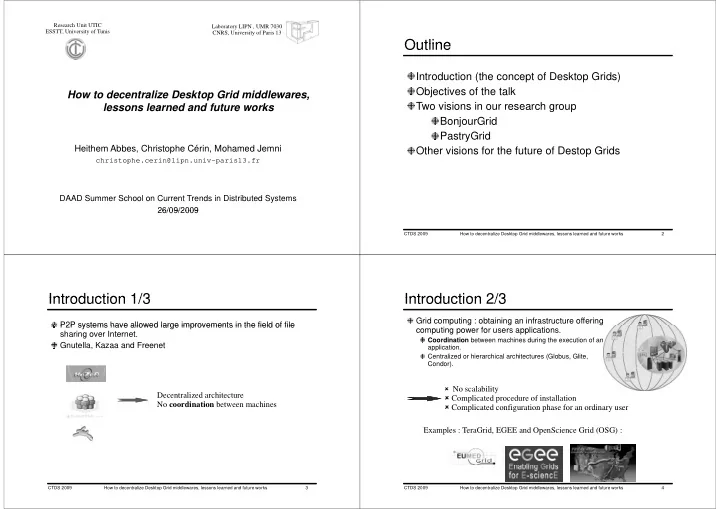
Research Unit UTIC Laboratory LIPN , UMR 7030 ESSTT, University of Tunis CNRS, University of Paris 13 Outline Outline Introduction (the concept of Desktop Grids) Objectives of the talk How to decentralize Desktop Grid middlewares, p , Two


slide-1
SLIDE 1

Laboratory LIPN , UMR 7030 CNRS, University of Paris 13 Research Unit UTIC ESSTT, University of Tunis

How to decentralize Desktop Grid middlewares, p , lessons learned and future works

Heithem Abbes, Christophe Cérin, Mohamed Jemni

christophe.cerin@lipn.univ-paris13.fr

DAAD Summer School on Current Trends in Distributed Systems 26/09/2009 26/09/2009

Outline Outline

Introduction (the concept of Desktop Grids) Objectives of the talk Two visions in our research group BonjourGrid PastryGrid Other visions for the future of Destop Grids p

CTDS 2009 How to decentralize Desktop Grid middlewares, lessons learned and future works 2

Introduction 1/3

P2P systems have allowed large improvements in the field of file

Introduction 1/3

P2P systems have allowed large improvements in the field of file sharing over Internet. Gnutella, Kazaa and Freenet Decentralized architecture No coordination between machines

CTDS 2009 How to decentralize Desktop Grid middlewares, lessons learned and future works 3

Introduction 2/3

Grid computing : obtaining an infrastructure offering

Introduction 2/3

computing power for users applications.

Coordination between machines during the execution of an application. Centralized or hierarchical architectures (Globus, Glite, Condor).

No scalability

Complicated procedure of installation Complicated configuration phase for an ordinary user Complicated configuration phase for an ordinary user Examples : TeraGrid, EGEE and OpenScience Grid (OSG) :

CTDS 2009 How to decentralize Desktop Grid middlewares, lessons learned and future works 4

slide-2
SLIDE 2

Introduction 3/3

Desktop Grid led the community to build computing systems b d l hi

Introduction 3/3

based on voluntary machines. Current systems use Master/Worker model United Devices, BOINC, PLANETLAB, XtremWeb, Condor , , , , A li ti d i Applications domain

  • Global climate prediction (BOINC)
  • Search for extraterrestrial intelligence (SETI@Home)

Cosmic rays study (XtremWeb)

  • Cosmic rays study (XtremWeb).

Demonstrate the potential of Desktop Grid To suffer from being hardly scalable due to centralized control To suffer from being hardly scalable due to centralized control To rely on permanent administrative staff who guarantees the master operation

CTDS 2009 How to decentralize Desktop Grid middlewares, lessons learned and future works 5

The history of Desktop Grids by Franck Cappello y p y pp

Date

CTDS 2009 How to decentralize Desktop Grid middlewares, lessons learned and future works 6

The history of Desktop Grids by Franck Cappello y p y pp

CTDS 2009 How to decentralize Desktop Grid middlewares, lessons learned and future works 7

The history of Desktop Grids by Franck Cappello y p y pp

CTDS 2009 How to decentralize Desktop Grid middlewares, lessons learned and future works 8

slide-3
SLIDE 3

Objectives of this talk Objectives of this talk

To offer a comprehensive survey of (some) hot topics in Desktop Grids To illustrate with innovative middleware To explain views from other researchers To motivate people to join our community

CTDS 2009 How to decentralize Desktop Grid middlewares, lessons learned and future works 9

BonjourGrid Middleware

To offer a collaborative decentralized and multi-coordinators

BonjourGrid Middleware

To offer a collaborative, decentralized and multi coordinators platform To build an infrastructure which does not depend on a central l t element. No static coordinator To create coordinators in a dynamic automatic way and To create coordinators in a dynamic, automatic way and without system administrator intervention Each coordinator asks and seeks, in a decentralized way, idle y machines to participate to the execution of a given application Pluggable computing systems

CTDS 2009 How to decentralize Desktop Grid middlewares, lessons learned and future works 10

BonjourGrid : Basic design (1/3) BonjourGrid : Basic design (1/3)

Coordinator Coordinator Workers

CTDS 2009 How to decentralize Desktop Grid middlewares, lessons learned and future works 11

Computing Element (CE) = 1 Coordinator + N Workers

BonjourGrid : Basic design (2/3) BonjourGrid : Basic design (2/3)

CTDS 2009 How to decentralize Desktop Grid middlewares, lessons learned and future works 12

slide-4
SLIDE 4

BonjourGrid : Basic design (3/3)

A computing element for each user

BonjourGrid : Basic design (3/3)

No static coordinator

User B User D User C User A User C

CTDS 2009 How to decentralize Desktop Grid middlewares, lessons learned and future works 13

Coordinator Worker Idle

Advantages in using pub/sub systems

Only 3 primitives in the toolbox: publish, subscribe, browse , Notions of global state and global/multicast Notions of global state and global/multicast

  • perations

Easy to develop applications

CTDS 2009 How to decentralize Desktop Grid middlewares, lessons learned and future works 14

BonjourGrid’s vision

A user requests for a computation

BonjourGrid s vision

A user requests for a computation He provides tasks graph and codes implementing his distributed application He deploys locally a coordinator node and requests for participants The coordinator node selects a subset of idle nodes (CPU The coordinator node selects a subset of idle nodes (CPU, RAM, Cost) When the coordinator node finishes application tasks it pp becomes free and returns to the idle status Its worker nodes become idle

CTDS 2009 How to decentralize Desktop Grid middlewares, lessons learned and future works 15

Fundamental Parts

BonjourGrid is composed of three fundamental parts:

Fundamental Parts

BonjourGrid is composed of three fundamental parts:

A resources discovery protocol

Fully decentralized protocol Fully decentralized protocol

A “computing elements” constructor

Executes and handles the various tasks of an application pp (XtremWeb, Condor, Boinc, MPICH)

A global coordination protocol

M d t l ll i d ti Manages and controls all resources, services and computing elements Does not depend on any specific machine or centralized element

CTDS 2009 How to decentralize Desktop Grid middlewares, lessons learned and future works 16

slide-5
SLIDE 5

Discovery protocol

Based on Bonjour protocol

Discovery protocol

Based on Bonjour protocol Bonjour is an implementation by Apple of the ZeroConf protocol

To obtain a functional IP network without DHCP or DNS servers To obtain a functional IP network without DHCP or DNS servers

Bonjour is structured around three functionalities: j

Dynamic allocation of IP addresses without DHCP Resolution of names and IP addresses without DNS Services discovery without directory server Services discovery without directory server

CTDS 2009 How to decentralize Desktop Grid middlewares, lessons learned and future works 17

Analysis of Pub/Sub systems

Questions ?

Analysis of Pub/Sub systems

Questions ?

Can a system based on publish/subscribe be scalable? What is the response time to publish a service? What is the response time to publish a service? What is the discovery time of a service?

Experiments on Bonjour protocol on the Grid5000 Experiments on Bonjour protocol, on the Grid5000 platform using more than 300 nodes (Orsay site)

Bonjour is reliable and very powerful in resources Bonjour is reliable and very powerful in resources discovery. It discovers all the services (100%) It succeeds to discover more than 300 services published simultaneously in less than 2 seconds

CTDS 2009 How to decentralize Desktop Grid middlewares, lessons learned and future works 18

A computing element (CE)

Each user uses his machine as a coordinator

A computing element (CE)

Each user uses his machine as a coordinator Each coordinator creates dynamically its CE

CE = Coordinator + set of workers CE = Coordinator + set of workers

CE functionalities

To allocate workers To allocate workers To submit and run tasks on workers To schedule and get results To schedule and get results

Computing systems

XtremWeb Condor Boinc MPICH XtremWeb, Condor, Boinc, MPICH

Specific CE middleware for each user

CTDS 2009 How to decentralize Desktop Grid middlewares, lessons learned and future works 19

BonjourGrid node state

Each machine can have one of the three states (Idle

BonjourGrid node state

Each machine can have one of the three states (Idle, Worker or Coordinator). A machine announces its state by publishing the specific specific service service to this state service service to this state

IdleService for Idle state WorkerService for worker state CoordinatorService for coordinator state.

When a machine state changes:

it bli h th di i t d ti thi t t it publishes the according service to advertise this new state, after having deactivated the old one.

Every machine can discover machines that are in a given y g state.

CTDS 2009 How to decentralize Desktop Grid middlewares, lessons learned and future works 20

slide-6
SLIDE 6

BonjourGrid’s Layers BonjourGrid s Layers

Deployment of a computing system

XW B i C d MPICH Builiding of CEs XW, Boinc, Condor, MPICH

Resources Discovery (RAM CPU L d C t)

Builiding of CEs

Resources h t i ti (RAM, CPU, Load, Cost) characteristics

BonjourGird Connexion ZeroConf Protocol (Pub/Sub) j

CTDS 2009 How to decentralize Desktop Grid middlewares, lessons learned and future works 21

Idle into Coordinator

Submission of application Submission of application

Coordinator

(CE=N) (CE=N) Stop the service « IdleService » Stop the service « IdleService » Publish the service « CoordinatorService » Publish the service « CoordinatorService » Start the coordinator Start the coordinator « CoordinatorService » « CoordinatorService » Status Status coordinator coordinator Find idles machines Find idles machines Select machines Select machines mations « Coordinator » « Coordinator » Select machines Select machines Request worker participation Request worker participation

  • Nbre. Confirm

Nbre of Confirmations ==N Nbre of Confirmations ==N No N = N - Start application Start application N Yes Application in execution Application in execution Stop the service « WorkerService » Stop the service « WorkerService » 22 Execution achieved Execution achieved Stop the worker Stop the worker

Idle into worker

Start BonjourGri d Start BonjourGri d

worker

Discover coordinators requests Discover coordinators requests Publish the service « IdleService » Publish the service « IdleService » Coordinator X is found Coordinator X is found Status « Idle » Status « Idle » Treat the first participation request of coordinateur X Treat the first participation request of coordinateur X Stop the service « IdleService » and the Stop the service « IdleService » and the Start worker Start worker Publish the service Publish the service Browse on Browse on Stop the service « IdleService » and the browser Stop the service « IdleService » and the browser Start worker Start worker Connexion of worker to coordinator X Connexion of worker to coordinator X « WorkerService » « WorkerService » coordinator X coordinator X Coordinateur X i d Coordinateur X i d Execution of assigned tasks Execution of assigned tasks Stop the service « CoordinatorService » Stop the service « CoordinatorService » X is removed X is removed 23 « CoordinatorService » « CoordinatorService » Stop the coordinator Stop the coordinator

Experimentation Experimentation

Evaluate a system Evaluate a system

based on a set of specific applications ? based on a specific arrival pattern (Poisson’s Law) ?

Workload model very close to the reality

Feitelson and Lublin Inputs of the workload model Inputs of the workload model

Number of nodes (system size) Arrival time of applications Maximum number of parallel tasks Maximum number of parallel tasks Tasks execution times

Application ID Arrival Time Execution Time Nbre of parallel tasks 1 19 4 32 2 39 11 13 3 69 13 16 4 98 87 1 CTDS 2009 How to decentralize Desktop Grid middlewares, lessons learned and future works 24 4 98 87 1 5 200 100 4

slide-7
SLIDE 7

Experimentations Experimentations

To emulate a set of users with a set of applications To emulate a set of users with a set of applications An application is submitted by a user To create CEs to carry out all submitted applications A python generator which creates a set of applications using a workload model An application is created for each entry in the workload with different pp y parameters

Binary and data files A data flow graph (in XML format) A data flow graph (in XML format) Gather : fictitious task to detect the final date of the application

Size of an application varies from 2 to N tasks

N b l t th i b f il bl hi i th N may be equal to the maximum number of available machines in the network

CTDS 2009 How to decentralize Desktop Grid middlewares, lessons learned and future works 25

Experimentations Experimentations

1 CE is created dynamically for each application 1 CE is created dynamically for each application Emulator

List of machines List of machines List of applications Workload model Workload model

Submit an application following the arrival pattern of applications in the workload applications in the workload Look for free machine on which a coordinator will start to initiate the application tasks execution to initiate the application tasks execution The CE is released when application tasks finish

CTDS 2009 How to decentralize Desktop Grid middlewares, lessons learned and future works 26

Experimentations Experimentations

Grid’5000

* A b i f i

A nation w ide

Grid 5000

A very brief overview

A nation w ide Experim ental Grid

F k C ll Franck Cappello (with all project members) INRIA fci@lri.fr

CTDS 2009 How to decentralize Desktop Grid middlewares, lessons learned and future works 27

Experimentations Experimentations Tools for Distributed System Tools for Distributed System y Studies Studies

T i ti t Di t ib t d S t i d

Models:

To investigate Distributed System issues, we need: 1) Tools (model, simulators, emulators, experi. Platforms)

Real system s Sys, apps, Platform s, conditions Real system s Real applications “I n-lab” platform s Synthetic conditions Key system m ecas.

Realism

Real applications Real platform s Real conditions Algo, app. kernels Virtual platform s Synthetic conditions

Abstraction Realism

m ath sim ulation em ulation live system s

validation

CTDS 2009 How to decentralize Desktop Grid middlewares, lessons learned and future works 28

2) Strong interaction between these research tools a da o

slide-8
SLIDE 8

Experimentations Experimentations

Comparative study of BonjourGrid and XW Comparative study of BonjourGrid and XW

Execution time = Final date – Submission date Same set of applications Same workload model N machines for BonjourGrid = 1 Coordinator + N-1 workers for XW XW

1st Setup 1st Setup

128 machines on Grid5000 (Orsay's node). Creation of 100 applications with // tasks (1 à 128) (2150 tasks) C eat o

  • 00 app cat o s

t // tas s ( à 8) ( 50 tas s) 3 hours of execution (arrival dates are elapsed within this period) Management of 100 instances of CE

CTDS 2009 How to decentralize Desktop Grid middlewares, lessons learned and future works 29

Experimentations Experimentations

Results

B j G id t h d f b t 60 f 90 % li ti BonjourGrid generates an overhead of about 60 sec for 90 % applications Waiting time to find a free machine for a coordiantor (delay the end time of an application with BonjourGrid) + CE building Time BonjourGrid can give in some cases better turnaround times than XW BonjourGrid can give, in some cases, better turnaround times than XW XW-Coordinator: access to mysql DB, task assignment, workers allocation

  • verload of the coordinator

Loss of workers connections (same port on the central server to maintain ti ) connections) XW-Coordinator must wait for WorkRequest to submit a task (back-off effect) submission tasks may delay

CTDS 2009 How to decentralize Desktop Grid middlewares, lessons learned and future works 30

Experimentations Experimentations

2nd Setup

t

1st setup with 20 (15%) machines more for BonjourGrid. Relaxing the previous scenario Give more chance to BonjourGrid to find a free machine for the coordinator.

Results

The difference between BonjourGrid and XW turnaround times is decreased 1 single peak with a diminution of 140 sec (3 applications which have 1 single peak with a diminution of 140 sec (3 applications which have requested more than 120 workers) BonjourGrid can provide better performance with other more relaxed scenarios.

CTDS 2009 How to decentralize Desktop Grid middlewares, lessons learned and future works 3131

Experimentations Experimentations

To make more experiments over a large number of machines To check if BonjourGrid scale well? Can it orchestrate a great number of CEs? To use virtual machine to increase the experiment scale p To use the virtual system Vgrid Vgrid provides a mechanism to create several virtual machines on Vgrid provides a mechanism to create several virtual machines on the same host The different virtual machines communicate through a virtual Hub created on each physical machine (or real machine denoted by RM) created on each physical machine (or real machine denoted by RM). 500 virtual machines means: 10 VM*50 RM or 5VM*100 RM.

CTDS 2009 How to decentralize Desktop Grid middlewares, lessons learned and future works 32

slide-9
SLIDE 9

Experimentations Experimentations

3rd Setup

500 VM 4 VM 125 RM 500 VM = 4 VM x 125 RM 50 applications already executed on128 real machines (RM) To observe the impact of virtual machines(VM) use.

Results

Virtual machines lacked sufficient RAM to manage many opened sockets at the same time and to allocate necessary memory for the Java virtual machine. The increase in machines number from128 RM to 500 VM did not enhance turnaround times.

CTDS 2009 How to decentralize Desktop Grid middlewares, lessons learned and future works 33

Experimentations Experimentations

4th Setup p

405 applications ===> 405 CE managed by BonjourGrid

The parallel tasks number varies from 2 to 128

BonjourGrid : 1000 VM (4 VM x 250 RM) BonjourGrid : 1000 VM (4 VM x 250 RM)

300 MB per each VM

XW: 1 coordinator + 480 workers

special VM with 1500 MB for the coordinator to reach 480 connexions of workers 300 MB per each worker p

CTDS 2009 How to decentralize Desktop Grid middlewares, lessons learned and future works 34

Experimentations

Results

Experimentations

esu ts

Bonjour can manage more than 400 CEs BonjourGrid performs better around the application 380

The overload of XW-Coordinator The overload of XW-Coordinator The lose of workers connexions Back-off effect

CTDS 2009 How to decentralize Desktop Grid middlewares, lessons learned and future works 35

Fault tolerance in BonjourGrid Fault tolerance in BonjourGrid

A CE is managed by a computing system (XtremWeb, g y p g y ( Boinc, Condor)

  • A computing system handles fault inside a CE (faults
  • f workers)
  • f workers)
  • BonjourGrid must tolerate the coordinator fault

A replication approach of coordinator states

CTDS 2009 How to decentralize Desktop Grid middlewares, lessons learned and future works 36

slide-10
SLIDE 10

Fault tolerance in BonjourGrid Fault tolerance in BonjourGrid

Replication approach: p pp

Create dynamically replicas (C2 and C3) of the principal coordinator (C1) Use virtual machines (Xen) to save the state (checkpoints) of ( ) ( p ) the principal coordinator Send periodically checkpoints to replicas (C2 and C3) Use publish/subscribe infrastructure to exchange information Use publish/subscribe infrastructure to exchange information and detect failure Redirect workers to the new coordinator (C2)

C2 C2 C1 C2 C3 C1 C2 C3

CTDS 2009 How to decentralize Desktop Grid middlewares, lessons learned and future works 37

Conclusion about BonjourGrid Conclusion about BonjourGrid

BonjourGrid: A novel approach for making a BonjourGrid: A novel approach for making a collaborative and decentralized Desktop Grid systems. Publish/Subscribe protocol

Orchestrate the participants

A ti t ( XW B i C d A computing system (e.g XW, Boinc, Condor, MPICH) for the execution level of an application BonjourGrid makes a distributed control

  • ver

BonjourGrid makes a distributed control

  • ver

resources and does not depend

  • n

a central element.

BonjourGrid favors collaborative execution and Meta-Grids orchestration

CTDS 2009 How to decentralize Desktop Grid middlewares, lessons learned and future works 38

PastryGrid objectives PastryGrid objectives

Decentralize the execution

  • f

distributed Decentralize the execution

  • f

distributed applications with precedence between tasks New approach: PastryGrid: a fully decentralized system based

  • n

DHT which decentralizes the execution of distributed applications execution of distributed applications. Decentralize the resources management in Decentralize the resources management in the Desktop Grid (DG)

CTDS 2009 How to decentralize Desktop Grid middlewares, lessons learned and future works 39

Distributed Application (1/4) Distributed Application (1/4)

  • Chalenge : Distributed applications with precedence

Chalenge : Distributed applications with precedence between tasks:

  • DA is composed of several modules
  • A

d l i f k i h bi d ll

  • A module is a set of tasks, using the same binary and, generally,

different input files.

  • Tasks of the same module can be carried out in a parallel way

Module 1 Module 2 Module 3 Module 4 CTDS 2009 How to decentralize Desktop Grid middlewares, lessons learned and future works 40

slide-11
SLIDE 11

Distributed Application (2/4)

  • Terminology

Distributed Application (2/4)

  • Terminology

CTDS 2009 How to decentralize Desktop Grid middlewares, lessons learned and future works 41

Distributed Application (3/4)

  • How a user can describe his application?

Distributed Application (3/4)

  • How a user can describe his application?
  • He provides a compressed package : binary, data , data

flow graph.

  • Data flow graph: nodes are tasks, edges are precedence

between tasks

  • Application xml to describe his application

Application.xml to describe his application

  • Data flow graph
  • Execution requirement

q

  • Path of binary file and data

NOT easy to write it by hand

CTDS 2009 How to decentralize Desktop Grid middlewares, lessons learned and future works 42

Distributed Application (4/4)

  • SDAD : System for Distributed Applications

Distributed Application (4/4)

  • SDAD : System for Distributed Applications

Description

  • Help user to prepare his package

Help user to prepare his package

  • A tool with graphical mode for simple applications and

an advanced mode for complex ones p

  • User has just to draw the data flow graph for simple

applications or follow special wizard for complex ones.

  • SDAD generates the Application.xml, puts data and

binary files in a directory tree, and compresses all these data in a zip file these data in a zip file.

CTDS 2009 How to decentralize Desktop Grid middlewares, lessons learned and future works 43

SDAD SDAD

CTDS 2009 How to decentralize Desktop Grid middlewares, lessons learned and future works 44

slide-12
SLIDE 12

Design of PastryGrid Design of PastryGrid

  • PastryGrid is composed of four components:

PastryGrid is composed of four components:

  • Addressing scheme to identify machines and

applications applications

  • RDV concept
  • Protocol of resources discovery

Protocol of resources discovery

  • Coordination approach between machines

carrying out a given application y g g pp

CTDS 2009 How to decentralize Desktop Grid middlewares, lessons learned and future works 45

1 Addressing scheme

  • 1. Addressing scheme
  • Withdraw the master/worker model Decentralized

Withdraw the master/worker model Decentralized style

  • Modern P2P networks: Pastry, CAN, CHORD
  • Based on DHT (Distributed Hash Table)
  • Nodes can join/leave the network
  • DHT is updated and mapped to new physical nodes
  • Fully decentralized routing algorithm
  • d li

f l k t th i t h i l delivery of lookup messages to the appropriate physical node in at most O(log(N)) (N = number of alive physical nodes) nodes)

  • Pastry : overlay network for the PastryGrid system.

CTDS 2009 How to decentralize Desktop Grid middlewares, lessons learned and future works 46

1 Add i h

  • Node: is assigned with a 128-bit nodeId to each physical
  • 1. Addressing scheme
  • Node: is assigned with a 128 bit nodeId to each physical

node when it joins the network.

  • Application:
  • is assigned with a 128-bit ApplicationId
  • hashed using application and user name and current

d t th b i i hi date on the submission machine

  • Unique identifier for each application

CTDS 2009 How to decentralize Desktop Grid middlewares, lessons learned and future works 47

2 Concept of RDV

  • 2. Concept of RDV
  • How to localize a node without identifier (neither IP

How to localize a node without identifier (neither IP address neither Hostname) ?

  • From where can I get my data (binary + data) ?
  • e e ca

get y data (b a y data)

  • Where should I store my results ?

Solution

RDV created according to the application identifier ApplicationID

  • Communication with RDV via ApplicationID

Communication with RDV via ApplicationID

CTDS 2009 How to decentralize Desktop Grid middlewares, lessons learned and future works 48

slide-13
SLIDE 13

2 Concept of RDV

RDV

Coord.

  • 2. Concept of RDV
  • Unknown

Coord.

  • Known and fixed
  • Static central element
  • Variable
  • In case of breakdown the

system remain functional

  • Decentralised resources
  • Static central element
  • In case of breakdown, the

system collapses

  • Centralised management of
  • Decentralised resources

management

  • RDV for each application

no overload

  • Centralised management of

resources

  • Management of all

applications

  • Si

l no overload

  • Simple
  • Overload

CTDS 2009 How to decentralize Desktop Grid middlewares, lessons learned and future works 4949

RDV i iti li ti RDV initialization

  • RDV is the machine which nodeId is numerically closest to

A li i ID

RDV

ApplicationID

Submission node

RDV

Application Application

CTDS 2009 How to decentralize Desktop Grid middlewares, lessons learned and future works 50

RDV initialization RDV initialization

  • Extracts the zip file to rebuild the initial tree structure of the application
  • Generates Task.xml file for each task (Application.xml)

Module 1 Task 1 Task 1.xml

Application

Module i Task 1 Task i Task 1.xml Task i.xml

Info in Task.xml of Ti:

  • Task name Ti

Distributed Application

OS 1 Task i Task i.xml

  • successors of Ti (Succ(Ti))
  • Requirements of Succ(Ti)

bin OS i

  • Friends of Ti

CTDS 2009 How to decentralize Desktop Grid middlewares, lessons learned and future works 51 Application.xml

3 Resources discovery protocol

  • 3. Resources discovery protocol
  • Each node M participates in the execution of a task T, is

ac

  • de

pa t c pates t e e ecut o

  • a tas

, s susceptible to look for free machines for the successors of M

  • No machine dedicated for research (to avoid centralisation)

Notation: Mi execute the task Ti

: 1 Case

T1 T2

M1 finishes T1 then looks for M2 for T2

: 2 Case

T1

Avoid the research redundancy

: 2 Case

T1 T2 T3

y Only one machine, among M1 and M2, looks for M3 Optimization: the last that finishes, looks for M3

CTDS 2009 How to decentralize Desktop Grid middlewares, lessons learned and future works 52

slide-14
SLIDE 14

3 Resources discovery protocol

New discovery protocol

  • 3. Resources discovery protocol

New discovery protocol

Implementation: simplicity of grafting and controlling the discovery module y Existing : a machine sends its local information (CPU, RAM, OS, Cost) to one or many servers Not real information (real time) information (real time) Proposal solution: to access to the machine and to check directly its characteristics check directly its characteristics

CTDS 2009 How to decentralize Desktop Grid middlewares, lessons learned and future works 53

3 Resources discovery protocol

  • 3. Resources discovery protocol
  • M1 executes T1 and search available and suitable machines for T2 and

T3

  • 1. M1 constructs a vector Va (H,W,R) :

T2

M2

( , , )

a : application ID H : list of nodes handles of M1 leafset W : list of tasks names (T2, T3)

T1 T2 T3

M1 M3

R : execution requirement

  • 2. M1 sends Va(H,W,R) to head(H)
  • 3. M=head(H) checks if it is free and fits R: if yes, M takes T=head(W) to
  • 3. M head(H) checks if it is free and fits R: if yes, M takes T head(W) to

execute it and deletes it from W (W=W-T).

  • 4. If W=, then the discovery process is accomplished. Else, M deletes

its node handle from H (H=H M) Goto 2 its node handle from H (H=H-M). Goto 2

  • 5. If H=, M updates it with a new leaf set: H leaf set of M. M forwards

the new Va(H,W,R) to the head(H). Goto 2

CTDS 2009 How to decentralize Desktop Grid middlewares, lessons learned and future works 54

Coordination and data transfer

RDV M2 (2 T1 T4

Coordination and data transfer

RDV (1) (0) (2 ) T1 T4 T2 T5 (1) T2 T5 T3 T6 (3) M3 (1) (2) (3) (2) T3 T6

InitApplication

Bootstrap M1 (2) M*

InitApplication NodeRequest NodeRequestAck

(2)

  • Hash (Application + User + Date) Unique Identifier: ApplicationId
  • Initialization of RDV machine which node is numeriquely closest to
  • Hash (Application + User + Date) Unique Identifier: ApplicationId
  • Initialization of RDV machine which node is numeriquely closest to

CTDS 2009 How to decentralize Desktop Grid middlewares, lessons learned and future works 55

ApplicationId

  • Lookup for free machines for T1, T2 et T3 M1, M2 and M3

ApplicationId

  • Lookup for free machines for T1, T2 et T3 M1, M2 and M3

Coordination and data transfer

(2 )

Coordination and data transfer

RDV M2 (1) T1 T4 (1) (1) (2) (2) T2 T5 T3 T6 M1 (1) M3

YourWork

T3 T6

DataRequest Y D t

Assignment of tasks T1, T2 and T3 to M1, M2 and M3 YourWork message containing the task name and ApplicationId . Assignment of tasks T1, T2 and T3 to M1, M2 and M3 YourWork message containing the task name and ApplicationId .

YourData

CTDS 2009 How to decentralize Desktop Grid middlewares, lessons learned and future works 56

g g pp Demand and recuperation of the data by M1, M2 and M3 DataRequest and YourData g g pp Demand and recuperation of the data by M1, M2 and M3 DataRequest and YourData

slide-15
SLIDE 15

Coordination and data transfer

T1 T4 RDV M2 (5)

Coordination and data transfer

T1 T4 T2 T5 RDV (5) (2) (6) (4) T2 T5 T3 T6 (5) (2) (7) (4) M5 (3) T3 T6 M1 (1) M3

WorkDone YourWork

M6 M4

YourWork SearchRequest SearchRequestAck SearchRequestReject

  • M1 assigns T4 to M4 which it has just found
  • M1 assigns T4 to M4 which it has just found

q j

CTDS 2009 How to decentralize Desktop Grid middlewares, lessons learned and future works 57

  • M3 finishes T3 but do not search a machine for T6
  • M2 searches M5 and M6 and affect them to T5 and T6
  • M3 finishes T3 but do not search a machine for T6
  • M2 searches M5 and M6 and affect them to T5 and T6

Implementation and experimentation Implementation and experimentation

  • PastryGrid is entirely developed in JAVA

ast yG d s e t e y de e oped J

  • FreePastry API to create the overlay network and implement

DHT functionalities

  • C

i d b l d l XW CH d Comparison study between a central model, XW-CH, and PastryGrid

  • To validate and evaluate PastryGrid

y

  • workload model very close to the reality
  • Feitelson and Lublin
  • I

t f th kl d d l

Application ID Arrival Time (s) Execution Time (s) Nbre of parallel tasks

  • Inputs of the workload model
  • Number of nodes (system size)
  • Arrival time of applications

1 19 4 32 2 39 11 13 3 69 13 16 4 98 87 1

pp

  • Maximum number of parallel tasks
  • Tasks execution times

4 98 87 1 5 200 100 4 CTDS 2009 How to decentralize Desktop Grid middlewares, lessons learned and future works 58

Implementation and experimentation

  • Extension of the basic model by adding a fictitious

Implementation and experimentation

  • Extension of the basic model by adding a fictitious

“gather” task

  • “gather” receive all results of the previous tasks

gather receive all results of the previous tasks.

  • An application with k tasks means that k-1 friend

tasks and the kth is the gather one tasks and the kth is the gather one

  • Stressful scenario (Big number of friend tasks)

CTDS 2009 How to decentralize Desktop Grid middlewares, lessons learned and future works 59

Experimentations Experimentations

  • G id’5000

l tf i O ’ d

  • Grid’5000 platform using Orsay’s node
  • 205 machines Amd Opterons, 2Go RAM,

t d connected via 1GB/s network

  • “Python” based applications generator
  • Setup :

PastryGrid : 205 machines XtremWeb : 1 coordinator + 204 workers 100 applications ( 2 to 129 // tasks), 2500 tasks Task turnaround time varies from 1 to 450 sec.

CTDS 2009 How to decentralize Desktop Grid middlewares, lessons learned and future works 60

3 hours as period for arrival pattern

slide-16
SLIDE 16

Experimentations Experimentations

PastryGrid gives turnaround times < XW ones : y g

XW-Coordinator: access to mysql DB, task assignment, workers allocation overload of the coordinator Loss of workers connections (same port on the central server to Loss of workers connections (same port on the central server to maintain connections) XW-Coordinator must wait for WorkerRequest to submit a task

  • b

i i t k d l submission tasks may delay

CTDS 2009 How to decentralize Desktop Grid middlewares, lessons learned and future works 6161

Fault tolerance in PastryGrid Fault tolerance in PastryGrid

  • RDV fault tolerance

RDV fault tolerance

  • Active replication of RDV
  • Maintain a fixed replication coefficient
  • Last state (checkpoint) saved on replication machines

Last state (checkpoint) saved on replication machines

  • Migration on a new RDV copy, numerically closest to the
  • ld one in case of fault

CTDS 2009 How to decentralize Desktop Grid middlewares, lessons learned and future works 62

PastryGrid vs Vigne PastryGrid vs Vigne

Vigne (Christine Morin, INRIA, Rennes (2007)) g ( , , ( ))

  • App. manager is also created according to the application ID
  • App. Manager makes "ALL", controls the tasks, looks for

resources sends data resources, sends data…

  • App. Manager supervises participants nodes.

PastryGrid y

  • RDV: primordial function: a simple storage point of results and

data

  • RDV does not make research
  • RDV does not make research
  • A direct data exchange may take place between the nodes

without crossing by the RDV

  • A different research strategy : collaborative research.
  • Participants, permanently, share information between themselves

via the RDV

CTDS 2009 How to decentralize Desktop Grid middlewares, lessons learned and future works 63

via the RDV.

Conclusion about PastryGrid

PastryGrid

Conclusion about PastryGrid

PastryGrid

Executes distributed applications with precedence between tasks Executes distributed applications with precedence between tasks in a decentralized way C ll b ti d t k t b t Collaborative resources and tasks management between participating nodes. No overhead caused by decentralization

CTDS 2009 How to decentralize Desktop Grid middlewares, lessons learned and future works 64

slide-17
SLIDE 17

Views from other researchers Views from other researchers

J W i U i it f Mi t USA Jon Weissman, University

  • f

Minnesota, USA, (PCGrid'2009 talk in Rome) Promote proxy network comprised of volunteer nodes and how proxies accelerate applications spanning p pp p g

  • ne or more clouds.

Describe how several classes of cloud applications might be better suited to an

  • n-demand

cloud comprised of distributed volunteer resources comprised of distributed volunteer resources

CTDS 2009 How to decentralize Desktop Grid middlewares, lessons learned and future works 65

Views from other researchers Views from other researchers

P i Proxies may serve as: Cloud service interaction: Computing: A proxy may carry out computations on data via a set of data

  • perators.

Caching:

users.cs.umn.edu/~jon/

  • http://www

: See

CTDS 2009 How to decentralize Desktop Grid middlewares, lessons learned and future works 66

Views from other researchers Views from other researchers

David Anderson, University of Houston, USA, Keynote David Anderson, University of Houston, USA, Keynote Talk at GPC'2009 (Geneva): Exa-Scale Volunteer Computing Also available on http://www.researchchannel.org/prog/displayevent.aspx?fI D=569&rID=27420 Mentioned (rank=2) the problem of result certification Certification is not the process that flotting points

  • perations are 'good' but refers to certify that the result is

correct and not falsified correct and not falsified

CTDS 2009 How to decentralize Desktop Grid middlewares, lessons learned and future works 67

Views from other researchers Views from other researchers

Techniques for result certification Techniques for result certification Redundancy + votes (consensus in distributed systems is hard) Probabilistic certification (massive attacks) : http://moais.imag.fr/membres/jean- louis roch/perso html/publications html louis.roch/perso_html/publications.html Without any specific secure system is the architecture: see http://www.loria.fr/~ejeannot/aleae-doc/Canon- C ll i df Collusion.pdf Use TPM?

CTDS 2009 How to decentralize Desktop Grid middlewares, lessons learned and future works 68

slide-18
SLIDE 18

Some others perspectives in our group Some others perspectives in our group

Short term Production versions of BonjourGrid and PastryGrid Rich user interface that helps users of BonjourGrid and PastryGrid to deploy their applications PastryGrid to deploy their applications Extended evaluation of BonjourGrid and PastryGrid Extended evaluation of BonjourGrid and PastryGrid

Real applications deployment Collaboration

  • f
  • ther

research teams (physics, i i l ti bi i f ti ) numeric simulation, bio-informatics…)

CTDS 2009 How to decentralize Desktop Grid middlewares, lessons learned and future works 69

Some others perspectives in our group

Mean and long term

Some others perspectives in our group

Fault tolerance

PastryGrid : checkpoints to not re-execute long tasks BonjourGrid : optimization of data exchange between virtual BonjourGrid : optimization of data exchange between virtual machines

Dynamic infrastructure of services using BonjourGrid

Create services on demand (storage, computing, ..)

Reservation rules to share,

  • ptimally,

resources between users (BonjourGrid) between users (BonjourGrid) Resource authentication in BonjourGrid and PastryGrid Interaction between computing elements in BonjourGrid p g j

Negotiations to exchange workers between coordinators (XW, Condor, Boinc)

CTDS 2009 How to decentralize Desktop Grid middlewares, lessons learned and future works 70