Outline Introduction to Parsing Regular languages revisited - - PowerPoint PPT Presentation

outline introduction to parsing regular languages
SMART_READER_LITE
LIVE PREVIEW

Outline Introduction to Parsing Regular languages revisited - - PowerPoint PPT Presentation

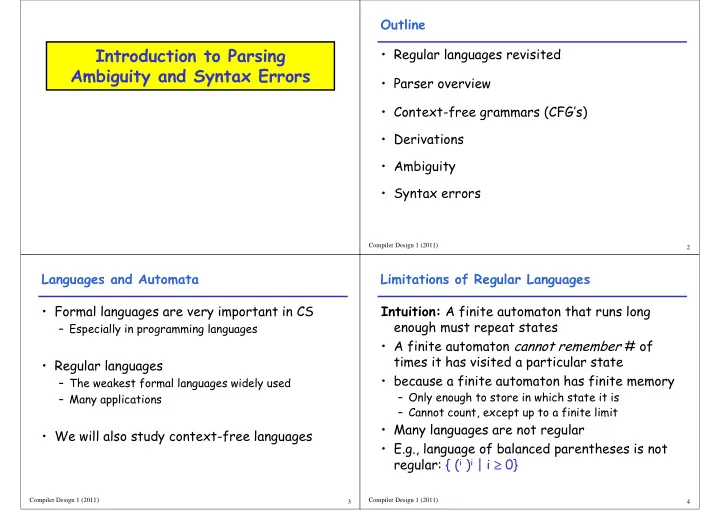
Outline Introduction to Parsing Regular languages revisited Ambiguity and Syntax Errors Parser overview Context-free grammars (CFGs) Derivations Ambiguity Syntax errors Compiler Design 1 (2011) 2 Languages


slide-1
SLIDE 1

Introduction to Parsing Ambiguity and Syntax Errors

Compiler Design 1 (2011) 2

Outline

  • Regular languages revisited
  • Parser overview
  • Context-free grammars (CFG’s)
  • Derivations
  • Ambiguity
  • Syntax errors

Compiler Design 1 (2011) 3

Languages and Automata

  • Formal languages are very important in CS

– Especially in programming languages

  • Regular languages

– The weakest formal languages widely used – Many applications

  • We will also study context-free languages

Compiler Design 1 (2011) 4

Limitations of Regular Languages Intuition: A finite automaton that runs long enough must repeat states

  • A finite automaton cannot remember # of

times it has visited a particular state

  • because a finite automaton has finite memory

– Only enough to store in which state it is – Cannot count, except up to a finite limit

  • Many languages are not regular
  • E.g., language of balanced parentheses is not

regular: { (i )i | i ≥ 0}

slide-2
SLIDE 2

Compiler Design 1 (2011) 5

The Functionality of the Parser

  • Input: sequence of tokens from lexer
  • Output: parse tree of the program

Compiler Design 1 (2011) 6

Example

  • If-then-else statement

if (x == y) the n z =1; e lse z = 2;

  • Parser input

IF (ID == ID) T HEN ID = INT ; ELSE ID = INT ;

  • Possible parser output

IF-T HEN-ELSE == ID ID = ID INT = ID INT

Compiler Design 1 (2011) 7

Comparison with Lexical Analysis Phase Input Output

Lexer Sequence of characters Sequence of tokens Parser Sequence of tokens Parse tree

Compiler Design 1 (2011) 8

The Role of the Parser

  • Not all sequences of tokens are programs . . .
  • . . . Parser must distinguish between valid and

invalid sequences of tokens

  • We need

– A language for describing valid sequences of tokens – A method for distinguishing valid from invalid sequences of tokens

slide-3
SLIDE 3

Compiler Design 1 (2011) 9

Context-Free Grammars

  • Many programming language constructs have a

recursive structure

  • A STMT is of the form

if COND then STMT else STMT , or while COND do STMT , or …

  • Context-free grammars are a natural notation

for this recursive structure

Compiler Design 1 (2011) 10

CFGs (Cont.)

  • A CFG consists of

– A set of terminals T – A set of non-terminals N – A start symbol S (a non-terminal) – A set of productions Assuming X ∈ N the productions are of the form X → ε , or X → Y1 Y2 ... Yn where Yi ∈ N ∪T

Compiler Design 1 (2011) 11

Notational Conventions

  • In these lecture notes

– Non-terminals are written upper-case – Terminals are written lower-case – The start symbol is the left-hand side of the first production

Compiler Design 1 (2011) 12

Examples of CFGs A fragment of our example language (simplified): STMT → if COND then STMT else STMT ⏐ while COND do STMT ⏐ id = int

slide-4
SLIDE 4

Compiler Design 1 (2011) 13

Examples of CFGs (cont.) Grammar for simple arithmetic expressions:

E → E * E ⏐ E + E ⏐ ( E ) ⏐ id

Compiler Design 1 (2011) 14

The Language of a CFG Read productions as replacement rules: X → Y1 ... Yn

Means X can be replaced by Y1 ... Yn

X → ε

Means X can be erased (replaced with empty string)

Compiler Design 1 (2011) 15

Key Idea (1) Begin with a string consisting of the start symbol “S” (2) Replace any non-terminal X in the string by a right-hand side of some production (3) Repeat (2) until there are no non-terminals in the string

1 n

X Y Y → L

Compiler Design 1 (2011) 16

The Language of a CFG (Cont.) More formally, we write if there is a production

1 1 1 1 1 i n i m i n

X X X X X Y Y X X

− +

→ L L L L L

1 i m

X Y Y → L

slide-5
SLIDE 5

Compiler Design 1 (2011) 17

The Language of a CFG (Cont.) Write if in 0 or more steps

1 1 n m

X X Y Y

→ L L

1 1 n m

X X Y Y → → → L L L L

Compiler Design 1 (2011) 18

The Language of a CFG Let G be a context-free grammar with start symbol S. Then the language of G is:

{ }

1 1

| and every is a terminal

n n i

a a S a a a

→ K K

Compiler Design 1 (2011) 19

Terminals

  • Terminals are called so because there are no

rules for replacing them

  • Once generated, terminals are permanent
  • Terminals ought to be tokens of the language

Compiler Design 1 (2011) 20

Examples L(G) is the language of the CFG G Strings of balanced parentheses Two grammars:

( ) S S S ε → → ( ) | S S ε →

{ }

( ) |

i i i ≥

OR

slide-6
SLIDE 6

Compiler Design 1 (2011) 21

Example A fragment of our example language (simplified): STMT → if COND then STMT ⏐ if COND then STMT else STMT ⏐ while COND do STMT ⏐ id = int COND → (id == id) ⏐ (id != id)

Compiler Design 1 (2011) 22

Example (Cont.) Some elements of the our language id = int if (id == id) then id = int else id = int while (id != id) do id = int while (id == id) do while (id != id) do id = int if (id != id) then if (id == id) then id = int else id = int

Compiler Design 1 (2011) 23

Arithmetic Example Simple arithmetic expressions: Some elements of the language:

E E+E | E E | (E) | id → ∗ id id + id (id) id id (id) id id (id) ∗ ∗ ∗

Compiler Design 1 (2011) 24

Notes The idea of a CFG is a big step. But:

  • Membership in a language is just “yes”
  • r “no”;

we also need the parse tree of the input

  • Must handle errors gracefully
  • Need an implementation of CFG’s (e.g., yacc)
slide-7
SLIDE 7

Compiler Design 1 (2011) 25

More Notes

  • Form of the grammar is important

– Many grammars generate the same language – Parsing tools are sensitive to the grammar Note: Tools for regular languages (e.g., lex/ML-Lex) are also sensitive to the form of the regular expression, but this is rarely a problem in practice

Compiler Design 1 (2011) 26

Derivations and Parse Trees A derivation is a sequence of productions A derivation can be drawn as a tree

– Start symbol is the tree’s root – For a production add children to node

S → → → L L L

1 n

X Y Y → L X

1 n

Y Y L

Compiler Design 1 (2011) 27

Derivation Example

  • Grammar
  • String

E E+E | E E | (E) | id → ∗ id id + id ∗

Compiler Design 1 (2011) 28

Derivation Example (Cont.)

E E+E E E+E id E + E id id + E id id + id → → ∗ → ∗ → ∗ → ∗

E E E E E + id * id id

slide-8
SLIDE 8

Compiler Design 1 (2011) 29

Derivation in Detail (1)

E

E

Compiler Design 1 (2011) 30

Derivation in Detail (2)

E E+E →

E E E +

Compiler Design 1 (2011) 31

Derivation in Detail (3)

E E E E+E E + → ∗ →

E E E E E + *

Compiler Design 1 (2011) 32

Derivation in Detail (4)

E E+E E E+E id E + E → ∗ → → ∗

E E E E E + * id

slide-9
SLIDE 9

Compiler Design 1 (2011) 33

Derivation in Detail (5)

E E+E E E+E id E + id id + E E → ∗ → → ∗ → ∗

E E E E E + * id id

Compiler Design 1 (2011) 34

Derivation in Detail (6)

E E+E E E+E id E + E id id + E id id + id → → ∗ → ∗ → → ∗ ∗

E E E E E + id * id id

Compiler Design 1 (2011) 35

Notes on Derivations

  • A parse tree has

– Terminals at the leaves – Non-terminals at the interior nodes

  • An in-order traversal of the leaves is the
  • riginal input
  • The parse tree shows the association of
  • perations, the input string does not

Compiler Design 1 (2011) 36

Left-most and Right-most Derivations

  • The example is a left-most

derivation

– At each step, replace the left-most non-terminal

  • There is an equivalent

notion of a right-most derivation

E E+E E+id E E + id E id + id id id + id → → → ∗ → ∗ → ∗

slide-10
SLIDE 10

Compiler Design 1 (2011) 37

Right-most Derivation in Detail (1)

E

E

Compiler Design 1 (2011) 38

Right-most Derivation in Detail (2)

E E+E →

E E E +

Compiler Design 1 (2011) 39

Right-most Derivation in Detail (3)

id E E+E E+ → →

E E E + id

Compiler Design 1 (2011) 40

Right-most Derivation in Detail (4)

E E+E E+id E E + id → ∗ → →

E E E E E + id *

slide-11
SLIDE 11

Compiler Design 1 (2011) 41

Right-most Derivation in Detail (5)

E E+E E+id E E E + id id + id → → → ∗ ∗ →

E E E E E + id * id

Compiler Design 1 (2011) 42

Right-most Derivation in Detail (6)

E E+E E+id E E + id E id + id id id + id → ∗ → → → ∗ → ∗

E E E E E + id * id id

Compiler Design 1 (2011) 43

Derivations and Parse Trees

  • Note that right-most and left-most

derivations have the same parse tree

  • The difference is just in the order in which

branches are added

Compiler Design 1 (2011) 44

Summary of Derivations

  • We are not just interested in whether

s ∈ L(G)

– We need a parse tree for s

  • A derivation defines a parse tree

– But one parse tree may have many derivations

  • Left-most and right-most derivations are

important in parser implementation

slide-12
SLIDE 12

Compiler Design 1 (2011) 45

Ambiguity

  • Grammar

E → E + E | E * E | ( E ) | int

  • String

int * int + int

Compiler Design 1 (2011) 46

Ambiguity (Cont.) This string has two parse trees

E E E E E * int + int int E E E E E + int * int int

Compiler Design 1 (2011) 47

Ambiguity (Cont.)

  • A grammar is ambiguous if it has more than
  • ne parse tree for some string

– Equivalently, there is more than one right-most or left-most derivation for some string

  • Ambiguity is bad

– Leaves meaning of some programs ill-defined

  • Ambiguity is common

in programming languages

– Arithmetic expressions – IF-THEN-ELSE

Compiler Design 1 (2011) 48

Dealing with Ambiguity

  • There are several ways to handle ambiguity
  • Most direct method is to rewrite grammar

unambiguously E → T + E | T T → int * T | int | ( E )

  • Enforces precedence of *
  • ver +
slide-13
SLIDE 13

Compiler Design 1 (2011) 49

Ambiguity: The Dangling Else

  • Consider the following grammar

S → if C then S | if C then S else S | OTHER

  • This grammar is also ambiguous

Compiler Design 1 (2011) 50

The Dangling Else: Example

  • The expression

if C1 then if C2 then S3 else S4

has two parse trees

if C1 if C2 S3 S4 if C1 if C2 S3 S4

  • Typically we want the second form

Compiler Design 1 (2011) 51

The Dangling Else: A Fix

  • else

matches the closest unmatched then

  • We can describe this in the grammar

S → MIF /* all then are matched */ | UIF /* some then are unmatched */ MIF → if C then MIF else MIF | OTHER UIF → if C then S | if C then MIF else UIF

  • Describes the same set of strings

Compiler Design 1 (2011) 52

The Dangling Else: Example Revisited

  • The expression if C1

then if C2 then S3 else S4

if C1 if C2 S3 S4 if C1 if C2 S3 S4

  • Not valid because the

then expression is not a MIF

  • A valid parse tree

(for a UIF)

slide-14
SLIDE 14

Compiler Design 1 (2011) 53

Ambiguity

  • No general techniques for handling ambiguity
  • Impossible to convert automatically an

ambiguous grammar to an unambiguous one

  • Used with care, ambiguity can simplify the

grammar

– Sometimes allows more natural definitions – We need disambiguation mechanisms

Compiler Design 1 (2011) 54

Precedence and Associativity Declarations

  • Instead of rewriting the grammar

– Use the more natural (ambiguous) grammar – Along with disambiguating declarations

  • Most tools allow precedence and associativity

declarations to disambiguate grammars

  • Examples …

Compiler Design 1 (2011) 55

Associativity Declarations

  • Consider the grammar E

→ E + E | int

  • Ambiguous: two parse trees of int

+ int + int

E E E E E + int + int int E E E E E + int + int int

  • Left associativity

declaration: %left +

Compiler Design 1 (2011) 56

Precedence Declarations

  • Consider the grammar E

→ E + E | E * E | int

– And the string int + int * int

E E E E E + int * int int E E E E E * int + int int

  • Precedence declarations: %left +

%left *

slide-15
SLIDE 15

Compiler Design 1 (2011) 57

Error Handling

  • Purpose of the compiler is

– To detect non-valid programs – To translate the valid ones

  • Many kinds of possible errors (e.g. in C)

Error kind Example Detected by …

Lexical … $ … Lexer Syntax … x *% … Parser Semantic … int x; y = x(3); … Type checker Correctness your favorite program Tester/User

Compiler Design 1 (2011) 58

Syntax Error Handling

  • Error handler should

– Report errors accurately and clearly – Recover from an error quickly – Not slow down compilation of valid code

  • Good error handling is not easy to achieve

Compiler Design 1 (2011) 59

Approaches to Syntax Error Recovery

  • From simple to complex

– Panic mode – Error productions – Automatic local or global correction

  • Not all are supported by all parser generators

Compiler Design 1 (2011) 60

Error Recovery: Panic Mode

  • Simplest, most popular method
  • When an error is detected:

– Discard tokens until one with a clear role is found – Continue from there

  • Such tokens are called synchronizing

tokens

– Typically the statement or expression terminators

slide-16
SLIDE 16

Compiler Design 1 (2011) 61

Syntax Error Recovery: Panic Mode (Cont.)

  • Consider the erroneous expression

(1 + + 2) + 3

  • Panic-mode recovery:

– Skip ahead to next integer and then continue

  • (ML)-Yacc: use the special terminal error

to describe how much input to skip

E → int | E + E | ( E ) | error int | ( error )

Compiler Design 1 (2011) 62

Syntax Error Recovery: Error Productions

  • Idea: specify in the grammar known common

mistakes

  • Essentially promotes common errors to

alternative syntax

  • Example:

– Write 5 x instead of 5 * x – Add the production E → … | E E

  • Disadvantage

– Complicates the grammar

Compiler Design 1 (2011) 63

Syntax Error Recovery: Past and Present

  • Past

– Slow recompilation cycle (even once a day) – Find as many errors in one cycle as possible – Researchers could not let go of the topic

  • Present

– Quick recompilation cycle – Users tend to correct one error/cycle – Complex error recovery is needed less – Panic-mode seems enough