
SLIDE 1
OUR GOAL IS TO ESTABLISH A STRONG AND EFFECTIVE HOMELESS SYSTEM - - PowerPoint PPT Presentation
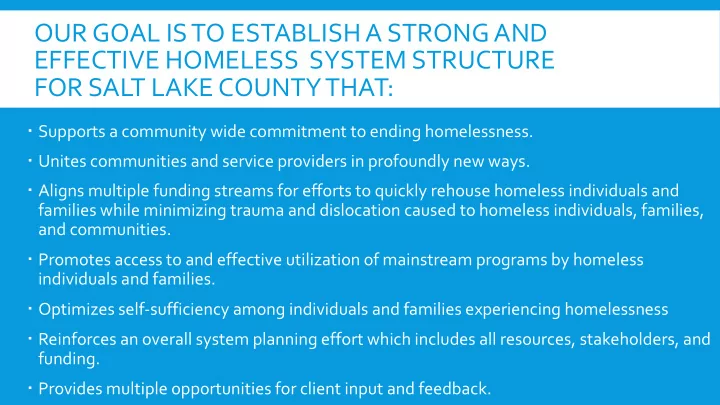
OUR GOAL IS TO ESTABLISH A STRONG AND EFFECTIVE HOMELESS SYSTEM STRUCTURE FOR SALT LAKE COUNTY THAT: Supports a community wide commitment to ending homelessness. Unites communities and service providers in profoundly new ways. Aligns multiple
Sets Vision & Priorities, Leads Effort to End Homelessness
Leads Task Groups
Works on Issues
Works on Issues
Works on Issues
Works on Issues
Offers Support & Data
Sets Vision & Priorities, Leads Effort to End Homelessness
Leads Task Groups
Works on Issues
Works on Issues
Works on Issues
Works on Issues
Offers Support & Data
Collaborative Applicant HMIS Lead Shelter The Homeless Other, as needed
Bridge between Task Groups & Primary Decision Making Group Take the information and data presented by task groups and make recommendations Meets Monthly Group consists of:
Leads from each task group Receives support from support agencies
Broad participation working on specific issues Identify information and data regarding issues Meets regularly or ad hoc Nonvoting members
Multiple representatives from each engaged stakeholder group Multiple representatives from agencies
Informs Primary Decision Making Group
Offer support and data at all levels of system
PDMG will be supported by (at least) one representative from (at least) two support agencies Advisory Committee will be supported by (at least) one representative from (at least) two support agencies Task groups will be supported by support agencies as needed
Hold MOUs with Primary Decision Making Group
Primary Decision Making Group - Board (Former Collective Impact & CoC Combined)
25-30 Voting Members Owns Effort to End Homelessness Sets Vision & Priorities
Advisory Committee
Lead from each Task Groups, Help Inform PDMG Data Action Task Group
Works on Issues
Prioritization Task Group
Works on Issues
Coordinated Entry Task Group
Works on Issues
Works on Issues
System Support Collaborative Applicant, HMIS Lead, STH, etc. Offers Support & Data
Coordinated Entry Mental Health Substance Use Disorder Youth Data Action DV & Families Education Communicat ions/Public Relations Outreach HUD Application PIT Affordable Housing Lived Experience Emergency Shelters/Reso urce Centers Trauma Informed Care Criminal Justice Training & Education Funders Etc. As needed Employment
Primary Decision Making Group Sets Vision & Priorities, Informs SHCC & key stakeholders of gaps and needs, facilitates requests for funding for substance abuse treatment Advisory Committee Leads from task groups discuss, strategize, and present for funding for substance abuse treatment Criminal Justice Task Group
Sees uptick in drug arrests
Outreach Task Group
Sees uptick in unsheltered
Substance Use Task Group
Sees Increase in waiting list for treatment
Emergency Shelters Task Group
Sees Decrease in number served
Support Agencies Offers Support & Data
Primary Decision Making Group Sets Vision & Priorities, Informs SHCC & key stakeholders of gaps and needs, facilitates requests for funding for substance abuse treatment Advisory Committee Leads from task groups discuss, strategize, and present for funding for substance abuse treatment Funders Task Group
Coordinates funding
Outreach Task Group
Sees uptick in unsheltered
Substance Use Task Group
Sees Increase in waiting list for treatment
Emergency Shelters Task Group
Sees Decrease in number served
Support Agencies Offers Support, Data Evaluation & Monitoring
Data Leadership Committee Task Group HMIS Steering Committee Allocation Task Group State Plan Task Group
State Homeless Coordinating Committee Salt Lake County System Mountainland System Balance of State System Utah, Wasatch, & Summit LHCC Davis LHCC Uinta LHCC Bear River LHCC Carbon & Emory LHCC San Juan LHCC Weber LHCC Tooele LHCC Washington LHCC Grand LHCC Six County LHCC Iron LHCC Salt Lake LHCC Support Agency
Present proposed structure at Collective Impact Steering Committee meeting (12/12) - DONE Update CoC Board and Membership (12/6 & 12/20) - DONE Accept new structure name proposals (12/20 – 1/14) – In Progress
Work group to finalize membership and structure details (1/3, 1/8, etc.) Update STH Board (1/9) Update CoC Board and Membership (1/3 & 1/17)
CoC Board & Membership vote on new structure (2/7 & 2/21) Update at Collective Impact Steering Committee meeting (2/13)
STH Board vote on new structure Transition to new structure
Launch new structure
Will the other groups (CoC, CI) still continue once this new structure is in place?
The new structure combines the strengths of each of these entities, which will no longer exist as they are currently structured.
What is the role of DWS-HCD?
DWS – HCD will be a support agency. Currently they are the HMIS Lead for all the CoCs in Utah. Shelter the Homeless may participate in task groups.
What is the role of Salt Lake County?
Salt Lake County will be a support agency. Currently they are the Collaborative Applicant for the CoC. Shelter the Homeless may participate in task groups.
What is the role of Shelter the Homeless?
Shelter the Homeless will be one of the support agencies for the new system. Currently, they are the support/staffing for CI. Shelter the Homeless may participate in task groups.
How is membership determined?
All stakeholders can become members and participate in one or more task group. Task Group members make nominations for voting members, who make up the Primary Decision Making Group. The Primary Members of the PDMG votes on new voting members.
How does my organization get involved?
Complete and submit the membership form indicating how the organization wants to be involved. The Primary Decision Making Group will accept nominations from Task Groups and also review membership applications to determine voting members.