
SLIDE 1
OUR GOAL IS TO ESTABLISH A STRONG AND EFFECTIVE HOMELESS SYSTEM - - PowerPoint PPT Presentation
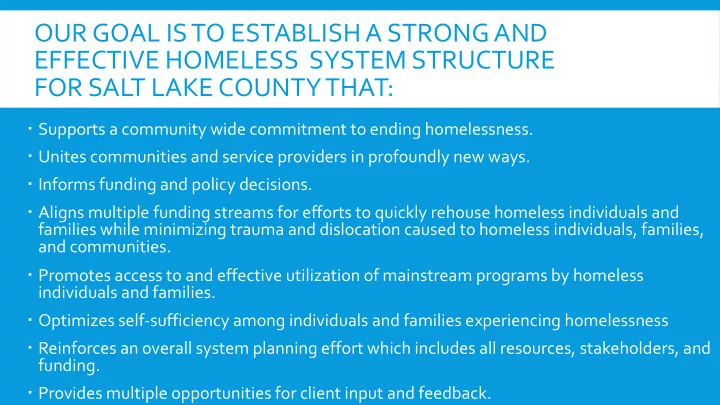
OUR GOAL IS TO ESTABLISH A STRONG AND EFFECTIVE HOMELESS SYSTEM STRUCTURE FOR SALT LAKE COUNTY THAT: Supports a community wide commitment to ending homelessness. Unites communities and service providers in profoundly new ways. Informs funding
Steering Committee 16 voting members , 4-6 advisory members
Health/Wellness Core Function Mental Health Task Group Physical Health *Substanc e Use Disorder Dental Care Terminally Ill/ Medically Frail Housing Core Function Affordable Rapid Re- housing Tiny /Shared Permanent Supportive Housing Location Assisted Living Transitional
Crisis Response Core Function
Resource Centers/ Shelter Food Security Diversion Client Intake Outreach Medical Respite First Responder s Education Core Function K-12 Higher Ed Early Childhood Technical & Vocational Training Employment Core Function Public & Private Employee Education / Training Community Engagement Core Function *Communi ty Councils City Governme nts Faiths Communica tions Legal Rights/Safety Core Function Legal Defenders Association *Criminal Justice Advisory Committee Public Safety Criminal Justice Services Policy & Funding Decision Makers: Government, STH Board, Private Funders Client Focused Core Function Human Trafficking *Youth Client Groups LGBTQ Veterans Families Domestic Violence Aging Data Action/ Research *HMIS *PIT Count Non-HMIS Data HUD Activities *Applicati
Group *Ranking Funding/ ESG, Etc. Best Practices Coordinat ed Entry Trauma Informed Care Housing First
Support Agencies
*Existing group
Policy & Funding Decision Makers: Government, STH Board, Private Funders Steering Committee (16 voting members) Advisors (4-6 ) Crisis Response Core Function Resources Centers/Emerge ncy Shelter Food Security Diversion Client Intake Outreach Medical Respite First Responders Housing Core Function Affordable Transitional Tiny/Shared Permanent Supportive Housing Location Assisted Living Health & Wellness Mental Health Physical Health Substance Use Disorder Dental Care Terminally Ill/Medically Frail Employment Core Function Public & Private Employee Education & Training Education Core Function Early Childhood K-12 Technical & Vocational Higher Ed Client Focus Core Function Aging Client Groups Domestic Violence Families Human Trafficking LGBTQ Veterans Youth Community Engagement Core Function City Governments Community Councils Faiths Safety/Legal Rights Core Functions Criminal Justice Advisory Committee Legal Defenders Assoc. Public Safety Support Agencies (STH, SLCo, DWS)
Best Practices
Coordinated Entry Housing First Trauma Informed Care
Data Action/ Research
HMIS Non-HMIS PIT Count
Funding Activities
HUD Application Ranking/Prio ritization ESG, etc. Communication Rapid Rehousing Criminal Justice Services
Data Leadership Committee Task Group HMIS Steering Committee Allocation Task Group State Plan Task Group Training Task Group
Policy & Funding Decision Makers: SHCC, Government, STH Board, Private Funders Salt Lake County System Mountainland System Balance of State System
Utah, Wasatch, & Summit LHCC Davis LHCC Uinta LHCC Bear River LHCC Carbon & Emory LHCC San Juan LHCC Weber LHCC Tooele LHCC Washington LHCC Grand LHCC Six County LHCC Iron LHCC Salt Lake LHCC Support Agency Support Agencies
Balanced decision making will be incorporated into the system's structure to ensure no one organization (or group
Checks and balances are incorporated into the system. Members, stakeholder groups, and representatives agree to uphold the system in function and in spirit. Those who have lived experiences of homelessness have a meaningful voice in the system. All stakeholders that can influence change should be involved and new organizations that can aid in ending homelessness will be invited to participate. Transparency in roles, responsibilities, decision making, and membership will be paramount; and all member
Continuity and flow of information will take place from Statewide to local level. Trauma informed care will be central to the actions of all stakeholders in the system. Trust will exist throughout every level of the system. Each member will trust that other stakeholders will operate with a commitment to the entire system. Data and informed conversations will flow throughout the system. All stakeholders will commit to accepting the consensus recommendations of the Coalition. All stakeholders will commit to the goal of ending AND preventing homelessness.