
SLIDE 1
Our Approach:
- J. N. Darby and
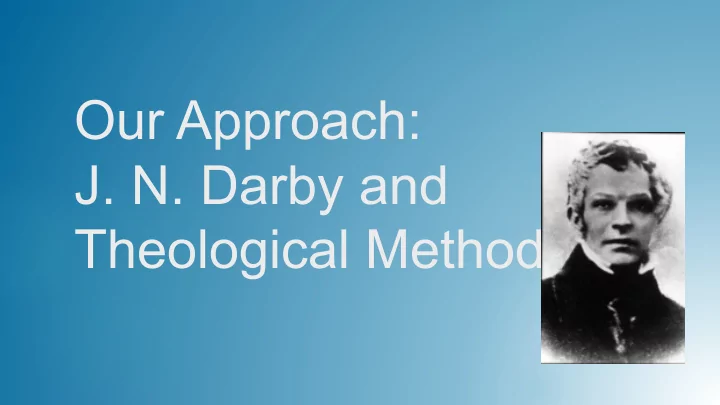
Our Approach: J. N. Darby and Theological Method Outline - - PowerPoint PPT Presentation
Our Approach: J. N. Darby and Theological Method Outline Overview: Materials, History, and Theological Method Sources for Darby Darbys Life On Theological Method Sources for Studying Darby Synopsis of the Books of the
Overview: Materials, History, and Theological
Method
Sources for Darby Darby’s Life On Theological Method
Synopsis of the Books of the Bible Collected Writings in 34 Volumes Collected Letters in 3 Volumes Notes and Comments in 7 Volumes Notes and Jottings All available from Bibletruthpublishers.com in
pdf format
Please Go to logos.com/communitypricing and
bid!
Larry V. Crutchfield, The Doctrine of the Ages and Dispensations as Found in
the Published Writings of John Nelson Darby (1800-1882). PhD Dissertation at Drew University, 1985
Larry E. Dixon, The Pneumatology of John Nelson Darby, PhD Dissertation,
1985 at Drew University by Larry E. Dixon
Floyd S. Elmore, A Critical Examination of the Doctrine of the Two Peoples of
God in John Nelson Darby –PhD Dissertation at DTS in 1991
Shin-An Deng, Ideas of the Church in an Age of Reform: The Ecclesiological
Thoughts of John Nelson Darby and John Henry Newman, 1824-1850, PhD Dissertation at University of Minnesota, 1994.
Paul Wilkinson, For Zion’s Sake: Christian Zionism and the Role of John
Nelson Darby, 2007
Born: London, 18 Nov 1800 Father: Irishman with title to Leap Castle in
Offaly, Ireland.
Mother: Daughter of Philadelphia sugar
plantation owner named Vaughn. Extremely successful family.
Christened in St. Martin’s Church,
Westminster 3 March 1801. Named after godfather Lord Horatio Nelson
1812 enrolled in Westminster public school. 1815 matriculated at Trinity College in Dublin
as a S.C. (fellow commoner)
1819 Graduated as a Classical Gold Medalist
and entered King’s Inn to study law, then Lincoln’s Inn in London
1822 called to Irish bar
“I was a lawyer; but, feeling that if the Son of God gave Himself for me, I owed myself entirely to Him and that the so-called Christian world was characterized by deep ingratitude towards Him, I longed for complete devotedness to the work of the Lord; my chief thought was to get round amongst the poor Catholics of Ireland.”
Not different from Reformed Theology on
Soteriology; Heavily Depended on Total Depravity
Emphasized Revision in Ecclesiology and
Eschatology
Three Distinct Actors:
GOD ISRAEL THE CHURCH
The body of authoritative truth for building a
Christian systematic theology is the Bible.
We would all agree that our theological
statements are not on par with the authority of the Scriptures.
Yet we would also agree that the Bible speaks
consistently within itself and addresses all of life.
These axiomatic convictions render a view of
systematic theology as an ongoing process, a task, and not a creed.
Michael Stallard’s “Level” Approach to the Task of ST is
a helpful way of arranging our thoughts in terms of authority and priority.
Level1: “Biblical Theology”—From Exegesis to
Biblical Theology
Level 2: Whole-Bible Integration Level 3: Categorization or Systematization Level 4: Interaction for Validation/Invalidation of
Extra-Biblical Truth Claims
Level 5: Application
0000000
Exegesis Biblical Theology Whole-Bible Integration Extra-Biblical Interaction Application
“Deeply convinced of the divine inspiration of the Scriptures, given to us of God, and confirmed in this conviction by daily and growing discoveries
more sensible, through grace, of the admirable perfection of the parts and the wonderful connection of the whole, the writer only hopes to help the reader in the study of them.” -- Synopsis of the Books of the Bible, Vol1 p8
Deeply convinced of the divine inspiration of the Scriptures, given to us of God, and confirmed in this conviction by daily and growing discoveries of their fullness, depth, and perfectness, ever more sensible, through grace, of the admirable perfection of the parts and the wonderful connection of the whole, the writer only hopes to help the reader in the study of them.
Deeply convinced
and confirmed in this conviction by daily and growing discoveries
ever more sensible, through grace,
The Scriptures have a living source, and living power has pervaded their composition: hence their infiniteness of bearing, and the impossibility of separating any one part from its connection with the whole, because one God is the living centre from which all flows;
and to which it refers, though in various glory; and one Spirit, the divine sap which carries its power from its source in God to the minutest branches of the all- united truth, testifying of the glory, the grace, and the truth of Him [Christ] whom God sets forth as the object and centre and head of all that is in connection with Himself, of Him who is, withal, God over all, blessed for evermore.
Literal (authorial-intent) interpretation of the
Bible
Literal fulfillment of OT prophecy Non-contradiction Typological meaning of OT narratives and
poetry in light of NT revelation
Millard Erickson, Baptist Evangelical
Theologian in Christian Theology
That doctrinal category which enables the
reader to interpret his system.
An unfortunate name, since we reserve
interpretation for “the meaning of a text.”
Proposal: “Central Integrative Motif”
Convalescence after a horse-riding accident Intense time of Bible reading, where “the
Scriptures gained full ascendancy”
Reading in Isaiah 32
The careful reading of the Acts afforded me a practical picture of the early church, which made me feel deeply the contrast with its actual present state, though still as ever, beloved by God. At that time I had to use crutches when moving about, so that I had no longer any
as the state of my health did not allow me to attend worship, I was compelled to remain away. It seemed to me that the good hand of God had thus come to my help, hiding my spiritual weakness under physical incapacity. In the meanwhile, there grew up in my heart the conviction that what Christianity had accomplished in the world in no way answered to the needs of a soul burdened with the sense of what God's holy governmental dealing was intended to effect.
In my retreat, the 32nd chapter of Isaiah taught me clearly, on God's behalf, that there was still an economy to come, of His ordering; a state of things in no way established as yet. The consciousness of my union with Christ had given me the present heavenly portion of the glory, whereas this chapter clearly sets forth the corresponding earthly part. I was not able to put these things in their respective places or arrange them in order, as I can now; but the truths themselves were then revealed of God, through the action
What was to be done? I saw in that word the coming of Christ to take the church to Himself in glory. I saw there the cross, the divine basis of salvation, which should impress its own character on the Christian and on the church in view of the Lord's coming; and also that meanwhile the Holy Spirit was given to be the source of the unity of the church, as well as the spring of its activity, and