Orthopaedic Surgery in patients with inhibitors: A Haematologists - - PowerPoint PPT Presentation

orthopaedic surgery in patients with inhibitors a
SMART_READER_LITE
LIVE PREVIEW

Orthopaedic Surgery in patients with inhibitors: A Haematologists - - PowerPoint PPT Presentation

Orthopaedic Surgery in patients with inhibitors: A Haematologists Perspective EHC Round Table Brussels, Belgum 27 th June 2017 Dr Steve Austin St Georges University Hospitals NHS Foundation Trust Guys and St Thomas NHS Foundation


slide-1
SLIDE 1

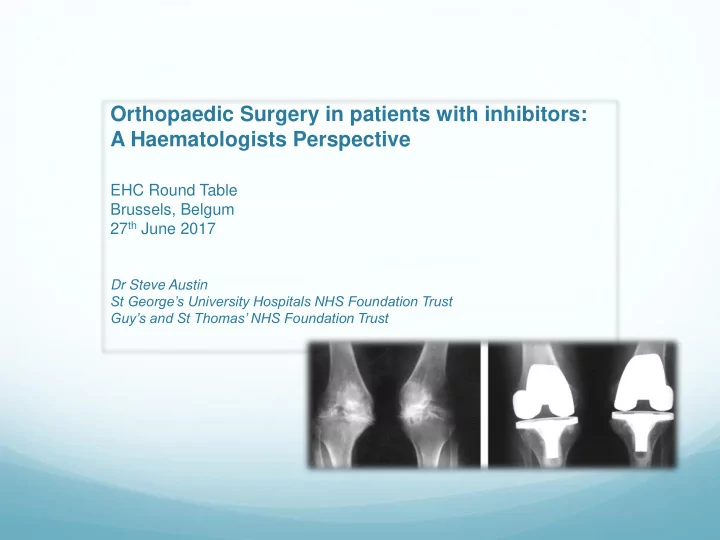
Orthopaedic Surgery in patients with inhibitors: A Haematologists Perspective

EHC Round Table Brussels, Belgum 27th June 2017

Dr Steve Austin St George’s University Hospitals NHS Foundation Trust Guy’s and St Thomas’ NHS Foundation Trust

slide-2
SLIDE 2

The South London Haemophilia Network

slide-3
SLIDE 3
  • Inhibitor development is the most

serious complication of congenital haemophilia

  • Life becomes challenging as bleeding

episodes can no longer be treated with FVIII replacement

  • Patients become dominated by risk of
  • difficult to control bleeding
  • arthropathy
  • delays to surgery
  • physical disability
  • Options for treatment are intense and

impact on quality of life Inhibitor development in Haemophilia : Patient Challenges

slide-4
SLIDE 4

Risk factors for Inhibitor Development

Patient-related

Severity of hemophilia F8 gene mutation Family history of inhibitor Ethnicity Polymorphisms of immune-response genes

Treatment-related

Number of exposure days Intensity of treatment Age at first exposure Type of FVIII concentrates Current infection or inflammatory state

Inhibitor development in Haemophilia : Risk factors

slide-5
SLIDE 5

Morfini et al, Haemophilia, 13:606-12 2007

Group A

Inhibitor (14-35y)

Group B

Inhibitor (36-65y)

Group C

No Inhibitor (14-35y)

A vs C Number of Patients n = 38 n = 41 n = 49 Age (years) 14-35 36-65 14-35 Inhibitor Status + +

  • Hospitalization for

Orthopaedic Procedures 16% 27% 4% Use of Wheelchairs 24% 22% 4% Need for Walking Aid 50% 51% 29% Pain Evaluation All Joints 3.89 (±3.26) 5.82 (±5.29) 2.27 (±2.67) P < .05 Clinical Examination 15.4 (±13.6) 23.2 (±11.6) 5.46 (±7.11) P < .05 Radiological Evaluation 27.8 (±19.6) 35.8 (±26.4) 19.3 (±12.4) P <.05

Orthopaedic Status of Haemophilia Patients With Inhibitors compared to non-inhibitor patients

slide-6
SLIDE 6

Leissinger et al, Blood 2001

Joint function (ankles, knees, ellbows) in 122 severe hemophiliacs (mean age 22.4 years) and 22 inhibitor patients (mean age 21.2 years)

Joint abnormalities [%]

2.3% 22.7%

Joint status in inhibitor patients Adolescents / Young adults Children

  • Joint ROM in 2378 severe haemophilic children (age 2-19 years)
  • n=186 with inhibitors >2-fold greater loss of ROM than non-inhibitor patients

Soucie et al, Blood 2004

slide-7
SLIDE 7

Morfini et al, Haemophilia, 13:606-12 2007

Group A: n = 38 severe haemophilia A, aged 14-35 years, with inhibitors >5 years Group B: n = 41 severe haemophilia A, aged 36-65 years, with inhibitors >5 years Group C: n = 49 severe haemophilia A, aged 14-35 years, without inhibitors >5 years

QoL - EQ-5D in Inhibitor Patients Compared With Noninhibitor Patients

slide-8
SLIDE 8

Morfini et al, Haemophilia, 13:606-12 2007

Joint Surgery in patients with Haemophilia and inhibitors

slide-9
SLIDE 9

Surgery in Haemophilia patients with inhibitors

Haemostatic control during orthopaedic surgery is one of the most challenging situations of haemophilia care

 For haemostatic control during surgery, two bypassing agents

exist in Europe:  FEIBA (Factor eight inhibitor bypass activity; Baxalta (now part of

Shire), Deerfield, IL, USA)

 Novo Seven (Novo Nordisk A/S, Bagsværd,Denmark)

have been used either separately or in parallel (combined or sequentially)

 A third Haemostatic agent exists in Japan (since Nov 2014)

 Byclot (Kaketsuken, Kumamoto, Japan)

 a complex concentrate of plasma-derived FVIIa and factor X (FX;

pd-FVIIa/FX)
slide-10
SLIDE 10

Bypassing agents

Recombinant FVIIa (Novoseven) (90-270 ug/kg)

Activated prothrombin complex concentrate (FEIBA)

 50-100 units/kg

(max 200 units /24 hours)

Both lead to thrombin generation on the platelet surface independent of FVIII

Management of Surgery with bypassing agents

slide-11
SLIDE 11

Bypassing agents: laboratory changes with thrombin generation

Negrier C, Dargaud Y & Bordet JC. Basic aspects of bypassing agents. Haemophilia (2006), 12(supp6):48-53

  • Ex-vivo studies of both bypassing

agents are unable to generate thrombin to the same level as non- inhibitor patients treated with FVIII

  • Unclear how much improvement in

thrombin generation is required to achieve clinical benefit

  • In many even a small improvement

may be sufficient

  • May account for significant intra –

and inter- individual variability in efficacy

aPCC rFVIIa

slide-12
SLIDE 12

 No laboratory surrogate marker to correlate with haemostatic efficacy  Haemostasis efficacy determined clinically  Variability in individual responses to agents

 limited predictors of efficacy

 Dosage, frequency not well defined  Duration of therapy not well defined  Agents infrequently used  Needs to be expert-lead  Requires significant resources  Nursing input  Multidisciplinary involvement  Expensive

Limitations of Bypassing Agents

slide-13
SLIDE 13

Quintana-Molina M, Martinez Bahamonde F, Gonzalez Garcia E, et al. Surgery in haemophilic patients with inhibitor: 20 years of experience. Haemophilia 2004;10 (supp 2) 30-40.

Efficacy of Bypassing Agents

Type of Study Product No of episodes Response Adverse events Retrospective FVIII 18 Good 100% None Retrospective aPCC 32 Good 96.9% (31/32) Bleeding Retrospective rFVIIa 14 Good 71.4% (10/14) Bleeding aPCC efficacy ranges from 64-90% rFVIIa efficacy ranges from 80-95%

slide-14
SLIDE 14

 19 Centres  35 surgical procedures  37.1% procedures described as ‘high risk’  Haemostasis control

 Good or excellent in 91.2% (31/34)  Fair in 8.8% (3/34)

“aPCC can be safely and effectively used when performing surgical procedures in Haemophilia A patients with inhibitors”

SURF Study: Surgical interventions with FEIBA

Negrier C, Lienhart A, Numerof R et al. SURgical interventions with FEIBA (SURF) : international registry of surgery in haemophilia patients with inhibitory antibodies. Haemophilia 2013; 19:e143-150

slide-15
SLIDE 15

FEIBA dosing for Major procedures:

75-100 U/kg preoperatively

75-100 U/Kg 8 hourly for days 1-7

75-100 U/kg 12 hourly for days 8-21

75-100 U/kg once a day for a week

75-100 U/kg alternate day for weeks 5-6

Consensus Recommendations for FEIBA use in Surgery

Haemophilia (2013), 19, 294–303

slide-16
SLIDE 16

Pre-OP Days 1-5 Days6-14

Minor Orthopedic (eg.arthoscopy) 90-120 ug/ kg 90–120 ug/kg q2 h x 4, then q3–6 h for 24 h Minor Non-orthopedic 90-120 ug/ kg 90–120 ug/kg q2 h x 4, then q3–6 h for 24 h 90 ug/kg 6hry (until repair) ? Major surgery 120 ug /kg 120 ug/kg q 3 h day 2/day 3-5 90-120 ug/kg 6 hrly

Rodriguez-Merchan et al., Haemophilia 2010; 16 84–8.

Dosage recommendations for rFVIIa in surgery

slide-17
SLIDE 17

rFVIIa in surgery : Using an intermittent pump device

slide-18
SLIDE 18

Antifibrinolytc therapy in surgery Tranexamic acid

  • Synthetic Lysine analogue
  • Blocks the lysine binding sites on

plasminogen and prevent activation to plasmin

  • The most favourable anti-fibrinolytic
  • Years of experience in bleeding

disorders

  • Mainly studied in Cardiac and
  • rthopaedic settings
slide-19
SLIDE 19

Increasing FVIII levels with porcine FVIII

  • Lower chance of cross-reactivity compared to

congenital haemophilia A pts

  • Good haemostatic efficacy in 78% of bleeds -

partial response 11%; no response in 9%.

(Morrison et al., Blood 1993)

  • Adverse events: allergic reactions,

thrombocytopenia, development of pFVIII antibodies

  • Plasma derived porcine FVIII no longer available;
  • Recombinant B-domain deleted porcine FVIII

(Obizur) now available

slide-20
SLIDE 20

Novel non-replacement therapies in Haemophilia

  • Novel non-replacement therapies may be useful as

surgical prophylaxis for inhibitor patients

  • ALN-AT3SC (Fitursiran) : an RNAi therapeutic

targeting the natural anticoagulant antithrombin

  • ACE910 (Emicizumab) bispecific monoclonal antibody

that mimics FVIII

  • Anti Tissue factor pathway inhibitor (TFPI)

Concizumab monoclonal antibody

  • Alternative bypassing agents
  • Factor Xa variants
  • Factor Va variants
slide-21
SLIDE 21

The Haemophilia Clinic

 Complications include:

 excessive/uncontrolled bleeding  death  poor wound healing  subsequent risk of infection  anamnestic response  thromboembolism/disseminated intravascular

coagulation

 increased cost of treatment

Complications of Surgery in Haemophilia patients with inhibitors

slide-22
SLIDE 22

The Haemophilia Clinic

 Complications include:

 excessive/uncontrolled bleeding  death  poor wound healing  subsequent risk of infection  anamnestic response  thromboembolism/disseminated intravascular

coagulation

 increased cost of treatment

Complications of Surgery in Haemophilia patients with inhibitors

slide-23
SLIDE 23

The Haemophilia Clinic

 Type of surgical procedure

 minor / major

 Patients inhibitor titre

 <5BU – FVIII replacement can be considered  >5BU – Bypassing agents are treatment of choice

 Patients anamnestic response  Patients usual response to bypassing agents  Patients comorbidities

 May affect response to therapies

Addressing bleeding risk in Haemophilia patients with inhibitors

slide-24
SLIDE 24

The Haemophilia Clinic

 A key step for the success of a major elective surgery in

inhibitor patients is excellent communication and collaboration:  patient  expert haematologist  experienced surgeon  anaesthetist  pharmacist  Nursing staff  laboratory staff  Specialist Physiotherapist

Multidisciplinary collaboration is paramount for successful surgery of Haemophilia patients with inhibitors

slide-25
SLIDE 25

Questions ??

Inhibitors are a challenge to all