Organizer in EAP courses Consultant Pete Sharma BALEAP April 2015 - - PDF document

organizer in eap courses
SMART_READER_LITE
LIVE PREVIEW

Organizer in EAP courses Consultant Pete Sharma BALEAP April 2015 - - PDF document

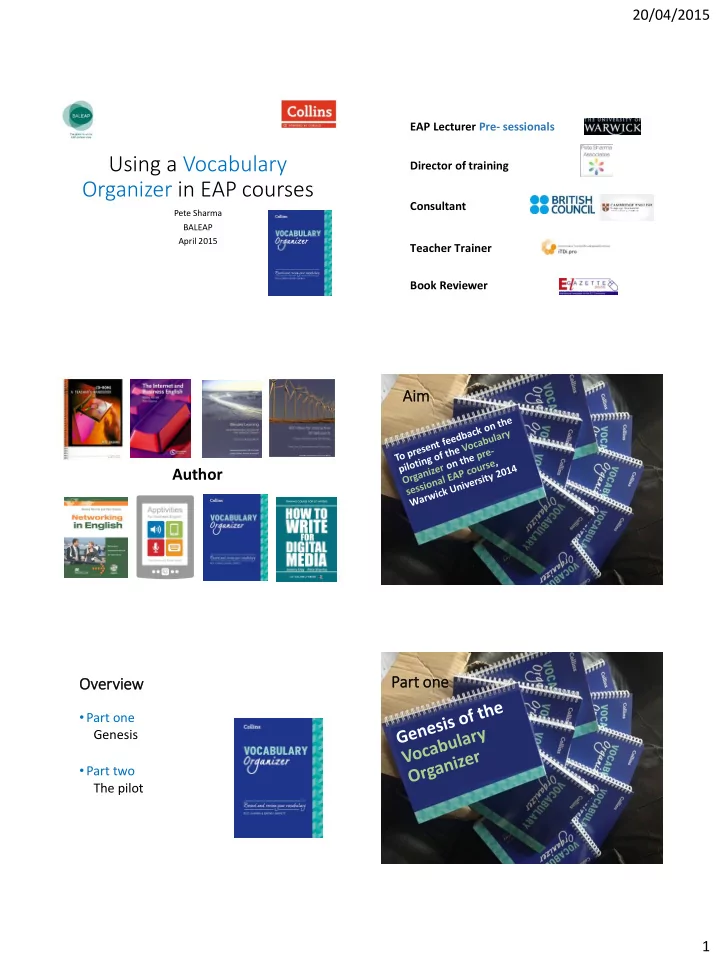
20/04/2015 EAP Lecturer Pre- sessionals Using a Vocabulary Director of training Organizer in EAP courses Consultant Pete Sharma BALEAP April 2015 Teacher Trainer Book Reviewer Aim Aim Author Part rt on one Overview Part one


slide-1
SLIDE 1

20/04/2015 1

Using a Vocabulary Organizer in EAP courses

Pete Sharma BALEAP April 2015

Teacher Trainer Book Reviewer Director of training EAP Lecturer Pre- sessionals Consultant

Author Aim Aim Overview

  • Part one

Genesis

  • Part two

The pilot

Part rt on

  • ne
slide-2
SLIDE 2

20/04/2015 2

A A br brie ief his history of Lexic xical No Notebooks

1990 1998 Red*** Red** Red* Black A1, A2, B1, B2 (CEFR) Oxford3000™ S1 / W3 ◊◊◊ ◊◊ ◊ No diamond

1980’s - electronic corpora Collins Birmingham University International Language Database (COBUILD)

Collins online dictionary

Band 5 – just over 700 Band 4 – just over 1000 Band 3 – just over 1500 Band 2 – just over 3000 Band 1 – just over 8000 No frequency tag – c. 17,900

Word Frequency

◊ ◊ ◊ ◊ ◊ ◊ Pre sessionals Word – translation

Photographer: Pete Sharma

Pre sessionals

“Write it in your lexical notebook!” “What’s that?”

slide-3
SLIDE 3

20/04/2015 3

14

Knowing ng a word Meaning Use Pronunciation Spelling Class/ form Connotation Collocations Register

Synonyms / antonyms

Etymology

The good language learner…. thinks about how they are learning is willing to experiment and take risks is independent - does not expect to learn English just by sitting in the classroom” is organised and active has insights into their preferred learning modality [VAK]

17

TWO PARTS

Vocabulary to use Vocabulary to recognise

18

Part one: bands 5,4,3,2 6,200+ Part two: band 1 / no frequency tag

slide-4
SLIDE 4

20/04/2015 4

19

PART ONE Word maps templates Key words Phrasal verbs / collocations / idioms

20

PART ONE Word maps templates Key words Phrasal verbs / collocations / idioms

21

PART ONE Word maps templates Key words Phrasal verbs / collocations / idioms

22

PART TWO

  • A-Z

Andy Ciordia / Creative Commons / www.flickr.com

“How do your students store their new words?”

writing down a word with the translation alphabetically, as in a dictionary in a diagram, e.g. a ‘word tree’ / 'mind-map' in lexical sets i.e. in groups of related words

  • n index-cards

(translation on back)

Index cards

Photographer: Pete Sharma

slide-5
SLIDE 5

20/04/2015 5

electronically spread-sheet app

My Wordbook British Council / CUP Quizlet OALD

26

No single ‘best way’ to record and review – all students are different ‘A’ system is better than ‘no system’ Using the Vocabulary Organizer encourages good practice!

To sum up….

Part two

The pilot

Photographer: Pete Sharma

Th The Pil Pilot

Vocabulary Organizer piloted in a five week course, August – September 2014, by four teachers Students given a feedback sheet with quantative and qualitative questions 79 feedback sheets collected Not all questions were answered

Data Q1: Did you enjoy using the V.O.?

5 10 15 20 25 30 35 Enjoyed a lot Enjoyed Somewhat Not much Not at all

  • Q1. Did you enjoy using the V.O.?
slide-6
SLIDE 6

20/04/2015 6

Q2: How often did you use your V.O.?

5 10 15 20 25 30 35 40 Every day Every few days Once a week

Q2 How often did you use your V.O.?

Q3: How useful was the V.O.?

5 10 15 20 25 30 35 40 Very useful Useful OK Not very Not at all

  • Q3. How useful was the V.O.?

Q4: Will you continue to use your V.O.?

5 10 15 20 25 30 35 40 Definitely Probably Not sure Probably not Definitely not

Will you continute to use your V.O?

Q5: Which sections did you use?

10 20 30 40 50 60 70 Word maps New words Phrasals Collocations Idioms Key words A-Z

  • Q5. Which sections did you use?

Q6: What should happen next year?

5 10 15 20 25 30 35 40 45 Issue to all students Issue to some students Students to buy their own

What should happen next year?

Com Comments

+

  • Useful (10)

Useful / very useful (3) Good (8) Could be smaller / more portable (5) App version (2) / electronic version (3) More examples (3) More space (7) More pages (8) Didn’t use (2) – don’t know how to More pages for new words (2)

slide-7
SLIDE 7

20/04/2015 7

Con Conclusions & recommendations (1/ 1/2)

Scope to develop a Teacher’s pack to supplement the Vocabulary Organiser with tasks - already developed during the pilot Feedback bears out the hypothesis that uptake is linked to learner training Link any future pilot to following students on in- sessionals to see if students continue to use it

Con Conclusions & & recommendations (2/ 2/2)

Upon reflection, many students not autonomous learners - would have appreciated more direction from teacher e.g. how to construct a word map which words to build word maps around I asked SS to bring books every Friday. In future, leave books in room weeks 1-2, & use every day

Th The fut uture More feedback? Build in changes? More adoptions?

41

Bibliography and further reading

Business English (LTP: 1990) Peter Wilberg & Michael Lewis English Collocations in Use Advanced (CUP: 2008) Felicity O'Dell & Michael McCarthy English LearnerNotebook (Enlano) Ken Goméz From corpus to classroom (CUP: 2007) Anne O'Keefe, Michael McCarthy and Ronald Carter Learning to Learn English (CUP: 2009) Gail Ellis and Barbara Sinclair Vocabulary Study Book (Garnet Education: 2007) Colin Campbell Vocabulary Matrix (Heinle Cengage Teaching: 2010) Michael McCarthy, Anne O'Keefe, Steve Walsh Word Knowledge (OUP: 2009) Cheryl Boyd Zimmerman Wordflo’ (Longman: 1998) Ellis,G. Acklam, R. Sinclair, B. Smith,S. & Smith,J.

predipsharma@gmail.com