OpenNF: Enabling Innovation in Network Function Control Aaron - - PowerPoint PPT Presentation

opennf enabling innovation in
SMART_READER_LITE
LIVE PREVIEW

OpenNF: Enabling Innovation in Network Function Control Aaron - - PowerPoint PPT Presentation

OpenNF: Enabling Innovation in Network Function Control Aaron Gember-Jacobson , Chaithan Prakash, Raajay Viswanathan, Robert Grandl, Junaid Khalid, Sourav Das, Aditya Akella 1 Network functions (NFs) Perform sophisticated stateful actions


slide-1
SLIDE 1

Aaron Gember-Jacobson, Chaithan Prakash, Raajay Viswanathan, Robert Grandl, Junaid Khalid, Sourav Das, Aditya Akella

1
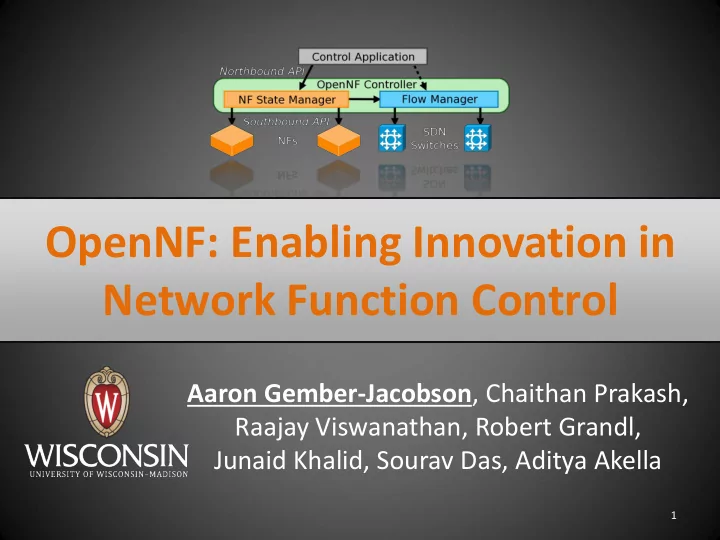
OpenNF: Enabling Innovation in Network Function Control

slide-2
SLIDE 2

Network functions (NFs)

  • Perform sophisticated stateful

actions on packets/flows

2

Intrusion detection system (IDS) Caching proxy WAN

  • ptimizer
slide-3
SLIDE 3

NF trends

  • NFV → dynamically allocate NF instances
  • SDN → dynamically reroute flows

Dynamic reallocation

  • f packet processing

3

Intrusion detection system (IDS) Caching proxy WAN

  • ptimizer

Xen/KVM

slide-4
SLIDE 4

Example: elastic NF scaling

  • 1. Satisfy performance SLAs
  • 2. Minimize operating costs
  • 3. Accurately monitor traffic

4

CPU Packet loss

slide-5
SLIDE 5

Example: elastic NF scaling

  • 1. Satisfy performance SLAs
  • 2. Minimize operating costs
  • 3. Accurately monitor traffic

5

CPU Packet loss

To simultaneously…

Problem: NFV+SDN is insufficient

Cannot effectively implement new services or abstractions!

slide-6
SLIDE 6

Why NFV + SDN falls short

  • 1. SLAs 2. Cost 3. Accuracy

Reroute new flows

[Stratos - arXiv:1305.0209]

Reroute existing flows

[SIMPLE - SIGCOMM ‘13]

Wait for flows to die

[Stratos - arXiv:1305.0209]

6

?

Packet loss SLA: <1%

slide-7
SLIDE 7

SLAs + cost + accuracy: What do we need?

  • Quickly move, copy, or share internal NF state

alongside updates to network forwarding state

  • Guarantees: loss-free, order-preserving, …

7

   … 1 2 3 …

Also applies to other scenarios

slide-8
SLIDE 8

Outline

  • Motivation and requirements
  • Challenges
  • OpenNF architecture

– State export/import – State operations – Guarantees

  • Evaluation

8

slide-9
SLIDE 9
  • 1. Supporting many NFs with minimal changes
  • 2. Dealing with race conditions
  • 3. Bounding overhead

Challenges

9

slide-10
SLIDE 10

OpenNF overview

10

NF State Manager Flow Manager

OpenNF Controller

Control Application

move/copy/share state export/import State

slide-11
SLIDE 11

State created or updated by an NF applies to either a single flow or a collection of flows

NF state taxonomy

11

Connection Connection TcpAnalyzer HttpAnalyzer TcpAnalyzer HttpAnalyzer

Per-flow state

ConnCount

Multi-flow state All-flows state

Statistics

slide-12
SLIDE 12

NF API: export/import state

  • Functions: get, put, delete

12

No need to expose/change internal state organization! Filter

Per Multi All

Scope NF get put

slide-13
SLIDE 13

Control operations: move

13

NF State Manager Control Application

move (port=80, Bro1, Bro2) get(per, port=80) [Chunk1] put (per, Chunk1) del(per, port=80) [Chunk2] put (per, Chunk2) forward(port=80, Bro2)

Flow Manager Bro2 Bro1 Also provide copy and share

slide-14
SLIDE 14

detect- MHR

  • Split/Merge [NSDI ‘13]: pause traffic, buffer packets

– Packets in-transit when buffering starts are dropped

Lost updates during move

14

B1 R1 R2 R2

Missing state

Bro2 Bro1

move(red,Bro1 ,Bro2 ) Missing updates

Loss-free: All state updates should be reflected in the transferred state, and all packets should be processed

R3

slide-15
SLIDE 15

NF API: observe/prevent updates using events

15

Only need to change an NF’s receive packet function!

R1

NF

slide-16
SLIDE 16
  • 1. enableEvents(red,drop) on Bro1
  • 2. get/delete on Bro1
  • 3. Buffer events at controller
  • 4. put on Bro2
  • 5. Flush packets in

events to Bro2

  • 6. Update

forwarding

Use events for loss-free move

16

Bro2 Bro1

R3 R1 Drop R1 R1,R2 R2 R2 R1,R2,R3

slide-17
SLIDE 17
  • False positives from Bro’s weird script

Re-ordering of packets

17

Order-preserving: All packets should be processed in the order they were forwarded by the switch

Controller Switch Bro2

  • 5. Flush buffer
  • 6. Request

forwarding update Bro1

R2 R2 R4 R3 R3 R3 R2 R4 R3 R3

slide-18
SLIDE 18
  • 1. Dealing with diversity
  • 2. Dealing with race conditions

OpenNF: SLAs + cost + accuracy

18

Export/import state based

  • n its association with flows

Events Lock-step forwarding updates

+

slide-19
SLIDE 19

Implementation

  • Controller (3.8K lines of Java)
  • Communication library (2.6K lines of C)
  • Modified NFs (3-8% increase in code)

19

Bro IDS iptables Squid Cache PRADS

slide-20
SLIDE 20

Overall benefits for elastic scaling

  • Bro IDS processing 10K pkts/sec

– At 180 sec: move HTTP flows (489) to new IDS – At 360 sec: move back to old IDS

  • SLAs: 260ms to move (loss-free)
  • Accuracy: same log entries as using one IDS

– VM replication: incorrect log entries

  • Cost: scale down after state is moved

– Stratos: scale down delayed 25+ minutes

20

[arXiv:1305.0209]

slide-21
SLIDE 21

Evaluation: state export/import

21

Serialization/deserialization costs dominate Cost grows with state complexity

slide-22
SLIDE 22

50 100 150 200 Average Maximum

Per-packet Latency Increase (ms)

100 200 300 400 500 NG NG PL LF PL+ER

Move Time (ms)

  • PRADS asset detector processing 5K pkts/sec
  • Move per-flow state for 500 flows

Evaluation: operations

22

Packets dropped! 686 462 881 packets in events

Operations are efficient, but guarantees come at a cost!

1120 pkts buffered 838 pkts in events + Bro: 5% of alerts missed!

NG NG PL LF PL+ER OP PL+ER

slide-23
SLIDE 23
  • Dynamic reallocation of packet

processing enables new services

  • Realizing SLAs + cost + accuracy requires

quick, safe control of internal NF state

  • OpenNF provides flexible and efficient

control with few NF modifications

Conclusion

23

http://opennf.cs.wisc.edu

slide-24
SLIDE 24

Backup

  • Related work
  • Copy and share
  • Order-preserving move
  • Bounding overhead
  • Example control application
  • Evaluation: controller scalability
  • Evaluation: importance of guarantees
  • Evaluation: benefits of granular control

24

slide-25
SLIDE 25
  • Virtual machine replication

– Unneeded state → incorrect actions – Cannot combine → limited reallocation

  • Split/Merge [NSDI’13]

– State allocations and accesses occur via library – Addresses a specific problem → limited suitability – Packets may be dropped or re-ordered → wrong NF behavior

25

Existing approaches

slide-26
SLIDE 26

Copy and share operations

  • Used when multiple instances need some state
  • Copy – no or eventual consistency

– Once, periodically, based on events, etc.

  • Share – strong or strict consistency

– Events are raised for all packets – Events are released

  • ne at a time

– State is copied before releasing the next event

26

Copy (multi-flow): 111ms Share (strong): 13ms/packet

slide-27
SLIDE 27
  • Flush packets in events to Inst2
  • enableEvents(blue,buffer) on Inst2
  • Forwarding update: send to Inst1 & controller
  • Wait for packet from

switch (remember last)

  • Forwarding update:

send to Inst2

  • Wait for event

for last packet from Inst2

  • Release buffer of packets on Inst2

Order-preserving move

27

B1 Drop B1 B1,B2 B2 B1,B2, B3 Buf B3 B3 B3 B4 B1,B2, B3,B4

slide-28
SLIDE 28

Applications decide (based on NF & objectives):

  • 1. Granularity of
  • perations
  • 2. Guarantees

desired

Bounding overhead

28

Filter Per Multi All Scope

   …

LF LF+OP

1 2 3 …    …

+ None

slide-29
SLIDE 29

Example app: elastic NF scaling

movePrefix(prefix,oldInst,newInst): copy(oldInst,newInst,{nw_src:prefix},multi) move(oldInst,newInst,{nw_src:prefix},per,LF+OP) while (true): sleep(60) copy(oldInst,newInst,{nw_src:prefix},multi) copy(newInst,oldInst,{nw_src:prefix},multi)

scan.bro vulnerable.bro weird.bro

29

slide-30
SLIDE 30

Evaluation: controller scalability

Improve scalability with P2P state transfers

30

slide-31
SLIDE 31

Evaluation: importance

  • f guarantees
  • Bro1 processing malicious trace @ 1K pkts/sec
  • After 14K packets: move active flows to Bro2

Alert Baseline NF LF LF+OP Incorrect file type 26 25 24 26 MHR Match 31 28 27 31 MD5 116 111 106 116 Total 173 164 157 173

slide-32
SLIDE 32

Evaluation: benefits

  • f granular control
  • HTTP requests from 2 clients (40 unique URLs)
  • Initially: both go to Squid1
  • 20s later: reassign Client1 to Squid2

Ignore Copy-client Copy-all Hits @ Squid1 117 117 117 Hits @ Squid2 Crash! 39 50 State transferred 0 MB 4 MB 54 MB