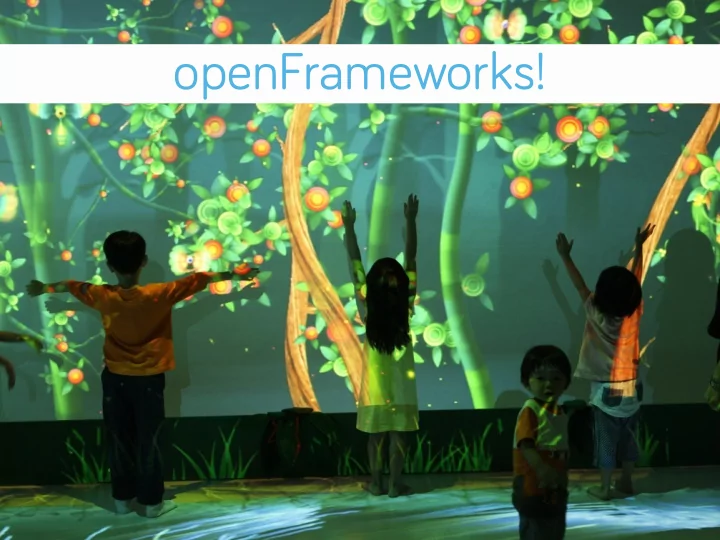
SLIDE 2
What is openFrameworks?
SLIDE 3
- oF is a software framework for C++
- Software framework: a prefab software infrastructure
designed to provide low-level functionality
What is openFrameworks?
SLIDE 4
SLIDE 5
How do I make a new project?
SLIDE 6 Part 1: Copy emptyExample
SLIDE 7 Part 2: Make a new folder in “apps” and paste it there
(Your project must be exactly three levels below your base oF folder!) base folder level 1 level 2 level 3
SLIDE 8 Part 3: Open the project
SLIDE 9
Can I take notes in my code?
SLIDE 10
SLIDE 11
SLIDE 12
- DO IT.
- Seriously, do it.
- Use two forward slashes (//) for a one-line comment.
- You can also do multi-line comments:
- Preface your comment with slash-asterisk (/*)
- End it with asterisk-slash (*/)
Commenting Code
SLIDE 13
SLIDE 14
What’s going on in testApp.cpp?
SLIDE 15
void testApp::setup() {}
SLIDE 16
void testApp::update() {}
SLIDE 17
void testApp::draw() {}
SLIDE 18
RUN SETUP UPDATE DRAW
SLIDE 19
SLIDE 20 Main oF Functions
- setup(): runs just once when the app starts
- Good place to set initial values for variables, e.g.
playerHealth = 100;
- update(): runs once per frame, before draw()
- Good place for number-crunching, e.g. playerHealth -
= 1;
- draw(): runs once per frame, after update()
- Where you should put all your drawing, e.g.
player.draw();
SLIDE 21
Listeners
SLIDE 22 Other oF Functions
- oF will listen for certain events, and when they
happen, it will run whatever code is in the corresponding event
- E.g. keyPressed() runs at the moment that a key is
pressed (not held!)
SLIDE 23
How do I draw stuff?
SLIDE 24
SLIDE 25
- Function: a named section of a program that does a
specific task
- Wraps up code in an easy-to-reference way
- Parameter: additional information you can give the
function to change the output
Functions
SLIDE 26
Bake me a chocolate cake! Baking a cake: the action Chocolate: additional info that affects the action
SLIDE 27
- Name of the function
- Parentheses: delinate that it’s a function, hold
arguments
- Semicolon: end of line, move onto the next thing
Function Structure
bake_me_a_cake(chocolate);
SLIDE 28
Wait, that doesn’t answer my question about drawing stuff!
SLIDE 29 Drawing Shapes
Function Notes
x and y are at center by default
- fRect(x, y, width, height);
x and y are at upper-left corner by default
- fLine(x1, y1, x2, y2);
- fTriangle(x1, y1, x2, y2, x3,
y3);
SLIDE 30
Compare the function with what’s inside it. Which would you rather type?
SLIDE 31 Coloring Shapes
Function Notes
Fill all following shapes with a color.
Don’t fill the following shapes.
Sets the color to be used on all following shapes. Each value goes from 0-255.
SLIDE 32
Exercise: Try drawing some stuff! (Where would you put this code?)
SLIDE 33
How does positioning work?
SLIDE 34
SLIDE 35 X=0 x=WIDTH y=0 y=HEIGHT
SLIDE 36 X=0 x=WIDTH y=0 y=HEIGHT
(3,2)
SLIDE 37 Coordinate Plane
- X: horizontal axis, gets larger as you go right
- Y: vertical axis, gets larger as you go down
SLIDE 38
Question: How would you draw a circle at x-position 9, y-position 15? If you drew another circle at y-position 25, would it be higher or lower than the first circle? Hint: if you don’t know, try drawing it!
SLIDE 39
How can I incorporate interactivity?
SLIDE 40 Mouse Positions
- Variable: a symbol used to stand in for a value
- mouseX: returns the current x pixel position of the
mouse
- mouseY: returns the current y pixel position of the
mouse
SLIDE 41
Exercise: Try drawing a circle at mouseX and mouseY!
SLIDE 42 Variables
- Variables are useful for storing data that may change
throughout the course of your app (e.g. your player’s health)
- To create a variable, you have to tell the computer:
- What kind of data you’re storing (a number? a
word?)
- The name you’re going to refer to it by
SLIDE 43 Some Variable Types
- Float: a decimal number (“I’m 5.4 feet tall.”)
- Integer: a whole number (“I’m 25 years old.”)
- Boolean: a true/false condition (“I’m not from
California.”)
- String: text (“My name is Jane.”)
- Char: a single letter (“You all get an A in
programming!”)
SLIDE 44
float jane_height; the type of data (datatype) the variable’s name
SLIDE 45
jane_height = 5.4; the value of that variable the variable’s name
SLIDE 46 How can I make stuff move on its
SLIDE 47
Movement
If our object starts at x=1, at time=0, and moves at a speed of 1 frame/sec, what will x equal at time=1? How do you know?
SLIDE 48 Movement
x will equal 1! Its current position (0) + the total distance it will go over
= 1!
SLIDE 49 Movement
New position = old position + speed
SLIDE 50
Exercise: Try drawing a circle that moves vertically down the screen. Hint: you’ll want a variable to hold the circle’s position. (Why?)
SLIDE 51
How can I test for collisions?
SLIDE 52
Collision: when one point is less than a certain distance from another point.
SLIDE 53 radius
radius
Have these circles collided yet?
SLIDE 54 radius
radius
How about now?
SLIDE 55 Circle Collision
radius
radius
- If the distance between the center-points of the circles
is less than or equal to the sum of their radii, they have collided!
- You can calculate distance in openFrameworks with
- fDist(x1, y1, x2, y2).
SLIDE 56 Circle Collision
- If the distance between the center-points of the circles
is less than or equal to the sum of their radii, they have collided!
- You can calculate distance in openFrameworks with
- fDist(x1, y1, x2, y2).
radius
radius
SLIDE 57
How can I check whether something is true?
SLIDE 58
If I’m hungry, then I’ll eat.
SLIDE 59 If-statements
- Consist of a condition and an action to take.
- Can have alternatives (if-else) and can put if-
statements inside of if-statements, too!
If I’m hungry, then I’ll eat. if (hungry) { eat(); } General syntax: if (condition) { action to take }
SLIDE 60 If-statements
- Consist of a condition and an action to take.
- Can have alternatives (if-else) and can put if-
statements inside of if-statements, too!
If I’m hungry, then I’ll eat. if (hungry) { eat(); } If I’m hungry, then I’ll eat. Otherwise, I’ll dance! if (hungry) { eat(); } else { dance(); } If I’m hungry, then I’ll eat. If I’m hungry and in the mood for pizza, I’ll get pizza. Otherwise, I’ll dance! if (hungry) { if (want_pizza) { eat(pizza); } else { eat(something_else); } } else { dance(); }
SLIDE 61
How can I incorporate images, sounds, fonts, etc.?
SLIDE 62 Images
- ofImage: a built-in object that handles the loading and
drawing of images
- Must put the file inside “data” folder of project!
- Three steps:
- Create your image variable: ofImage image;
- Load your image file: image.loadImage(“image.png”);
- Draw your image: image.draw(x, y);
SLIDE 63 Fonts
- ofTrueTypeFont: a built-in object that handles the loading
and drawing of fonts
- Must put the file inside “data” folder of project!
- Three steps:
- Create your font variable: ofTrueTypeFont font;
- Load your image file: font.loadFont(“font.ttf”, size);
- Draw your words: font.drawString(string, x, y);
SLIDE 64 Sounds
- ofSoundPlayer: a built-in object that handles the loading
and playing of sounds
- Must put the file inside “data” folder of project!
- Three steps:
- Create your font variable: ofSoundPlayer sound;
- Load your image file: sound.loadSound(“sound.mp3”);
- Play your sound: sound.play();