Open data provenance and reproducibility: a case study from - - PowerPoint PPT Presentation

open data provenance and reproducibility a case study
SMART_READER_LITE
LIVE PREVIEW

Open data provenance and reproducibility: a case study from - - PowerPoint PPT Presentation

Open data provenance and reproducibility: a case study from publishing CMS open data Tibor Simko 1 Heitor Pascoal de Bittencourt 2 Edgar Carrera 2 Clemens Lange 2 Kati Lassila-Perini 2 Lara Lloret 2 Tom McCauley 2 Jan Okraska 1 Daniel


slide-1
SLIDE 1

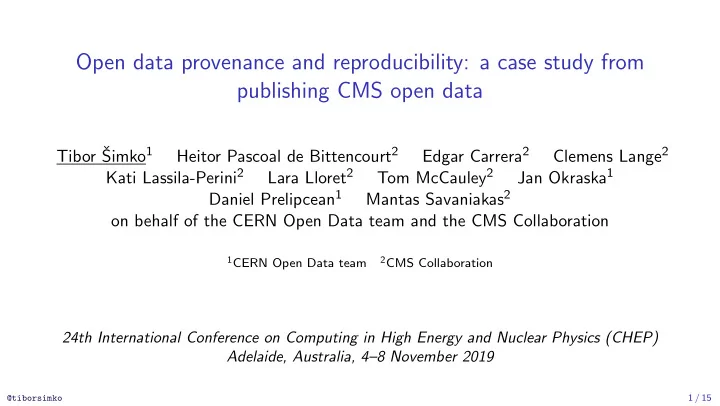
Open data provenance and reproducibility: a case study from publishing CMS open data

Tibor ˇ Simko1 Heitor Pascoal de Bittencourt2 Edgar Carrera2 Clemens Lange2 Kati Lassila-Perini2 Lara Lloret2 Tom McCauley2 Jan Okraska1 Daniel Prelipcean1 Mantas Savaniakas2

  • n behalf of the CERN Open Data team and the CMS Collaboration

1CERN Open Data team 2CMS Collaboration

24th International Conference on Computing in High Energy and Nuclear Physics (CHEP) Adelaide, Australia, 4–8 November 2019

@tiborsimko 1 / 15

slide-2
SLIDE 2

CERN Open Data

◮ launched in November 2014 ◮ rich content

◮ collision and simulated datasets for research ◮ derived datasets for education ◮ configuration files and documentation ◮ virtual machines and container images ◮ software tools and analysis examples

◮ total size in November 2019

◮ over 7’000 bibliographic records ◮ over 800’000 files ◮ over 2 petabytes

http://opendata.cern.ch

Developed by CERN-IT in close collaboration with Experiments

@tiborsimko 2 / 15

slide-3
SLIDE 3

Education-oriented use cases

Interactive event display and histogramming for derived datasets

@tiborsimko 3 / 15

slide-4
SLIDE 4

Research-oriented use cases

Run CernVM Virtual Machines Run realistic physics analysis examples

@tiborsimko 4 / 15

slide-5
SLIDE 5

Enables independent theoretical research

Over twenty papers citing CMS open data

arXiv:1704.05066 arXiv:1807.11916 arXiv:1902.04222

Searches, QCD jet studies, Machine Learning. . . . . . that the CMS collaboration start to cite!

@tiborsimko 5 / 15

slide-6
SLIDE 6

New CMS open data release

Latest batch of CMS open data was released in Summer 2019

@tiborsimko 6 / 15

slide-7
SLIDE 7

Example 1: Data provenance of simulated datasets

◮ full capture of data generation steps ◮ full capture of compute environments ◮ full capture of configuration files ◮ full capture of production scripts

Data records come with full provenance information

@tiborsimko 7 / 15

slide-8
SLIDE 8

Capturing data provenance via ad-hoc curation techniques

Dedicated data curation scripts CMS DAS CMS McM Mining several CMS collaboration sources

@tiborsimko 8 / 15

slide-9
SLIDE 9

Harmonising year-dependent sources

From year-dependent DAS/McM information to year-independent Open Data JSON schema

@tiborsimko 9 / 15

slide-10
SLIDE 10

Example 2: Raw data samples for 2010-2012 data

RAW AOD

@tiborsimko 10 / 15

slide-11
SLIDE 11

Can we reprocess raw data samples from 2010-2012?

Workflow steps to run CMS reconstruction in CMSSW environment

@tiborsimko 11 / 15

slide-12
SLIDE 12

Running scientific workflows on containerised clouds

◮ REANA reproducible analysis platform http://www.reana.io ◮ multiple workflow systems (CWL, Serial, Yadage) ◮ multiple compute backends (Kubernetes, HTCondor, Slurm) ◮ multiple shared storage (Ceph, EOS, NFS)

reproducibility

code + data + environment + workflow

@tiborsimko 12 / 15

slide-13
SLIDE 13

Preserving CMS software stack environment

CMSSW docker image with “embedded” CVMFS Condition data for open data analyses are available on “live” CVMFS

@tiborsimko 13 / 15

slide-14
SLIDE 14

Automated reconstruction workflows

dataset=Jet year=2011A 1 input parameters ↓ 2 workflow factory → 3 reana.yaml → 5 serving open data files ↓ 4 run by REANA platform → 6 output histograms Parametrised workflow runnable on REANA reproducible analysis platform

@tiborsimko 14 / 15

slide-15
SLIDE 15

Conclusions

CMS open data now contains detailed provenance information ◮ knowing “how the data came about” enhances current knowledge and future reuse ◮ capturing data provenance requires non-trivial information hunt and harmonisation ◮ a posteriori approach: running after ∼5 year old data and procedures ◮ a priori approach: ultra legacy run to generate preservation-friendly assets? Successful RAW to AOD reconstruction tests on open data ◮ AOD reconstruction and histogram verification permitted to validate approach ◮ using non-production compute environment ensures reproducibility http://opendata.cern.ch

@tiborsimko 15 / 15