
SLIDE 1
Open Access – a battle of words
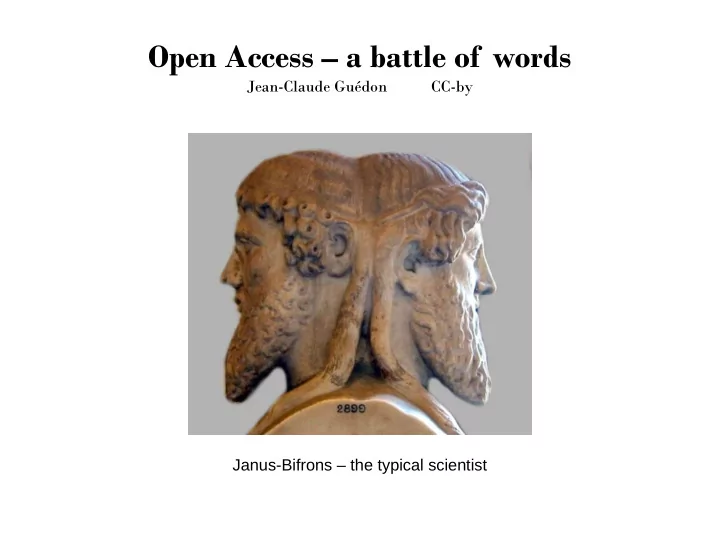
Jean-Claude Guédon CC-by Janus-Bifrons – the typical scientist
Open Access a battle of words Jean-Claude Gudon CC-by - - PowerPoint PPT Presentation
Open Access a battle of words Jean-Claude Gudon CC-by Janus-Bifrons the typical scientist Open Access a battle of words Jean-Claude Gudon CC-by The researcher-bifrons Seeks information Produces
Open Access – a battle of words
Jean-Claude Guédon CC-by Janus-Bifrons – the typical scientist
Open Access – a battle of words
Jean-Claude Guédon CC-by
The researcher-bifrons
➢ Seeks information ➢ Produces information
Open Access – a battle of words
Jean-Claude Guédon CC-by
Searching leads (almost) anywhere
Open Access – a battle of words
Jean-Claude Guédon CC-by However, producing knowledge is also associated with showing oneself
Open Access – a battle of words
Jean-Claude Guédon CC-by Our researcher-Janus is not symmetrical
Open Access – a battle of words
Jean-Claude Guédon CC-by
The researcher needs: The researcher needs:
Open Access – a battle of words
Jean-Claude Guédon CC-by
At this stage, new players are clearly needed:
Open Access – a battle of words
Jean-Claude Guédon CC-by
Until the Second World War, the situation was relatively clear:
their researchers needed most;
works in their field;
dissemination.
Open Access – a battle of words
Jean-Claude Guédon CC-by
Thanks to librarians, research was:
Thanks to editors, their research was
Open Access – a battle of words
Jean-Claude Guédon CC-by
After the Second World War, the whole situation changed: Commercial publishers became dominant Many scientific societies lost their importance (but some very large ones did not) The Science Citation Index (Eugene Garfield) helps create an inelastic market for some journals
Open Access – a battle of words
Jean-Claude Guédon CC-by
Commercial publishers compete for market share They compete to sell journal subscriptions, not to individuals, but to libraries As a result, they need to reorganize the production of knowledge to align it on their commercial objectives To this end, they need to create a form of competition among researchers that is governed by journals, not fellow researchers
Open Access – a battle of words
Jean-Claude Guédon CC-by
The solution? The Impact Factor Journals can be ranked The ranking is wrongly assimilated to quality Researchers are being judged by where they publish (not what they publish)
Open Access – a battle of words
Jean-Claude Guédon CC-by
The new situation means:
librarians and access is limited)
publishers monopolize them)
defined and constrained by publishers)
prestigious (and publishers emphasize prestige and create it with journals)
editors.
Open Access – a battle of words
Jean-Claude Guédon CC-by
Open Access – a battle of words
Jean-Claude Guédon CC-by
Open Access – a battle of words
Jean-Claude Guédon CC-by
Open Access signalled a desire among researchers to recover some control over their communication system
Open Access – a battle of words
Jean-Claude Guédon CC-by
From this point on, a contest has developed between researchers, librarians and publishers (particularly the large, commercial, publishers)
Open Access – a battle of words
Jean-Claude Guédon CC-by
Recently, this contest has been fought around a few words:
Open Access – a battle of words
Jean-Claude Guédon CC-by
Open Access – a battle of words
Jean-Claude Guédon CC-by
Let us go back to these terms:
Open Access – a battle of words
Jean-Claude Guédon CC-by
The scholarly publishing market is an ‘intermediated market’
Open Access – a battle of words
Jean-Claude Guédon CC-by
“...market forces are unlikely to deliver either widespread open access, or a competitive and sustainable market.” (p. 53) !!!!!!!
Open Access – a battle of words
Jean-Claude Guédon CC-by
Finally: Sustainable... What does it mean? For whom?
Open Access – a battle of words
Jean-Claude Guédon CC-by