Ontology matching tutorial J er ome Euzenat Pavel Shvaiko - - PowerPoint PPT Presentation

ontology matching tutorial
SMART_READER_LITE
LIVE PREVIEW

Ontology matching tutorial J er ome Euzenat Pavel Shvaiko - - PowerPoint PPT Presentation

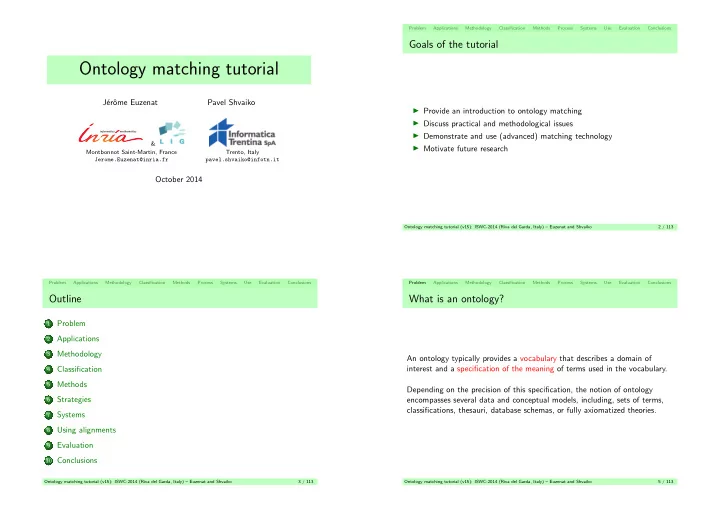
Problem Applications Methodology Classification Methods Process Systems Use Evaluation Conclusions Goals of the tutorial Ontology matching tutorial J er ome Euzenat Pavel Shvaiko Provide an introduction to ontology matching


slide-1
SLIDE 1

Ontology matching tutorial

J´ erˆ

  • me Euzenat

Pavel Shvaiko

& Montbonnot Saint-Martin, France Trento, Italy Jerome.Euzenat@inria.fr pavel.shvaiko@infotn.it

October 2014

Problem Applications Methodology Classification Methods Process Systems Use Evaluation Conclusions

Goals of the tutorial

◮ Provide an introduction to ontology matching ◮ Discuss practical and methodological issues ◮ Demonstrate and use (advanced) matching technology ◮ Motivate future research

Ontology matching tutorial (v15): ISWC-2014 (Riva del Garda, Italy) – Euzenat and Shvaiko 2 / 113 Problem Applications Methodology Classification Methods Process Systems Use Evaluation Conclusions

Outline

1

Problem

2

Applications

3

Methodology

4

Classification

5

Methods

6

Strategies

7

Systems

8

Using alignments

9

Evaluation

10 Conclusions

Ontology matching tutorial (v15): ISWC-2014 (Riva del Garda, Italy) – Euzenat and Shvaiko 3 / 113 Problem Applications Methodology Classification Methods Process Systems Use Evaluation Conclusions

What is an ontology?

An ontology typically provides a vocabulary that describes a domain of interest and a specification of the meaning of terms used in the vocabulary. Depending on the precision of this specification, the notion of ontology encompasses several data and conceptual models, including, sets of terms, classifications, thesauri, database schemas, or fully axiomatized theories.

Ontology matching tutorial (v15): ISWC-2014 (Riva del Garda, Italy) – Euzenat and Shvaiko 5 / 113

slide-2
SLIDE 2

Problem Applications Methodology Classification Methods Process Systems Use Evaluation Conclusions

Various forms of ontologies

Terms ‘Ordinary’ glossaries Ad hoc hierarchies Data dictionaries Thesauri Structured glossaries XML DTDs Principled, informal hierarchies Database schemas XML schemas Entity- relationship models Formal taxonomies Frames Description logics Logics expressivity Glossaries and data dictionaries Thesauri and taxonomies Metadata and data models Formal

  • ntologies

adapted from [Uschold and Gruninger, 2004]

Ontology matching tutorial (v15): ISWC-2014 (Riva del Garda, Italy) – Euzenat and Shvaiko 6 / 113 Problem Applications Methodology Classification Methods Process Systems Use Evaluation Conclusions

Being serious about the semantic web

◮ It is not one guy’s ontology. ◮ It is not several guys’ common ontology. ◮ It is many guys and girls’ many ontologies. ◮ So it is a mess, but a meaningful mess.

Ontology matching tutorial (v15): ISWC-2014 (Riva del Garda, Italy) – Euzenat and Shvaiko 7 / 113 Problem Applications Methodology Classification Methods Process Systems Use Evaluation Conclusions

Living with heterogeneity

The semantic web will be: ◮ huge, ◮ dynamic, ◮ heterogeneous. These are not bugs, these are features. We must learn to live with them and master them.

Ontology matching tutorial (v15): ISWC-2014 (Riva del Garda, Italy) – Euzenat and Shvaiko 8 / 113 Problem Applications Methodology Classification Methods Process Systems Use Evaluation Conclusions

The heterogeneity problem

Often resources expressed in different ways must be reconciled before being used. Mismatch between formalized knowledge can occur when: ◮ different languages are used, ◮ different terminologies are used, ◮ different modelling is used.

Ontology matching tutorial (v15): ISWC-2014 (Riva del Garda, Italy) – Euzenat and Shvaiko 9 / 113

slide-3
SLIDE 3

Problem Applications Methodology Classification Methods Process Systems Use Evaluation Conclusions

On reducing heterogeneity

Reconciliation can be performed in 2 steps

Match, Matcher thereby determine an alignment A Generate Generator a processor (for merging, transforming, etc.) Transformation Matching can be achieved at run time or at design time.

Ontology matching tutorial (v15): ISWC-2014 (Riva del Garda, Italy) – Euzenat and Shvaiko 10 / 113 Problem Applications Methodology Classification Methods Process Systems Use Evaluation Conclusions

The matching process

matching A′ A parameters resources

Ontology matching tutorial (v15): ISWC-2014 (Riva del Garda, Italy) – Euzenat and Shvaiko 11 / 113 Problem Applications Methodology Classification Methods Process Systems Use Evaluation Conclusions

Motivation: two ontologies

Product DVD Book CD price title doi creator topic author integer string uri Person Monograph Essay Litterary critics Politics Biography Autobiography Literature isbn author title subject Human Writer Bertrand Russell: My life Albert Camus: La chute

Ontology matching tutorial (v15): ISWC-2014 (Riva del Garda, Italy) – Euzenat and Shvaiko 12 / 113 Problem Applications Methodology Classification Methods Process Systems Use Evaluation Conclusions

Motivation: two ontologies

Product DVD Book CD price title doi creator topic author Person Monograph Essay Litterary critics Politics Biography Autobiography Literature isbn author title subject Human Writer ≥ ≥ ≥ ≥ ≤

Ontology matching tutorial (v15): ISWC-2014 (Riva del Garda, Italy) – Euzenat and Shvaiko 12 / 113

slide-4
SLIDE 4

Problem Applications Methodology Classification Methods Process Systems Use Evaluation Conclusions

Motivation: two XML schemas

Electronics Personal Computers Microprocessors PID Name Quantity Price Accessories Photo and Cameras PID Name Quantity Price Electronics PC PC board ID Brand Amount Price Cameras and Photo Accessories Digital Cameras ID Brand Amount Price ⊥ ≥ ≥

Ontology matching tutorial (v15): ISWC-2014 (Riva del Garda, Italy) – Euzenat and Shvaiko 13 / 113 Problem Applications Methodology Classification Methods Process Systems Use Evaluation Conclusions

Correspondence

Definition (Correspondence)

Given two ontologies o and o′, a correspondence between o and o′ is a 3-uple: e, e′, r such that: ◮ e and e′ are entities of o and o′, for instance, classes, XML elements; ◮ r is a relation, for instance, equivalence (=), more general (⊒), disjointness (⊥).

Ontology matching tutorial (v15): ISWC-2014 (Riva del Garda, Italy) – Euzenat and Shvaiko 14 / 113 Problem Applications Methodology Classification Methods Process Systems Use Evaluation Conclusions

Alignment

Definition (Alignment)

Given two ontologies o and o′, an alignment (A) between o and o′: ◮ is a set of correspondences on o and o′ ◮ with some additional metadata (multiplicity: 1-1, 1-*, method, date, . . .)

Ontology matching tutorial (v15): ISWC-2014 (Riva del Garda, Italy) – Euzenat and Shvaiko 15 / 113 Problem Applications Methodology Classification Methods Process Systems Use Evaluation Conclusions

Terminology: a summary

Matching is the process of finding relationships or correspondences between entities of different ontologies. Alignment is a set of correspondences between two or more (in case of multiple matching) ontologies. The alignment is the output of the matching process. Correspondence is the relation supposed to hold according to a particular matching algorithm or individual, between entities of different

  • ntologies.

Mapping is the oriented version of an alignment.

Ontology matching tutorial (v15): ISWC-2014 (Riva del Garda, Italy) – Euzenat and Shvaiko 16 / 113

slide-5
SLIDE 5

Problem Applications Methodology Classification Methods Process Systems Use Evaluation Conclusions

Applications: ontology evolution

Kbt

  • t
  • t+n

Matcher A Generator Transformation Kbt+n

Ontology matching tutorial (v15): ISWC-2014 (Riva del Garda, Italy) – Euzenat and Shvaiko 18 / 113 Problem Applications Methodology Classification Methods Process Systems Use Evaluation Conclusions

Applications: catalog integration

DB

DBPortal Matcher A Generator Translator

Ontology matching tutorial (v15): ISWC-2014 (Riva del Garda, Italy) – Euzenat and Shvaiko 19 / 113 Problem Applications Methodology Classification Methods Process Systems Use Evaluation Conclusions

Applications: linked data interlinking

d

  • d′

L Matcher A Linker

Ontology matching tutorial (v15): ISWC-2014 (Riva del Garda, Italy) – Euzenat and Shvaiko 20 / 113 Problem Applications Methodology Classification Methods Process Systems Use Evaluation Conclusions

Applications: p2p information sharing

peer1

  • peer2

Matcher A Generator mediator query query answer answer

Ontology matching tutorial (v15): ISWC-2014 (Riva del Garda, Italy) – Euzenat and Shvaiko 21 / 113

slide-6
SLIDE 6

Problem Applications Methodology Classification Methods Process Systems Use Evaluation Conclusions

Applications: web service composition

service1 service2

  • utput

input

Matcher A Generator mediator

Ontology matching tutorial (v15): ISWC-2014 (Riva del Garda, Italy) – Euzenat and Shvaiko 22 / 113 Problem Applications Methodology Classification Methods Process Systems Use Evaluation Conclusions

Applications: query answering

Ontology matching tutorial (v15): ISWC-2014 (Riva del Garda, Italy) – Euzenat and Shvaiko 23 / 113 Problem Applications Methodology Classification Methods Process Systems Use Evaluation Conclusions

Applications requirements

Application instances run time automatic correct complete

  • peration

Ontology evolution √ √ √ transformation Schema integration √ √ √ merging Catalog integration √ √ √ data translation Data integration √ √ √ query answering Linked data √ √ data interlinking P2P information sharing √ query answering Web service composition √ √ √ data mediation Multi agent communication √ √ √ √ data translation Query answering √ √ query reformulation

Ontology matching tutorial (v15): ISWC-2014 (Riva del Garda, Italy) – Euzenat and Shvaiko 24 / 113 Problem Applications Methodology Classification Methods Process Systems Use Evaluation Conclusions

The alignment life cycle

creation A enhancement A′ evaluation communication A′′ exploitation

Ontology matching tutorial (v15): ISWC-2014 (Riva del Garda, Italy) – Euzenat and Shvaiko 26 / 113

slide-7
SLIDE 7

Problem Applications Methodology Classification Methods Process Systems Use Evaluation Conclusions

The matching methodology workflow

Identifying ontologies, characterising need Retrieving existing alignments Selecting and composing matchers not found Matching Evaluating Enhancing failed found Storing and sharing Rendering passed

Ontology matching tutorial (v15): ISWC-2014 (Riva del Garda, Italy) – Euzenat and Shvaiko 27 / 113 Problem Applications Methodology Classification Methods Process Systems Use Evaluation Conclusions

Matching dimensions

◮ Input dimensions

◮ Underlying models (e.g., XML, OWL) ◮ Schema-level vs. instance-level ◮ Content vs. context

◮ Process dimensions

◮ Approximate vs. exact ◮ Interpretation of the input

◮ Output dimensions

◮ Cardinality (e.g., 1-1, 1-*) ◮ Equivalence vs. diverse relations (e.g., subsumption) ◮ Graded vs. absolute confidence

Ontology matching tutorial (v15): ISWC-2014 (Riva del Garda, Italy) – Euzenat and Shvaiko 29 / 113 Problem Applications Methodology Classification Methods Process Systems Use Evaluation Conclusions

Three layers

◮ The upper layer

◮ Granularity of match ◮ Interpretation of the input information

◮ The middle layer represents classes of matching techniques ◮ The lower layer

◮ Origin ◮ Kind of input information

Ontology matching tutorial (v15): ISWC-2014 (Riva del Garda, Italy) – Euzenat and Shvaiko 30 / 113 Problem Applications Methodology Classification Methods Process Systems Use Evaluation Conclusions

Classification of matching techniques

Concrete techniques Formal resource- based upper- level

  • ntologies,

domain- specific

  • ntologies,

linked data Informal resource- based directories, annotated resources String- based name similarity, description similarity, global names- pace Language- based tokenisation, lemmatisation, morphology, elimination, lexicons, thesauri Constraint- based type similarity, key properties Taxonomy- based taxonomy structure Graph- based graph homomor- phism, path, children, leaves Instance- based data analysis and statistics Model- based SAT solvers, DL reasoners Granularity/Input interpretation

Matching techniques Element-level Semantic Syntactic Structure-level Syntactic Semantic

Origin/Kind of input

Matching techniques Context-based Semantic Syntactic Content-based Terminological Structural Extensional Semantic

Ontology matching tutorial (v15): ISWC-2014 (Riva del Garda, Italy) – Euzenat and Shvaiko 31 / 113

slide-8
SLIDE 8

Problem Applications Methodology Classification Methods Process Systems Use Evaluation Conclusions

Basic methods: string-based

◮ Prefix

◮ takes as input two strings and checks whether the first string starts with the second one ◮ net = network; but also hot = hotel

◮ Suffix

◮ takes as input two strings and checks whether the first string ends with the second one ◮ ID = PID; but also word = sword

(e.g., COMA, SF, S-Match, OLA)

Ontology matching tutorial (v15): ISWC-2014 (Riva del Garda, Italy) – Euzenat and Shvaiko 33 / 113 Problem Applications Methodology Classification Methods Process Systems Use Evaluation Conclusions

Basic methods: string-based

Edit distance ◮ takes as input two strings and calculates the number of edition

  • perations, (e.g., insertions, deletions, substitutions) of characters

required to transform one string into another ◮ normalized by length of the maximum string ◮ EditDistance(NKN,Nikon) = NiKoN/5 = 2/5 = 0.4 ◮ EditDistance(editeur,editor) = edit e

  • ur/7= 3/7 = 0.43

(e.g., S-Match, OLA, Anchor-Prompt)

Ontology matching tutorial (v15): ISWC-2014 (Riva del Garda, Italy) – Euzenat and Shvaiko 34 / 113 Problem Applications Methodology Classification Methods Process Systems Use Evaluation Conclusions

Basic methods: string-based

◮ N-gram

◮ takes as input two strings and calculates the number of common n-grams (i.e., sequences of n characters) between them, normalized by max(length(string1), length(string2)) ◮ trigram(3) for the string nikon are nik, iko, kon

(e.g., COMA, S-Match)

Ontology matching tutorial (v15): ISWC-2014 (Riva del Garda, Italy) – Euzenat and Shvaiko 35 / 113 Problem Applications Methodology Classification Methods Process Systems Use Evaluation Conclusions

Basic methods: language-based

◮ Tokenization

◮ parses names into tokens by recognizing punctuation, cases ◮ Hands-Free Kits → hands, free, kits

◮ Lemmatization

◮ analyses morphologically tokens in order to find all their possible basic forms ◮ Kits → Kit

(e.g., COMA, Cupid, S-Match, OLA)

Ontology matching tutorial (v15): ISWC-2014 (Riva del Garda, Italy) – Euzenat and Shvaiko 36 / 113

slide-9
SLIDE 9

Problem Applications Methodology Classification Methods Process Systems Use Evaluation Conclusions

Basic methods: language-based

◮ Elimination

◮ discards “empty” tokens that are articles, prepositions, conjunctions, etc. ◮ a, the, by, type of, their, from

(e.g., Cupid, S-Match)

Ontology matching tutorial (v15): ISWC-2014 (Riva del Garda, Italy) – Euzenat and Shvaiko 37 / 113 Problem Applications Methodology Classification Methods Process Systems Use Evaluation Conclusions

Basic methods: linguistic resources

◮ Sense-based: WordNet

◮ A ⊑ B if A is a hyponym or meronym of B

◮ Brand ⊑ Name

◮ A ⊒ B if A is a hypernym or holonym of B

◮ Europe ⊒ Greece

◮ A = B if they are synonyms

◮ Quantity = Amount

◮ A ⊥ B if they are antonyms or the siblings in the part of hierarchy

◮ Microprocessors ⊥ PC Board

(e.g., Artemis, CtxMatch, S-Match)

Ontology matching tutorial (v15): ISWC-2014 (Riva del Garda, Italy) – Euzenat and Shvaiko 38 / 113 Problem Applications Methodology Classification Methods Process Systems Use Evaluation Conclusions

Basic methods: linguistic resources

◮ Sense-based: WordNet hierarchy distance person God creator1 creator2 artist maker communicator litterate legal document illustrator author1 writer2=author2 writer1 writer3 illustrator author creator Person writer Some other measures (e.g., Resnik measure) depend on the frequency of the terms in the corpus made of all the labels of the ontologies. (e.g., S-Match)

Ontology matching tutorial (v15): ISWC-2014 (Riva del Garda, Italy) – Euzenat and Shvaiko 39 / 113 Problem Applications Methodology Classification Methods Process Systems Use Evaluation Conclusions

Basic methods: multilingual matching

Ontologies can be multilingual if they use several different languages, e.g., EN, IT, FR. Matching can be done by comparing to a pivot language or through cross-translation. We distinguish between: monolingual matching, which matches two ontologies based on their labels in a single language, such as English; multilingual matching, which matches two ontologies based on labels in a variety of languages, e.g., English, French and Spanish. This can be achieved by parallel monolingual matching of terms or crosslingual matching of terms in different languages; crosslingual matching, which matches two ontologies based on labels in two identified different languages, e.g., English vs. French.

Ontology matching tutorial (v15): ISWC-2014 (Riva del Garda, Italy) – Euzenat and Shvaiko 40 / 113

slide-10
SLIDE 10

Problem Applications Methodology Classification Methods Process Systems Use Evaluation Conclusions

Basic methods: constraint-based

◮ Datatype comparison

◮ integer < real ◮ date ∈ [1/4/2005 30/6/2005] < date[year = 2005] ◮ {a, c, g, t}[1 − 10] < {a, c, g, u, t}+

◮ Multiplicity comparison

◮ [1 1] < [0 10]

Can be turned into a distance by estimating the ratio of domain coverage of each datatype. (e.g., OLA, COMA)

Ontology matching tutorial (v15): ISWC-2014 (Riva del Garda, Italy) – Euzenat and Shvaiko 41 / 113 Problem Applications Methodology Classification Methods Process Systems Use Evaluation Conclusions

Basic methods: extensional

ǫ : C → E E can be a set of instances, a set of documents which are indexed by concepts, a set of items, e.g., people, which use these concepts. Two cases: ◮ E is common to both ontologies; ◮ E depends on the ontology. This can be reduced to the former case by identification or record linkage techniques. Techniques: ◮ statistical and machine learning techniques infer and compare the characteristics of populations; ◮ set-theoretic techniques compare the extensions;

Ontology matching tutorial (v15): ISWC-2014 (Riva del Garda, Italy) – Euzenat and Shvaiko 42 / 113 Problem Applications Methodology Classification Methods Process Systems Use Evaluation Conclusions

Extensional techniques

Product DVD Book CD Monograph Essay Literary critics Politics Biography Autobiography Literature ≥ ≥ . 8

Ontology matching tutorial (v15): ISWC-2014 (Riva del Garda, Italy) – Euzenat and Shvaiko 43 / 113 Problem Applications Methodology Classification Methods Process Systems Use Evaluation Conclusions

Extensional techniques

Product DVD Book CD Monograph Essay Literary critics Politics Biography Autobiography Literature ≥ ≥ . 8

Ontology matching tutorial (v15): ISWC-2014 (Riva del Garda, Italy) – Euzenat and Shvaiko 43 / 113

slide-11
SLIDE 11

Problem Applications Methodology Classification Methods Process Systems Use Evaluation Conclusions

Global methods: tree-based

◮ Children

◮ Two non-leaf schema elements are structurally similar if their immediate children sets are highly similar

◮ Leaves

◮ Two non-leaf schema elements are structurally similar if their leaf sets are highly similar, even if their immediate children are not

(e.g., Cupid, COMA)

Ontology matching tutorial (v15): ISWC-2014 (Riva del Garda, Italy) – Euzenat and Shvaiko 44 / 113 Problem Applications Methodology Classification Methods Process Systems Use Evaluation Conclusions

Global methods: tree-based

Electronics Personal computers Photos and cameras PID Name Quantity Price Electronics PC Cameras and photos Digital cameras ID Brand Amount Price (e.g., Cupid, COMA)

Ontology matching tutorial (v15): ISWC-2014 (Riva del Garda, Italy) – Euzenat and Shvaiko 45 / 113 Problem Applications Methodology Classification Methods Process Systems Use Evaluation Conclusions

Global methods: graph-based

◮ Iterative fix point computation

◮ If the neighbors of two nodes of the two ontologies are similar, they will be more similar.

(e.g., SF, OLA)

Ontology matching tutorial (v15): ISWC-2014 (Riva del Garda, Italy) – Euzenat and Shvaiko 46 / 113 Problem Applications Methodology Classification Methods Process Systems Use Evaluation Conclusions

Global methods: probabilistic matching

Probabilistic methods, such as Bayesian networks or Markov networks, can be used universally in ontology matching, e.g., to enhance some available matching candidates.

A probabilistic modeling probabilistic reasoner M extraction A′

Ontology matching tutorial (v15): ISWC-2014 (Riva del Garda, Italy) – Euzenat and Shvaiko 47 / 113

slide-12
SLIDE 12

Problem Applications Methodology Classification Methods Process Systems Use Evaluation Conclusions

Probabilistic matching: bayesian networks example

Bayesian networks are made up of (i) a directed acyclic graph, containing nodes (also called variables) and arcs, and (ii) a set of conditional probability tables. Arcs between nodes stand for conditional dependencies and indicate the direction of influence. m(hasWritten, creates)

hasWritten creates

m(Writer, Creator)

Writer Creator

m(author, hasCreated)

author hasCreated

Ontology matching tutorial (v15): ISWC-2014 (Riva del Garda, Italy) – Euzenat and Shvaiko 48 / 113 Problem Applications Methodology Classification Methods Process Systems Use Evaluation Conclusions

Global methods: model-based

Description logics (DL)-based micro-company = company ⊓ ≤5 employee SME = firm ⊓ ≤10 associate = ≥ company = firm ; associate ⊑ employee ≤ micro-company ⊑ SME

Ontology matching tutorial (v15): ISWC-2014 (Riva del Garda, Italy) – Euzenat and Shvaiko 49 / 113 Problem Applications Methodology Classification Methods Process Systems Use Evaluation Conclusions

Ontology partitioning and search-space pruning

Partitioning: split large ontologies into smaller ontologies, and match these smaller ontologies, e.g., Falcon-AO, TaxoMap. Pruning: dynamically ignore parts of large ontologies when matching, e.g., AROMA, LogMap.

A partitioner

  • 1

A1

1

  • n

An

n

matcher . . . matcher A′

1

A′

n

aggregation A′

Ontology matching tutorial (v15): ISWC-2014 (Riva del Garda, Italy) – Euzenat and Shvaiko 51 / 113 Problem Applications Methodology Classification Methods Process Systems Use Evaluation Conclusions

Sequential composition

A matching A′ matching′ A′′ parameters resources parameters′ resources′

Ontology matching tutorial (v15): ISWC-2014 (Riva del Garda, Italy) – Euzenat and Shvaiko 52 / 113

slide-13
SLIDE 13

Problem Applications Methodology Classification Methods Process Systems Use Evaluation Conclusions

Parallel composition

A matching A′ matching′ A′′ A′′′ resources′ parameters′ resources parameters

Ontology matching tutorial (v15): ISWC-2014 (Riva del Garda, Italy) – Euzenat and Shvaiko 53 / 113 Problem Applications Methodology Classification Methods Process Systems Use Evaluation Conclusions

Context-based matching (CBM)

◮ Using the ontologies on the web as context ◮ Composing the relations obtained through these ontologies The seven steps:

  • 1. Ontology arrangement
  • 2. Contextualization
  • 3. Ontology selection
  • 4. Local inference
  • 5. Global inference
  • 6. Composition
  • 7. Aggregation

Ontology matching tutorial (v15): ISWC-2014 (Riva del Garda, Italy) – Euzenat and Shvaiko 54 / 113 Problem Applications Methodology Classification Methods Process Systems Use Evaluation Conclusions

CBM step 1: ontology arrangement

Ontology arrangement preselects and ranks the ontologies to be explored as intermediate ontologies a b a b

Ontology matching tutorial (v15): ISWC-2014 (Riva del Garda, Italy) – Euzenat and Shvaiko 55 / 113 Problem Applications Methodology Classification Methods Process Systems Use Evaluation Conclusions

CBM step 2: contextualization

Contextualisation (or anchoring) finds anchors between the ontologies to be matched and the candidate intermediate ontologies a b a′′′ a′ b′ b′′ a′′ a b = = = = ≤

Ontology matching tutorial (v15): ISWC-2014 (Riva del Garda, Italy) – Euzenat and Shvaiko 56 / 113

slide-14
SLIDE 14

Problem Applications Methodology Classification Methods Process Systems Use Evaluation Conclusions

CBM step 3: selection

Ontology selection restricts the candidate ontologies that will actually be used a′′′ a′ b′ b′′ a′′ a b = = = = ≤ a′ b′ b′′ a′′ a b = = = =

Ontology matching tutorial (v15): ISWC-2014 (Riva del Garda, Italy) – Euzenat and Shvaiko 57 / 113 Problem Applications Methodology Classification Methods Process Systems Use Evaluation Conclusions

CBM step 4: local inference

Local inference obtains relations between entities of a single ontology. It may be reduced to logical entailment a′ b′ b′′ a′′ a b = = = = a′ b′ b′′ c′ ⊒ a′′ c ⊒ a b = = = = ⊒

Ontology matching tutorial (v15): ISWC-2014 (Riva del Garda, Italy) – Euzenat and Shvaiko 58 / 113 Problem Applications Methodology Classification Methods Process Systems Use Evaluation Conclusions

CBM step 5: global inference

Global inference finds relations between two concepts of the ontologies to be matched by concatenating relations obtained from local inference and correspondences across intermediate ontologies a′ b′ b′′ c′ ⊒ a′′ c ⊒ a b = = = = ⊒ a′ b′ c′ b′′ c a′′ a b = = = = ⊒ ⊒ ⊒ ≥

Ontology matching tutorial (v15): ISWC-2014 (Riva del Garda, Italy) – Euzenat and Shvaiko 59 / 113 Problem Applications Methodology Classification Methods Process Systems Use Evaluation Conclusions

CBM step 6: composition

Composition determines the relations holding between the source and target entities by composing the relations in the path (sequence of relations) connecting them a′ b′ c′ b′′ c a′′ a b = = = = ⊒ ⊒ ⊒ ≥ a′ b′ c′ b′′ c a′′ a b = = = = ⊒ ⊒ ⊒ ≥ ≤ ≥

Ontology matching tutorial (v15): ISWC-2014 (Riva del Garda, Italy) – Euzenat and Shvaiko 60 / 113

slide-15
SLIDE 15

Problem Applications Methodology Classification Methods Process Systems Use Evaluation Conclusions

CBM step 7: aggregation

Aggregation combines relations obtained between the same pair of entities a′ b′ c′ b′′ c a′′ a b = = = = ⊒ ⊒ ⊒ ≥ ≤ ≥ a′ b′ c′ b′′ c a′′ a b = = = = ⊒ ⊒ ⊒ ≥ =

Ontology matching tutorial (v15): ISWC-2014 (Riva del Garda, Italy) – Euzenat and Shvaiko 61 / 113 Problem Applications Methodology Classification Methods Process Systems Use Evaluation Conclusions

CBM example: Scarlet

Beef Food Agrovoc NAL TAP Beef MeatOrPoultry RedMeat Food ≤ ≤ ≤ = = ≤ Beef Food ≤ = = Beef Food = =

Ontology matching tutorial (v15): ISWC-2014 (Riva del Garda, Italy) – Euzenat and Shvaiko 62 / 113 Problem Applications Methodology Classification Methods Process Systems Use Evaluation Conclusions

Matching learning

These algorithms learn how to sort alignments through the presentation of many correct alignments (positive examples) and incorrect alignments (negative examples)

R training

  • 1
  • 2

matching A′

Ontology matching tutorial (v15): ISWC-2014 (Riva del Garda, Italy) – Euzenat and Shvaiko 63 / 113 Problem Applications Methodology Classification Methods Process Systems Use Evaluation Conclusions

Matching learning: examples

A multistrategy learning approach is useful when several learners are used, each one handling a particular kind of pattern that it learns best, e.g., GLUE, CSR, YAM++. Various well-known machine learning methods, which had been used for text categorisation, were also applied in ontology matching: ◮ Bayes learning, ◮ WHIRL learning, ◮ neural networks, ◮ support vector machines, ◮ decision trees. And, in many cases the Weka data mining software was used.

Ontology matching tutorial (v15): ISWC-2014 (Riva del Garda, Italy) – Euzenat and Shvaiko 64 / 113

slide-16
SLIDE 16

Problem Applications Methodology Classification Methods Process Systems Use Evaluation Conclusions

Tuning

Tuning refers to the process of adjusting a matcher for a better functioning in terms of: ◮ better quality of matching results, measured, e.g., through precision or F-measure, and ◮ better performance of a matcher, measured through resource consumption, e.g., execution time, main memory.

A tuning (pre- match) matching parameters resources A′′ tuning (post- match) A′

Ontology matching tutorial (v15): ISWC-2014 (Riva del Garda, Italy) – Euzenat and Shvaiko 65 / 113 Problem Applications Methodology Classification Methods Process Systems Use Evaluation Conclusions

Tuning: examples

From a methodological point of view, tuning may be applied at various levels of architectural granularity: ◮ for choosing a specific matcher, such as edit distance, from a library of matchers, ◮ for setting parameters of the matcher chosen, e.g., cost of edit distance

  • perations,

◮ for aggregating the results of several matchers, e.g., through weighting, ◮ for enforcing constraints, such as 1:1 alignments, ◮ for selecting the final alignment, e.g., through thresholds. Informed decisions, for instance, for choosing a specific threshold of 0.55 vs. 0.57 vs. 0.6, should be made. A variety of systems have explored different possibilities, e.g., eTuner, MatchPlaner, ECOMatch, AMS.

Ontology matching tutorial (v15): ISWC-2014 (Riva del Garda, Italy) – Euzenat and Shvaiko 66 / 113 Problem Applications Methodology Classification Methods Process Systems Use Evaluation Conclusions

Similarity filter, alignment extractor and alignment filter

Many algorithms are based on similarity or distance computation. A number

  • f operations can be based on similarity/distance matrices.

M similarity filter M′ alignment extractor A alignment filter A′

Ontology matching tutorial (v15): ISWC-2014 (Riva del Garda, Italy) – Euzenat and Shvaiko 67 / 113 Problem Applications Methodology Classification Methods Process Systems Use Evaluation Conclusions

Filtering similarities: thresholding

◮ Hard threshold retains all the correspondence above threshold n; ◮ Delta threshold consists of using as a threshold the highest similarity value out of which a particular constant value d is subtracted; ◮ Proportional threshold consists of using as a threshold the percentage

  • f the highest similarity value;

◮ Percentage retains the n% correspondences above the others.

Ontology matching tutorial (v15): ISWC-2014 (Riva del Garda, Italy) – Euzenat and Shvaiko 68 / 113

slide-17
SLIDE 17

Problem Applications Methodology Classification Methods Process Systems Use Evaluation Conclusions

Extracting alignments

Book Translator Publisher Writer Product .84 0. .90 .12 Provider .12 0. .84 .60 Creator .60 .05 .12 .84 ◮ Greedy algorithm: 1.86 (stable marriage)

Ontology matching tutorial (v15): ISWC-2014 (Riva del Garda, Italy) – Euzenat and Shvaiko 69 / 113 Problem Applications Methodology Classification Methods Process Systems Use Evaluation Conclusions

Extracting alignments

Book Translator Publisher Writer Product .84 0. .90 .12 Provider .12 0. .84 .60 Creator .60 .05 .12 .84 ◮ Greedy algorithm: 1.86 (stable marriage) ◮ Permutation: 2.1 (better)

Ontology matching tutorial (v15): ISWC-2014 (Riva del Garda, Italy) – Euzenat and Shvaiko 69 / 113 Problem Applications Methodology Classification Methods Process Systems Use Evaluation Conclusions

Extracting alignments

Book Translator Publisher Writer Product .84 0. .90 .12 Provider .12 0. .84 .60 Creator .60 .05 .12 .84 ◮ Greedy algorithm: 1.86 (stable marriage) ◮ Permutation: 2.1 (better) ◮ Maximal weight match: 2.52 (optimal)

Ontology matching tutorial (v15): ISWC-2014 (Riva del Garda, Italy) – Euzenat and Shvaiko 69 / 113 Problem Applications Methodology Classification Methods Process Systems Use Evaluation Conclusions

Alignment improvement

These algorithms measure some quality of a produced alignment, reduce the alignment, so that the quality may improve, and possibly iterate by expanding the resulting alignment, e.g., LogMap, ASMOV, ALCOMO.

A matching/ expansion A′′ A′ measure C selection

Ontology matching tutorial (v15): ISWC-2014 (Riva del Garda, Italy) – Euzenat and Shvaiko 70 / 113

slide-18
SLIDE 18

Problem Applications Methodology Classification Methods Process Systems Use Evaluation Conclusions

Alignment improvement: quality measures

Quality measures are the main ingredients for improvement. Contrary to the evaluation measures, such as precision and recall, these must be intrinsic measures of the alignment (they do not depend on any reference): ◮ threshold on confidence or average confidence, ◮ cohesion measures between matched entities, i.e., their neighbours are matched with each other, ◮ ambiguity degree, i.e., proportion of classes matched to several other classes, ◮ agreement or non-disagreement between the aligned ontologies, ◮ violation of some constraints, e.g., acyclicity in the correspondence paths, ◮ satisfaction of syntactic anti-patterns, ◮ consistency and coherence.

Ontology matching tutorial (v15): ISWC-2014 (Riva del Garda, Italy) – Euzenat and Shvaiko 71 / 113 Problem Applications Methodology Classification Methods Process Systems Use Evaluation Conclusions

Alignment improvement: alignment debugging

  • wl:Thing

Person Book topic Essay Biography subject string foaf:Person ⊥ ⊥ ≥ ≤ = ≤

Ontology matching tutorial (v15): ISWC-2014 (Riva del Garda, Italy) – Euzenat and Shvaiko 72 / 113 Problem Applications Methodology Classification Methods Process Systems Use Evaluation Conclusions

User involvement

◮ In traditional applications semi-automatic matching/design-time interaction is a promising way to improve quality of the results ◮ Burdenless to the user interaction schemes

◮ Usability ◮ Scalability of visualization

◮ Exploit the user feedback

◮ to adjust matcher parameters ◮ to take it as (partial) input alignment to a matcher ◮ . . .

◮ In dynamic settings, agents involved in the matching process can negotiate the mismatches in a fully automated way

Ontology matching tutorial (v15): ISWC-2014 (Riva del Garda, Italy) – Euzenat and Shvaiko 73 / 113 Problem Applications Methodology Classification Methods Process Systems Use Evaluation Conclusions

Individual matching

There are at least three areas in which users may be involved: ◮ by providing initial alignments to the system (before matching), ◮ by configuring and tuning the system, and ◮ by providing feedback to matchers in order for them to adapt their results.

A A′ matching seed tuning config feedback

Ontology matching tutorial (v15): ISWC-2014 (Riva del Garda, Italy) – Euzenat and Shvaiko 74 / 113

slide-19
SLIDE 19

Problem Applications Methodology Classification Methods Process Systems Use Evaluation Conclusions

Collective matching

Besides involving a single user at a time, mostly in a synchronous fashion, matching may also be a collective effort in which several users are involved.

A matching A′ tuning config seed feedback communication A′′ discuss comment

Ontology matching tutorial (v15): ISWC-2014 (Riva del Garda, Italy) – Euzenat and Shvaiko 75 / 113 Problem Applications Methodology Classification Methods Process Systems Use Evaluation Conclusions

Social and collaborative ontology matching

◮ The network effect:

◮ Each person has to do a small amount of work ◮ Each person can improve on what has been done by others ◮ Errors remain in minority

◮ A community of people can share alignments and argue about them by using annotations ◮ The key issues are to:

◮ Provide adequate annotation support and description units ◮ Handle adequately contradictory and incomplete alignments ◮ Incentivise active user participation ◮ Handle adequately the malicious users

Ontology matching tutorial (v15): ISWC-2014 (Riva del Garda, Italy) – Euzenat and Shvaiko 76 / 113 Problem Applications Methodology Classification Methods Process Systems Use Evaluation Conclusions

An overview of the state of the art systems

Schema-based systems Instance-based systems

DELTA, Hovy, TransScm, DIKE, SKAT &ONION, Artemis, H-Match, Tess, Anchor-Prompt, OntoBuilder, Cupid, COMA & COMA++, QuickMig, SF, MapOnto, CtxMatch&CtxMatch2, S-Match, HCONE, MoA, ASCO, XClust, Stroulia & Wang, MWSDI, SeqDisc, BayesOWL, OMEN, HSM, GeRoMe, CBW, AOAS, BLOOMS & BLOOMS++, OMviaUO, DCM, Scarlet, CIDER, Elmeleegy et al., BeMatch, PORSCHE, MatchPlanner, Anchor-Flood, Lily, AgreementMaker, Homolonto, DSSim, MapPSO, TaxoMap, iMatch T-tree, CAIMAN, FCA-merge, LSD, GLUE, iMAP, Automatch, SBI&NB, Kang and Naughton, Dumas, Wang et al., sPLMap, FSM, VSBM & GBM, ProbaMap SEMINT, IF-Map, NOM & QOM, oMap, Xu and Embley, Wise-Integrator, IceQ, OLA, Falcon-AO, RiMOM, CBM, iMapper, SAMBO, AROMA, ILIADS, SeMap, ASMOV, HAMSTER, SmartMatcher, GEM/Optima/Optima+, CSR, Prior+, YAM & YAM++, MoTo, CODI, LogMap & LogMap2, PARIS Ontology matching tutorial (v15): ISWC-2014 (Riva del Garda, Italy) – Euzenat and Shvaiko 78 / 113 Problem Applications Methodology Classification Methods Process Systems Use Evaluation Conclusions

State of the art systems

100+ matching systems exist, . . . we consider some of them ◮ Cupid (U. of Washington, Microsoft Corporation and U. of Leipzig) ◮ S-Match (U. of Trento) ◮ OLA (INRIA Rhˆ

  • ne-Alpes and U. de Montr´

eal) ◮ Falcon-AO (China Southwest U.) ◮ RiMOM (Tsinghua U.) ◮ ASMOV (INFOTECH Soft, Inc., U. of Miami) ◮ LogMap (U. of Oxford) ◮ eTuner (U. of Illinois and The MITRE Corporation) ◮ . . .

Ontology matching tutorial (v15): ISWC-2014 (Riva del Garda, Italy) – Euzenat and Shvaiko 79 / 113

slide-20
SLIDE 20

Problem Applications Methodology Classification Methods Process Systems Use Evaluation Conclusions

Cupid

◮ Schema-based ◮ Computes similarity coefficients in the [0 1] range ◮ Performs linguistic and structure matching ◮ Sequential system

Ontology matching tutorial (v15): ISWC-2014 (Riva del Garda, Italy) – Euzenat and Shvaiko 80 / 113 Problem Applications Methodology Classification Methods Process Systems Use Evaluation Conclusions

Cupid architecture

O O′ M Linguistic matching M′ Structure matching M′′ Weighting M′′′ A′ thesauri

Ontology matching tutorial (v15): ISWC-2014 (Riva del Garda, Italy) – Euzenat and Shvaiko 81 / 113 Problem Applications Methodology Classification Methods Process Systems Use Evaluation Conclusions

S-Match

◮ Schema-based ◮ Computes equivalence (=), more general (⊒), less general (⊑), disjointness (⊥) ◮ Transforms each ontology into a propositional theory based on external resources (WordNet definitions of terms) and ontology structure ◮ Sequential system with a composition at the element level

Ontology matching tutorial (v15): ISWC-2014 (Riva del Garda, Italy) – Euzenat and Shvaiko 82 / 113 Problem Applications Methodology Classification Methods Process Systems Use Evaluation Conclusions

S-Match architecture

Pre- processing PTrees Match manager A′ Oracles Basic matchers SAT solvers

Ontology matching tutorial (v15): ISWC-2014 (Riva del Garda, Italy) – Euzenat and Shvaiko 83 / 113

slide-21
SLIDE 21

Problem Applications Methodology Classification Methods Process Systems Use Evaluation Conclusions

OLA

◮ Schema- and Instance-based ◮ Computes dissimilarities + extracts alignments (equivalences in the [0 1] range) ◮ Based on terminological (including linguistic) and structural (internal and relational) distances ◮ Neither sequential nor parallel

Ontology matching tutorial (v15): ISWC-2014 (Riva del Garda, Italy) – Euzenat and Shvaiko 84 / 113 Problem Applications Methodology Classification Methods Process Systems Use Evaluation Conclusions

OLA architecture

O O′ A M similarity compu- tation M′ A′ parameters resources

Ontology matching tutorial (v15): ISWC-2014 (Riva del Garda, Italy) – Euzenat and Shvaiko 85 / 113 Problem Applications Methodology Classification Methods Process Systems Use Evaluation Conclusions

Falcon-AO

◮ Schema- and instance-based ◮ Sequence of string-based and structural matcher ◮ Does not use the structural matcher if the terminological match is high enough ◮ String-based matcher based on so-called virtual documents ◮ Structural matcher close to OLA’s ◮ Partition the ontologies so that they can be processed faster

Ontology matching tutorial (v15): ISWC-2014 (Riva del Garda, Italy) – Euzenat and Shvaiko 86 / 113 Problem Applications Methodology Classification Methods Process Systems Use Evaluation Conclusions

Falcon-OA architecture

M Linguistic matching M′ Structure matching M′′ A′

Ontology matching tutorial (v15): ISWC-2014 (Riva del Garda, Italy) – Euzenat and Shvaiko 87 / 113

slide-22
SLIDE 22

Problem Applications Methodology Classification Methods Process Systems Use Evaluation Conclusions

RiMOM

◮ Schema- and instance-based ◮ Dynamic strategy selection based on pre-processing ◮ Sequence of linguistic and structural matchers ◮ Linguistic matching is based on edit distance, WordNet and vector distance ◮ Structural matcher implements variations of similarity flooding

Ontology matching tutorial (v15): ISWC-2014 (Riva del Garda, Italy) – Euzenat and Shvaiko 88 / 113 Problem Applications Methodology Classification Methods Process Systems Use Evaluation Conclusions

RiMOM architecture

Pre- processing Linguistic matching Label matchers Vector matcher Combination Structural matching CCP PPP CPP A′ Similarity factors Strategy selection

Ontology matching tutorial (v15): ISWC-2014 (Riva del Garda, Italy) – Euzenat and Shvaiko 89 / 113 Problem Applications Methodology Classification Methods Process Systems Use Evaluation Conclusions

ASMOV

◮ Schema- and instance-based ◮ Iterative similarity computation with sematic verification ◮ Matchers: string-based, language based, WordNet UMLS, iterative fix point computation ◮ Verification through rule-based (anti-patterns) inference

Ontology matching tutorial (v15): ISWC-2014 (Riva del Garda, Italy) – Euzenat and Shvaiko 90 / 113 Problem Applications Methodology Classification Methods Process Systems Use Evaluation Conclusions

ASMOV architecture

A Pre- processing Iterative similarity compu- tation WordNet UMLS A′ Semantic verifica- tion A′′

Ontology matching tutorial (v15): ISWC-2014 (Riva del Garda, Italy) – Euzenat and Shvaiko 91 / 113

slide-23
SLIDE 23

Problem Applications Methodology Classification Methods Process Systems Use Evaluation Conclusions

LogMap

◮ Schema- and instance-based ◮ Applies partitioning and pruning of large ontologies ◮ Initial anchors through indices’ intersection (exact strings) ◮ Mapping repair through propositional satisfiability ◮ String-based mapping discovery from anchors through class hierarchies

Ontology matching tutorial (v15): ISWC-2014 (Riva del Garda, Italy) – Euzenat and Shvaiko 92 / 113 Problem Applications Methodology Classification Methods Process Systems Use Evaluation Conclusions

LogMap architecture

Auxiliary resource (WordNet, UMLS) Indexing (lexical, struc- tural) Lexical indices’ intersec- tion A Mapping repair A′ Compute

  • verlap

Mapping discovery

  • f

f

Ontology matching tutorial (v15): ISWC-2014 (Riva del Garda, Italy) – Euzenat and Shvaiko 93 / 113 Problem Applications Methodology Classification Methods Process Systems Use Evaluation Conclusions

eTuner

◮ A metamatching system ◮ Automatically tunes a matching system for a particular task by choosing the most effective matchers and the best parameters to be used ◮ A matching system is modeled as a triple L, G, K:

◮ L is a library of matching components, e.g., edit distance; combiners, e.g., through averaging; constraint enforcers, e.g., pre-defined domain constraints; match selectors, e.g., thresholds. ◮ G is a directed graph which encodes the execution flow among the components of the given matching system. ◮ K is a set of knobs to be set.

◮ Two phases: training through synthetic workload and (greedy) search.

Ontology matching tutorial (v15): ISWC-2014 (Riva del Garda, Italy) – Euzenat and Shvaiko 94 / 113 Problem Applications Methodology Classification Methods Process Systems Use Evaluation Conclusions

eTuner architecture

S Sample generator Transformation rules Task generator S′ Augmented schema S Tuning procedures Staged tuner System M: L, G, K Tuned system M Synthetic training task

Ontology matching tutorial (v15): ISWC-2014 (Riva del Garda, Italy) – Euzenat and Shvaiko 95 / 113

slide-24
SLIDE 24

Problem Applications Methodology Classification Methods Process Systems Use Evaluation Conclusions

Main operations

◮ Merge(o, o′, A) = o′′ ◮ Translate(d, A) = d′ ◮ Interlink(d, d′, A) = L ◮ TransformQuery(q, A) = q′ and Translate(a′, Invert(A)) = a ◮ . . .

Ontology matching tutorial (v15): ISWC-2014 (Riva del Garda, Italy) – Euzenat and Shvaiko 97 / 113 Problem Applications Methodology Classification Methods Process Systems Use Evaluation Conclusions

Merging

O O′ Matcher A Generator axioms SWRL, OWL, SKOS Merge(O, O′, A)

Ontology matching tutorial (v15): ISWC-2014 (Riva del Garda, Italy) – Euzenat and Shvaiko 98 / 113 Problem Applications Methodology Classification Methods Process Systems Use Evaluation Conclusions

Data translation

D O O′ Matcher A Generator Transformation XSLT, C-OWL D

Ontology matching tutorial (v15): ISWC-2014 (Riva del Garda, Italy) – Euzenat and Shvaiko 99 / 113 Problem Applications Methodology Classification Methods Process Systems Use Evaluation Conclusions

Query mediator

Query O Query’ O′ Matcher A Generator mediator WSML, QueryMediator Answer Answer’

Ontology matching tutorial (v15): ISWC-2014 (Riva del Garda, Italy) – Euzenat and Shvaiko 100 / 113

slide-25
SLIDE 25

Problem Applications Methodology Classification Methods Process Systems Use Evaluation Conclusions

Evaluation of matching algorithms

http://oaei.ontologymatching.org Goal: improvement of matching algorithms through comparison, measure of the evolution of the field. ◮ Yearly campaigns comparing algorithms on different test cases ◮ Participants submit their alignments in a standard format ◮ We use alignment API for comparing these formats with reference alignments ◮ Various degrees of blindness, expressiveness, realism ◮ Tests and results are published on the web site

Ontology matching tutorial (v15): ISWC-2014 (Riva del Garda, Italy) – Euzenat and Shvaiko 102 / 113 Problem Applications Methodology Classification Methods Process Systems Use Evaluation Conclusions

6 tracks, 8 test cases, 23 participants in 2013

test formalism relations confidence modalities language SEALS benchmark OWL = [0 1] blind+open EN √ anatomy OWL = [0 1]

  • pen

EN √ conference OWL-DL =, <= [0 1] blind+open EN √ large bio OWL = [0 1]

  • pen

EN √ multifarm OWL = [0 1]

  • pen

CZ, CN, EN, . . . √ library OWL = [0 1]

  • pen

EN, DE √ interactive OWL-DL =, <= [0 1]

  • pen

EN √ rdft RDF = [0 1] blind EN

Ontology matching tutorial (v15): ISWC-2014 (Riva del Garda, Italy) – Euzenat and Shvaiko 103 / 113 Problem Applications Methodology Classification Methods Process Systems Use Evaluation Conclusions

Evaluation process

matching parameters resources A′ R evaluator m

Ontology matching tutorial (v15): ISWC-2014 (Riva del Garda, Italy) – Euzenat and Shvaiko 104 / 113 Problem Applications Methodology Classification Methods Process Systems Use Evaluation Conclusions

Precision and recall

C × C ′ × Q A R

Definition (Precision, Recall)

Given a reference alignment R, the precision of some alignment A is given by P(A, R) = |R ∩ A| |A| and recall is given by R(A, R) = |R ∩ A| |R| .

Ontology matching tutorial (v15): ISWC-2014 (Riva del Garda, Italy) – Euzenat and Shvaiko 105 / 113

slide-26
SLIDE 26

Problem Applications Methodology Classification Methods Process Systems Use Evaluation Conclusions

2013: Precision-recall graph for the conference test case

rec=1.0

rec=.8 rec=.6

pre=1.0

pre=.8 pre=.6

F1-measure=0.5 F1-measure=0.6 F1-measure=0.7 YAM++ AML-bk LogMap AML ODGOMS StringsAuto ServOMap MapSSS Hertuda WikiMatch WeSeE-Match IAMA HotMatch CIDER-CL edna

Ontology matching tutorial (v15): ISWC-2014 (Riva del Garda, Italy) – Euzenat and Shvaiko 106 / 113 Problem Applications Methodology Classification Methods Process Systems Use Evaluation Conclusions

Summary

◮ Heterogeneity of ontologies is in the nature of the semantic web; ◮ Ontology matching is part of the solution; ◮ It can be based on many different techniques; ◮ There are already numerous systems around; ◮ A relatively solid research field has emerged (tools, formats, evaluation, etc.) and it keeps making progress; ◮ But there remain serious challenges ahead.

Ontology matching tutorial (v15): ISWC-2014 (Riva del Garda, Italy) – Euzenat and Shvaiko 108 / 113 Problem Applications Methodology Classification Methods Process Systems Use Evaluation Conclusions

Challenges

◮ Large-scale and efficient matching, ◮ Matching with background knowledge, ◮ Matcher selection, combination and tuning, ◮ User involvement, ◮ Social and collaborative matching, ◮ Uncertainty in matching, ◮ Reasoning with alignments, ◮ Alignment management. and, of course, many others...

Ontology matching tutorial (v15): ISWC-2014 (Riva del Garda, Italy) – Euzenat and Shvaiko 109 / 113 Problem Applications Methodology Classification Methods Process Systems Use Evaluation Conclusions

Acknowledgments

We thank all the participants of the Heterogeneity workpack- age of the Knowledge Web network of excellence In particular, we are grateful to Than-Le Bach, Jesus Barrasa, Paolo Bouquet, Jan De Bo, Jos De Bruijn, Rose Dieng-Kuntz, Enrico Franconi, Ra´ ul Garc´ ıa Castro, Manfred Hauswirth, Pascal Hitzler, Mustafa Jarrar, Markus Kr¨

  • tzsch, Ruben Lara, Malgorzata Mochol, Amedeo Napoli, Luciano

Serafini, Fran¸ cois Sharffe, Giorgos Stamou, Heiner Stuckenschmidt, York Sure, Vojtˇ ech Sv´ atek, Valentina Tamma, Sergio Tessaris, Paolo Traverso, Rapha¨ el Troncy, Sven van Acker, Frank van Harmelen, and Ilya Zaihrayeu. And more specifically to Marc Ehrig, Fausto Giunchiglia, Loredana Laera, Diana Maynard, Deborah McGuinness, Petko Valchev, Mikalai Yatskevich, and Antoine Zimmermann for their support and insightful comments Part of this work was carried out while Pavel Shvaiko was with the University of Trento.

Ontology matching tutorial (v15): ISWC-2014 (Riva del Garda, Italy) – Euzenat and Shvaiko 110 / 113

slide-27
SLIDE 27

Problem Applications Methodology Classification Methods Process Systems Use Evaluation Conclusions

Ontology matching the book, 2nd edition

J´ erˆ

  • me Euzenat, Pavel Shvaiko

Ontology matching

  • 1. Applications
  • 2. The matching problem
  • 3. Methodology
  • 4. Classification
  • 5. Basic similarity measures
  • 6. Global matching methods
  • 7. Strategies
  • 8. Systems
  • 9. Evaluation
  • 10. Representation
  • 11. User involvement
  • 12. Processing

http://book.ontologymatching.org

Ontology matching tutorial (v15): ISWC-2014 (Riva del Garda, Italy) – Euzenat and Shvaiko 111 / 113 Problem Applications Methodology Classification Methods Process Systems Use Evaluation Conclusions

Thank you for your attention and interest!

Ontology matching tutorial (v15): ISWC-2014 (Riva del Garda, Italy) – Euzenat and Shvaiko 112 / 113

Questions? Jerome.Euzenat@inria.fr Pavel.Shvaiko@infotn.it http://www.ontologymatching.org