Ontology Engineering for the Semantic Web COMP62342 Sean Bechhofer - - PDF document

ontology engineering for the semantic web
SMART_READER_LITE
LIVE PREVIEW

Ontology Engineering for the Semantic Web COMP62342 Sean Bechhofer - - PDF document

Ontology Engineering for the Semantic Web COMP62342 Sean Bechhofer and Uli Sattler University of Manchester sean.bechhofer@manchester.ac.uk ulrike.sattler@manchester.ac.uk 1 Whats the Problem? Typical web page markup consists of:


slide-1
SLIDE 1

Ontology Engineering for the Semantic Web

COMP62342 Sean Bechhofer and Uli Sattler University of Manchester sean.bechhofer@manchester.ac.uk ulrike.sattler@manchester.ac.uk

1

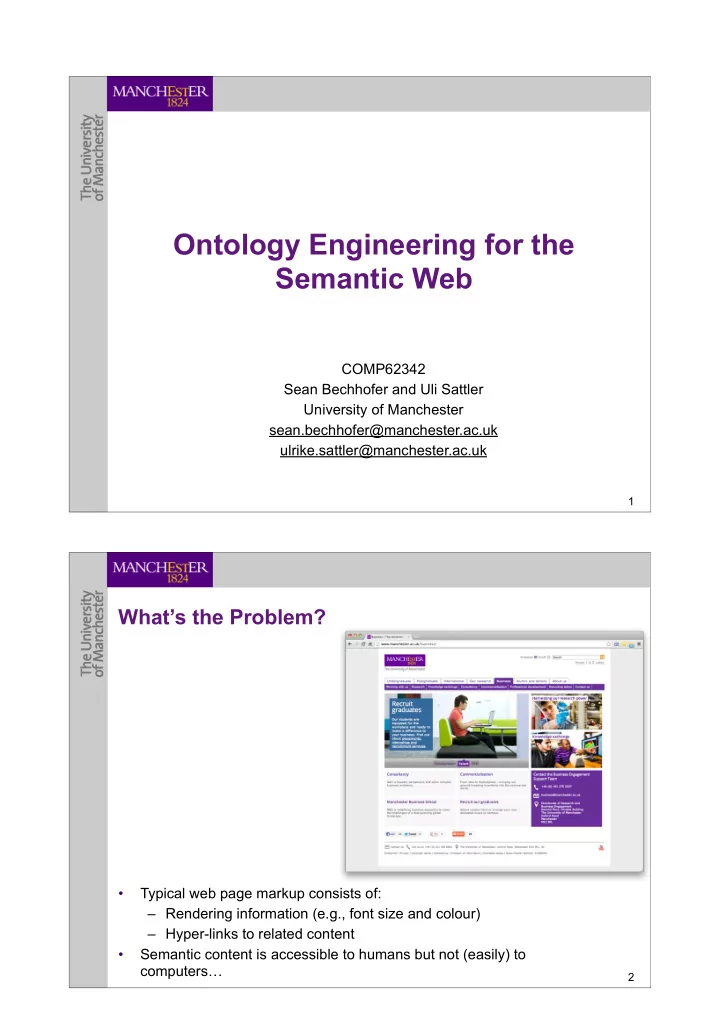
What’s the Problem?

  • Typical web page markup consists of:

– Rendering information (e.g., font size and colour) – Hyper-links to related content

  • Semantic content is accessible to humans but not (easily) to

computers…

2

slide-2
SLIDE 2

Information we can see

  • University of Manchester

– The Business School

  • Consultancy

– Gain a broader perspective and solve complex business problems

  • Commercialisation

– From idea to marketplace -- bringing our ground-breaking inventions into the commercial world

  • Manchester Business School

– MBS is redefiing business education to meet the challenges of a fast- evolving global landscape

  • Recruit our graduates

– Attend careers fairs or arrange your own dedicated event on campus

  • Contact the Business Engagement Support Team

– +44 161 275 2227 – business@manchester.ac.uk

  • ....

3

WWW2002 The eleventh international world wide web con Sheraton waikiki hotel Honolulu, hawaii, USA 7-11 may 2002 1 location 5 days learn interact Registered participants coming from australia, canada, chile denmark, fran ce, germany, ghana, hong kong, india , ireland, italy, japan, malta, new ze aland, the netherlands, norway, singapor e, switzerland, the united kingdom, the united states, vietnam, zaire Register now On the 7th May Honolulu will provide the backdrop of the eleventh international w

  • rld wide web conference. This prestigiou

s event … Speakers confirmed Tim berners-lee Tim is the well known inventor of the Web ,…

Information a machine can see…

slide-3
SLIDE 3

Solution: XML markup with “meaningful” tags?

<university>WWW2002 The eleventh international world wide webco n</university> <school>7-11 may 2002</school> <address>Sheraton waikiki hotel Honolulu, hawaii, USA</address> <topic>Register now On the 7th May Honolulu will provide the b ackdrop of the eleventh international worl d wide web conference. This prestigious eve nt … Speakers confirmed</topic> <topic>Tim berners-lee <details>Tim is the well known inventor of the W eb,</details>… </topic> <topic>Tim berners-lee <details>Tim is the well known inventor of the W eb,</details>… </topic> <contact>Registered participants coming from australia, canada, chile denmark, france , germany, ghana, hong kong, india, ir eland, italy, japan, malta, new zealand, the netherlands, norway, singapore, switze rland, the united kingdom, the united sta tes, vietnam, zaire<contact>
But what about....?

<university>WWW2002 The eleventh international world wide webco n</university> <department>7-11 may 2002</department> <address>Sheraton waikiki hotel Honolulu, hawaii, USA</address> <activity>Register now On the 7th May Honolulu will provide the b ackdrop of the eleventh international worl d wide web conference. This prestigious eve nt … Speakers confirmed</activity> <activity>Tim berners-lee <details>Tim is the well known inventor of the W eb,</details>… </activity> <activity>Tim berners-lee <details>Tim is the well known inventor of the W eb,</details>… </activity> <contact>Registered participants coming from australia, canada, chile denmark, france , germany, ghana, hong kong, india, ir eland, italy, japan, malta, new zealand, the netherlands, norway, singapore, switze rland, the united kingdom, the united sta tes, vietnam, zaire<contact>

slide-4
SLIDE 4

Still the Machine only sees…

<conf>WWW2002 The eleventh international world wide webco n<conf> <date>7-11 may 2002</date> <place>Sheraton waikiki hotel Honolulu, hawaii, USA<place> <introduction>Register now On the 7th May Honolulu will provide the b ackdrop of the eleventh international worl d wide web conference. This prestigious eve nt … Speakers confirmed</introduction> <speaker>Tim berners-lee <bio>Tim is the well known inventor of the W eb,</bio>… </speaker> <speaker>Tim berners-lee <bio>Tim is the well known inventor of the W eb,</bio>… </speaker> <registration>Registered participants coming from australia, canada, chile denmark, france , germany, ghana, hong kong, india, ir eland, italy, japan, malta, new zealand, the netherlands, norway, singapore, switze rland, the united kingdom, the united sta tes, vietnam, zaire<registration>

Need to Add “Semantics”

  • External agreement on meaning of annotations

– E.g., Dublin Core for annotation of library/bibliographic information

  • Agree on the meaning of a set of annotation tags

– Problems with this approach

  • Inflexible
  • Limited number of things can be expressed
  • Use Vocabularies or Ontologies to specify meaning of annotations

– Ontologies provide a vocabulary of terms – New terms can be formed by combining existing ones

  • “Conceptual Lego”

– Meaning (semantics) of such terms is formally specified

Machine Processable not Machine Understandable

slide-5
SLIDE 5

Four principles towards a Semantic Web of Data*

* With thanks to Frank van Harmelen

9

α ωεβ παγε' ιν Ενγλιση' αβουτ ' Φρανκ' ' ' ' Ανδ τηισ' παγε ισ' αβουτ ' ΛαρΚΧ' ανδ ανοτηερ' ωεβ παγε' αβουτ' Φρανκ' Ανδ τηισ' παγε ισ ' αβουτ ' Στεφανο' ' ' Τηισ παγε' ισ αβουτ' τηε ςριϕε' Υνιερσιτει '

P1: Give all things a name

10

slide-6
SLIDE 6

P2: Relationships form a graph between things

11

P3: The names are addresses on the Web

12

x T [<x>%IsOfType%<T>]%

different%

  • wners%&%loca;ons%

<analgesic>%

slide-7
SLIDE 7

P1 + P2 + P3 = Giant Global Graph

13

P4: Explicit, Formal Semantics

  • Assign Types to Things
  • Assign Types to Relations
  • Organise Types in a Hierarchy
  • Impose Constraints on Possible Interpretations

14

This is where we will spend most of our time on this course unit -- looking at the

  • ntologies that provide this

semantics

slide-8
SLIDE 8

Semantics

15

Φρανκ& Λψνδα&

married'to*

  • Φρανκ*is*male*
  • married'to*relates*

males*to*females*

  • married'to*relates**

1*male*to*1*female*

  • Λψνδα*=*Ηαζελ&

lowerbound* upperbound* Ηαζελ&

married'to*

KR: Cloth Weaves
 [Maier & Warren, Computing with Logic, 1988]

  • An example showing how we can represent the qualities and characteristics
  • f cloth types using a simple propositional logic knowledge base.

16

slide-9
SLIDE 9

Cloth

  • Woven fabrics consist of two sets of threads interlaced at right angles.
  • The warp threads run the length of the fabric
  • The weft (fill, pick or woof) threads are passed back and forth between the

warp threads.

  • When weaving, the warp threads are raised or lowered in patterns, leading

to different weaves.

  • Factors include:

– The pattern in which warps and wefts cross – Relative sizes of threads – Relative spacing of threads – Colours of threads

17

Plain Weave

  • Over and under in a 


regular fashion

18

slide-10
SLIDE 10

Twill Weave

  • Warp end passes over 


more than one weft – Known as “floats”

  • Successive threads 

  • ffset by 1

19

Satin Weave

  • Longer “floats”
  • Offsets larger than 1

20

slide-11
SLIDE 11

Classifying Cloth

  • The example provides a number of rules that describe how particular kinds
  • f cloth are described.
  • alternatingWarp ! plainWeave

– If a piece of cloth has alternating warp, then it’s a plain weave.

  • hasFloats, warpOffsetEq1 ! twillWeave

– If a piece of cloth has floats and a warp offset of 1, then it’s a twill weave.

  • There are many other properties concerning the colour of threads, spacings

etc.

Using the Rules

  • We could use these rules to build a system that would be able to recognise

different kinds of cloth through recognising the individual characteristics.

  • The example given shows that once we have recognised the following

characteristics – diagonalTexture – floatGTSink – colouredWarp – whiteFill

  • Then we can determine that this cloth is denim.

22

slide-12
SLIDE 12

Knowledge Representation

  • Although this is relatively simple (in terms of both the expressivity of the

language used and the number of facts), this really is an example of Knowledge Representation. – The rules represent some knowledge about cloth -- objects in the real world – Together they form a knowledge base – The knowledge base along with some deductive framework allow us to make inferences (which we hope reflect the characteristics/behaviour of the real world objects)

23

What is a Knowledge Representation?

  • Surrogate

That is, a representation

  • Expression of ontological commitment
  • f the world
  • Theory of intelligent reasoning

and our knowledge of it

  • Medium of efficient computation

that is accessible to programs

  • Medium of human expression

and usable

24

Davis, Shrobe & Szolovits

  • http://groups.csail.mit.edu/medg/ftp/psz/k-rep.html
slide-13
SLIDE 13

KR as Surrogate

  • Reasoning is an internal process, while the things that we wish to reason

about are (usually) external

  • A representation acts as a surrogate, standing in for things that exist in the

world. – Reasoning operates on the surrogate rather than the things

  • Surrogates can serve for tangible and intangible objects

– Bicycles, cats, dogs, proteins – Actions, processes, beliefs

25

KR as Surrogate

  • What is the correspondence between the representation and the things it is

intended to represent? – Semantics

  • How close is the representation?

– What’s there? – What’s missing?

  • Representations are not completely accurate

– Necessarily abstractions – Simplifying assumptions will be present

  • Imperfect representation means that incorrect conclusions are inevitable.
  • We can ensure that our reasoning processes are sound

– Only guarantees that the reasoning is not the source of the error.

26

slide-14
SLIDE 14

KR as Set of Ontological Commitments

  • A representation encapsulates a collection of decisions about what to see in

the world and how to see it.

  • Determine the parts in focus and out of focus

– Necessarily so because of the imperfection of representation

  • Choice of representation
  • Commitments as layers
  • KR != Data Structure

– Representational languages carry meaning – Data structures may be used to implement representations – Semantic Nets vs. graphs

27

KR as Fragmentary Theory of Intelligent Reasoning

  • Incorporates only part of the insight or belief
  • Insight or belief is only part of the phenomenon of intelligent reasoning
  • Intelligent inference

– Deduction

  • Sanctioned inferences

– What can be inferred

  • Recommended inferences

– What should be inferred

28

slide-15
SLIDE 15

KR as Medium for Efficient Computation

  • To use a representation, we must compute with it.
  • Programs have to work with representations

– The representation management system is a component in a larger system – If the representation management system is inefficient, programmers will compensate

  • Representations get complex quickly

– People need prosthetics to work well with them

29

KR as Medium of Human Expression

  • Representations as the means by which we

– express things about the world; – tell the machine about the world; – tell one another about the world

  • Representations as a medium for communication and expression by us.

– How general is it? – How precise is it? – Is the expressiveness adequate?

  • How easy is it for us to talk or think in the representation language?

– How easy is it? vs. can we?

30

slide-16
SLIDE 16

Ontologies

  • Metadata

– Resources marked-up with descriptions of their content. No good unless everyone speaks the same language;

  • Terminologies

– Provide shared and common vocabularies of a domain, so search engines, agents, authors and users can communicate. No good unless everyone means the same thing;

  • Ontologies

– Provide a shared and common understanding of a domain that can be communicated across people and applications, and will play a major role in supporting information exchange and discovery.

31

Ontology

  • A representation of the shared background knowledge for a community
  • Providing the intended meaning of a formal vocabulary used to describe a

certain conceptualisation of objects in a domain of interest

  • In CS, ontology taken to mean an engineering artefact
  • A vocabulary of terms plus explicit characterisations of the assumptions

made in interpreting those terms

  • Nearly always includes some notion of hierarchical classification (is-a)
  • Richer languages allow the definition of classes through description of their

characteristics – Introduce the possibility of using inference to help in management and deployment of the knowledge.

32

slide-17
SLIDE 17

33

Ontologies and Ontology Representations

  • “Ontology” – a word borrowed from philosophy

– But we are necessarily building logical systems

  • “Concepts” and “Ontologies”/ “conceptualisations” in their

  • riginal sense are psychosocial phenomena

– We don’t really understand them

  • “Concept representations” and “Ontology representations” are


engineering artefacts – At best approximations of our real concepts and conceptualisations (ontologies)

  • And we don’t even quite understand what we are approximating

34

Ontologies and Ontology Representations (cont)

  • Most of the time we will just say “concept” and “ontology” but whenever

anybody starts getting religious, remember… – It is only a representation!

  • We are doing engineering, not philosophy – although philosophy is

an important guide

  • There is no one way!

– But there are consequences to different ways

  • and there are wrong ways

– and better or worse ways for a given purposes – The test of an engineering artefact is whether it is fit for purpose

  • Ontology representations are engineering artefacts
slide-18
SLIDE 18

A Spectrum of Representation

35 Catalogue Terms/ glossary Thesauri Informal is-a Formal is-a Frames Value Restrictions Expressive Logics

So why is it hard?

  • Ontologies are tricky

– People do it too easily;
 People are not logicians

  • Intuitions hard to formalise
  • Ontology languages are tricky

– “All tractable languages are useless;
 all useful languages are intractable”

  • The evidence

– The problem has been about for 3000 years

  • But now it matters!
  • The semantic web means knowledge representation matters

36

slide-19
SLIDE 19

Ontology Engineering

  • How do we build ontologies that are

– Fit for purpose? (and what does that mean?) – Extensible? – Flexible? – Maintainable?

  • Methodologies and guidelines

– Knowledge acquisition – Ontology patterns – Normalisation – Upper level ontologies

37 38

Beware

  • OWL is not all of Knowledge Representation
  • Knowledge Representation is not all of the Semantic Web
  • The Semantic Web is not all of Knowledge Management
  • The field is still full of controversies
  • This course unit is to teach you about implementation in OWL