Online Open World Face Recognition From Video Streams ID:23202 Fed - - PowerPoint PPT Presentation

online open world face recognition from video streams
SMART_READER_LITE
LIVE PREVIEW

Online Open World Face Recognition From Video Streams ID:23202 Fed - - PowerPoint PPT Presentation

IARPA JANUS Online Open World Face Recognition From Video Streams ID:23202 Fed ederico Pern ernici, Federico Bartoli, Matteo Bruni and Alberto Del Bimbo MICC - University of Florence - Italy http://www.micc.unifi.it The effectiveness of


slide-1
SLIDE 1

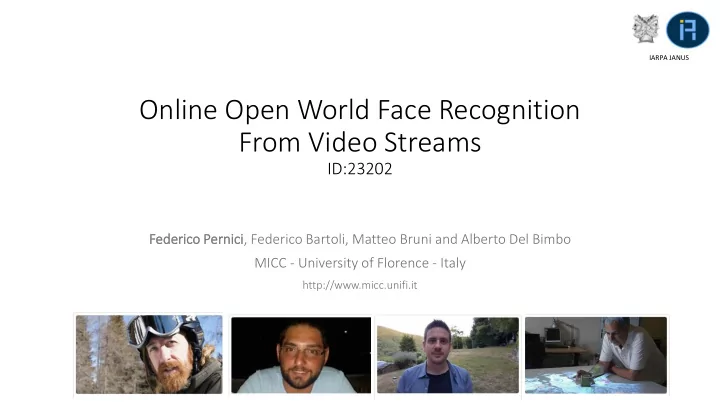
Online Open World Face Recognition From Video Streams

ID:23202

Fed ederico Pern ernici, Federico Bartoli, Matteo Bruni and Alberto Del Bimbo MICC - University of Florence - Italy

http://www.micc.unifi.it

IARPA JANUS
slide-2
SLIDE 2

The effectiveness of data in Deep Learning

  • Performance increases linearly with orders of

magnitude of training data [Chen2017].

(Log scale)

[Sun2017: Revisiting the Unreasonable Effectiveness of Data ICCV2017]

slide-3
SLIDE 3

However...

  • Linear improvement in performance requires

exponential number of labelled examples.

(Log scale)

[Sun2017: Revisiting the Unreasonable Effectiveness of Data ICCV2017]

slide-4
SLIDE 4

The cost of annotation

  • The cost of annotation remains the most

critical fact in Supervised Learning.

  • Crowdsourcing...
  • 1M images with 1000 categories at 1 cent per

question $10M.

  • ImageNet used several heuristics (e.g., hierarchy
  • f labels) to reduce the space of questions,

reducing the cost to the order of $100K

slide-5
SLIDE 5

Learning from video streams

An attracting alternative:

  • learn objects appearance from

video streams with no supervision, both exploiting

  • the large quantity of video available

in the Internet and

  • the fact that adjacent video frames

contain semantically similar information (weak supervision).

Time

slide-6
SLIDE 6

Practical Problem...

  • Online Open World Face Recognition from video streams
  • It is not possible to predict a priori how many face objects to

recognize (i.e. the number of classes is unknown).

  • The system must be able to detect known/unknown classes.
  • There are no labels.
  • The system must be able to add the detected unknown classes to

the model (Open World).

  • The system cannot be retrained from scratch (it must be works

forever).

  • The problem appears to present a daunting challenge for

deep learning (catastrophic forgetting).

1 1 2 1 2 3

slide-7
SLIDE 7

Problem details...

  • New face identities...
  • Wrong identity associations...
  • False positives... (not a novel class)

Unconstrained videos are typically made of shots

slide-8
SLIDE 8

Problem details

  • The Learner operates in two steps.
  • First, it automatically labels the data in

the next frame.

  • Second, it uses this labeled data to train

the classifier.

  • Errors may introduce noisy labels

(wrong identities).

  • Noisy labels may impair irreversibly

the learning process as time advance.

slide-9
SLIDE 9

Our solution: exploit a Memory module

  • The appearance in video streams typically evolves
  • ver time:
  • Data can no longer be assumed as independent

and identically distributed (i.i.d.)

  • Store the past experience in a memory module (i.e.

Hippocampus) [Schaul2015].

  • If appearances are never forgotten (Infinite

Memory), it is possible to limit the non stationary effects [Cornuéjols2006].

  • This also makes it possible to mix more and less

recent information.

[Schaul2015: Prioritized Experience Replay]

slide-10
SLIDE 10
  • Main components:
  • Face detection (GPU)
  • Descriptor extraction (GPU)
  • Matching (GPU)
  • Memory (GPU)
  • Memory Controller

System Overview

Face Detection Descriptor Extraction Matching ko

  • k

New Ids Generation

Memory Controller

6 1

slide-11
SLIDE 11

Face Dectection and Description

  • Faces are detected using the Tiny Faces method [Peiyun2017]
  • The method uses a CNN with the ResNet101 architecure
  • Detected faces are represented according CNN activations (the face

descriptor) exctracted from the VGGface CNN [Parkhi2015]

slide-12
SLIDE 12
  • The memory module is used for fast learning and

consists of the following triples:

  • The eligibility 𝑓𝑗 is a scalar quantity in [0,1]

associated to each descriptor 𝐲𝑗 (i.e. CNN activations)

  • It captures the redundancy of a descriptor with respect

to the other descriptors in the memory.

  • Each descriptor has an associated identity Id𝑗.

Main Idea: quick learning using Memory

slide-13
SLIDE 13

Intuition: Memory and Eligibilities

  • Faces appearance model is extended using the video

exemplars collected while tracking.

  • To control redundancy the eligibilities 𝑓𝑗 of matching

descriptors are time updated according to: where 𝜃𝑗 take into account descriptor distance (i.e. spatial redundancy).

Appearance Learned Offline (i.e. VggFace Deep Learning ) The extended appearance learned from video Video data exemplars

  • Descriptors are removed when their corresponding

eligibilities 𝑓𝑗 drops below a given threshold.

  • The eligibility is:
  • Low for ordinary «events»
  • High for rare «events»
  • Unmatched descriptors are added to the memory

with a novel Id and e=1.

slide-14
SLIDE 14

Discriminative Matching

  • Video temporal coherence:
  • Faces in consecutive frames have little differences.
  • Similar descriptors will be stored in the memory (Repeated Temporal Structure).
  • Distance Ratio test: compares the distance to

the closest neighbor with the distance to the second closest neighbor.

  • If they are far apart (d1/d2<thresh): OK.
  • If repeated structure distances are

comparable, the discriminative match cannot be assessed.

  • This limit is solved using Reverse

Nearest Neighbor(ReNN)

𝐩1 𝐩2 𝐲𝑗

Repeated Temporal Structure (Memory) d1/d2 ??

slide-15
SLIDE 15

Reverse Nearest Neighbour (ReNN)

  • In ReNN Roles are exchanged
  • Each entry of the database

is a query.

  • Faces in the current

frame are the database.

ReNN NN

slide-16
SLIDE 16
  • This strategy exploits discriminatively the uniqueness of

face in the current frame.

ReNN and distance ratio

ReNN ReNN

Queries (Memory)

  • The other important advantage ReNN

is that all the descriptors 𝐲𝑗of the repeated structure match with 𝐩1:

  • This allows the automatic

selection of the descriptors that need to be condensed into a more compact representation.

slide-17
SLIDE 17

GPU based ReNN

  • Reverse Nearest Neighbor under the

distance ratio criterion can be effectively accelerated on the GPU.

  • This is achieved using the min function

twice in a GPUarray (Matlab, PyCuda).

  • Cuda Parallel Reduction is exploited.
  • Complexity is almost constant as the

number of descriptors in the memory increases (Nvidia Titan X Maxwell).

...

number of descriptors time

slide-18
SLIDE 18

Asymptotic Stability

  • Eligibility updating stabilizes around the

pdf of each individual subject face.

  • The eligibility updating rule:

is a contraction (i.e. 𝜃𝑗<1), it converges to its unique fixed point.

  • Toy problem with increasing difficulty…

Easy Medium Hard

slide-19
SLIDE 19

Experimental Results

  • We used the Music-dataset [Zhang2016].
  • 8 music videos downloaded from YouTube with

annotations of 3,845 face tracks

  • Big Ban Theory 1° season (Ep1,2,...,6).
  • 6 videos, about 23 minutes each.
slide-20
SLIDE 20

Experimental Results: drifting analisys

  • Ground Truth as

detections

  • Accuracy:
  • Fluctuations: no

information at the beginning.

  • Stability is common to

all the videos.

slide-21
SLIDE 21

Experimental Results: drifting analisys

  • Ground Truth as

detections

  • Accuracy:
  • Fluctuations: no

information at the beginning.

  • Stability is common to

all the videos.

slide-22
SLIDE 22

Comparison with Offline Methods

Scores are based on Purity. Purity is a measure of the extent to which clusters contain a single class.

slide-23
SLIDE 23

Comparison with Offline Methods

slide-24
SLIDE 24

Online Open World Face Recognition From Video Streams https://youtu.be/6S7D6Dgmt3Y

Link:

slide-25
SLIDE 25

Qualitative results

slide-26
SLIDE 26

Conclusion

  • Online Open World Face Recognition From Video Streams
  • Fully implemented on a GPU
  • Wide applicability: Enables face recognition with auto enrollment of subjects
  • Applicability in other contexts:
  • Person Detector – Person Descriptor
  • Car detector – Car Descriptor
  • Traffic Signal Detector – Traffic Signal Descriptor
  • Future developments:
  • Exploit the data diversity in the memory

to train online a Deep CNN.