On >modes of coping< with uncertainties How young academic - - PDF document

on gt modes of coping lt with uncertainties
SMART_READER_LITE
LIVE PREVIEW

On >modes of coping< with uncertainties How young academic - - PDF document

29.07.15 On >modes of coping< with uncertainties How young academic life scientists (learn to) deal with precarious conditions by Lisa Sigl Research Colloquium @ zhb Dortmund July 08, 2015 Projects & Empirical Basis How do


slide-1
SLIDE 1

29.07.15 ¡ 1 ¡

On >modes of coping< with uncertainties

How young academic life scientists (learn to) deal with precarious conditions

by Lisa Sigl

Research Colloquium @ zhb Dortmund July 08, 2015

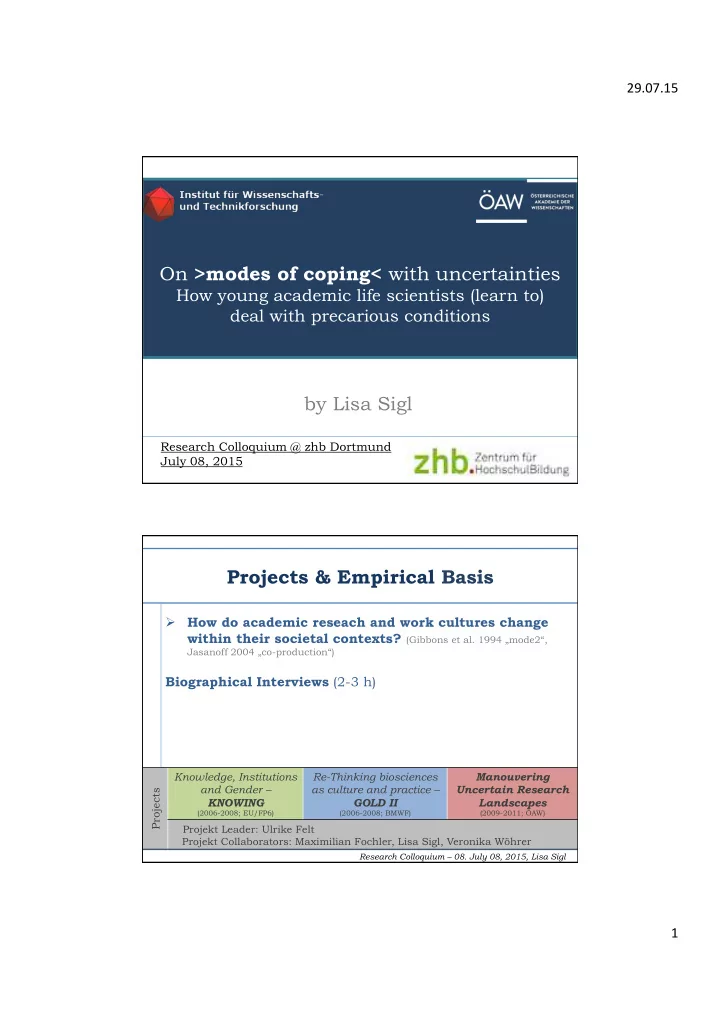
Ø How do academic reseach and work cultures change within their societal contexts? (Gibbons et al. 1994 „mode2“,

Jasanoff 2004 „co-production“)

Biographical Interviews (2-3 h)

Projects Knowledge, Institutions and Gender – KNOWING

(2006-2008; EU/FP6)

Re-Thinking biosciences as culture and practice – GOLD II

(2006-2008; BMWF)

Manouvering Uncertain Research Landscapes

(2009-2011; ÖAW)

Projekt Leader: Ulrike Felt Projekt Collaborators: Maximilian Fochler, Lisa Sigl, Veronika Wöhrer

Projects & Empirical Basis

Research Colloquium – 08. July 08, 2015, Lisa Sigl
slide-2
SLIDE 2

29.07.15 ¡ 2 ¡ Research Questions: Why do researchers experience uncertainties? How do they experience uncertainties? To what broader societal contexts and transformations are these uncertainties linked? How do researchers cope with these uncertainties? Do uncertainties in turn contribute to the transformation

  • f research and work cultures?

And if so, how?

Ø How do academic reseach and work cultures change within their societal contexts? (Gibbons et al. 1994 „mode2“,

Jasanoff 2004 „co-production“)

Biographical Interviews (2-3 h)

Perspektive of young researchers in the life sciences (PhDs, Postdocs) Material: 14 qualitative, biographical Interviews, 5 group discussions, observations, quantitative „Life Course Questionnaires“ Methodical Approach: Grounded Theory

Projects Knowledge, Institutions and Gender – KNOWING

(2006-2008; EU/FP6)

Re-Thinking biosciences as culture and practice – GOLD II

(2006-2008; BMWF)

Manouvering Uncertain Research Landscapes

(2009-2011; ÖAW)

Projekt Leader: Ulrike Felt Projekt Collaborators: Maximilian Fochler, Lisa Sigl, Veronika Wöhrer

Projects & Empirical Basis

Research Colloquium – 08. July 08, 2015, Lisa Sigl

slide-3
SLIDE 3

29.07.15 ¡ 3 ¡

Course of the Presentation

Relevance & Policy Background

  • I. Experience of Uncertainty

+ Conditions for the development of uncertainty experiences + Character of uncertainty experiences

  • II. >Modes of Coping< with Uncertainties

⇒ Implications for Research Governance

Research Colloquium – 08. July 08, 2015, Lisa Sigl Research Colloquium – 08. July 08, 2015, Lisa Sigl

Media Attention

Friedmann (taz, 07/2010)

slide-4
SLIDE 4

29.07.15 ¡ 4 ¡

Research Colloquium – 08. July 08, 2015, Lisa Sigl

Newsletter „Templiner Manifest“ GEW, 03.07.2015

Unions against precarious conditions

Research Colloquium – 08. July 08, 2015, Lisa Sigl

Policies against Precarious Conditions..?

slide-5
SLIDE 5

29.07.15 ¡ 5 ¡

European Union

Research Framework Programmes since 1986 Lisbon-Process 2000: „knowledge-based society / economy“ academic activity shows up on the radar for regimes of productivity, profitability and instrumental reasoning

On national level

  • Research, Technology & Innovation Reports & Strategies
  • Shift Towards Competitive Funding Mechanisms
  • New Evaluation Criteria

Research Colloquium – 08. July 08, 2015, Lisa Sigl

Policy Background

Since 1990s: more conscious „science policies“: 1994 Setup of “Fachhochschulen” (Univ. for Applied Sciences) 1999 Green Book on Austrian Research Policy („Grünbuch zur österreichischen Forschungspolitik“) 2000 Establishment of „Rat für Forschung und Technologie- entwicklung“ (Austrian Council for Research & Technology Development) 2002 Universitätsgesetz 2002 2009 Collective Contract (“Kollektivvertrag für die ArbeitnehmerInnen der Universitäten”) Ongoing: e.g. international criteria for knowledge production and innovation performance evaluation adopted or reinforced

The Case “Austria”

Research Colloquium – 08. July 08, 2015, Lisa Sigl

slide-6
SLIDE 6

29.07.15 ¡ 6 ¡

¡

¡

Research Programmes and focuses: e.g. GenAU (seit 2000, funded by „Forschungsmilliarde“) oder nano- initiative

¡

Vienna: E.g.: Research site St. Marx > Since 1988, the Campus Vienna Biocenter (CVBC) has developed into one of the most outstanding and prominent life sciences hubs... in Austria... With the foundation of the Research Institute of Molecular Pathology (IMP)… quickly a University building went up next door... start-up Intercell was spun off the University and the IMP... the Austrian Academy of Sciences founded two new research institutes, IMBA and GMI, situated next door to the IMP. <

Quelle: http://www.viennabiocenter.org

Research Programmes & Regional Policies

Research Colloquium – 08. July 08, 2015, Lisa Sigl

…makes working conditions more flexible and precarious

Austrian Case:

The Project Modus of Funding…

Shift to competitive project funding at universities 2007-2011: Project funds increased 30% (BMWF 2011: 107)

Life Sciences: up to 80% externally funded

⇒ as a result, researchers are increasingly employed part-time and for shorter time periods

Research Colloquium – 08. July 08, 2015, Lisa Sigl

slide-7
SLIDE 7

29.07.15 ¡ 7 ¡

Research Colloquium – 08. July 08, 2015, Lisa Sigl

Safe? No, certainly not... You can qualify for the profession, but then you need to perform extraordinarily to have a salary… as soon as you are in… you need to fight to stay in. (f8: 604-10)

Research Colloquium – 08. July 08, 2015, Lisa Sigl

Governance ¡as ¡distributed ¡ constellations ¡of ¡power ¡ ¡

(Jordan, ¡Wurzel, ¡and ¡Zito ¡2005) ¡ ¡

slide-8
SLIDE 8

29.07.15 ¡ 8 ¡

¡

Epistemic ¡Uncertain.es ¡

Output-­‑ ¡and ¡Process-­‑Uncertainty ¡in ¡Life ¡Science ¡ Research ¡(Krohn/Krücken ¡1993) ¡

  • I. Experience of Uncertainty

Conditions

Research Colloquium – 08. July 08, 2015, Lisa Sigl

¡

Epistemic ¡Uncertain.es ¡

Output-­‑ ¡and ¡Process-­‑Uncertainty ¡in ¡Life ¡Science ¡ Research ¡(Krohn/Krücken ¡1993) ¡

  • I. Experience of Uncertainty

Conditions

¡

Career ¡Standards ¡

individualising ¡norms ¡

(Müller ¡2012) ¡

¡

¡

“Casualisa.on” ¡

Short, ¡mostly ¡fixed-­‑term ¡ contracts ¡

¡

“Commodifica.on” ¡

quan.ta.ve, ¡performance ¡ standards ¡(Jacob ¡2009) ¡

Research Colloquium – 08. July 08, 2015, Lisa Sigl

slide-9
SLIDE 9

29.07.15 ¡ 9 ¡

¡

Epistemic ¡Uncertain.es ¡

Output-­‑ ¡and ¡Process-­‑Uncertainty ¡in ¡Life ¡Science ¡ Research ¡(Krohn/Krücken ¡1993) ¡

  • I. Experience of Uncertainty

Conditions

¡

Career ¡Standards ¡

individualising ¡norms ¡

(Müller ¡2012) ¡

¡

¡

“Casualisa.on” ¡

Short, ¡mostly ¡fixed-­‑term ¡ contracts ¡

¡

“Commodifica.on” ¡

quan.ta.ve, ¡performance ¡ standards ¡(Jacob ¡2009) ¡ Paradox of the Project Form (Torka 2006)

Research Colloquium – 08. July 08, 2015, Lisa Sigl

¡

Epistemic ¡Uncertain.es ¡

Output-­‑ ¡and ¡Process-­‑Uncertainty ¡in ¡Life ¡Science ¡ Research ¡(Krohn/Krücken ¡1993) ¡

  • I. Experience of Uncertainty

Conditions

¡

Career ¡Standards ¡

individualising ¡norms ¡

(Müller ¡2012) ¡

¡

¡

“Casualisa.on” ¡

Short, ¡mostly ¡fixed-­‑term ¡ contracts ¡

¡

“Commodifica.on” ¡

quan.ta.ve, ¡performance ¡ standards ¡(Jacob ¡2009) ¡ Paradox of the Project Form (Torka 2006)

Research Colloquium – 08. July 08, 2015, Lisa Sigl

There is a lot of luck involved… we work certain things on proteins, that’s (sic!) not exactly predictable whether or not it will work or not… when you consider a few things beforehand, you will be successful in about 10% of the cases... (m1.2: 356-64)

slide-10
SLIDE 10

29.07.15 ¡ 10 ¡

¡

Epistemic ¡Uncertain.es ¡

Output-­‑ ¡and ¡Process-­‑Uncertainty ¡in ¡Life ¡Science ¡ Research ¡(Krohn/Krücken ¡1993) ¡

  • I. Experience of Uncertainty

Conditions

¡

Career ¡Standards ¡

individualising ¡norms ¡

(Müller ¡2012) ¡

¡

¡

“Casualisa.on” ¡

Short, ¡mostly ¡fixed-­‑term ¡ contracts ¡

¡

“Commodifica.on” ¡

quan.ta.ve, ¡performance ¡ standards ¡(Jacob ¡2009) ¡ Paradox of the Project Form (Torka 2006)

Research Colloquium – 08. July 08, 2015, Lisa Sigl

¡

Subjec.fied ¡Ac.vity ¡

Personal ¡RelaMon ¡to ¡/ ¡MoMvaMon ¡for ¡the ¡ AcMvity ¡(Lohr/Nickel ¡2009) ¡

(Kleemann 1999)

The convergence of these conditions establishes a space where… ...quite pervasive experiences of uncertainty develop ...epistemic uncertainties appear as an existential, generalised anxiety („Unbehagen“) / precarity

  • I. Experience of Uncertainty

Character

Research Colloquium – 08. July 08, 2015, Lisa Sigl

The PROJECT MODUS creates a structural link between epistemic and social uncertainties !!

slide-11
SLIDE 11

29.07.15 ¡ 11 ¡ 2 social modes

++ Coping as a member of a clan ++ Coping as a member of a collective

2 individuelle modes

++ Coping as a manager ++ Coping as a trickster

(semi)institutionalised modes

Research Colloquium – 08. July 08, 2015, Lisa Sigl

  • II. >modes of coping< with Uncertainties
  • II. >modes of coping< with Uncertainties

modes of coping <> typologies of coping

Personalised ideal types e.g. Klecha/Reimer (2008):

  • Managers of precarity
  • Career-oriented idealists
  • fragile middle
  • Opportunist scientists

(Gelegenheitswissenschaftler)

  • Transitional scientists

(Übergangswissenschaftler) De-personalised logics “modes of ordering” (Law 1994) Sinn aus der Umwelt und sich selbst darin machen (Blackman et al. 2011) Combined flexibly… …with regard to situatedness …with regard to embedding in the social structures ¡

Research Colloquium – 08. July 08, 2015, Lisa Sigl

slide-12
SLIDE 12

29.07.15 ¡ 12 ¡ 2 soziale Modi

++ Coping as a member of a clan

  • II. >modes of coping< with uncertainties

2 social modes

There is no protection at all. You can only hope that – should the experiments not work out … that the supervisor … will allow for you [to stay] anyways. (m4.2: 929-32) Leitmotif: paternalistic care

  • Protection is granted via a system of guardianship

Research Colloquium – 08. July 08, 2015, Lisa Sigl

2 soziale Modi

++ Coping like a clan ++ Coping as a member of a collective

  • II. >modes of coping< mit Unsicherheiten

2 soziale Modi

So, most things only work through teamwork. You will almost never be able to achieve anything alone... (f8: 253-7) Leitmotif: „Commonalising“ von experience

  • Protection is granted via self-organised solidarity

Research Colloquium – 08. July 08, 2015, Lisa Sigl

slide-13
SLIDE 13

29.07.15 ¡ 13 ¡ 2 soziale Modi

++ Coping like a clan ++ Coping like a collective ++ Coping like a manager

  • II. >modes of coping< mit Unsicherheiten

2 individuelle Modi

the… [one] project... is very risky... I hope that something will come out but also that... with its little sub-projects, that I can define sub-targets that can lead to a publication anyways. I hope that I can accomplish a certain, a certain output this way (f6.1: 469-77) Leitmotif: Optimising individual performance / output

  • Protection granted via orientation at career requirements

Research Colloquium – 08. July 08, 2015, Lisa Sigl

2 soziale Modi

++ Coping like a clan ++ Coping like a collective ++ Coping like a manager ++ Coping like a trickster

  • II. >modes of coping< mit Unsicherheiten

2 individuelle Modi

I would apply for a different project, but continue doing my idea... That is a bit exaggerated... Formally you work on a project but really you work on... this actual project that has been previously rejected... (m1.2: 891-6) Leitmotif: reclaim a livable present with worthwhile research

  • Protection via a mindset that rejects experience of uncertainty

Research Colloquium – 08. July 08, 2015, Lisa Sigl

slide-14
SLIDE 14

29.07.15 ¡ 14 ¡ Semi-institutionalised collective modus

e.g. lab meetings

Institutionalised

Possibility to prolong projects Intermediary funding for projects

Research Colloquium – 08. July 08, 2015, Lisa Sigl

  • II. >modes of coping< with uncertainties

(semi)institutionalised modes

Semi-institutionalised

e.g. lab meetings

Institutionalised

Possibility to prolong projects Intermediary funding for projects Social Systems of Protection

  • Unemployment benefits
  • Education leave („Bildungskarenz“)
  • II. >modes of coping< with uncertainties

(semi)institutionalised modes

Research Colloquium – 08. July 08, 2015, Lisa Sigl

slide-15
SLIDE 15

29.07.15 ¡ 15 ¡ Beginning of a Contract: collective & trickster End of Contract: clan & manager When the beginning of a contract is close to the end of the contract...

⇒ Shift towards individual and clan-modus ⇒ Collective and trickster modus under pressure

  • Might marginalise risky research
  • Lost potential of collective research

Transformation of Research Cultures

Research Colloquium – 08. July 08, 2015, Lisa Sigl Research Colloquium – 08. July 08, 2015, Lisa Sigl

In our situation it is very difficult to plan something. If I could I would really like the feeling of having more than three or five years to work on certain projects… then we could be concerned more about planning the scientific stuff… but the way it is right now, we’re mostly planning our own futures. (m1.2: 289-94)

slide-16
SLIDE 16

29.07.15 ¡ 16 ¡ Governance Dimensions (De Boer/Enders/Schimank 2007)

Academic self-governance Competition Stakeholder guidance State regulation Managerial self-governance

Implications for Research Governance

Research Colloquium – 08. July 08, 2015, Lisa Sigl

¡

Governance Dimensions (De Boer/Enders/Schimank 2007)

Academic self-governance Competition Stakeholder guidance State regulation Managerial self-governance ¡ ¡

Implications for Research Governance

Research Colloquium – 08. July 08, 2015, Lisa Sigl

slide-17
SLIDE 17

29.07.15 ¡ 17 ¡

¡

Governance Dimensions (De Boer/Enders/Schimank 2007)

Academic self-governance Competition Researchers experience risky research as taking a biographical risk ⇒ This influences how researchers choose their research questions and projects ⇒ Rationales of social security gain relevance to the detriment of other rationales (e.g. scientific or societal relevance) ¡ ¡

Implications for Research Governance

Research Colloquium – 08. July 08, 2015, Lisa Sigl

Thank you for your attention!

REFERENZEN: Blackman, Lisa, John Cromby, Derek Hook, Dimitris Papadopoulos, and Valerie Walkerdine. 2008. Creating

  • Subjecitivities. Subjectivities 22(1): 1-27.

BMWF - Bundesministerium für Wissenschaft und Forschung. (2011). Universitätsbericht 2011. Vienna: bm.w_f. De Boer, H. F., J. Enders, and U. Schimank. "Comparing Higher Education Governance Systems in Four European Countries." In Governance and Performance of Education Systems, edited by N. C. Soguel and P. Jaccard. 35-54. Dordrecht: Springer, 2007. Felt, Ulrike, and Maximilian Fochler. 2010. "Riskante Verwicklungen des epistemischen, strukturellen und biographischen: Governance-Strukturen und deren mikropolitische Implikationen für das akademische Leben". In Governance des Österreichischen Innovationssystems, edited by Peter Biegelbauer. 297-328. Innsbruck: StudienVerlag. Friedmann, Alexandra. 2010. Akademische Prekarit.t: „Uni ist Ein Spiegel Der Gesellschaft“. Taz. Die tageszeitung, [accessed April 24, 2010]. Gibbons, M., Limoges, C., Nowotny, H., Schwartzman, S., Scott, P., & Trow, M. (1994). New Production of Knowledge: Dynamics of Science and Research in Contemporary Societies. London, Thousand Oaks, New Delhi: SAGE Publications. Jacob, Merle. "On Commodification and the Governance of Academic Research." Minerva 47 (2009): 391-405. Jasanoff, S. (Ed.). (2004). States of Knowledge. The Co-Production of Science and Social Order. London/New York: Routledge. Krohn, Wolfgang and Georg Krücken. 1993. Risiko als Konstruktion und Wirklichkeit. Eine Einführung in die sozialwissenschaftliche Risikoforschung. In Riskante Technologien: Reflexion und Regulation. Einführung in die sozialwissenschaftliche Risikoforschung, edited by W. Krohn and G. Krücken. Frankfurt am Main: Suhrkamp, 9-44. Klecha, Stephan und Melanie Reimer (2008). Wissenschaft als besonderer Arbeitsmarkt, In: Klecha/Krumbein: Die Beschäftigungssituation von wissenschaftlichem Nachwuchs, Wiesbaden: VS. Lohr, Karin and Hildegard Maria Nickel, eds. 2009. Subjektivierung von Arbeit. Riskante Chancen, Forum Frauenforschung, Münster: Verlag Westfählisches Dampfboot. Law, J. (1992). Notes on the Theory of the Actor Network: Ordering, Strategy and Heterogeneity. Retrieved from www.lancs.ac.uk/fass/sociology/papers/law-notes-on-ant.pdf Lorey, Isabell. 2011. "Governmental Precarization." Transversal Journal (8). Müller, Ruth. “Collaborating in Life Science Research Groups: The Question of Authorship.” Higher Education Policy 25,

  • no. 3 (2012): 289–311.

Torka, Marc. 2006. Die Projektförmigkeit der Forschung. Die Hochschule. Journal für Wissenschaft und Bildung (1): 63-83.

Research Colloquium – 08. July 08, 2015, Lisa Sigl