On Dynamic Resource Management Contents Mechanism using Control - - PDF document

on dynamic resource management contents mechanism using
SMART_READER_LITE
LIVE PREVIEW

On Dynamic Resource Management Contents Mechanism using Control - - PDF document

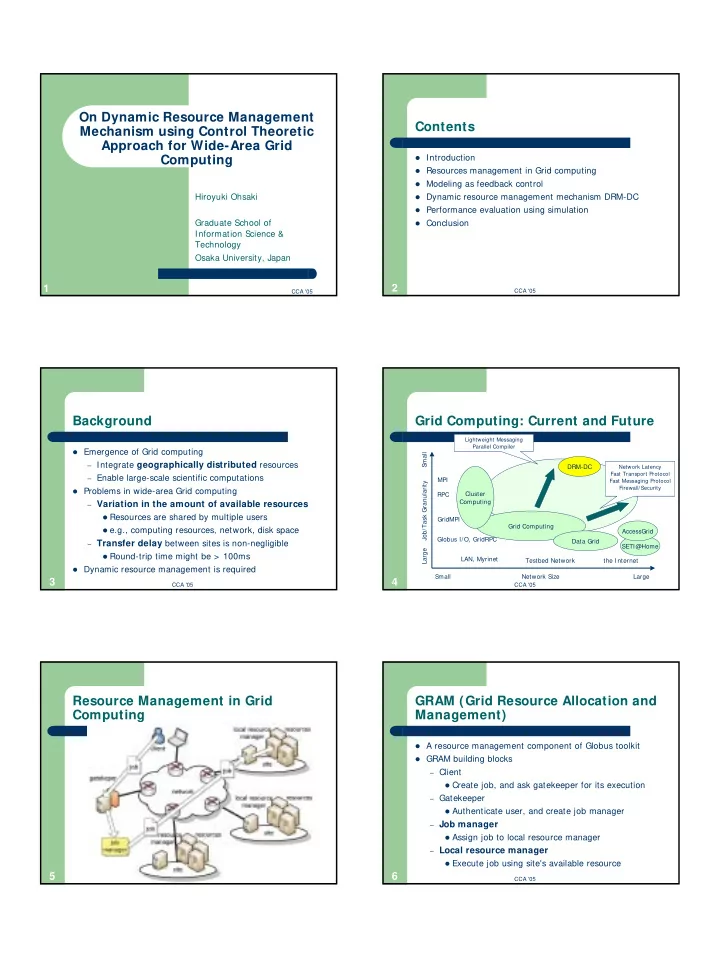
On Dynamic Resource Management Contents Mechanism using Control Theoretic Approach for Wide-Area Grid Computing Introduction Resources management in Grid computing Modeling as feedback control Hiroyuki Ohsaki Dynamic resource


slide-1
SLIDE 1

CCA '05

1

On Dynamic Resource Management Mechanism using Control Theoretic Approach for Wide-Area Grid Computing

Hiroyuki Ohsaki Graduate School of Information Science & Technology Osaka University, Japan

CCA '05

2

Contents

Introduction Resources management in Grid computing Modeling as feedback control Dynamic resource management mechanism DRM-DC Performance evaluation using simulation Conclusion

CCA '05

3

Background

Emergence of Grid computing – Integrate geographically distributed resources – Enable large-scale scientific computations Problems in wide-area Grid computing – Variation in the amount of available resources Resources are shared by multiple users e.g., computing resources, network, disk space – Transfer delay between sites is non-negligible Round-trip time might be > 100ms Dynamic resource management is required

CCA '05

4

Grid Computing: Current and Future

Network Size Large Small Job/Task Granularity Small Large the Internet Testbed Network LAN, Myrinet GridMPI Globus I/O, GridRPC MPI RPC Grid Computing Cluster Computing Data Grid SETI@Home AccessGrid

Lightweight Messaging Parallel Compiler Network Latency Fast Transport Protocol Fast Messaging Protocol Firewall/Security

DRM-DC CCA '05

5

Resource Management in Grid Computing

CCA '05

6

GRAM (Grid Resource Allocation and Management)

A resource management component of Globus toolkit GRAM building blocks – Client Create job, and ask gatekeeper for its execution – Gatekeeper Authenticate user, and create job manager – Job manager Assign job to local resource manager – Local resource manager Execute job using site's available resource

slide-2
SLIDE 2

CCA '05

7

Requirements for Resource Management in Grid Computing

Objectives – Adjust the amount of jobs injected into a site... According to the amount of available resources Desired characteristics – Steady-state performance High resource utilization, fast job execution – Transient-state performance Fast convergence – Stability, robustness, flexibility...

CCA '05

8

Problems in Wide-Area Grid Computing

Variation in the amount of available resources – Simple open-loop control is insufficient – Closed-loop control using feedback information is

indispensable

Transfer delay between sites is non-negligible – Difficult to realize stability and fast convergence – Feedback delay must be taken account of

CCA '05

9

Research Objectives

Propose dynamic resource management mechanism – DRM-DC (Dynamic Resource Management with Delay

Compensator)

– Feedback-based control with a delay compensator – Realize high steady-/ transient-state performance Performance evaluation of DRM-DC – Implement DRM-DC in Simgrid simulator – Comparison of DRM-DC with PI controller – Show DRM-DC's effectiveness in WAN environment

CCA '05

10

Modeling Assumptions

Parameter-sweep applications – Job manager always has jobs to execute Job = multiple tasks – Task granularity is small i.e., task execution time < < transfer delay Transfer delay is constant – Network between sites is not heavily congested

CCA '05

11

Modeling Site (Plant)

  • Can be modeled as a single queue

Site processes assigned tasks one by one

1.

Receive tasks from job manager

2.

Queue them in buffer of local resource manager

3.

Process tasks in the buffer one by one

  • Continuous-time system model

Input u(t): task injection rate from job manager

Output x(t): the number of tasks in the buffer

CCA '05

12

Modeling Job Manager (Controller)

  • Can be modeled as a controller

Job manager assigns tasks to each site

1.

Receive feedback information from sites

2.

Adjust the amount of task assignments to sites

  • Continuous-time system model

Input x(t): the number of waiting tasks in site

Output u(t): task injection rate to site

slide-3
SLIDE 3

CCA '05

13

Dynamic Resource Management Mechanism DRM-DC

DRM-DC (Dynamic Resource Management with Delay

Compensator)

Controller running on job manager – Input: the number of tasks waiting in site – Output: task injection rate to site DRM-DC control objective – Keep the number of tasks in the buffer at target level Avoid overload and realize high utilization PI (Proportional Integral) controller with a delay

compensator (Smith Predictor)

CCA '05

14

Block Diagram of DRM-DC

CCA '05

15

Performance Evaluation

Modified a discrete-time simulator Simgrid – Implement discrete-time version of DRM-DC

(controls at every constant interval T)

Simulation conditions – Parameter-sweep applications – Number of sites: 10 – Network: LAN (1 [ms]), WAN (100 [ms]) Performance metrics – Queue dynamics (i.e., the number of tasks in buffer)

CCA '05

16

Simulation Scenario: Parameter Configuration

  • Simulation scenarios
  • 1. Varying amount of available resources

2.

Varying transfer delay between job manager and site

CCA '05

17

Simulation Result (Queue Dynamics for Varying Available Resources)

m= 1000 [MIPS](t< 5) m= 200 [MIPS](5< t< 10) m= 1500 [MIPS](15< t) DRM-DC shows better utilization, faster convergence

CCA '05

18

Simulation Result (Rise Time, Overshoot, Settling Time)

DRM-DC shows significantly shorter rise time/settling time DRM-DC shows smaller overshoot

slide-4
SLIDE 4

CCA '05

19

Conclusion and Future Work

Proposed dynamic resources management mechanism – Designed for wide-area Grid computing – Utilize a delay compensator (Smith predictor) Verified its effectiveness by simulation – Realize high steady-/transient-state performance – Effective in WAN environment with a large delay Future work – Improvement of stability, robustness, and flexibility – Implementation in Globus toolkit