OF CLOSING THE ACHIEVEMENT GAP Dr. Teresa D. Hill National Title - - PowerPoint PPT Presentation

of closing
SMART_READER_LITE
LIVE PREVIEW

OF CLOSING THE ACHIEVEMENT GAP Dr. Teresa D. Hill National Title - - PowerPoint PPT Presentation

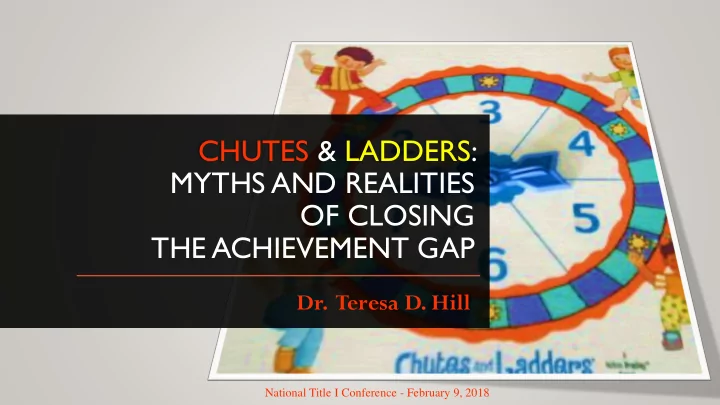
CHUTES & LADDERS: MYTHS AND REALITIES OF CLOSING THE ACHIEVEMENT GAP Dr. Teresa D. Hill National Title I Conference - February 9, 2018 AGENDA Defining what it means to close the achievement gap Myths and realities about

slide-1
SLIDE 1

CHUTES & LADDERS: MYTHS AND REALITIES OF CLOSING THE ACHIEVEMENT GAP

  • Dr. Teresa D. Hill

National Title I Conference - February 9, 2018

slide-2
SLIDE 2

AGENDA

  • Defining what it means to “close the achievement gap”
  • Myths and realities about closing the achievement gap
  • Chutes that do not close group achievement gaps
  • Ladders that promote improved achievement and diminishing gaps
  • Short term – Moderate term – Long term
  • Resources for systematically combating your achievement gap

National Title I Conference - February 9, 2018

slide-3
SLIDE 3

WHAT DOES IT MEAN TO “CLOSE THE ACHIEVEMENT GAP”?

slide-4
SLIDE 4

MYTHS

  • Closing the test score gap = Closing

the achievement gap

  • If students read at grade level by

grade 3, the achievement gap will be closed.

  • Test-taking strategies and test prep

help to close the achievement gap.

National Title I Conference - February 9, 2018

slide-5
SLIDE 5

REALITIES

  • Closing the achievement gap requires:
  • A “big picture” approach to the gap
  • Establishing a strong foundation of core curriculum*
  • Reading, Writing, Listening Speaking
  • Mathematics, Problem Solving, Science, Engineering
  • Social Studies (Civics, History, Geography, Culture), Social Skills
  • Coherent, consistent, sustained, high quality curriculum and

instruction within a stable, positive environment*

National Title I Conference - February 9, 2018

slide-6
SLIDE 6

CHUTES THAT DO NOT CLOSE GROUP ACHIEVEMENT GAPS

  • Parallel interventions and remediation
  • Computer programs and websites
  • Worksheets, workbooks, flashcards, etc. (even

if labeled as “interactive)

  • Seatwork, independent work, homework
  • Targeted supplements to core curriculum
  • Gaming the system
slide-7
SLIDE 7

LADDERS THAT PROMOTE IMPROVED ACHIEVEMENT AND DIMINISHING GAPS

  • Short term – 6 months – 2 years
  • Reading and test questions and prompts
  • Text “attack” skills and strategies
  • Assessment specific strategies *
  • Tricks, algorithms and pneumonic devices
  • Anchor charts and classroom resources *
  • Targeted skill instruction and curricular

supplements

  • Aligned vocabulary, strategies and formulas
slide-8
SLIDE 8

LADDERS THAT PROMOTE IMPROVED ACHIEVEMENT AND DIMINISHING GAPS

  • Moderate term – 3 – 5 years
  • Cold, close reads with written response
  • Text dependent questions
  • Standards-aligned curricula
  • Writing to learn strategies
  • Self-efficacy and perseverance
  • Early childhood education
slide-9
SLIDE 9

LADDERS THAT PROMOTE IMPROVED ACHIEVEMENT AND DIMINISHING GAPS

  • Long term – 6 – 15 years
  • Access to learning resources
  • Ample exposure, experiences and
  • pportunities
  • High expectations and expanded horizons
  • Positive long-term relationships
  • Ethical, social and emotional

development

  • Executive functioning and self-regulation
slide-10
SLIDE 10

RESOURCES FOR COMBATING YOUR ACHIEVEMENT GAP

  • Ladders Planning Sheet
  • Tools for Moderate term strategies
  • Hill, T. (2017). Combating the Achievement

Gap: Ending Failure as a Default in Schools. Rowman & Littlefield: Lanham, MD.

  • Book signing @ 1:00pm
  • Dr. Teresa Hill – tdhilledd@yahoo.com

National Title I Conference - February 9, 2018