OECD Bio&Food safety work: 2 programmes Aim: Help to address - - PowerPoint PPT Presentation

oecd bio amp food safety work 2 programmes
SMART_READER_LITE
LIVE PREVIEW

OECD Bio&Food safety work: 2 programmes Aim: Help to address - - PowerPoint PPT Presentation

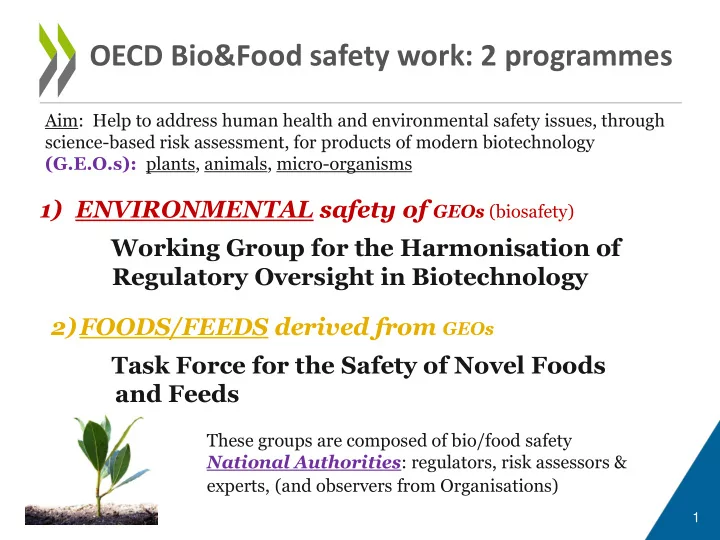
OECD Bio&Food safety work: 2 programmes Aim: Help to address human health and environmental safety issues, through science-based risk assessment, for products of modern biotechnology (G.E.O.s): plants, animals, micro-organisms 1)


slide-1
SLIDE 1

1) ENVIRONMENTAL safety of GEOs (biosafety) Working Group for the Harmonisation of Regulatory Oversight in Biotechnology 2)FOODS/FEEDS derived from GEOs Task Force for the Safety of Novel Foods and Feeds

These groups are composed of bio/food safety National Authorities: regulators, risk assessors & experts, (and observers from Organisations)

1

OECD Bio&Food safety work: 2 programmes

Aim: Help to address human health and environmental safety issues, through science-based risk assessment, for products of modern biotechnology (G.E.O.s): plants, animals, micro-organisms

slide-2
SLIDE 2

Consensus documents: Tools for risk assessment

Is this new food-feed as safe as its conventional counterpart? OECD docs collate key composition elements on foods and feeds issued from G.E. organisms, with compiled data, for possible comparison. The elements are considered --and completed-- at national level.

Environmental Safety

Consensus Documents

Food/Feed Safety

Consensus Documents On which features should my environmental RA be based on? OECD docs provide info. on what should be considered for risk assessment of G.E. organisms to be released in the environment. The elements are considered --and completed-- at national level.

2

  • Scientific information reference, internationally

recognised, a common basis

  • However NOT prescriptive (= not a compulsory standard)
slide-3
SLIDE 3

CROP PLANTS BIOSAFETY FOOD/FEED

Alfalfa Barley Cassava Cowpea

in progress

Cotton Common bean Grain sorghum Maize

under revision under revision

Oilseed rape

Brassica spp.

  • Rev. 2012

Canola

  • Rev. 2011

Peppers Potato Rice

  • Rev. 2016

under revision

Soybean

  • Rev. 2012

Pumpkins Sugar beet Sugarcane Sunflower Sweet potato Tomato

in progress

Wheat

under revision

Overview of OECD Consensus Documents Plant species (August 2016)

  • Fruits
  • Mushrooms
  • Crop Plants
  • (Forest & plantation Trees: biosafety only)

FRUITS BIOSAFETY FOOD/FEED

Apple

in progress in progress

Bananas & plantains Papaya Stone fruits (e.g. plum)

MUSHROOMS BIOSAFETY FOOD/FEED Cultivated mushroom

Oyster mushroom

slide-4
SLIDE 4
  • OECD Novel Food & Feed Safety programme since 1999

4

OECD Consensus documents for novel food and feed safety assessment

  • 1990-2000: Basic principles of "substantial equivalence" and

"comparative approach" for safety assessment elaborated by FAO, WHO, and OECD

  • Practical approach: to compare the critical components of the

species: key nutrients, anti-nutrients, toxicants, (allergens, other

elements) between G.E.Os and conventional crops.

  • 2000-2003: The Codex Alimentarius Commission developed

principles and guidelines for foods derived from G.E.Os

(+ 2008 Annexes on G.E.O.s for nutritional/health benefits, and safety assessment in LLP situation in food)

  • OECD Consensus Documents on composition since 2001.

Collate science-based information for use during RA of a particular food/feed product. Reference for comparison.

slide-5
SLIDE 5

Example: RICE composition document (rev. 2016)

Terminology

  • I. Background: cultivated rice species, production and consumption,

processes, uses, appropriate comparators, breeding characteristics

5

  • II. Nutrients

a) Key nutrients in rice products for food use: CARBOHYDRATES

PROTEIN LIPIDS MINERALS VITAMINS

b) Key nutrients in rice products for feed use

  • III. Other constituents

a) Anti-nutrients and toxicants: Phytic acid Trypsin inhibitors Lectins… b) Allergens: 14-16 kDa proteins 33-kDa protein

  • IV. Suggested constituents to be analysed related to food use
  • V. Suggested constituents to be analysed related to feed use
slide-6
SLIDE 6

Table example: mineral content (1)

6

Paddy rice

Data source Juliano and Bechtel (1985) a ILSI-CCDB (2014) b Heuzé, Tran and Hassoun in Feedipedia (2015) NRC (1982)

MINERAL

range mean range mean range mean Macro-minerals (mg/g dry matter) Calcium 0.1-0.9 0.32 0.25-0.43 0.6 0.2-1.5 0.7 Magnesium 0.7-1.7 1.0 0.3-1.4 1.5 Phosphorus 2.0-4.5 2.89 2.49-3.35 2.9 1.9-4.7 3.2 Potassium 1.7-4.3 2.8 1.9-3.5 3.6 Silicon 12.6 Sulfur 0.5-1.9 0.5 Micro-minerals (μg/g dry matter) Copper 2-13 3 3.0 Iron 16-70 56.4 36.3-74.2 53 57.0 Manganese 20-109 82 46-117 20.0 Sodium 62-942 300 0-1000 600 Zinc 2.0-36 14 17.0

Notes:

  • a. Data from Juliano and Bechtel are presented on a fresh weight basis; values at 14% moisture in the literature were converted to those at % dry matter.
  • b. The data are obtained from measurements using an indica rice variety

Table 10a. Mineral content in paddy rice

slide-7
SLIDE 7

Table example: mineral content (2)

7

Notes:

  • a. Data from Juliano and Bechtel are presented on a fresh weight basis; values at 14% moisture in the literature were converted to those at % dry matter.

Table 10b. Mineral content in brown rice and other rice milling fractions

Brown rice Milled rice Hull Bran Germ Poli-shings

Data source Juliano and Bechtel (1985) a USDA (2014) Juliano and Bechtel (1985) a USDA (2014) Juliano and Bech tel (1985)

a

Juliano and Becht el (1985) a USDA (2014) Juliano and Bechtel (1985) a Juliano and Bechtel (1985)

a

MINERAL

range mean range mean range range mean range range Macro-minerals (mg/g dry matter) Calcium 0.1-0.6 0.32 0.1-0.3 0.12 0.7-1.5 0.3-1.4 0.61 0.2-1.2 0.6-0.8 Magnesium 0.2-1.7 1.61 0.2-0.6 0.29 0.3 5.8-15.1 8.32 5-15 7-8 Phosphorus 2.0-5.0 3.36 0.9-1.7 1.11 0.3-0.8 13-29 17.87 12-24 12-26 Potassium 0.7-3.2 2.77 0.8-1.5 0.98 1.7-8.7 12-23 15.82 13-17 8; 13 Silicon 0.7-1.6 0.1-0.5 74-110 3-6 0.5-1.0 1.3; 1.9 Sulfur 0.3-2.2 0.9 0.5 2.0 1.9 Micro-minerals (μg/g dry matter) Copper 1-7 3.13 2-3 2.10 35-45 10-40 7.76 10-40 6-30 Iron 2-60 18.5 2-33 18.8 45-110 100-500 197.5 70-209 50-180 Manganese 2-42 42.24 7-20 11.95 116-337 110-267 151.4 106-140 Sodium 20-395 60 6-100 30 78-960 83-390 50 162-740 trace-160 Zinc 7-33 22.8 7-27 12.9 10-47 50-300 64.3 66-300 20; 70

slide-8
SLIDE 8

In case of biofortified rice (e.g. golden rice)?

8

… « 16. Conventional breeding of rice as well as those based

  • n modern biotechnology can include considerations of

nutritive improvements with increased content (biofortification) of elements such as pro-vitamin A, iron,

  • r zinc. In these cases, the amonts of these components

are specifically evaluated for those objectives. » Breeding characteristics screened by developers

slide-9
SLIDE 9

Suggested elements to be analysed / FOOD use

9 Notes: 1. Proximates includes moisture, protein, fat, ash and carbohydrate (calculated). 2. B vitamins, namely thiamine (B1), riboflavin (B2), niacin (B3), pantothenic acid (B5) and Pyridoxine (B6), and E vitamin alpha-tocopherol, are suggested.

Table 14. Suggested nutritional and compositional parameters to be analysed in rice matrices for food use

Parameter Paddy rice

  • r Brown rice

Proximates1 X Total dietary fibre X Vitamins2 X Amino acids X Fatty acids X

slide-10
SLIDE 10

Suggested elements to be analysed / FEED use

10 Notes: 1. Proximates includes moisture, protein, fat, ash and carbohydrate (calculated).

Table 15. Suggested nutritional and compositional parameters to be analysed in rice matrices for feed use

Parameter Paddy rice Straw or Whole plant Proximates1 X X Acid detergent fibre X Neutral detergent fibre X Amino acids X

slide-11
SLIDE 11

Conclusions

  • Scientific information/ data contained in the OECD

composition documents can be used as reference in food and feed safety assessments

  • Other international/national documents & databases can be

usefully considered

  • Select/adapt the information from the OECD composition

documents (‘global’ documents) to national needs

  • ‘Biofortified’ elements to be considered separately
  • Suggested parameters to be analysed are… suggestions only!

11

slide-12
SLIDE 12

Consensus Documents & Product database available at:

www.oecd.org/biotrack

12

Thank You

OECD’s Biosafety Team: Peter Kearns; Takahiko Nikaido; Bertrand Dagallier; Mika Hosokawa

Contact: bertrand.dagallier@oecd.org