
SLIDE 1
Peter Madigan
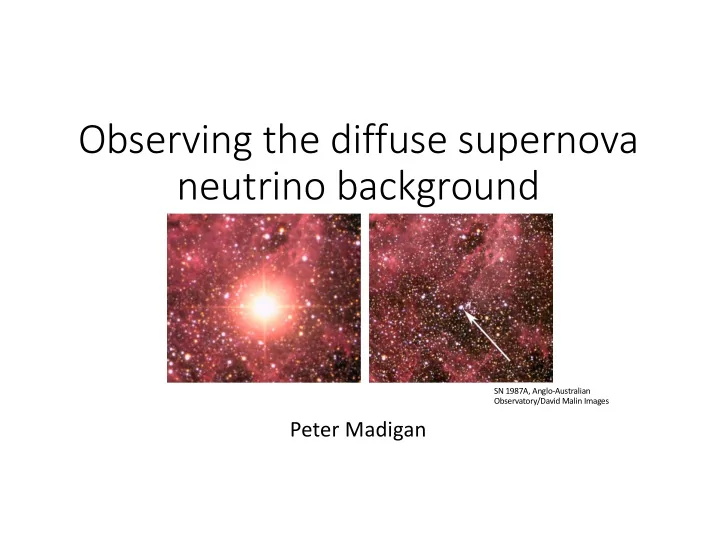
SN 1987A, Anglo-Australian Observatory/David Malin Images
Observing the diffuse supernova neutrino background SN 1987A, - - PowerPoint PPT Presentation
Observing the diffuse supernova neutrino background SN 1987A, Anglo-Australian Observatory/David Malin Images Peter Madigan Outline What is the diffuse supernova neutrino background (DSNB)? Why search for the DSNB? Recent DSNB searches
SN 1987A, Anglo-Australian Observatory/David Malin Images
11/8/16 290E - Peter Madigan 2
What is the diffuse supernova neutrino background (DSNB)? Why search for the DSNB? Recent DSNB searches Future of the DSNB
11/8/16 290E - Peter Madigan 3
H He C Fe
Stars fuse light nuclei into heavier and heavier nuclei. Requiring hotter temperatures to fuse. Iron ends the fusion cycle.
11/8/16 290E - Peter Madigan 4
H He C Fe
Stars fuse light nuclei into heavier and heavier nuclei. Requiring hotter temperatures to fuse. Iron ends the fusion cycle.
Fe
The inward gravitational pressure of the core eventually overcomes the
degeneracy pressure. (>8M) Collapsing the core into neutron star.
11/8/16 290E - Peter Madigan 5
During collapse,
99% of energy released (~0.2 solar masses) Core is on the order of nuclear densities so the neutrino scattering length is appreciable: Most of the energy is released through neutrinos. Neutrinos are likely emitted with a thermal spectrum.
φ(Eν) = E¯
νe,tot
120 7π4 E2
ν
T 4 1 eEν/T + 1
11/8/16 290E - Peter Madigan 6
During collapse,
99% of energy released (~0.2 solar masses) Core is on the order of nuclear densities so the neutrino scattering length is appreciable: Most of the energy is released through neutrinos. Neutrinos are likely emitted with a thermal spectrum.
φ(Eν) = E¯
νe,tot
120 7π4 E2
ν
T 4 1 eEν/T + 1
But how likely are we to see one of these?
11/8/16 290E - Peter Madigan 7
Not that likely… about 1 supernova within the Milky Way every 20-50 years. Last one in 1987:
SN 1987A, NASA 2007.
So do we just hope for another
11/8/16 290E - Peter Madigan 8
“Space is big. Really big. You just won't believe how vastly, hugely, mind-bogglingly big it is. I mean, you may think it's a long way down the road to the chemist, but that's just peanuts to space.”
At any given moment, there should be some neutrinos reaching Earth from some distant supernova. A number density using the supernova rate as a function of redshift:
ν) dt
supernovae,” New Journal of Physics, vol. 6, pp. 170–170, Nov. 2004.
11/8/16 290E - Peter Madigan 9
For astrophysics:
unaffected by interstellar dust.
the physics that occurs in this process. For particle physics:
angles.
implications in particle physics and in astrophysics.
11/8/16 290E - Peter Madigan 10
Roughly equal portions of all neutrino flavors. Thermal spectrum peaked at about 4-8 MeV. Isotropic. Flux comparable to low-energy atmospheric neutrinos. Low energy excludes CC interactions for muon and tau neutrinos. Cross-sections make NC/elastic scattering unlikely. Observation will likely be made through an inverse beta decay search.
11/8/16 290E - Peter Madigan 11
Generic detector e+ n
11/8/16 290E - Peter Madigan 12
Generic detector e+ n
Coincidence
11/8/16 290E - Peter Madigan 13
Generic detector e+ n
Coincidence
[1] K. Bays et al., “Supernova relic neutrino search at Super-Kamiokande,” Physical Review D, vol. 85, no. 5, Mar. 2012. [2] H. Zhang et al., “Supernova Relic Neutrino search with neutron tagging at Super-Kamiokande-IV,” Astroparticle Physics,
[3] A. Gando et al., “Search for extraterrestrial antineutrino sources with the KamLAND detector,” The Astrophysical Journal,
11/8/16 290E - Peter Madigan 14
50kt water Cherenkov detector buried 1000m underground in the Kamioka mine (Japan). Operating since 1996, published bounds
two different methods:
Biggest backgrounds:
11/8/16 290E - Peter Madigan 15 KamLAND (2012) [3] SuperK (2012) [1] SuperK (2015) [2] Figure from [2] Figure from [1]
11/8/16 290E - Peter Madigan 16
1kt liquid scintillator detector also in Kamioka mine. Running from 2002-11, searches for the DSNB through delayed coincidence. Backgrounds:
11/8/16 290E - Peter Madigan 17 (2003) Figure from [3] Figure from [3]
11/8/16 290E - Peter Madigan 18
Of course! Super-Kamiokande has an inverse beta decay efficiency of only 13%.
Figure from [4]
11/8/16 290E - Peter Madigan 19 Figures: P. Fernandez, “Status of GADZOOKS!: Neutron Tagging in Super-Kamiokande,” in Nuclear Physics B Proceedings Supplement 00 (2014), pp. 1–8.
Detectors,” Phys. Rev. Lett., vol. 93, no. 17, p. 171101, Oct. 2004.
11/8/16 290E - Peter Madigan 20
Liquid argon detector (DUNE): Water-based liquid scintillator (ASDC/THEIA): Large liquid scintillator detector (JUNO):
νe +40 Ar → e− +40 K∗ ¯ νe +40 Ar → e+ +40 Cl∗
www.dunescience.org arxiv:1409.5864 arxiv:1507.05613 arxiv:1504.08284
11/8/16 290E - Peter Madigan 21
next near-by supernova.
factor of <10).
11/8/16 290E - Peter Madigan 22
[1] K. Bays et al., “Supernova relic neutrino search at Super-Kamiokande,” Physical Review D,
[2] H. Zhang et al., “Supernova Relic Neutrino search with neutron tagging at Super- Kamiokande-IV,” Astroparticle Physics, vol. 60, pp. 41–46, Jan. 2015. [3] A. Gando et al., “Search for extraterrestrial antineutrino sources with the KamLAND detector,” The Astrophysical Journal, vol. 745, no. 2, p. 193, Feb. 2012. [4] S. Horiuchi, J. F. Beacom, and E. Dwek, “Diffuse supernova neutrino background is detectable in Super-Kamiokande,” Phys. Rev. D, vol. 79, no. 8, p. 083013, Apr. 2009. + others where cited.