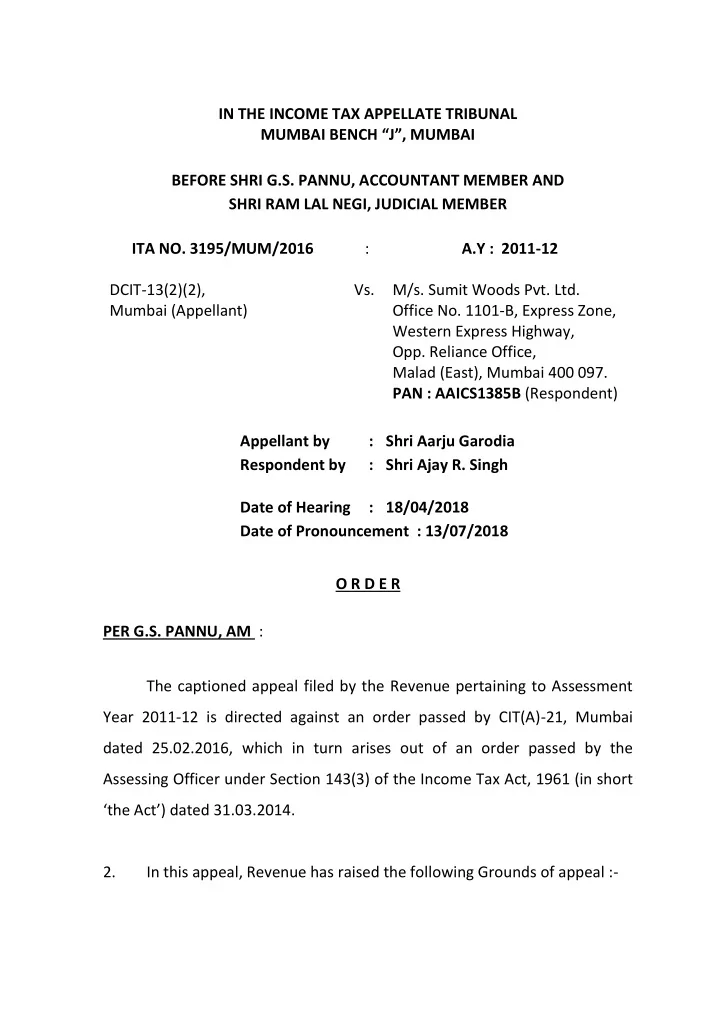
SLIDE 1 IN THE INCOME TAX APPELLATE TRIBUNAL MUMBAI BENCH “J”, MUMBAI BEFORE SHRI G.S. PANNU, ACCOUNTANT MEMBER AND SHRI RAM LAL NEGI, JUDICIAL MEMBER ITA NO. 3195/MUM/2016 : A.Y : 2011-12 DCIT-13(2)(2), Mumbai (Appellant) Vs. M/s. Sumit Woods Pvt. Ltd. Office No. 1101-B, Express Zone, Western Express Highway,
Malad (East), Mumbai 400 097. PAN : AAICS1385B (Respondent) Appellant by : Shri Aarju Garodia Respondent by : Shri Ajay R. Singh Date of Hearing : 18/04/2018 Date of Pronouncement : 13/07/2018 O R D E R PER G.S. PANNU, AM : The captioned appeal filed by the Revenue pertaining to Assessment Year 2011-12 is directed against an order passed by CIT(A)-21, Mumbai dated 25.02.2016, which in turn arises out of an order passed by the Assessing Officer under Section 143(3) of the Income Tax Act, 1961 (in short ‘the Act’) dated 31.03.2014. 2. In this appeal, Revenue has raised the following Grounds of appeal :-
SLIDE 2
2 ITA No. 3195/Mum/2016 M/s. Sumit Woods Pvt. Ltd.
“1. On the facts and the circumstances of the case and in law, the ld. CIT(A) erred in deleting the addition of Rs.5,25,00,000/- of unexplained share capital and share premium as the assessee failed to give the book value per share and not justified charging of any share premium on shares. 2. On the facts and the circumstances of the case and in law, the ld. CIT(A) erred in deleting the addition of Rs.8,67,118/- of expenditure incurred by way of interest during the previous year which is not directly attributable to any particular income or received, an amount computed as per Rule 8D. 3. On the facts and the circumstances of the case and in law, the ld. CIT(A) erred in deleting the addition of interest of Rs.29,91,631/- made u/s 37(1) to the extent of loans and advances of Rs.3,37,00,074/- given by the assessee without receiving of interest inspite of payment of interest of Rs.62,37,510/-. 4. The appellant prays that the order of the CIT(A) on the above grounds be set aside and that of the Assessing Officer be restored.”
3. The appellant before us is a company incorporated under the provisions of the Companies Act, 1956 and is, inter-alia, engaged in the business of builders, contractors and developers. For the assessment year under consideration, it filed a return of income declaring an income of Rs.1,94,05,793/-, which was subject to a scrutiny assessment whereby the total income has been assessed at Rs.7,85,98,270/- after making certain additions/disallowances which were carried in appeal before the CIT(A). The CIT(A) has allowed substantial relief, against which the Revenue is in appeal before us on the abovestated Grounds of appeal. The Grounds raised by the Revenue shall be taken up hereinafter in seriatim. 4. Insofar as the Ground of appeal no. 1 is concerned, the same relates to the addition of Rs.5,25,00,000/- made by the Assessing Officer on account
SLIDE 3 3 ITA No. 3195/Mum/2016 M/s. Sumit Woods Pvt. Ltd.
- f unexplained Share Capital and Share Premium by invoking Sec. 68 of the
- Act. In this context, the relevant facts are that the respondent-assessee is a
closely held company which is in the business of construction for more than 10 years. During the year under consideration, assessee made a preferential issue of equity capital of 2,62,500 equity shares of face value of Rs.10/- each at a premium of Rs.190 per share. Thus, it raised Equity Capital of Rs.26,25,000/- and Share Premium of Rs.4,98,75,000/- aggregating to Rs.5,25,00,000/-. In the course of assessment proceedings, the Assessing Officer required the assessee to furnish details of the source of Share Capital raised and the Share Premium and confirmation of the receipts supported by the relevant documentary evidence. The allottee of the Share Capital was M/s. Sumit Infotech Pvt. Ltd., a group concern, which was already holding shares in the assessee-company. The discussion in the assessment order reveals that a notice u/s 133(6) of the Act was also issued by the Assessing Officer to M/s. Sumit Infotech Pvt. Ltd. requiring it to furnish details of its income-tax particulars, PAN, copy of financial statements of the relevant period, copy of application for share allotment, copy of bank statement, etc. Before the Assessing Officer, assessee furnished the requisite details and also justified the Share Premium charged @ Rs.190/- per share. In support, assessee referred to a Valuation Report, which was obtained by it prior to issuance of fresh Share Capital, which showed the book value of the Equity shares at Rs.27/- per share and Earnings Per Share (EPS) ratio of 2.43. The assessee justified the Share Premium by future projections and comparing the PE ratios of other companies in the same business. The Assessing Officer, however, was not satisfied with the explanation furnished by the
- assessee. The Assessing Officer was also not satisfied with the
creditworthiness of the allottee, i.e. M/s. Sumit Infotech Pvt. Ltd. and he was
SLIDE 4 4 ITA No. 3195/Mum/2016 M/s. Sumit Woods Pvt. Ltd.
also not satisfied with the genuineness of the transaction. With regard to the allottee, M/s. Sumit Infotech Pvt. Ltd., the Assessing Officer noted that in Assessment Years 2008-09 to 2010-11, the said concern had carried forward losses and that the Balance-sheet of the instant year showed that it had raised Share Capital
Rs.49,00,000/- and Share Premium
Rs.4,75,00,000/-. According to the Assessing Officer, this reflected that M/s. Sumit Infotech Pvt. Ltd. had raised the Capital only for making further investments in the assessee-company. The Assessing Officer treated the entire sum of Rs.5,25,00,000/- inclusive of Equity Share Capital and Share Premium as the ‘unexplained cash credit’ within the meaning of Sec. 68 of the Act. 5. Before the CIT(A), assessee made varied submissions on facts as well as in law. The CIT(A) noted that the investor in question, i.e. M/s. Sumit Infotech Pvt. Ltd., was identified and that the payment has been received through banking channels. The CIT(A) also noted that M/s. Sumit Infotech
- Pvt. Ltd. was an existing assessee who was being subjected to tax.
Pertinently, the CIT(A) examined the facts as to whether the ingredients of
- Sec. 68 of the Act, namely, the identity and creditworthiness of the investor
and the genuineness of the transaction has been established or not? In this context, the findings of the CIT(A) is contained in para 4.8 of his order, which reads as under :-
“4.8 Thus, it can be safely concluded that even in case of credit appearing as share capital and premium, section 68 can be invoked in the case of a private limited company. Now coming to the facts of this case, the investment has been made by SIPL. The copy of audited accounts and the bank statements of SIPL and source of funds received by SIPL have been
SLIDE 5 5 ITA No. 3195/Mum/2016 M/s. Sumit Woods Pvt. Ltd.
- filed. The same was before the assessing officer. The confirmation of the
transaction was filed by SIPL in response to notice issued u/s 133(6) by the assessing officer. It is further seen that assessment order u/s 143(3) has been passed in the case of SIPL dated 31.01.2014 for AY 2011-12. Thus, the onus of explaining the identity, credit worthiness and genuineness of the credit as share application has been discharged by the appellant and the burden shifts on the assessing officer to show that the amount received is income of the appellant. If there is any doubt as regards the money received by SIPL, additions can be made, if justified, in the hands of SIPL and not the appellant here.”
6. After recording the aforesaid findings, the CIT(A) also addressed the main objection of the Assessing Officer to the effect that the Share Premium charged by the assessee was not justified. The CIT(A) noted that the investment was made by a group concern and that it could have been also made at the face value; that subscription to the Share Capital made at a premium led to savings on stamp duty on raising of Authorised Share Capital by the assessee-company and it made no difference in the control held by the promoters or the investment brought in. Be that as it may, the CIT(A) also examined as to whether the receipt towards shares issued by a private company in excess of its face value, to the extent it exceeds its fair market value, can be taxed or not. In this context, the CIT(A) referred to the provisions of Sec. 56(2)(viib) of the Act which according to him would apply in such a situation. However, the CIT(A) noted that the said section was applicable w.e.f. 01.04.2013 and thus it was not applicable for the assessment year under consideration. Thus, he confined himself to examining the requirements of Sec. 68 of the Act qua the entire amount of Share Capital inclusive of Share Premium and his conclusion is contained in para 4.13 and 4.14 of his order, which reads as under :-
SLIDE 6 6 ITA No. 3195/Mum/2016 M/s. Sumit Woods Pvt. Ltd.
“4.13 I am aware that the receipt towards shares issued by a private company in excess of its face value to the extent it exceeds its fair market value is taxable as income from other sources as per section 56(2)(viib). However, this section is w.e.f. 1-4-2013 and thus not applicable to current assessment year 2011-12. It is also to be noted that section 68 and section 56(2)(viib) operate in different fields. Thus, if any credit gets hit by section 68 on failure to discharge the onus of showing identity, creditworthiness and genuineness of transactions, the section 56(2)(viib) need not be invoked and the entire credit is deemed to be the income. However, even if credit meets the requirement of section 68, if the shares issued at a premium exceeds the fair market value, such excess over fair market value will be assessable as income for AY 13-14 onwards. In the present case the projections given by the appellant has not been accepted by the assessing
- fficer implying that shares have been issued at price higher than the
market value. 4.14 In the facts of the present case, the identity of the investor SIPL is not in doubt. It had share capital and reserves and loans of Rs 578 lakhs
- ut of which investment of Rs 525 lakhs were made. The same were made
through banking channels. The investment is reflected in its audited
- accounts. If there are doubts regarding the amount raised by SIPL, the
correct course is to investigate that and if justified, make additions in the hands of SIPL. Such addition cannot be made in the hands of the appellant. This is the view supported by the decisions in the cases of CIT vs Lovely Exports Pvt. Ltd. 216 CTR 195 (SC) and CIT vs Divine Leasing & Finance Ltd. 299 ITR 268 (Del.)”
In this manner, the CIT(A) deleted the entire addition of Rs.5,25,00,000/-, against which the Revenue is in appeal before us. As a perusal of the Ground of appeal no.1 reveals that the sum and substance of the stand of the Revenue before us is that assessee had failed to provide the book value per share and, therefore, it could not justify charging of Share Premium on the Share Capital raised during the year under consideration. Pertinently, the factual findings arrived at by the CIT(A) to the effect that the necessary
SLIDE 7 7 ITA No. 3195/Mum/2016 M/s. Sumit Woods Pvt. Ltd.
ingredients of Sec. 68 of the Act have been complied in the instant case, have not at all been assailed by the Revenue. It is also noteworthy that the Assessing Officer chose to invoke Sec. 68 of the Act in order to treat the entire credit of Rs.5,25,00,000/-, which was inclusive of Share Capital as well as Share Premium, as ‘unexplained cash credit’. Ostensibly, as the Assessing Officer had invoked Sec. 68 of the Act, the CIT(A) examined its efficacy and
- n the basis of his appreciation of the factual position, he concluded that
assessee has discharged the onus cast on it u/s 68 of the Act. In the Grounds
- f appeal raised before us, the Revenue has not assailed any of such findings
arrived at by the CIT(A). 8. At the time of hearing, the learned representative for the respondent- assessee, even in the context of the reasonableness of the Share Premium charged of Rs.190/- per share, explained that the book value of the assessee’s shares was Rs. 27/- per share and the issue value of Rs.200/- per share (face value of Rs.10/- plus Share Premium of Rs.190/-) was not abnormally high considering that the future projection of business and history of carrying on business for last 10 years. In any case, it is sought to be pointed out that the creditworthiness of the investor, i.e. M/s. Sumit Infotech Pvt. Ltd., stood established by the fact that an assessment in its case was made u/s 143(3) of the Act dated 31.01.2014 for Assessment Year 2011-12 wherein the source available with it to invest in the Share Capital of the assessee-company has not been doubted. Before us, reference has been made to the various papers placed in the Paper Book, which were also before the CIT(A) and which have formed the basis for the CIT(A) to arrive at his factual findings. Thus, it is noticeable that the findings arrived at by the CIT(A) are on the basis of the relevant material and is borne out of record.
SLIDE 8 8 ITA No. 3195/Mum/2016 M/s. Sumit Woods Pvt. Ltd.
Even on the aspect of genuineness of the transaction, we find that the Assessing Officer merely went by surmises and conjectures without establishing any infirmity. In fact, the financial statements of the investor, M/s. Sumit Infotech Pvt. Ltd. itself show that it had raised Share Capital of Rs.5,24,00,000/- being Equity Share Capital of Rs.49,00,000/- and Share Premium of Rs.4,75,00,000/- which it has used to subscribe to assessee company’s Share Capital. The learned representative pointed out that before the lower authorities it was canvassed that the investor company was having surplus funds with uncertain timeframe to commence its business and, therefore, it invested into assessee-company in order to deploy its funds for productive purposes. We find that all said aspects were very much before the Assessing Officer, who has merely disbelieved the same without establishing any infirmity therein. Therefore, under these circumstances, in
- ur considered opinion, the decision of the CIT(A) does not merit any
inference, which we hereby affirm. Thus, so far as Ground of appeal no. 1 is concerned, the same is dismissed. 9. Ground of appeal no. 2 relates to an amount of Rs.8,67,118/- which was disallowed u/s 14A of the Act. The said addition has since been deleted by the CIT(A), against which Revenue is in appeal before us. 10. In this context, the relevant facts are that in the return of income, assessee had claimed exemption on account of dividend income of Rs.5,017/-. The Assessing Officer applied Rule 8D of the Income Tax Rules, 1962 (in short ‘the Rules’) and made a disallowance of Rs.11,83,575/- u/s 14A of the Act. Assessee had canvassed before the Assessing Officer that no expenditure was incurred for earning such tax-free income. Before the
SLIDE 9 9 ITA No. 3195/Mum/2016 M/s. Sumit Woods Pvt. Ltd.
CIT(A), assessee explained that the dividend in question was received on shares of Saraswat Co-operative Bank Ltd. and that such investment was necessitated on account of assessee availing credit facilities from the said Co-operative Bank. In any case, assessee explained that the said dividend was not exempt u/s 10(34) of the Act and that the claim of exemption of Rs.5,017/- u/s 10(34) of the Act was a wrong claim. It consequently pleaded that in the absence of any exempt income, no disallowance u/s 14A of the Act could be made. The CIT(A) noted that assessee had incurred interest expenditure on vehicle loan and working capital loan availed from Saraswat Co-operative Bank Ltd. and since these were specific loans, the corresponding interest expenditure could not be considered for working of disallowance in terms of Rule 8D(2)(ii) of the Rules. He, therefore, directed the Assessing Officer to exclude the interest on such loans while working the disallowance under Rule 8D of the Rules. Against such a decision of the CIT(A), Revenue is in appeal before us. 11. Having considered the respective orders of the authorities below, we find that the CIT(A) made no mistake in directing the Assessing Officer to exclude the interest on specific loans, which obviously are used for activities
- ther than earning of exempt income. In the absence of any credible and
cogent reason, we find no reasons to interfere with the decision of CIT(A). Thus, on this aspect also, Revenue fails. 12. The last Ground in this appeal is with regard to the action of CIT(A) in deleting the addition of Rs.29,91,631/- out of interest expenditure. The relevant facts in this regard are that during the assessment proceedings, the Assessing Officer noted that assessee had incurred interest expenditure of
SLIDE 10 10 ITA No. 3195/Mum/2016 M/s. Sumit Woods Pvt. Ltd.
Rs.62,37,510/- on loans raised whereas no interest was received on the loans given out by the assessee. The Assessing Officer proceeded on the presumption that interest-free loans were made out of mixed bag created by way of interest bearing as well as non-interest bearing funds. The Assessing Officer noted that loans and advances given free of interest were Rs.3,37,00,074/-. He, therefore, computed proportionate interest at Rs.29,91,631/- and disallowed the same. In appeal before the CIT(A), assessee canvassed that no loans or advances were given for purposes other than business purpose. The figure of interest-free loans and advances of Rs.3,37,00,074/- adopted by the Assessing Officer was also challenged and it was asserted that the same does not match with the financial statements wherein loans and advances given were to the tune of Rs.1,63,80,949/- only, which too were given only for business purposes. In the context of the aforesaid factual aspects canvassed before him, the CIT(A) called for comments of the Assessing Officer, but in para 6.3 of his order it is observed that no report was received from the Assessing Officer. Thereafter, he has proceeded to dispose off the issue in the following manner :-
“6.3 A letter dated 4.02.2016 was written to the assessing officer informing that as per the appellant he figures stated in the order at Rs.3,37,00,074/- towards loans and advances does not match in the financial statement. Comments were called after verification. No report has been received from the assessing officer. 6.4 It is noticed that the assessing officer has mentioned capital WIP at some places and loans and advances at other at Rs.3,37,00,074/- for computing the disallowances. There are no capital WIP shown in the balance sheet. Even the loans and advances figure in the balance sheet is
- different. No clarification has been submitted by the assessing officer. It
appears that the assessing officer has taken the figure of sundry creditors
SLIDE 11 11 ITA No. 3195/Mum/2016 M/s. Sumit Woods Pvt. Ltd.
which is absolutely incorrect as it appears under liabilities. The appellant has filed details to show that the loans and advances are business advances and cannot also be held as non-business advances. The assessment order does not discuss any item to show that it is not for
- business. In this fact matrix, the disallowances made out of interest
expenses are not tenable and are deleted. This ground of appeal is allowed.”
13. The aforesaid discussion by the CIT(A) clearly brings out that the very basis adopted by the Assessing Officer to disallow a portion of the interest expenditure is misplaced. The Assessing Officer proceeds on the basis that loans and advances given interest-free is to the tune of Rs.3,37,00,074/- whereas as per the CIT(A) no such figure appears in the financial statements. The CIT(A) also records a categorical finding that so far as the loans and advances appearing in the financial statements are concerned, the same have been given for business purposes and cannot be held to be advanced for non-business purposes. In this manner, he has deleted the entire disallowance out of the interest expenditure. 14. Before us, the ld. DR has not referred to any material or evidence which would require us to interfere with the findings of the CIT(A), which we hereby affirm. Pertinently, the decision of the CIT(A) was preceded by his communication to the Assessing Officer asking for his say on the factual assertions of the assessee that no advances of the nature noted by the Assessing Officer were made free of interest. It is also specifically noted by the CIT(A) that there was no report or comments received from the Assessing Officer in this regard. Even before us, the Revenue has not brought out any material to controvert the factual assertions of the assessee which have been found to be acceptable by the CIT(A) on the basis of his
SLIDE 12
12 ITA No. 3195/Mum/2016 M/s. Sumit Woods Pvt. Ltd.
examination of the material on record. Therefore, under these circumstances, we find no reason to interfere with the decision of the CIT(A), which is hereby affirmed. Thus, on this aspect also, Revenue fails. 15. In the result, appeal of the Revenue is dismissed. Order pronounced in the open court on 13th July, 2018. Sd/- Sd/- (RAM LAL NEGI) JUDICIAL MEMBER (G.S. PANNU) ACCOUNTANT MEMBER Mumbai, Date : 13th July, 2018
*SSL*
Copy to : 1) The Appellant 2) The Respondent 3) The CIT(A) concerned 4) The CIT concerned 5) The D.R, “J” Bench, Mumbai 6) Guard file By Order Dy./Asstt. Registrar I.T.A.T, Mumbai