NUSTAR Annual Meeting 2013 Nuclear Structure Features as a Guide to - - PowerPoint PPT Presentation

nustar annual meeting 2013 nuclear structure features as
SMART_READER_LITE
LIVE PREVIEW

NUSTAR Annual Meeting 2013 Nuclear Structure Features as a Guide to - - PowerPoint PPT Presentation

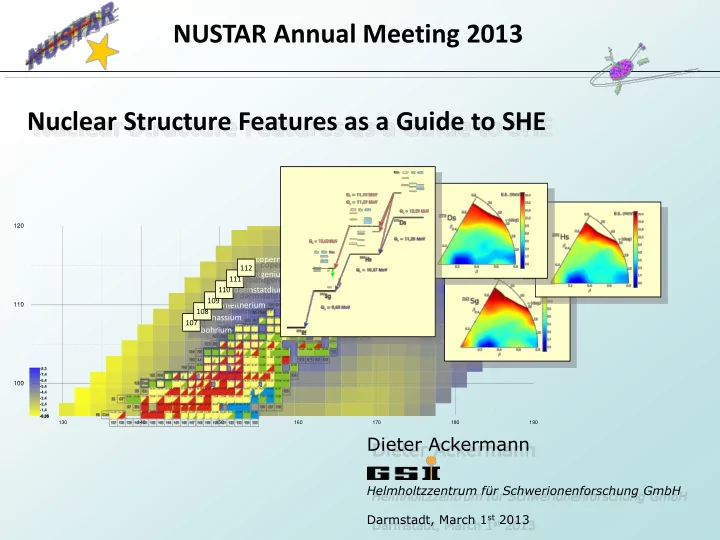
NUSTAR Annual Meeting 2013 Nuclear Structure Features as a Guide to SHE 120 copernicium 112 roentgenium 111 110 darmstatdium 109 meitnerium 110 108 hassium 107 bohrium -8,3 -7,4 -6,4 100 -5,4 -4,4 -3,4 -2,4 -1,4 -0,35 -0,25 130


slide-1
SLIDE 1

Dieter Ackermann NUSTAR Annual Meeting 2013 Darmstadt, March 1sth 2013

130 140 150 160 170 180 190

100 110 120

  • 8,3
  • 7,4
  • 6,4
  • 5,4
  • 4,4
  • 3,4
  • 2,4
  • 1,4
  • 0,35
  • 0,25

107

bohrium

108 hassium 109 meitnerium 110 darmstatdium 111

roentgenium

112

copernicium

Nuclear Structure Features as a Guide to SHE

Dieter Ackermann

Helmholtzzentrum für Schwerionenforschung GmbH Darmstadt, March 1st 2013

NUSTAR Annual Meeting 2013

slide-2
SLIDE 2

Dieter Ackermann NUSTAR Annual Meeting 2013 Darmstadt, March 1sth 2013

130 140 150 160 170 180

  • 8,3
  • 7,4
  • 6,4
  • 5,4
  • 4,4
  • 3,4
  • 2,4
  • 1,4
  • 0,35
  • 0,25

152

Nuclear Structure studies at SHIP

  • outline

discovered at SHIP new or improved decay data Eshell

Calc.: A. Sobszewiski 120 114 108 162 184

107 bohrium 108 hassium 109 meitnerium 110 darmstatdium 111 roentgenium 112 copernicium

spherical shell-stabilised superheavy nuclei deformed shell-stabilised superheavy nuclei

  • Nuclear structure features of superheavy nuclei
  • single particle levels  towards the shell gap (trends along isotone/isotope chains)
  • quasiparticle excitations  deformation/K-isomers
  • sf-properties  stability
  • Decay spectroscopy
  • separation + coincidences
  • , , e-, sf measurements
  • Ion traps (SHIPTRAP)
  • precise mass measurements
  • trap assisted spectroscopy
slide-3
SLIDE 3

Dieter Ackermann NUSTAR Annual Meeting 2013 Darmstadt, March 1sth 2013

RMF+BCS …+QVC RMF+BCS …+QVC

PC+QVC: Formation of the „shell gap“ ! 0.28 0.30

Comparable Spectroscopic strengths

Elena Litvinova

FUSHE 2012

Shell evolution in superheavy Z = 120 isotopes: QVC in relativistic framework – dominant n-states

slide-4
SLIDE 4

Dieter Ackermann NUSTAR Annual Meeting 2013 Darmstadt, March 1sth 2013

Shell evolution in superheavy Z = 120 isotopes: QVC in relativistic framework

Vibrational corrections: 1. Impact on the shell gaps

  • 2. Smearing
  • f the shell

effects

  • 1. Relativistic Mean Field: spherical minima
  • 2. Small amplitude vibrations: RQRPA
  • 3. Very soft nuclei: large amount of low-lying collective

vibrational modes (~100 phonons below 15 MeV)

296 298 300 302 304 11 12 13

Q [MeV] A

RMF RMF+QVC

Z = 120

Vibration corrections to alpha decay energies Q [MeV] Shell stabilization & vibration stabilization/destabilization (?) E.L., arXiv:1108.3508

Elena Litvinova

PRC 85, 021303(R) 2012

slide-5
SLIDE 5

Dieter Ackermann NUSTAR Annual Meeting 2013 Darmstadt, March 1sth 2013

184 162 126 152

neutrons protons

82 114 100 102 96 142 134 108

9/2-[734] j15/2 d5/2

1/2+[631]

7/2-[514]

h9/2 f5/2

1/2-[521]

f7/2

7/2+[633]

i13/2

3/2-[521]

g9/2

7/2+[624]

Nuclear Structure of Heavy Nuclei

  • Single Particle Levels and Deformation
slide-6
SLIDE 6

Dieter Ackermann NUSTAR Annual Meeting 2013 Darmstadt, March 1sth 2013

9/2

+

9/2

+

200

Present status of nuclear structure investigations of odd A odd Z elements in the region Z = 99 -105

Level assignments are partly tentive

243 9/2

+(?)

207Pb( 48Ca,2n) 253No

  • EC->

253Md

209Bi( 48Ca,2n) 255Lr 209Bi( 50Ti,2n) 257Db 209Bi( 40Ar,2n) 247Md niv_mend_alles_aktuell, FPH 10.1.2006

9/2

+[624] ?

9/2

+[624] ?

261Db 259Db

8930

257Lr 259Lr

7/2

  • [514]

7/2

  • [514]

8796 8861 9/2

  • ?

7/2

  • [514]

7/2

  • [514]

7100

253Md 251Md

353 (E1 ?)

249Es 247Es

3/2

  • [521] ?

7/2

+[633]

7/2

  • [514]

7/2

  • [514]

no  3/2

  • [521] ?

3/2

  • [521] ?

3/2

  • [521]

253 (E1) 9/2

  • 7/2
  • [514]

9/2

+

7/2

+[633]

7/2

+[633]

405 (E1) 453 (E1) 7/2

  • [514]

7/2

  • [514]

7752 7714 7327 7274 8450

8470 251Es 255Md 255Lr

8785 1/2

  • [521]

157 7/2

+[633]

9074 9474

257Db

8967 9163

253Lr

9/2

+[624]

1/2

  • [521]

1/2

  • [521]

1/2

  • [521]

9/2

  • ?

7/2

  • [514]

?

8385

no  8794 8722 1/2

  • [521]

8030 7540 1/2

  • [521]

1/2

  • [521]

sf 7/2

  • [514]

7/2

  • [514]

7/2

  • [514]

7/2

  • [514]

294 (E1) 7/2

+[633]

8421

249Md 247Md 245Es 243Es

210 (E1) 9/2

+

9/2

+

200

Present status of nuclear structure investigations of odd A odd Z elements in the region Z = 99 -105

Level assignments are partly tentive

243 9/2

+(?)

207Pb( 48Ca,2n) 253No

  • EC->

253Md

209Bi( 48Ca,2n) 255Lr 209Bi( 50Ti,2n) 257Db 209Bi( 40Ar,2n) 247Md niv_mend_alles_aktuell, FPH 10.1.2006

9/2

+[624] ?

9/2

+[624] ?

261Db 259Db

8930

257Lr 259Lr

7/2

  • [514]

7/2

  • [514]

8796 8861 9/2

  • ?

7/2

  • [514]

7/2

  • [514]

7100

253Md 251Md

353 (E1 ?)

249Es 247Es

3/2

  • [521] ?

7/2

+[633]

7/2

  • [514]

7/2

  • [514]

no  3/2

  • [521] ?

3/2

  • [521] ?

3/2

  • [521]

253 (E1) 9/2

  • 7/2
  • [514]

9/2

+

7/2

+[633]

7/2

+[633]

405 (E1) 453 (E1) 7/2

  • [514]

7/2

  • [514]

7752 7714 7327 7274 8450

8470 251Es 255Md 255Lr

8785 1/2

  • [521]

157 7/2

+[633]

9074 9474

257Db

8967 9163

253Lr

9/2

+[624]

1/2

  • [521]

1/2

  • [521]

1/2

  • [521]

9/2

  • ?

7/2

  • [514]

?

8385

no  8794 8722 1/2

  • [521]

8030 7540 1/2

  • [521]

1/2

  • [521]

sf 7/2

  • [514]

7/2

  • [514]

7/2

  • [514]

7/2

  • [514]

294 (E1) 7/2

+[633]

8421

249Md 247Md 245Es 243Es

210 (E1)

Nuclear Structure of the Heaviest Nuclei:

  • odd-A odd-Z Istopes for Z = 99 -105

increasing deformation

slide-7
SLIDE 7

Dieter Ackermann NUSTAR Annual Meeting 2013 Darmstadt, March 1sth 2013

Deformation of odd-mass Es-isotopes as function of mass number

  • Relation between energy of 7/2-[514] level and deformation

82

protons

82 114 100 102 96 108

7/2-[514]

h9/2 f5/2

1/2-[521]

f7/2

7/2+[633]

i13/2

3/2-[521]

slide-8
SLIDE 8

Dieter Ackermann NUSTAR Annual Meeting 2013 Darmstadt, March 1sth 2013

10 20 30 40 50

9000 9100 9200 9300 9400 9500 9600 9700 200 400 600

a)

stop stop + box

9702 keV 255 ms 9240 keV 296 ms 9545 keV 254 ms 9610 keV 411 ms 9035 keV 392 ms

Counts

b)

E / keV

E / keV

(462) (1/2+[620] ?) 1/2+[620]

9240 keV, 196 ms, (HF=30)

254 ms 411 ms

255Rf 259Sg

11/2-[725] 11/2-[725] 5/2+[622] 9/2-[734]

9610 keV, 411 ms, HF=26 9702 keV, 255 ms, HF=4500 9545 keV, 254 ms, HF=40 9 3 5 , 3 9 2 m s , H F = 4 (92) (594) (157)

105 120 135 150 165 180 195 210 225 240

2 4 6 8 10 12 14 16 18

sf(259Sg) (bsf = 6%) E = 180 MeV (uncorr.)

E = 11 MeV (FWHM)

sf (255Rf) (bsf=50%) E = 165 MeV (uncorrected)

E = 31 MeV (FWHM)

Events / 5 MeV E / MeV (Stop detector)

  • Production: 206Pb(54Cr,1n)259Sg, σ  1 nb
  • α-decay from two low lying levels
  • TKE(sf) of 259Sg >15 MeV higher than for

255Rf; change from asymmetric to symmetric fission

  • T1/2(sf, 259Sg) ≈ 235 ms; sf from 1/2+[620]
  • change of gs – configuration within N = 153

isotones from 1/2+[620] to 11/2-[725]

F.P. Heßberger et al.

Decay Study of 259Sg (Z=106)

  • sf Properties, Low Lying States and Trend for N=153 Tsotones
slide-9
SLIDE 9

Dieter Ackermann NUSTAR Annual Meeting 2013 Darmstadt, March 1sth 2013

10 20 30 40 50

9000 9100 9200 9300 9400 9500 9600 9700 200 400 600

a)

stop stop + box

9702 keV 255 ms 9240 keV 296 ms 9545 keV 254 ms 9610 keV 411 ms 9035 keV 392 ms

Counts

b)

E / keV

E / keV

(462) (1/2+[620] ?) 1/2+[620]

9240 keV, 196 ms, (HF=30)

254 ms 411 ms

255Rf 259Sg

11/2-[725] 11/2-[725] 5/2+[622] 9/2-[734]

9610 keV, 411 ms, HF=26 9702 keV, 255 ms, HF=4500 9545 keV, 254 ms, HF=40 9 3 5 , 3 9 2 m s , H F = 4 (92) (594) (157)

105 120 135 150 165 180 195 210 225 240

2 4 6 8 10 12 14 16 18

sf(259Sg) (bsf = 6%) E = 180 MeV (uncorr.)

E = 11 MeV (FWHM)

sf (255Rf) (bsf=50%) E = 165 MeV (uncorrected)

E = 31 MeV (FWHM)

Events / 5 MeV E / MeV (Stop detector)

  • Production: 206Pb(54Cr,1n)259Sg, σ  1 nb
  • α-decay from two low lying levels
  • TKE(sf) of 259Sg >15 MeV higher than for

255Rf; change from asymmetric to symmetric fission

  • T1/2(sf, 259Sg) ≈ 235 ms; sf from 1/2+[620]
  • change of gs – configuration within N = 153

isotones from 1/2+[620] to 11/2-[725]

F.P. Heßberger et al.

Decay Study of 259Sg (Z=106)

  • sf Properties, Low Lying States and Trend for N=153 Tsotones

100 200 300 400 500 600 700 800

0.25 s 4 s

259Sg 257Rf

/StrukturSWK/Abbildungen/Niv153_120412, F.P. Heßberger 12.4.2012

9/2+ [615] 9/2- [734] 1/2- [750] 0.5 s

Experiment

19 ns

255No 249Cm 251Cf 253Fm

5/2+[622] 1.3 s 11/2- [725] 3/2+[622] 7/2+[613] 1/2+[620]

slide-10
SLIDE 10

Dieter Ackermann NUSTAR Annual Meeting 2013 Darmstadt, March 1sth 2013

10 20 30 40 50

9000 9100 9200 9300 9400 9500 9600 9700 200 400 600

a)

stop stop + box

9702 keV 255 ms 9240 keV 296 ms 9545 keV 254 ms 9610 keV 411 ms 9035 keV 392 ms

Counts

b)

E / keV

E / keV

(462) (1/2+[620] ?) 1/2+[620]

9240 keV, 196 ms, (HF=30)

254 ms 411 ms

255Rf 259Sg

11/2-[725] 11/2-[725] 5/2+[622] 9/2-[734]

9610 keV, 411 ms, HF=26 9702 keV, 255 ms, HF=4500 9545 keV, 254 ms, HF=40 9 3 5 , 3 9 2 m s , H F = 4 (92) (594) (157)

105 120 135 150 165 180 195 210 225 240

2 4 6 8 10 12 14 16 18

sf(259Sg) (bsf = 6%) E = 180 MeV (uncorr.)

E = 11 MeV (FWHM)

sf (255Rf) (bsf=50%) E = 165 MeV (uncorrected)

E = 31 MeV (FWHM)

Events / 5 MeV E / MeV (Stop detector)

  • Production: 206Pb(54Cr,1n)259Sg, σ  1 nb
  • α-decay from two low lying levels
  • TKE(sf) of 259Sg >15 MeV higher than for

255Rf; change from asymmetric to symmetric fission

  • T1/2(sf, 259Sg) ≈ 235 ms; sf from 1/2+[620]
  • change of gs – configuration within N = 153

isotones from 1/2+[620] to 11/2-[725]

F.P. Heßberger et al.

Decay Study of 259Sg (Z=106)

  • sf Properties, Low Lying States and Trend for N=153 Tsotones

100 200 300 400 500 600 700 800

0.25 s 4 s

259Sg 257Rf

/StrukturSWK/Abbildungen/Niv153_120412, F.P. Heßberger 12.4.2012

9/2+ [615] 9/2- [734] 1/2- [750] 0.5 s

Experiment

19 ns

255No 249Cm 251Cf 253Fm

5/2+[622] 1.3 s 11/2- [725] 3/2+[622] 7/2+[613] 1/2+[620]

100 200 300 400 500 100 200 300 400 500

Theorie

E / keV

1/2+[620] 9/2- [734] 7/2+[613]

E / keV

graph/niv_schem_ssk/Niv153_120412 F.P.Heßberger 12.4.2012

0.25 s

259Sg 257Rf

  • A. Parkhomenko & A. Sobiczewski
  • Act. Phys. Pol. B35, 3115 (205)

Experiment

4 s 19 ns

255No 259Sg 261Hs 249Cm 251Cf 253Fm 249Cm 251Cf 253Fm 255No 257Rf 247Pu

5/2+[622] 9/2- [734] 1.3 s 11/2- [725] 3/2+[622] 7/2+[613] 1/2+[620] 11/2- [725] 3/2+[622]

slide-11
SLIDE 11

Dieter Ackermann NUSTAR Annual Meeting 2013 Darmstadt, March 1sth 2013

100 200 300 400 500 50 100 150 200

Counts t (ms) T1/2=101.2 ± 13.9 ms

206Pb(48Ca,2n)252No

50 100 150 200 700 750 800 850 900 950 50 100 150 200 250

No252iso F.P.Heßberger 8.6.2006

K (+ 123 ?)

156 133 687 107 (4+ --> 2+) (line dublett) 167 (6+ --> 4+) 224 (8+ --> 6+)

(evtl. diff. lifetime)

710 828 862 882 911 920

Counts E / keV

  • B. Sulignano et al. EPJ A33, 327 (2007)
  • B. Sulignano, PHD thesis, Universität Mainz, 2007

Nuclear Structure of the Heaviest Nuclei:

  • Isomeric states: 252No
slide-12
SLIDE 12

Dieter Ackermann NUSTAR Annual Meeting 2013 Darmstadt, March 1sth 2013

100 200 300 400 500 50 100 150 200

Counts t (ms) T1/2=101.2 ± 13.9 ms

206Pb(48Ca,2n)252No

50 100 150 200 700 750 800 850 900 950 50 100 150 200 250

No252iso F.P.Heßberger 8.6.2006

K (+ 123 ?)

156 133 687 107 (4+ --> 2+) (line dublett) 167 (6+ --> 4+) 224 (8+ --> 6+)

(evtl. diff. lifetime)

710 828 862 882 911 920

Counts E / keV

  • B. Sulignano et al. EPJ A33, 327 (2007)
  • B. Sulignano, PHD thesis, Universität Mainz, 2007

Nuclear Structure of the Heaviest Nuclei:

  • Isomeric states: 252No

inbeam studies at JUROGAM

  • B. Sulignano et al.
  • Phys. Rev. C 86, 044318 (2012)
slide-13
SLIDE 13

Dieter Ackermann NUSTAR Annual Meeting 2013 Darmstadt, March 1sth 2013

270Ds266Hs (6 chains)

chain# 1, 3 and 5 chain# 2 chain# 8 chain# 7 Theory:

  • Rot. levels:
  • A. Sobiczewski et al.

(MicMac) K-isomers

  • S. Cwiok et al.

(HFB) Experiment:

  • S. Hofmann et al.

266Hs262Sg (8 chains)

chain# 1-8

262Sg decay (8 chains)

chain# 1-8

8+ 6+

270Ds and its Decay Products

  • 1st experiment in 2000 (S. Hofmann et al., Eur. Phys. J. A 10, 5 (2001))
slide-14
SLIDE 14

Dieter Ackermann NUSTAR Annual Meeting 2013 Darmstadt, March 1sth 2013

  • 3
  • 2
  • 1

1 2 3 72 74 76 78 80 82 84 86 88 90 92

Mean time of flight / s

Excitation frequency / Hz - 850012

253No2+

  • 200
  • 150
  • 100
  • 50

50

253No 252No

MSHIPTRAP-MAME / keV

SHIPTRAP AME'03

254No

SHIPTRAP

August 2008

?

Decay Chain of 270Ds from 64Ni+207Pb

  • Results from October 2000 and Possible Extension
slide-15
SLIDE 15

Dieter Ackermann NUSTAR Annual Meeting 2013 Darmstadt, March 1sth 2013

2010: Observed types of decay chains

  • ER-α-α-α-sf

a) ER-α-α-sf b) ER-α-sf c) ER-α-α-α-sf

15 chains 8 chains

 sf(266Hs) = 24%

2 chains

 α(262Sg) = 6%

slide-16
SLIDE 16

Dieter Ackermann NUSTAR Annual Meeting 2013 Darmstadt, March 1sth 2013

270Ds

  • News III – 262Sg α-branch  link to 254No
  • 26 decay chains (270Ds: 25, 271Ds:1)
  • new spectroscopic data

80 90 100 110 120 130 140 102 104 106 108 110

  • 1

1 2 270Ds 266Hs 262Sg 258Rf 254No

mc2 / MeV

Möller-Nix Liran-Zeldes Myers-Swiatecki Smolanczuk-Sobiczewski

Atomic Number

(mc2(exp)- mc2(theo)) / MeV

new fission branch in 266Hs

α-decay link

262Sg  258Rf

* T1/2 from S. Hofmann et al., Eur. Phys. J. A 10, 5 (2001)

* * *

J. M. GATES et al. PRC 77, 034603 (2008)

slide-17
SLIDE 17

Dieter Ackermann NUSTAR Annual Meeting 2013 Darmstadt, March 1sth 2013

0,01 0,1 1 10 100

270Ds 266Hs 262Sg

Experiment 2000 Experiment 2010

270mDs

 ms

270gsDs 

 ms

266Hs

 ms

266Hs

 ms

266Hs

 ms

262Rf

 ms

262Sg

 ms

decay time [ms]

258Rf

Decay details

  • time distributions

Run 197 - experiment 2000 Run282 - experiment 2010

0,01 0,1 1 10 100

270Ds 266Hs 262Sg

Experiment 2000 Experiment 2010

270mDs

 ms

270gsDs 

 ms

266Hs

 ms

266Hs

 ms

266Hs

 ms

262Rf

 ms

262Sg

 ms

decay time (ms)

258Rf

105 ms

slide-18
SLIDE 18

Dieter Ackermann NUSTAR Annual Meeting 2013 Darmstadt, March 1sth 2013

0,01 0,1 1 10 100

270Ds 266Hs 262Sg

Experiment 2000 Experiment 2010

270mDs

 ms

270gsDs 

 ms

266Hs

 ms

266Hs

 ms

266Hs

 ms

262Rf

 ms

262Sg

 ms

decay time [ms]

258Rf

Decay details

  • time distributions

Run 197 - experiment 2000 Run282 - experiment 2010

0,01 0,1 1 10 100

270Ds 266Hs 262Sg

Experiment 2000 Experiment 2010

270mDs

 ms

270gsDs 

 ms

266Hs

 ms

266Hs

 ms

266Hs

 ms

262Rf

 ms

262Sg

 ms

decay time (ms)

258Rf

105 ms

Decay chain 8

266Hs 270Ds 262Sg 271Ds

10.968 MeV 5.31 ms 180 MeV + ? 6,239 ms 10.440 MeV 104,66 ms

slide-19
SLIDE 19

Dieter Ackermann NUSTAR Annual Meeting 2013 Darmstadt, March 1sth 2013

0,01 0,1 1 10 100

270Ds 266Hs 262Sg

Experiment 2000 Experiment 2010

270mDs

 ms

270gsDs 

 ms

266Hs

 ms

266Hs

 ms

266Hs

 ms

262Rf

 ms

262Sg

 ms

decay time [ms]

258Rf

Decay details

  • time distributions

Run 197 - experiment 2000 Run282 - experiment 2010

0,01 0,1 1 10 100

270Ds 266Hs 262Sg

Experiment 2000 Experiment 2010

270mDs

 ms

270gsDs 

 ms

266Hs

 ms

266Hs

 ms

266Hs

 ms

262Rf

 ms

262Sg

 ms

decay time (ms)

258Rf

105 ms

Decay chain 8

266Hs 270Ds 262Sg 271Ds

10.968 MeV 5.31 ms 180 MeV + ? 6,239 ms 10.440 MeV 104,66 ms

1E-5 1E-4 1E-3 0,01 0,1 2 4 6

data: all g.s. isomer

  • max. likelyhood

analysis: 4.1 ms 0.25 ms 1.7 ms

Maximum likelyhood investigation - Poisson statistics (K.-H. Schmidt)

270Ds counts t [s]

1E-5 1E-4 1E-3 0,01 0,1 2 4 6

data: all g.s. isomer

  • max. likelyhood

analysis: 4.1 ms 0.25 ms 1.7 ms

Maximum likelyhood investigation - Poisson statistics (K.-H. Schmidt)

270Ds counts t [s]

1E-5 1E-4 1E-3 0,01 0,1 2 4 6

data: all g.s. isomer

  • max. likelyhood

analysis: 4.1 ms 0.25 ms 1.7 ms

Maximum likelyhood investigation - Poisson statistics (K.-H. Schmidt)

270Ds counts t [s]

2 4 6 1E-5 1E-4 1E-3 0,01 0,1 2 4 6 8

data: all g.s. isomer

  • max. likelyhood

analysis: 4.1 ms 0.25 ms 1.7 ms

Maximum likelyhood investigation - Poisson statistics (K.-H. Schmidt)

270Ds counts t [s] 266Hs Count

data

  • max. likelyhood

analysis: 1,8 ms 105 ms (not to scale)

2 4 6 2 4 6 8 1E-5 1E-4 1E-3 0,01 0,1 2 4 6

data: all g.s. isomer

  • max. likelyhood

analysis: 4.1 ms 0.25 ms 1.7 ms

Maximum likelyhood investigation - Poisson statistics (K.-H. Schmidt)

270Ds counts 266Hs Count

data

  • max. likelyhood

analysis: 1,8 ms 105 ms (not to scale)

262Sg counts t [s]

data

  • max. likelihood

analysis 11.7 ms

2 4 6 2 4 6 8 2 4 6 1E-5 1E-4 1E-3 0,01 0,1 1

data: all g.s. isomer

  • max. likelyhood

analysis: 4.1 ms 0.25 ms 1.7 ms

Maximum likelyhood investigation - Poisson statistics (K.-H. Schmidt)

270Ds counts 266Hs Count

data

  • max. likelyhood

analysis: 1,8 ms 105 ms (not to scale)

262Sg counts

data

  • max. likelihood

analysis 11.7 ms data

  • max. likelyhood

analysis: 1.2 ms literature value: 12 ms

counts t [s] 258Rf
slide-20
SLIDE 20

Dieter Ackermann NUSTAR Annual Meeting 2013 Darmstadt, March 1sth 2013

270Ds Decay Scheme 270Ds:

12 g.s. decays 13 isomer decays - 2 γ‘s: 175/741 keV (in 2000: 3:3 + 1 γ) chain 8: Eα 200-300 keV lower

266Hs:

16 g.s. decays 1 isomer decay with a 332 keV γ-ray chain 8: Eα  200 keV higher Ev = 332 keV

262Sg:

α decay observed for the first time (1 full E, 1 escape)

332 kev

Calculations: HFB: S. Cwiok, et al. PES: F.R. Xu, et al. PRL 92, 252501 (2004) TCSM: G.G. Adamian et al., PRC 81, 024320 (2010)

8+ 9- 10-

10+ 9- 8+ 9- 10- 10+ 8+ 6+ 7- 4- 9- 9- 10- 10- 6- 8+ 6+ 10- 9- 10- 8+ 6+ 7- 9- 10- 7- 6+ 4+ 5+ 5-

slide-21
SLIDE 21

Dieter Ackermann NUSTAR Annual Meeting 2013 Darmstadt, March 1sth 2013

10+ 9- 8+ 9- 10-

Energy Density Functional Calculations

  • Vaia Prassa, Dario Vretenar et al.

Calculations: HFB: S. Cwiok, et al. PES: F.R. Xu, et al. PRL 92, 252501 (2004) TCSM: G.G. Adamian et al., PRC 81, 024320 (2010)

8+ 9- 10-

10+ 8+ 6+ 7- 4- 9- 9- 10- 10- 6- 8+ 6+ 10-

Tisomer Tg.s.

9- 10- 8+ 6+

332 kev

7- 9- 10- 7- 6+ 4+ 5+ 5-

slide-22
SLIDE 22

Dieter Ackermann NUSTAR Annual Meeting 2013 Darmstadt, March 1sth 2013

10+ 9- 8+ 9- 10-

Energy Density Functional Calculations

  • Vaia Prassa, Dario Vretenar et al.

Calculations: HFB: S. Cwiok, et al. PES: F.R. Xu, et al. PRL 92, 252501 (2004) TCSM: G.G. Adamian et al., PRC 81, 024320 (2010)

8+ 9- 10-

10+ 8+ 6+ 7- 4- 9- 9- 10- 10- 6- 8+ 6+ 10-

Tisomer Tg.s.

9- 10- 8+ 6+

332 kev

7- 9- 10- 7- 6+ 4+ 5+ 5-

slide-23
SLIDE 23

Dieter Ackermann NUSTAR Annual Meeting 2013 Darmstadt, March 1sth 2013

Energy Density Functional Calculations

  • Vaia Prassa, Dario Vretenar et al.
slide-24
SLIDE 24

Dieter Ackermann NUSTAR Annual Meeting 2013 Darmstadt, March 1sth 2013

Energy Density Functional Calculations

  • Vaia Prassa, Dario Vretenar et al.
  • S. Ćwiok et al., NATURE, 433 (2005)

HFB + SLy4

slide-25
SLIDE 25

Dieter Ackermann NUSTAR Annual Meeting 2013 Darmstadt, March 1sth 2013

Potential E surface Calculations (rel. HFB)

  • Bingnan Lu, Dario Vretenar et al.
  • Rel. Hartree Bogoliubov PES

E(β20;β30)

  • axial symmetry
  • ΔE = 1 MeV.
slide-26
SLIDE 26

Dieter Ackermann NUSTAR Annual Meeting 2013 Darmstadt, March 1sth 2013

Potential E surface Calculations (rel. HFB)

  • Bingnan Lu, Dario Vretenar et al.
  • Rel. Hartree Bogoliubov PES

E(β20;β30)

  • axial symmetry
  • ΔE = 1 MeV.
  • g.s. deformation

varies slowly from Z=100 to 112

  • wide octupole range

for second minimum for Fm and No isotopes

  • second minimum

decreases  K-isomer in 276Cn?

  • Z = 112: at the edge of

the sperical shell stabilized region - “island of stability”?

slide-27
SLIDE 27

Dieter Ackermann NUSTAR Annual Meeting 2013 Darmstadt, March 1sth 2013

Potential E surface Calculations (rel. HFB)

  • Bingnan Lu, Dario Vretenar et al.
  • Rel. Hartree Bogoliubov PES

E(β20;β30)

  • axial symmetry
  • ΔE = 1 MeV.
  • g.s. deformation

varies slowly from Z=100 to 112

  • wide octupole range

for second minimum for Fm and No isotopes

  • second minimum

decreases  K-isomer in 276Cn?

  • Z = 112: at the edge of

the sperical shell stabilized region - “island of stability”?

Known K-Isomers for Z ≥ 96

slide-28
SLIDE 28

Dieter Ackermann NUSTAR Annual Meeting 2013 Darmstadt, March 1sth 2013

Summary and outlook

  • approaching and understanding SHE

130 140 150 160 170 180

100 110 120

  • 8,3
  • 7,4
  • 6,4
  • 5,4
  • 4,4
  • 3,4
  • 2,4
  • 1,4
  • 0,35
  • 0,25

152

discovered at SHIP new or improved decay data Eshell

Calc.: A. Sobszewiski 120 114 108 162 184

single particle states (sps) transition energies sf/ branching ratios - specific for g.s. and excited states Sf barriers K isomers, mass masurements EDF calculations PES, Q, sps

slide-29
SLIDE 29

Dieter Ackermann NUSTAR Annual Meeting 2013 Darmstadt, March 1sth 2013

D.A., M. Block, H.G. Burkhard, Ch. Dröse, M. Dworschak, F.P. Heßberger, S. Heinz, S. Hofmann, W. Hartmann,

  • A. Hübner, B. Kindler, J. Khuyagbaatar*, I. Kojouharov, B. Lommel, R. Mann, J. Maurer, E. Minaya, J. Steiner

GSI Helmholtzzentrum für Schwerionenforschung Darmstadt, Germany

L.-L.Andersson, E. Minaya,

  • M. Laatiaoui

Helmholtzinstitut Mainz, Germany

A.G. Popeko, A.V. Yeremin

Flerov Laboratory of Nuclear Reactions, JINR Dubna, Russia

  • S. Antalic, Z.Kalininova, S. Šaro

Comenius University Bratislava, Slovakia

  • M. Leino, P. Greenlees, V. Prassa
  • J. Uusitalo,

University of Jyväskylä, Finland

  • K. Nishio

JAEA Tokai, Japan

  • D. Vretenar,

University of Zagreb, Croatia

  • B. Lu

Academy of Science, Beijing, China

  • E. Litvinova

MSU, East Lansing, U.S.A.

The SHIP Collaboration

  • efficient beam separation
  • high transmission
  • M/q separation
  • highly efficient particle and photon detection

New M/q spectrometer – separator for SHE

particle and phonon detection array

beam target

HSI

HSI cw warm cw cold UNILAC

SIS

ECR 1 ECR 2 MUCIS MEVVA Penning SHE Exp.

High intensity cw-accelerator