NP Completeness Tractability Polynomial time Stephen Cook Leonid - - PowerPoint PPT Presentation

np completeness
SMART_READER_LITE
LIVE PREVIEW

NP Completeness Tractability Polynomial time Stephen Cook Leonid - - PowerPoint PPT Presentation

NP Completeness Tractability Polynomial time Stephen Cook Leonid Levin Richard Karp Computation vs. verification Power of non-determinism Encodings Transformations & reducibilities P vs. NP Completeness


slide-1
SLIDE 1

NP Completeness

  • Tractability
  • Polynomial time
  • Computation vs. verification
  • Power of non-determinism
  • Encodings
  • Transformations & reducibilities
  • P vs. NP
  • “Completeness”

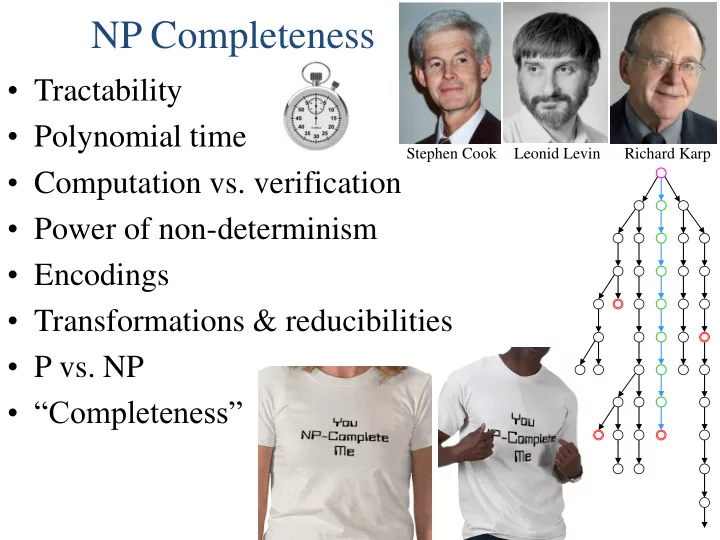
Stephen Cook Leonid Levin Richard Karp

slide-2
SLIDE 2

NP Completeness Benefits

  • 1. Saves time & effort of trying to solve intractable

problems efficiently;

  • 2. Saves money by not separately working to

efficiently solve different problems;

  • 3. Helps systematically build on & leverage the

work (or lack of progress) of others;

  • 4. Transformations can be used to solve new

problems by reducing them to known ones;

  • 5. Illuminates the structure & complexity of

seemingly unrelated problems;

slide-3
SLIDE 3

NP Completeness Benefits

  • 6. Informs as to when we should use approximate

solutions vs. exact ones;

  • 7. Helps understand the ubiquitous concept of

parallelism (via non-determinism);

  • 8. Enabled vast, deep, and general studies of other

“completeness” theories;

  • 9. Helps explain why verifying proofs seems to be

easier than constructing them;

  • 10. Illuminates the fundamental nature of algorithms

and computation;

slide-4
SLIDE 4

NP Completeness Benefits

  • 11. Gave rise to new and novel mathematical

approaches, proofs, and analyses;

  • 12. Helps us to more easily reason about and

manipulate large classes of problems;

  • 13. Robustly decouples / abstracts complexity from

underlying computational models;

  • 14. Gives disciplined techniques for identifying

“hardest” problems / languages;

  • 15. Forged new unifications between computer

science, mathematics, and logic;

  • 16. NP-Completeness is interesting and fun!
slide-5
SLIDE 5

Intuitively, A is “no harder” than B (modulo P) Denotation: A P B

Note: ƒ is a polynomial-time “reduction” of A to B Def: A language A is polynomial-time reducible to a

language B if $ polynomial-time computable function ƒ:** where wA  ƒ(w)B "w

Reducibilities Reloaded

Def: A language A is polynomial-time reducible to a

language B if $ polynomial-time computable function ƒ:** where wA  ƒ(w)B "w

Note: ƒ is a polynomial-time “reduction” of A to B

Denotation: A P B

A

ƒ

ƒ(w) w

B

 

Intuitively, A is “no harder” than B (modulo P) P

slide-6
SLIDE 6

Def: A language A is polynomial-time reducible to a

language B if $ polynomial-time computable function ƒ:** where wA  ƒ(w)B "w

Reducibilities Reloaded

Def: A language A is polynomial-time reducible to a

language B if $ polynomial-time computable function ƒ:** where wA  ƒ(w)B "w

A

ƒ

ƒ(w) w

B

 

P

Theorem: If A P B and B is decidable within polynomial

time then A is decidable within polynomial time.

Theorem: If A P B and A is not decidable within polynomial time then B is not decidable within polynomial time.

Note: be very

careful about the reduction direction!

slide-7
SLIDE 7

Problem Transformations

Idea: To solve a problem, efficiently transform to another problem, and then use a solver for the other problem:

(x+y)(x'+y') Colorability solver

SAT solution x=1, y=0

Satisfiability Colorability

slide-8
SLIDE 8
slide-9
SLIDE 9

NP Hardness & Completeness

Def: A problem L’ is NP-hard if: (1) Every L in NP reduces to L’ in polynomial time. Def: A problem L’ is NP-complete if: (1) L is NP-hard; and (2) L is in NP. One NPC problem is in P P=NP Open: is P=NP ? Open: is NP=co-NP ? Theorem: P = co-P P NP

NP-complete SAT co-NP-complete TAUT

co-NP

P-complete LP

slide-10
SLIDE 10

Boolean Satisfiability Problem (SAT)

Def: CNF (Conjunctive Normal Form) formula is in a product-of-sums format. Ex: (x1+x4+x5+x7+x'8)(x'1+x3+x'4+x'5) Def: A formula is satisfiable if it can be made true by some assignment of all of its variables. Problem (SAT): given an n-variable Boolean formula (in CNF), is it satisfiable? Ex: (x+y)(x'+z') is satisfiable (e.g., let x=1 & Z=0) (x+z)(x')(z') is not satisfiable (why?)

slide-11
SLIDE 11

Stephen Cook Leonid Levin

The Cook/Levin Theorem

Theorem [Cook/Levin, 1971]: SAT is NP-complete. Proof idea: given a non-deterministic polynomial time TM M and input w, construct a CNF formula that is satisfiable iff M accepts w. Create boolean variables: q[i,k]  at step i, M is in state k h[i,k]  at step i, M’s RW head scans tape cell k s[i,j,k]  at step i, M’s tape cell j contains symbol Sk M halts in polynomial time p(n)  total # of variables is polynomial in p(n)

Qk

slide-12
SLIDE 12

Stephen Cook Leonid Levin

Add clauses to the formula to enforce necessary restrictions on how M operates / runs:

  • At each time i:

M is in exactly 1 state r/w head scans exactly 1 cell All cells contain exactly 1 symbol

  • At time 0  M is in its initial state
  • At time P(n)  M is in a final state
  • Transitions from step i to i+1

all obey M's transition function Resulting formula is satisfiable iff M accepts w!

Qk

The Cook/Levin Theorem

slide-13
SLIDE 13

Historical Note

The Cook/Levin theorem was independently proved by Stephen Cook and Leonid Levin

  • Denied tenure at Berkeley (1970)
  • Invented NP completeness (1971)
  • Won Turing Award (1982)
  • Student of Andrei Kolmogorov
  • Seminal paper obscured by

Russian, style, and Cold War

slide-14
SLIDE 14

“Guess and Verify” Approach

Note: SAT  NP. Idea: Nondeterministically “guess” each Boolean variable value, and then verify the guessed solution.  polynomial-time nondeterministic algorithm  NP This “guess & verify” approach is general. Idea: “Guessing” is usually trivially fast ( NP)  NP can be characterized by the “verify” property: NP  set of problems for which proposed solutions can be quickly verified  set of languages for which string membership can be quickly tested.

slide-15
SLIDE 15
slide-16
SLIDE 16
slide-17
SLIDE 17

An NP-Complete Encyclopedia

Classic book: Garey & Johnson, 1979

  • Definitive guide to NP-completeness
  • Lists hundreds of NP-complete problems
  • Gives reduction types and refs

Michael Garey David Johnson

slide-18
SLIDE 18

Robustness of P and NP

Compositions of polynomials yields polynomials Computation models’ efficiencies are all polynomially related (i.e., can efficiently simulate one another). Defs of P and NP is computation model-independent!

μ λ

x3 + y3 + z3 = 33

slide-19
SLIDE 19
slide-20
SLIDE 20

Perelman 2006 ??

slide-21
SLIDE 21

B

Reduction Types

Many-one reduction: converts an instance of one problem to a single instance of another problem.

A

ƒ

ƒ(w) w

B

 

Turing reduction: solves a problem A by multiple calls to an “oracle” for problem B. A M B A T B

A

slide-22
SLIDE 22

Stephen Cook

Richard Karp

B A

Polynomial-Time Reduction Types

Polynomial-time many-one reduction: transforms in polynomial time an instance of problem A to an instance of problem B.

“Karp” reduction (transformation)

A

ƒ

ƒ(w) w

B

 

Polynomial-time Turing reduction: solves problem A by polynomially-many calls to “oracle” for B.

“Cook” reduction

Open: do polynomial-time-bounded many-one and Turing reductions yield the same complexity classes? (NP, co-NP, NP-complete, co-NP-complete, etc.)

slide-23
SLIDE 23

Boolean 3-Satisfiability (3-SAT)

Def: 3-CNF: each sum term has exactly 3 literals. Ex: (x1+x5+x7)(x3+x'4+x'5) Def: 3-SAT: given an n-variable boolean formula (in CNF), is it satisfiable? Theorem: 3-SAT is NP-complete. Proof: convert each long clause of the given formula into an equivalent set of 3-CNF clauses: Ex: (x+y+z+u+v+w) (x+y+a)(a'+z+b)(b'+u+c)(c'+v+w)

Resulting formula is satisfiable iff original formula is.

slide-24
SLIDE 24

1-SAT and 2-SAT

Idea: Determine the “boundary of intractability” by varying / trivializing some of the parameters. Q: Is 1-SAT NP-complete? A: No (look for a variable & its negation) Q: Is 2-SAT NP-complete? A: No (cycles in the implication graph)

slide-25
SLIDE 25

Richard Karp

Classic NP Complete Problems

Clique: given a graph and integer k, is there a subgraph that is a complete graph of size k?

slide-26
SLIDE 26

Classic NP Complete Problems

Set Cover: given a universe U, a collection of subsets Si and an integer k, can k of these subsets cover U?

U

S2 S3 S1 S4 S5

slide-27
SLIDE 27

Classic NP Complete Problems

Hamiltonian cycle: Given an undirected graph, is there a closed path that visits every vertex exactly once?

slide-28
SLIDE 28
slide-29
SLIDE 29

Classic NP Complete Problems

Graph coloring: given an integer k and a graph, is it k-colorable? (adjacent nodes get different colors)

slide-30
SLIDE 30

Classic NP Complete Problems

Partition: Given a set of integers, is there a way to partition is into two subsets each with the same sum?

slide-31
SLIDE 31

Classic NP Complete Problems

Knapsack: maximize the total value of a set of items without exceeding an overall weight constraint.

slide-32
SLIDE 32
slide-33
SLIDE 33

NP Complete Problems

Bin packing: minimize the number of same-size bins necessary to hold a set of items of various sizes.

slide-34
SLIDE 34

2

Other Classic NP Complete Problems

Steiner Tree: span a given node subset in a weighted graph using a minimum-cost tree.

slide-35
SLIDE 35

Other Classic NP Complete Problems

Traveling salesperson: given a set of points, find the shortest tour that visits every point exactly once.

slide-36
SLIDE 36
slide-37
SLIDE 37
slide-38
SLIDE 38

Graph Colorability

Problem: given a graph G and an integer k, is G k-colorable? Note: adjacent nodes must have different colors

slide-39
SLIDE 39

from “Complexity of Computer Computations”, pp. 85–103, 1972.

slide-40
SLIDE 40
slide-41
SLIDE 41
slide-42
SLIDE 42
slide-43
SLIDE 43
slide-44
SLIDE 44
slide-45
SLIDE 45
slide-46
SLIDE 46
slide-47
SLIDE 47

PSPACE-complete

slide-48
SLIDE 48

P [2004]

slide-49
SLIDE 49

Problem Transformations

Idea: To solve a problem, efficiently transform to another problem, and then use a solver for the other problem:

(x+y)(x'+y') Colorability solver

SAT solution x=1, y=0

Satisfiability Colorability

slide-50
SLIDE 50

Decision vs. Optimization Problems

Decision problem: “yes” or “no” membership answer. Ex: Given a Boolean formula, is it satisfiable? Ex: Given a graph, is it 3-colorable? Ex: Given a graph & k, does it contain a k-clique? Optimization problem: find a (minimal) solution. Ex: Given a formula, find a satisfying assignment. Ex: Given a graph, find a 3-coloring. Ex: Given a graph & k, find a k-qlique. Theorem: Solving a decision problem is not harder than solving its optimization version. Theorem: Solving an optimization problem is not (more than polynomially) harder than solving its decision version.

(x+y+z) ^(x'+y'+z) ^(x'+y+z')

slide-51
SLIDE 51

Decision vs. Optimization Problems

Corollary: A decision problem is in P if and only if its

  • ptimization version is in P.

Corollary: A decision problem is in NP if and only if its

  • ptimization version is in NP.

Building an optimizer from a decider: Ex: what is a satisfying assignemnt

  • f P=(x+y+z)(x'+y'+z)(x'+y+z') ?

Idea: Ask the decider 2 related yes/no questions: P^x P^x'

Satisfiability Decider yes no Satisfiability Decider yes no Satisfiability Decider yes no

x is true x is “don’t care” P is not satisfiable x is false

Iterate!

Satisfiability Optimizer

P

slide-52
SLIDE 52

Graph Cliques

Graph clique problem: given a graph and an integer k, is there a subgraph in G that is a complete graph of size k? Theorem: The clique problem is NP-complete. Proof: Reduction from 3-SAT: Literals become nodes; k clauses induce node groups; Connect all inter-group compatible nodes / literals. Example: (x+y+z)(x'+y'+z)(x'+y+z')

Z Y X Z' Y X' Z Y' X'

k-clique corresponds to 3-SAT solution: x = true, y = false, z = false

Clique is in NP  clique is NP-complete.

Graph clique solver

slide-53
SLIDE 53

Independent Sets

Independent set problem: given a graph and an integer k, is there a pairwise non-adjacent node subset of size k? Theorem: The independent set problem is NP-complete. Proof: Reduction from graph clique: Idea: independent set is an “anti-clique” (i.e., negated clique) finding a clique reduces to finding an independent set in the complement graph:

Graph clique solver Independent set solver

Independent set NP  NP-complete.

slide-54
SLIDE 54
slide-55
SLIDE 55

Graph Colorability

Problem: is a given graph G 3-colorable? Theorem: Graph 3-colorability is NP-complete. Proof: Reduction from 3-SAT. Idea: construct a colorability “OR gate” “gadget”:

F

T

(x+y+z) Property: gadget is 3-colorable iff (x+y+z) is true

x' x

"x

x y T z

slide-56
SLIDE 56

Example: (x+y+z)(x'+y'+z)(x'+y+z') F

x' y'

T

x z y z'

F

T x' x

"x

x y T z

x+y+z x'+y'+z x'+y+z' F

slide-57
SLIDE 57

Example: (x+y+z)(x'+y'+z)(x'+y+z') F

x' y'

T

x z y z'

3-satisfiability Solution: x = true y = false z = false 3-colorability Solution:

slide-58
SLIDE 58

What Makes Colorability Difficult?

Q: Are high node degrees the reason that graph colorability is computationally difficult? A: No! Graph colorability is easy for max-degree-0 graphs Graph colorability is easy for max-degree-1 graphs Graph colorability is easy for max-degree-2 graphs Theorem: Graph colorability is NP-complete for max-degree-4 graphs.

slide-59
SLIDE 59

Gadget properties: a) Gadget has max-degree of 4 b) Gadget is 3-colorable but not 2-colorable c) In any 3-coloring all corners get the same color

Restricted Graph Colorability

Theorem: Graph 3-colorability is NP-complete for max-degree-4 graphs. Proof: Use “degree reduction” gadgets:

3-colorability constraint propagation:

slide-60
SLIDE 60

Restricted Graph Colorability

Idea: combine gadgets into “super nodes”! Properties (inherited from simple gadget): a) Super-node has max-degree of 4 b) Super-node is 3-colorable but not 2-colorable c) In any 3-coloring all “corners” get the same color Idea: Use “super nodes” as “fan out” components to reduce all node degrees to 4 or less

Local node replacement:

High degree Max degree 4

slide-61
SLIDE 61

Restricted Graph Colorability

Example: convert high-degree to max-degree-4 graph Conclusion: Solving max-degree-4 graph colorability is as difficult as solving general graph colorability!

Max degree 4 Max degree 6

Max-degree-4 colorability solver

slide-62
SLIDE 62

Gadget properties: a) Gadget is planar and 3-colorable b) In any 3-coloring opposite corners get same color c) Pairs of opposite corners are “independent”

Restricted Graph Colorability

Theorem: Planar graph 3-colorability is NP-complete. Proof: Use “planarity preserving” gadgets:

3-colorability constraint propagation

slide-63
SLIDE 63

Restricted Graph Colorability

Idea: use gadgets to eliminate edge intersections!

Local replacement:

Conclusion: Solving planar graph colorability is as difficult as solving general graph colorability!

Planar graph is 3-colorable IFF original graph was

Planar graph colorability solver

slide-64
SLIDE 64

Restricted Graph Colorability

Theorem: Graph colorability is NP-complete for planar graphs with max degree 4. Proof: Compose max-degree-4 transformation with planarity preserving transformation:

Local intersection replacement

Resulting planar max-deg-4 graph is 3-colorable IFF original graph is!

Degree reduction replacement

More degree reduction replacements needed here

slide-65
SLIDE 65

Planar Graph Colorability

Theorem: Planar graph 1-colorability is trivial. DTIME(n) Theorem: Planar graph 2-colorability is easy. DTIME(n) Theorem: Planar graph 3-colorability is NP-complete. Theorem: Planar graph 4-colorability is trivial. DTIME(1) Theorem: All planar graphs have 4-colorings. Open since 1852; solved by Appel & Haken in 1976 using long computer-assisted proof based on 1936 special cases!

slide-66
SLIDE 66

Planar Graph Colorability

Theorem: Finding planar graph 4-coloring is in DTIME(n2). Theorem: Finding planar graph 5-coloring is in DTIME(n). Theorem: Graph planarity testing is in DTIME(n). Theorem: 4-coloring a 3-colorable graph is NP-hard. Theorem: 7 colors are necessary and sufficient on a torus. Theorem: For a surface of genus G, the number of colors that are both necessary and sufficient is

        2 48 1 7 G

Genus: 1 2 3 4 5 6 7 8 # colors: 4 7 8 9 10 11 12 12 13

slide-67
SLIDE 67

Time 1 Time 2 Time 3

Applications of Graph Coloring

Job scheduling:

  • Need to assign jobs to time slots;
  • Some jobs conflict (e.g., use shared resource);
  • Model jobs as nodes and conflicts as edges;
  • Chromatic number is “minimum makespan”

(optimal time to finish all jobs without conflict)

1 2 5 3 4 1 2 5 3 4 1 2 5 3 4

Jobs & conflicts Coloring Schedule

slide-68
SLIDE 68

Applications of Graph Coloring

CPU Register allocation:

  • Compiler optimizes assignment of variables to registers;
  • Interference graph: model registers as nodes, and edges

represent variables needed simultaneously;

  • Chromatic number corresponds to minimum # of CPU

registers needed to accommodate all the variables.

Register 1 Register 2 Register 3 1 2 5 3 4 1 2 5 3 4 1 2 5 3 4

Variables & simultaneity Graph coloring Register allocation

slide-69
SLIDE 69
slide-70
SLIDE 70

… … … … … … … … … …

PSPACE-complete QBF

The Extended Chomsky Hierarchy Reloaded

Context-free wwR

P

anbncn

NP Recognizable Not Recognizable H H

Decidable

Presburger arithmetic NP-complete SAT

Not finitely describable ?

2S*

EXPTIME

EXPTIME-complete Go EXPSPACE-complete =RE

Context sensitive LBA EXPSPACE PSPACE Dense infinite time & space complexity hierarchies

… … … … … … … … … … … … … … … … … … … … … … … … … … … … … … … … … … … … … … … …

Regular a*

… … … … … … … … … … … … … … …

Turing degrees Other infinite complexity & descriptive hierarchies

… … … … …

  • Det. CF anbn

… … … … …

Finite {a,b}

… … … … …

PH BPP

slide-71
SLIDE 71

Solution

exact approximate fast slow

Speed

“Short & sweet” “Quick & dirty” “Slowly but surely” “Too little, too late”

Algorithms

Tradeoff: Execution speed vs. solution quality

slide-72
SLIDE 72

Computational Complexity

Problem: Avoid getting trapped in local minima

Global optimum

slide-73
SLIDE 73

Approximation Algorithms

Idea: Some intractable problems can be efficiently approximated within close to optimal! Fast:

  • Simple heuristics (e.g., greed)
  • Provably-good approximations

Slower:

  • Branch-and-bound approaches
  • Integer Linear Programming relaxation
slide-74
SLIDE 74

Approximation Algorithms

Wishful:

  • Simulated annealing
  • Genetic algorithms
slide-75
SLIDE 75

Minimum Vertex Cover

Minimum vertex cover problem: Given a graph, find a minimum set of vertices such that each edge is incident to at least one of these vertices. Example: Applications: bioinformtics, communications, civil engineering, electrical engineering, etc.

  • One of Karp’s original NP-complete problems

Input graph Heuristic solution Optimal solution

Richard Karp

slide-76
SLIDE 76

Minimum Vertex Cover Examples

slide-77
SLIDE 77

Approximate Vertex Cover

Theorem: The minimum vertex cover problem is NP- complete (even in planar graphs of max degree 3). Theorem: The minimum vertex cover problem can be solved exactly within exponential time nO(1)2O(n). Theorem: The minimum vertex cover problem can not be approximated within  1.36*OPT unless P=NP. Theorem: The minimum vertex cover problem can be approximated (in linear time) within 2*OPT. Idea: pick an edge, add its endpoints, and repeat.

slide-78
SLIDE 78

Approximate Vertex Cover

Algorithm [Gavril, 1974]: Linear time 2*OPT approximation for minimum vertex cover:

– Pick random edge (x,y) – Add {x,y} to the heuristic solution – Eliminate x and y from graph – Repeat until graph is empty

Idea: one of {x,y} must be in any optimal solution.  Heuristic solution is no worse than 2*OPT.

x y

slide-79
SLIDE 79

Maximum Cut

Maximum cut problem: Given a graph, find a partition

  • f the vertices maximizing the # of crossing edges.

Example: Applications: VLSI circuit design, statistical physics, communication networks.

  • One of Karp’s original NP-complete problems.

A B C D E A B C D E

Input graph Heuristic solution Optimal solution

A B C D E cut size = 2 cut size = 4 cut size = 5

Richard Karp

slide-80
SLIDE 80

Maximum Cut

Theorem [Karp, 1972]: The minimum vertex cover problem is NP-complete. Theorem: The maximum cut problem can be solved in polynomial time for planar graphs. Theorem: The maximum cut problem can not be approximated within  17/16*OPT unless P=NP. Theorem: The maximum cut problem can be approximated in polynomial time within 2*OPT. Theorem: The maximum cut problem can be approximated in polynomial time within 1.14*OPT.

=1.0625*OPT

slide-81
SLIDE 81

Maximum Cut

Algorithm: 2*OPT approximation for maximum cut:

Start with an arbitrary node partition – If moving an arbitrary node across the partition will improve the cut, then do so – Repeat until no further improvement is possible

Idea: final cut must contain at least half of all edges.  Heuristic solution is no worse than 2*OPT.

A B C D E

Input graph Heuristic solution Optimal solution

cut size = 2 cut size = 3 A B C D E A B C D E cut size = 5

slide-82
SLIDE 82

Approximate Traveling Salesperson

Analysis:

Traveling salesperson problem: given a pointset, find shortest tour that visits every point exactly once.

2*OPT metric TSP heuristic:

– Compute MST – T = Traverse MST – S = shortcut tour – Output S

triangle inequality! TSP minus an edge is a spanning tree

S < T = MST < OPT TSP 2* 2*

T covers minimum spanning tree twice

slide-83
SLIDE 83
slide-84
SLIDE 84

Non-Approximability

  • NP transformations typically do not preserve the

approximability of the problem!

  • Some NP-complete problems can be approximated

arbitrarily close to optimal in polynomial time. Theorem [Arora, 1996] Geometric TSP approximation in polynomial time within (1+e)*OPT for any e>0.

  • Other NP-complete problems can not be approximated

within any constant in polynomial time (unless P=NP). Theorem: General graph TSP can not be approximated efficiently within K*OPT for any K>0 (unless P=NP).

slide-85
SLIDE 85

Graph Isomorphism

Definition: two graphs G1=(V1,E1) and G2=(V2,E2) are isomorphic iff $ bijection ƒ:V1V2 such that "vi,vjV1 (vi,vj)E1  (ƒ(vi),ƒ(vj))E2

Isomorphism  edge-preserving vertex permutation Problem: are two given graphs isomorphic?

Note: Graph isomorphism NP, but not known to be in P

slide-86
SLIDE 86

Graph Isomorphism

≈ ≈ ≈ ≈ ≈ ≈

slide-87
SLIDE 87

Zero-Knowledge Proofs

Idea: proving graph isomorphism without disclosing it! Premise: Everyone knows G1 and G2 but not ≈

≈ must remain secret!

Create random G ≈ G1 Note: ≈ is ≈(≈) Broadcast G Verifier asks for ≈ or ≈ Broadcast ≈ or ≈ Verifier checks G≈G1 or G≈G2 Repeat k times

 Probability of cheating: 2-k

G1 G2

G

slide-88
SLIDE 88

Zero-Knowledge Proofs

Idea: prove graph 3-colorable without disclosing how! Premise: Everyone knows G1 but not its 3-coloring χ

which must remain secret!

Create random G2 ≈ G1 Note: 3-coloring χ'(G2) is ≈(χ(G1)) Broadcast G2 Verifier asks for ≈ or χ' Broadcast ≈ or χ' Verifier checks G1≈G2 or χ'(G2) Repeat k times

 Probability of cheating: 2-k

G1 G2 χ

χ χ'

slide-89
SLIDE 89

Zero-Knowledge Caveats

  • Requires a good random number generator
  • Should not use the same graph twice
  • Graphs must be large and complex enough

χ

Applications:

  • Identification friend-or-foe (IFF)
  • Cryptography
  • Business transactions
slide-90
SLIDE 90

Zero-Knowledge Proofs

Idea: prove that a Boolean formula P is satisfiable without disclosing a satisfying assignment! Premise: Everyone knows P but not its secret satisfying assignment V !

Convert P into a graph 3-colorability instance G =ƒ(P) Publically broadcast ƒ and G Use zero-knowledge protocol to show that G is 3-colorable  P is satisfiable iff G is 3-colorable  P is satisfiable with probability 1-2-k

P = (x+y+z)(x'+y'+z)(x'+y+z')

ƒ

G =

slide-91
SLIDE 91

Interactive Proof Systems

  • Prover has unbounded power and may be malicious
  • Verifier is honest and has limited power

Completeness: If a statement is true, an honest verifier will be convinced (with high probability) by an honest prover. Soundness: If a statement is false, even an omnipotent malicious prover can not convince an honest verifier that the statement is true (except with a very low probability).

  • The induced complexity class depends on the verifier’s

abilities and computational resources: Theorem: For a deterministic P-time verifier, class is NP. Def: For a probabilistic P-time verifier, induced class is IP. Theorem [Shamir, 1992]: IP = PSPACE