Noteworthy Legal Issues for Pre-IPO and Small-Cap Directors - - PDF document

noteworthy legal issues for pre ipo and small cap
SMART_READER_LITE
LIVE PREVIEW

Noteworthy Legal Issues for Pre-IPO and Small-Cap Directors - - PDF document

Entrepreneurial Governance Noteworthy Legal Issues for Pre-IPO and Small-Cap Directors Interview by Adam J. Epstein Peter M. Astiz, partner and co- and expensive process doesnt sustain the aftermarket trading head of the Global Technology


slide-1
SLIDE 1

May/June 2012 www.directorship.com 63

Entrepreneurial Governance

Peter M. Astiz, partner and co- head of the Global Technology Sector Practice of DLA Piper in its Palo Alto, Calif., offjce, focus- es on general counsel services for high-technology companies, private and public fjnancing transactions, and mergers and

  • acquisitions. He represents both

issuers and underwriters in initial public offerings and follow-on

  • fferings as well as convertible

debt offerings under Rule 144A. Among his many IPOs, Astiz rep- resented Salesforce . com in the fjrst SaaS IPO, and the under- writers in connection with the Groupon IPO. He also represents buyers and sellers in public and private merger and acquisition transactions, and issuers and venture capitalists in venture capital and other private place- ment fjnancings. NACD Director- ship interviewed Astiz about the legal implications for directors of pre-IPO and small-cap compa- nies arising out of various issues making news of late.

The JOBS Act and related IPO on-ramp provisions have brought a renewed focus on IPOs and their importance to the U.S. economy. That said, the decision by a private com- pany board to undertake an IPO is complex, especially inas- much as the lengthy, distracting and expensive process doesn’t result in an offering for so many

  • companies. What are the least

understood fjduciary obliga- tions associated with a board’s IPO deliberations? Even with an improved IPO market, a substantial percent- age of the companies fjling for IPOs in the last couple of years have not been able to success- fully complete their transac-

  • tions. The recently enacted

JOBS Act will reduce certain

  • f the costs and burdens for

“emerging growth companies” pursuing IPOs. However, at least for the near term, there is no indication that it will result in increased investor demand, and therefore is not likely to in- crease the percentage of IPO fjlings that lead to a successful

  • ffering. Even for those compa-

nies that have completed their IPOs, many have been priced below

  • riginal

expectations, and post-IPO stock performance has been very mixed. Many, if not most, companies consider- ing an IPO are balancing pur- suing the IPO against an M&A

  • exit. In assessing a potential

M&A exit, boards need to factor in how achievable is the “IPO premium”: Will the deal actu- ally get done, and will it price at the level originally anticipat- ed? Will the company be able to sustain the aftermarket trading price? In addition, boards con- sidering an IPO must factor in the risks of a delayed or unsuc- cessful IPO in the company’s fj- nancing plans. If the company will need the IPO proceeds to fund operations, it is critical to have an alternative fjnancing

  • plan. IPOs are expensive, and

the distraction of the offering can adversely impact company

  • performance. Companies with

the need to obtain fjnancing following a failed IPO attempt face substantial challenges, and boards need to balance the cost versus the benefjts of arranging for additional fjnancing as secu- rity prior to the IPO process. As in all matters, in making these decisions independent directors must focus on the interests of all stockholders, not just the desires

  • f management or key investors,

particularly if existing inves- tors are likely the source of any needed fjnancing. The SEC recently has brought a number of actions arising out

  • f the increasingly vibrant sec-
  • ndary market for shares of pri-

vately held companies. What legal issues should directors be aware of if shares in their com- pany trade in these secondary markets? There are two signifjcant legal

Noteworthy Legal Issues for Pre-IPO and Small-Cap Directors

Interview by Adam J. Epstein

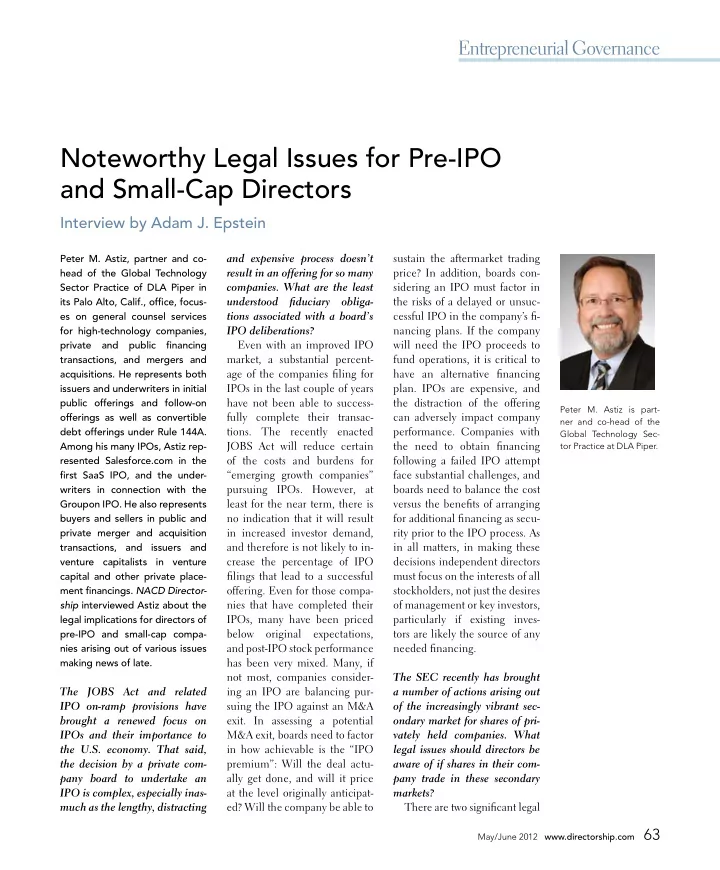
Peter M. Astiz is part- ner and co-head of the Global Technology Sec- tor Practice at DLA Piper.

slide-2
SLIDE 2

Entrepreneurial Governance Entrepreneurial

issues for boards to focus on in connection with secondary sales. The fjrst is that com- panies face a risk of claims based upon the information provided in secondary trans- actions, particularly if the sellers include any company insiders. Buyers may claim fraud based upon inaccurate or incom- plete information. Sellers may also make claims if they sell at too low a price as a result of incomplete information from the

  • company. Boards should be actively en-

gaged in the process of determining what information the company provides (or allows to be provided) to third parties to minimize the risk of claims. The second issue relates to differential treatment of dif- ferent stockholders. The board has a fjdu- ciary duty to all stockholders and needs to be sensitive to taking actions that facilitate sales by some stockholders (particularly insiders) without providing the same op- portunities to other stockholders. Separate from the legal issues, the board should be cognizant of the changing dynamics and shift in priorities that can happen when founders, key employees or major inves- tors gain liquidity prior to a liquidity event for all stockholders. Facebook’s IPO has inspired extensive commentary with respect to the con- trolled-company exemptions implement- ed by various stock exchanges. What are some legal issues that independent directors on controlled-company boards should be particularly cognizant of? “Controlled companies” are compa- nies with respect to which more than 50 percent of the voting power is controlled by one person or a group. Traditionally, the controlled-company exceptions most commonly arose in connection with pri- vate equity-backed IPOs. However, many

  • f the more recent high-profjle venture-

backed IPOs have included dual class voting structures, with founders retaining control as a result of super-voting shares. Exchange rules exempt controlled com- panies from the general requirements to have a majority of the board be indepen- dent, as well as the requirements for fully independent compensation and nomi- nating committees. Independent direc- tors need to be mindful that the exchange

WHO

More than 750 top public company directors, corporate

  • ffi

cers, C-suite executives, and the country’s leading governance experts.

WHAT

NACD’s annual conference committed to advancing exemplary board leadership — the largest and most premier thought-leadership event on the corporate governance calendar each year.

WHERE

Gaylord National Resort & Convention Center National Harbor, Maryland

S AV E

TH E

DAT E

NACD Board Leadership Conference 2012

October 14-16

Early Bird Savings End July 31

NACDonline.org/Conference

slide-3
SLIDE 3

May/June 2012 www.directorship.com 65

exemptions do not change the funda- mental fjduciary duty of the directors to represent the interests of all stockhold- ers, and that best practices should still in- clude steps to facilitate the most effective participation of the independent direc- tors, such as executive sessions without management and active engagement in the development of board agendas and board processes and procedures. Separate from the controlled-company issues, all boards considering an IPO should thor-

  • ughly review and consider the proposed

corporate governance structure. For ex- ample, substantially all venture-backed IPO companies adopt structures that are in confmict with what are generally viewed as best corporate governance practices. These include staggered boards, lack of independent chair or lead independent director, plurality voting, and restrictions regarding calling stockholder meetings, board nominations and raising stockhold- er proposals. Now that we’re approaching the 10th anniversary of the Sarbanes-Oxley Act, have you witnessed material changes in board conduct, or have you mostly seen lip service in the small-cap environment? As a result of the Sarbanes-Oxley Act, companies pursuing an IPO must now adopt a variety of specifjc policies and procedures that historically were not

  • required. For the most part, these policies

and procedures represent what otherwise might have been considered to be best

  • practices. For those matters, with respect

to which there are specifjc requirements, most boards seek to carefully comply with the requirements. In particular, the em- phasis on board independence and audit committee qualifjcations has had an im- pact on the composition of boards. That said, there is substantial question as to whether the manner in which boards con- duct their routine business has material- ly changed as a result of Sarbanes-Oxley and the related regulations. As with all matters, boards must focus on performing their duties consistent with the spirit of best corporate governance principles, and not by just checking off compliance with a list of specifjc requirements. D Everyone wants to grow. But grow how? In which markets? At what cost? To grow wisely, you need an advisor who really knows your business...and knows you. Who can deliver tailored solutions that create opportunities, maximize effjciency and build business. EisnerAmper is that advisor. We roll up our sleeves to get to the bottom of your toughest challenges so you get the advice and strategies you need to create sustainable growth.

NEW YORK | NEW JERSEY | PENNSYLVANIA | CALIFORNIA | CAYMAN ISLANDS

EisnerAmper LLP Accountants & Advisors

Independent Member of PKF International

www.eisneramper.com

Charles Weinstein Chief Executive Offjcer 212.949.8700 charles.weinstein@eisneramper.com Howard Cohen Chairman 732.287.1000 howard.cohen@eisneramper.com