
SLIDE 1
Shannon’s Theory of Secrecy Systems
See:
- C. E. Shannon,
Communication Theory of Secrecy Systems, Bell Systems Technical Journal,
- Vol. 28, pp. 656–715, 1948.
c Eli Biham - May 3, 2005 54 Shannon’s Theory of Secrecy Systems (2)
Notation
Given a cryptosystem, denote M a message (plaintext) C a ciphertext K a key E be the encryption function C = EK(M) D be the decryption function M = DK(C) For any key K, EK(·) and DK(·) are 1-1, and DK(EK(·)) =Identity.
c Eli Biham - May 3, 2005 55 Shannon’s Theory of Secrecy Systems (2)
Shannon’s Theory of Secrecy Systems (1949)
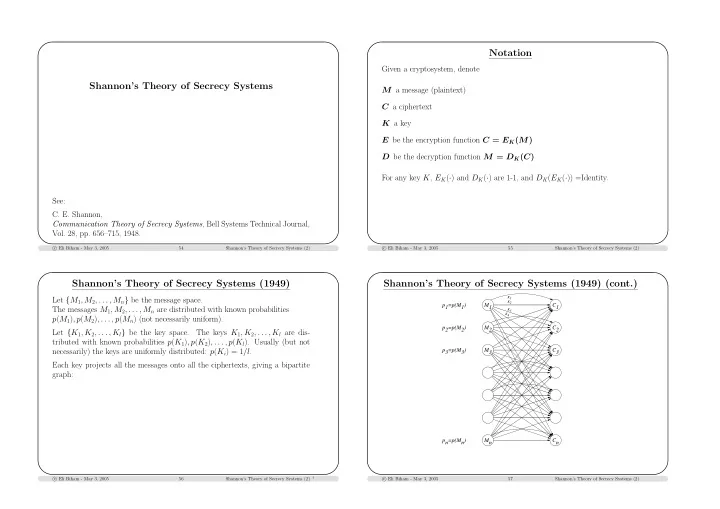
Let {M1, M2, . . . , Mn} be the message space. The messages M1, M2, . . . , Mn are distributed with known probabilities p(M1), p(M2), . . . , p(Mn) (not necessarily uniform). Let {K1, K2, . . . , Kl} be the key space. The keys K1, K2, . . . , Kl are dis- tributed with known probabilities p(K1), p(K2), . . . , p(Kl). Usually (but not necessarily) the keys are uniformly distributed: p(Ki) = 1/l. Each key projects all the messages onto all the ciphertexts, giving a bipartite graph:
c Eli Biham - May 3, 2005 56 Shannon’s Theory of Secrecy Systems (2)
†
Shannon’s Theory of Secrecy Systems (1949) (cont.)
p1=p(M1) p2=p(M2) p3=p(M3) pn=p(Mn) M1 M2 M3 Mn C1 C2 C3 Cn
K1 K2 K3 K4
c Eli Biham - May 3, 2005 57 Shannon’s Theory of Secrecy Systems (2)