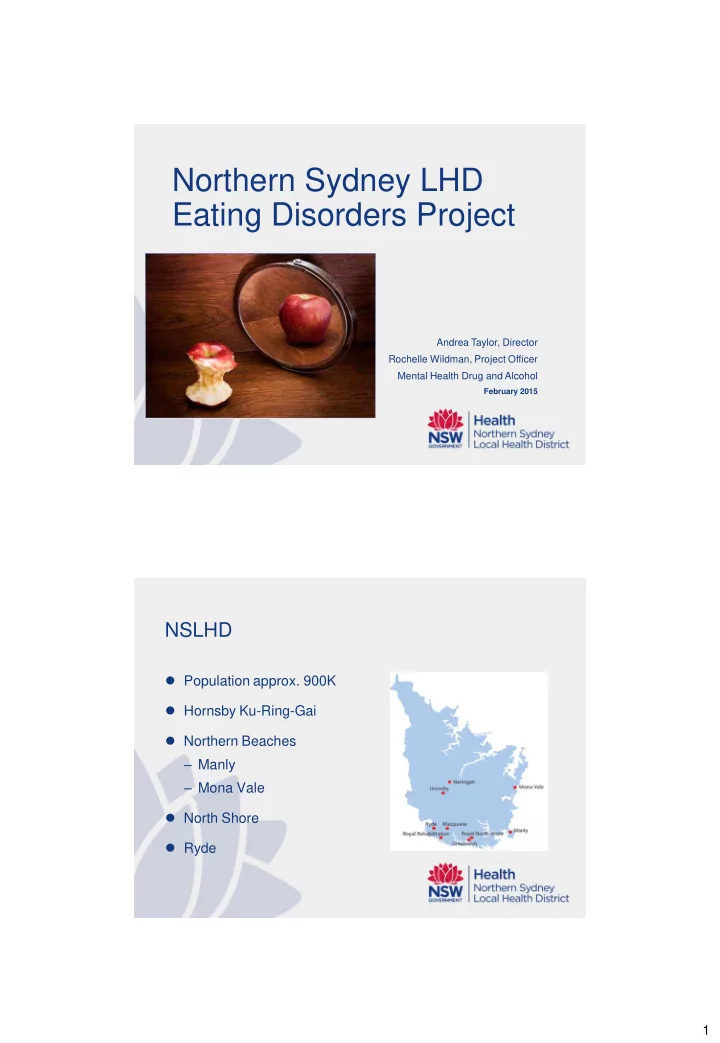
Northern Sydney LHD Eating Disorders Project Andrea Taylor, - - PDF document

northern sydney lhd eating disorders project
SMART_READER_LITE
LIVE PREVIEW

Northern Sydney LHD Eating Disorders Project Andrea Taylor, - - PDF document

Northern Sydney LHD Eating Disorders Project Andrea Taylor, Director Rochelle Wildman, Project Officer Mental Health Drug and Alcohol February 2015 NSLHD Population approx. 900K Hornsby Ku-Ring-Gai Northern Beaches Manly


slide-1
SLIDE 1

1

Andrea Taylor, Director Rochelle Wildman, Project Officer Mental Health Drug and Alcohol

February 2015

Northern Sydney LHD Eating Disorders Project

NSLHD

 Population approx. 900K  Hornsby Ku-Ring-Gai  Northern Beaches – Manly – Mona Vale  North Shore  Ryde

slide-2
SLIDE 2

2

Background

 NSLHD Clinical Services Plan  Executive Sponsor appointed by CE NSLHD  NSLHD Clinical Redesign Project for Eating Disorders initiated late 2012  Engaged NSLHD Planning Team  Steering Committee through EOI and partnerships  Workshop Feb 2013 and further workshops in 2014  Clinical Reference Group est. then merged with cttee  NSW Service Plan for Eating Disorders 2013 - 2018 released in September 2013  Draft NSLHD Eating Disorders Plan and training Sub Plan developed  Promotion, promotion and more promotion  EOI for Conference Attendance

What we knew

 No public eating disorders services in NSLHD  Periodic adverse media coverage about lack of services  NSLHD Planning Unit data: – NSLHD residents use 37% of Eating Disorders Services in NSW [aggregated public and private data] – NSLHD residents have a high utilisation of private health services.

slide-3
SLIDE 3

3

Separations by NSLHD hospital – primary and secondary diagnosis NSLHDA Admissions by primary and secondary diagnosis

slide-4
SLIDE 4

4

Blue = single admission Other colours = multiple admissions Number = LOS Blue = single admission Other colours = multiple admissions Number = LOS

slide-5
SLIDE 5

5

LOS by diagnosis

What does our customer profile look like? NSLHD File Audit

 124 admissions for 2012-2013  Audit Tool was developed by the Steering Committee and Clinical Reference Group  Collected info on:

– History – Current Diagnosis – BMI on admission/discharge – Clinical staff involved in care – Legal status – Discharge plan – Individual Patient Specialling

slide-6
SLIDE 6

6

File Audit results

 Patients were cared for in 22 different wards across NSLHD: – Psychiatric inpatient units – usually PECC – Physical inpatients units – usually EMU, MAU, General Medical Ward  Lack of a coordinated approach to care  Skill base of clinicians variable  Documentation varied  Consistency of diagnosis  15 admissions accounted for 50% of NSLHD bed days  Cost of care was variable

Audit findings: Admission by Hospital & ED type 2012/2013

slide-7
SLIDE 7

7

ED inpatient demographics Audit: ED Admission locations

slide-8
SLIDE 8

8

Clinical Stakeholder Consultation

 Staff interviews were conducted with clinicians across NSLHD to get a better understanding of the issues  Some of the key findings were: – No defined model of care – Generalist services have limited capacity to respond to this patient group effectively – Treating psychiatric or physical issues – not the ED – There is often no treatment plan or coordinated approach – Referral to specialist services can be challenging

NSLHD ED Options:

LHD Eating Disorders Service/s:

  • Outpatient
  • Day program
  • Inpatient Unit

LHD Eating Disorders Team

  • C/L service
  • Home Ward

LHD Eating Disorders Coordinator

slide-9
SLIDE 9

9

Which Option??

Clinical Council acknowledged that: 1.Status quo was unacceptable 2.Coordinator/Consultation Liaison Officer – Alone not viable secondary to limited capacity for clinical care – In Conjunction with a Pop-Up Team 3.ED Consultation Liaison Team a possibility 4.Inpatient Unit not supported by current activity nor under ABF projections

Eating Disorders Consultation Liaison Officer

The proposed role of this position is to: Develop a model including all aspects of governance Establish and Coordinate the Pop-Up Team Implement the NSLHD Eating Disorders Service Plan Provide technical and clinical advice across NSLHD Liaise with state tertiary ED services Develop NSLHD pathways Continue to provide awareness raising, education and training for LHD staff Pop-Up Team will receive specialist training by the CEDD

slide-10
SLIDE 10

10

What is a Pop-Up Team?

 Utilised in Paediatric and Rural and Remote Palliative Care Services  Volumes of customers are low and clinical complexity is high  Drawing together specific clinical expertise for complex cases, where there are insufficient patient numbers to support a dedicated team that is across medical specialties, divisions and geography under a clinical lead

Where are we now…

 NSLHD Clinical Council have given in principle agreement for the model  Working on the Pop-Up Team governance  Looking to fund the CL role  Added a Clinical Lead (Staff Specialist Psychiatrist, part- time) to the model to enhance Medical engagement  NSLHD Eating Disorders Service Plan draft has been developed, includes an Education and Training sub plan

slide-11
SLIDE 11

11