North Carolina Ferry Division 2017 Traffic Is Route Volumes Route - - PDF document

north carolina ferry division
SMART_READER_LITE
LIVE PREVIEW

North Carolina Ferry Division 2017 Traffic Is Route Volumes Route - - PDF document

03/22/2018 NCDOT Agency Response for PED Study on Reducing Off - Season Crossings, Adjusting Fares, and Using Partnerships Can Improve Ferry Division Efficiency Sterling Baker, P.E., Director of Facilities Management & Acting Special


slide-1
SLIDE 1

03/22/2018 1

NCDOT Agency Response for PED Study on “Reducing Off- Season Crossings, Adjusting Fares, and Using Partnerships Can Improve Ferry Division Efficiency” Sterling Baker, P.E., Director of Facilities Management &

Acting Special Deputy Ferry Director

March 26, 2018

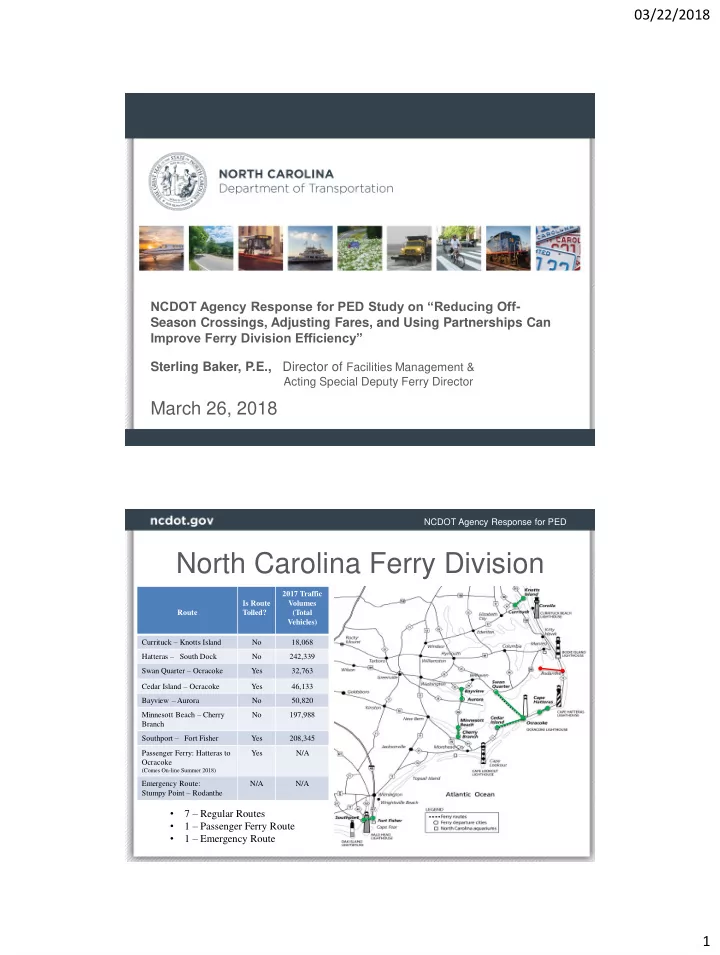
North Carolina Ferry Division

NCDOT Agency Response for PED

2 Route Is Route Tolled? 2017 Traffic Volumes (Total Vehicles) Currituck – Knotts Island No 18,068 Hatteras – South Dock No 242,339 Swan Quarter – Ocracoke Yes 32,763 Cedar Island – Ocracoke Yes 46,133 Bayview – Aurora No 50,820 Minnesott Beach – Cherry Branch No 197,988 Southport – Fort Fisher Yes 208,345 Passenger Ferry: Hatteras to Ocracoke

(Comes On-line Summer 2018)

Yes N/A Emergency Route: Stumpy Point – Rodanthe N/A N/A

  • 7 – Regular Routes
  • 1 – Passenger Ferry Route
  • 1 – Emergency Route
slide-2
SLIDE 2

03/22/2018 2

Future Passenger Ferry Route

NCDOT Agency Response for PED

3

Current Car Ferry Service (Crossing Time = 60 min) New Passenger Ferry Route (Crossing Time = 60-70 min)

NCDOT Agency Response for PED

4

Summary Item #1:

  • PED: The Ferry Division can save over $1.5M annually by reducing the number of

crossings on route during periods of lower use.

  • Agency Response:

 The NCDOT Ferry Division continuously reviews and adjusts schedules to meet demands across the system. This scheduling requires that we achieve the best and most practical balance between:

  • Route demands including seasonal variations,
  • Vessel maintenance schedules,
  • Funding and expenditure data,
  • Balancing Manpower requirements, and
  • U.S. Coast Guard requirements related to hours in order to qualify or

maintain required licenses and/or accreditations  Example: The 2018 Ferry Schedule has been adjusted to maximize efficiency. As such it is predicted that we will have at least a $100,000 savings based on the new schedule

slide-3
SLIDE 3

03/22/2018 3

NCDOT Agency Response for PED

5

Summary Item #2:

  • PED: Annual fare collections on currently tolled routes can be increased by $1.7M

without adversely affecting area commuters.

  • Agency Response:

 Currently 3 tolled routes:

  • Swan Quarter – Ocracoke Route
  • Cedar Island – Ocracoke Route
  • The Southport – Fort Fisher Routes

 Currently the Wilmington Metropolitan Planning Organization & the Cape Fear Rural Planning Organization have requested that their respective tolls be increased  Should be approved by the Board of Transportation in Spring of 2018  These increases bring in an estimated $335,000 in additional tolls for this route annually  Legislation mandates that toll revenues do not go toward operations, instead they are deposited in vessel replacement accounts for each respective route

NCDOT Agency Response for PED

6

Summary Item #3:

  • PED: Using partnerships with other governmental entities and the private sector

can reduce state funding requirements and improve the effectiveness of the ferry system.

  • Agency Response:

 As mentioned in the study the current passenger ferry project is an example of such a partnership. NCDOT Ferry Division is working side by side with stakeholders such as Dare County, Hyde County, NCDOT Transit, Outer Banks Tourism Board, Ocracoke Civic Association, and others in order to make this project a success for all.

Summary Item #4:

  • PED: Development of a long-range plan provides an opportunity to take a

systematic approach to identifying the most cost-effective contribution of ferry transportation services toward achievement of the mission of DOT and state transportation goals.

  • Agency Response:

 The Ferry Division is currently working with the NCDOT Transportation Planning Branch to initiate a comprehensive long range study to identify needs, quantify projected staffing, and look at future funding needs.

slide-4
SLIDE 4

03/22/2018 4

NCDOT Agency Response for PED

7

Recommendation #1:

  • PED: The General Assembly should direct the Ferry Division to produce a long-

range plan for the State’s ferry transportation system.

  • Agency Response:

 The Ferry Division is currently working with the NCDOT Transportation Planning Branch to initiate a comprehensive long range study to identify needs, quantify projected staffing, and look at future funding needs.  This study will incorporate current on-going studies such the Vessel Life-Cycle Determination and Needs Study (UNC-Charlotte); Shipyard Manpower and Personnel Needs Study (UNC-Charlotte); and Ferry Division Economic Impact Study (NC State – ITRE) and expand greatly upon future needs and funding requirements.  In the process of this study we will bring in a large group of stakeholders to add input, such as, but not limited to the USACE, DEQ, Visit NC, industry partners, local government partners, etc.  It is estimated a study of this size and complexity could take 18-24 months. Study is tentatively proposed to begin in Fall 2018.

NCDOT Agency Response for PED

8

Recommendation #2:

  • PED: The General Assembly should direct the Department of Transportation to

evaluate the schedule of crossings for each ferry route to ensure ferry services cost- effectively meet the needs of both area residents and tourists.

  • Agency Response:

 NCDOT does not feel that a legislative directive for this recommendation as needed as it is already a standard operating procedures that the NCDOT Ferry Division practices now.  The schedules are routinely reviewed and adjusted in order to achieve the best and most practical balance between:

  • Route demands including seasonal variations,
  • Vessel maintenance schedules,
  • Funding and expenditure data,
  • Balancing Manpower requirements, and
  • U.S. Coast Guard requirements related to hours in order to qualify or

maintain required licenses and/or accreditations

slide-5
SLIDE 5

03/22/2018 5

NCDOT Agency Response for PED

9

Summary

Goal = Improve Ferry Division Efficiency

Ferry Life-Cycle Plan for Terminal Structures

10

Questions?