Nonuniform Timeslicing of Dynamic Graphs Based on Visual Complexity - - PowerPoint PPT Presentation

nonuniform timeslicing of dynamic graphs based on visual
SMART_READER_LITE
LIVE PREVIEW

Nonuniform Timeslicing of Dynamic Graphs Based on Visual Complexity - - PowerPoint PPT Presentation

Nonuniform Timeslicing of Dynamic Graphs Based on Visual Complexity Yong Wang 1 , Daniel Archambault 2 , Hammad Haleem 1 , Yanhong Wu 3 , Torsten Moeller 4 , Huamin Qu 1 http://yong-wang.org/proj/nu_timeslicing.html 2 3 4 1 Background A


slide-1
SLIDE 1

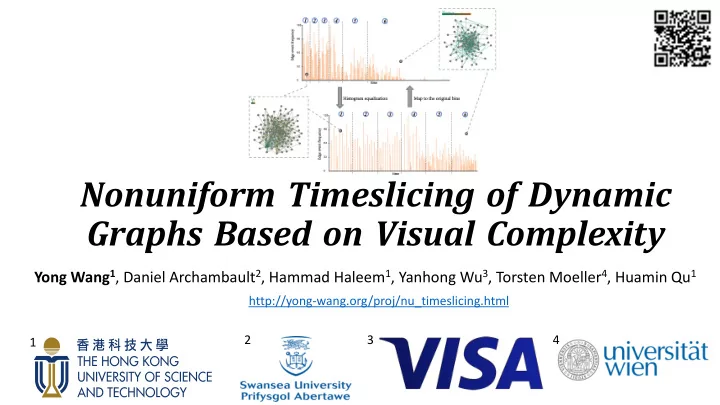
Nonuniform Timeslicing of Dynamic Graphs Based on Visual Complexity

Yong Wang1, Daniel Archambault2, Hammad Haleem1, Yanhong Wu3, Torsten Moeller4, Huamin Qu1

1 2 3 4 http://yong-wang.org/proj/nu_timeslicing.html
slide-2
SLIDE 2

Background

  • A dynamic graph is a sequence of graph snapshots defined
  • ver an edge stream
  • Uniform timeslicing divides time into equal intervals and is

usually used in dynamic graph visualization for convenience and simplicity

2

slide-3
SLIDE 3

Background

  • For dynamic graph visualization, uniform timeslicing:
  • Does not take the data into account
  • Can generate cluttered timeslices with bursting edges,

and empty timeslices with few edges

3

slide-4
SLIDE 4

Research Problem

  • How can we make full use of the limited number of

timeslices to show more meaningful information?

  • How can we provide users with better perception of the

dynamic graph (especially the periods with bursting edges)?

4

slide-5
SLIDE 5

Nonuniform Timeslicing

  • Goal: create timeslices of similar visual complexity

5

A simple definition of visual complexity: number of edges

slide-6
SLIDE 6

Nonuniform Timeslicing

  • Solution: nonuniform timeslicing based on histogram

equalization, a technique for enhancing image contrast

6

https://www.tutorialspoint.com/dip/histogram_equalization.htm

slide-7
SLIDE 7

Nonuniform Timeslicing

  • Image contrast enhancement vs. dynamic graph visualization

Image Contrast Enhancement Dynamic Graph Visualization Low color contrast Visual clutter in some timeslices Color convergence in certain color range Edge bursting in certain time range Re-distribute color bins for equal distribution Problems Causes Solutions

7

How ???

slide-8
SLIDE 8

Nonuniform Timeslicing For Dynamic Graphs

  • Adapt histogram equalization to redistribute edge counts across

time

8

For the i-th bin in the original time series, histogram equalization will transform it to the following bin: Where , T is the total time range, 𝐹" is the number of edge events in the i-th bin and 𝐹 is the total number of edge events.

slide-9
SLIDE 9
  • Visual hint for time information
  • An explicit time legend for each graph snapshot

Nonuniform Timeslicing For Dynamic Graphs

9

slide-10
SLIDE 10

Nonuniform Timeslicing For Dynamic Graphs

1 2 3 4 5 6 1 2 3 4 5 6 time time Edge event frequency Edge event frequency

Histogram equalization Map to the original bins

10

One example

slide-11
SLIDE 11

Evaluation – Qualitative Case Study

11

  • Rugby dataset --- uniform timeslicing

12

1

11 10

9

2 3 4 5 6 7 8

  • Intervals1, 2, 3, 9: sparse edges
  • Intervals 11, 12: dense edges, hindering users from checking details

https://arxiv.org/abs/1709.00372

slide-12
SLIDE 12

Evaluation – Qualitative Case Study

12

  • Rugby dataset --- nonuniform timeslicing

1 2 3 4 5 6 7 8 9

10

11 12

  • Intervals 8: sparse interactions (summer break from may to August)
  • Intervals 9-12: dense interactions (the season begins)
  • Reveal more details: “sc” interacted most with different teams along time
slide-13
SLIDE 13

Summary and Discussion

  • Compared with uniform timeslicing, the proposed

nonuniform timeslicing can achieve

  • Balance visual complexity across intervals
  • Reveal more details in the intervals of bursting edges
  • Limitations
  • Scalability issues: visual clutter can be reduced but cannot be

always removed

  • Application: more suitable for dynamic graphs with edge event

variations

13

slide-14
SLIDE 14

Nonuniform Timeslicing of Dynamic Graphs Based on Visual Complexity

Yong Wang1, Daniel Archambault2, Hammad Haleem1, Yanhong Wu3, Torsten Moeller4, Huamin Qu1

1 2 3 4 http://yong-wang.org/proj/nu_timeslicing.html