No! In fact, dynamic enforcement is as secure as Denning-style - - PowerPoint PPT Presentation

no in fact dynamic enforcement is as secure as denning
SMART_READER_LITE
LIVE PREVIEW

No! In fact, dynamic enforcement is as secure as Denning-style - - PowerPoint PPT Presentation

No! In fact, dynamic enforcement is as secure as Denning-style enforcement Trick: termination public:=0 channel Denning-style if secret enforcement termination-insensitive No assignments to public Monitor blocks variables


slide-1
SLIDE 1

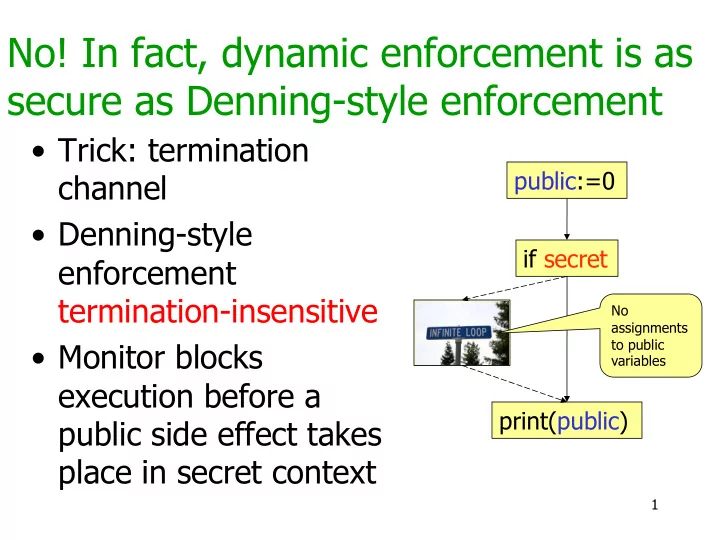
No! In fact, dynamic enforcement is as secure as Denning-style enforcement

  • Trick: termination

channel

  • Denning-style

enforcement termination-insensitive

  • Monitor blocks

execution before a public side effect takes place in secret context

1

if secret print(public) public:=0

No assignments to public variables

slide-2
SLIDE 2

2

Modular enforcement

cfg ⟶" cfg’ skip x:=e ; if…, while…

Program

cfgm ⟶" cfgm’

Monitor

b

s a(x,e) b(e) f

Actions #

slide-3
SLIDE 3

3

Termination-insensitive monitor

  • cfgm=st
  • prevent explicit flows l:=h
  • prevent implicit flows if h then l:=0

– by dynamic pc = highest level on context stack

stack of security contexts

Action Monitor’s reaction stop if stack update a(x,e) x and (e or pc) b(e) push(lev(e)) f pop

slide-4
SLIDE 4

Security and relative permissiveness

  • Denning-style analysis enforces

termination-insensitive security

– for while language [Volpano, Smith &

Irvine’96]

– for language with I/O [Askarov, Hunt,

Sabelfeld & Sands’08]

  • Monitoring enforces termination-

insensitive security

– for while language – for language with I/O

  • Monitoring more permissive than static

analysis

– Typable programs not blocked by monitor – l:=l*l; if l<0 then l:=h

4

slide-5
SLIDE 5

Flow sensitivity

  • Flow-insensitive analyses in this talk so far
  • Rejected by flow-insensitive analysis
  • Flow sensitive analysis relabels secret

when it is assigned public constant

– E.g. [Hunt & Sands’06]

  • Particularly useful for low-level languages

– secure register reuse

5

secret := 0; if secret then public := 1

slide-6
SLIDE 6

Not all channels can be collapsed into termination channel

  • Can we generalize

the results to flow- sensitive case?

  • Intuition: even more

dynamism with flow- sensitivity so we should gain in precision

6

Secure Preserved by monitor Typed

slide-7
SLIDE 7

Flow sensitivity: Turns out

  • Can have sound or

permissive analysis but not both

  • Theorem: no

purely dynamic permissive and sound monitor

7

Secure Typed Preserved by monitor

slide-8
SLIDE 8

Trade off between permissiveness and soundness

  • Purely dynamic monitor needs to make

a decision about temp

  • Impossible to make a correct decision

without sacrificing permissiveness

8

public := 1; temp := 0; if secret then temp := 1; if temp != 1 then public := 0

slide-9
SLIDE 9

Proof I

  • If secret is true,

we can type:

  • By permissiveness, it should be accepted by monitor
  • By dynamism, original program also accepted by monitor

9

public := 1; temp := 0; if secret then temp := 1; if temp != 1 then public := 0 skip;

  • utput(public)

public := 1; temp := 0; if secret then temp := 1; if temp != 1 then public := 0;

  • utput(public)
slide-10
SLIDE 10

Proof II

  • If secret is false,

we can type:

  • By permissiveness, it should be accepted by the monitor
  • By dynamism, original program also accepted by monitor
  • => Insecure program always accepted by monitor
  • Can have sound or permissive purely dynamic

monitor but not both

10

public := 1; temp := 0; if secret then temp := 1; if temp != 1 then public := 0;

  • utput(public)

public := 1; temp := 0; if secret then temp := 1 skip; if temp != 1 then public := 0;

  • utput(public)
slide-11
SLIDE 11

Static vs. dynamic

  • Fundamental trade offs between

dynamic and static analyses

  • Case studies to determine practical

consequences

11

Secure

Preserved by monitor

Typed

Secure

Typed

Preserved by monitor

Secure

Preserved by monitor

Typed

Flow-insensitive analysis Flow-sensitive analysis Flow-sensitive analysis, hybrid monitors