NIAGARA REGION WIND FARM PROJECT Community Liaison Committee - - PowerPoint PPT Presentation

niagara region
SMART_READER_LITE
LIVE PREVIEW

NIAGARA REGION WIND FARM PROJECT Community Liaison Committee - - PowerPoint PPT Presentation

NIAGARA REGION WIND FARM PROJECT Community Liaison Committee Meeting 4 | February 7, 2017 AGENDA Introductions & Meeting Structure Outline Review of Minutes CLC Meeting #3 Project Update Topics of Community


slide-1
SLIDE 1

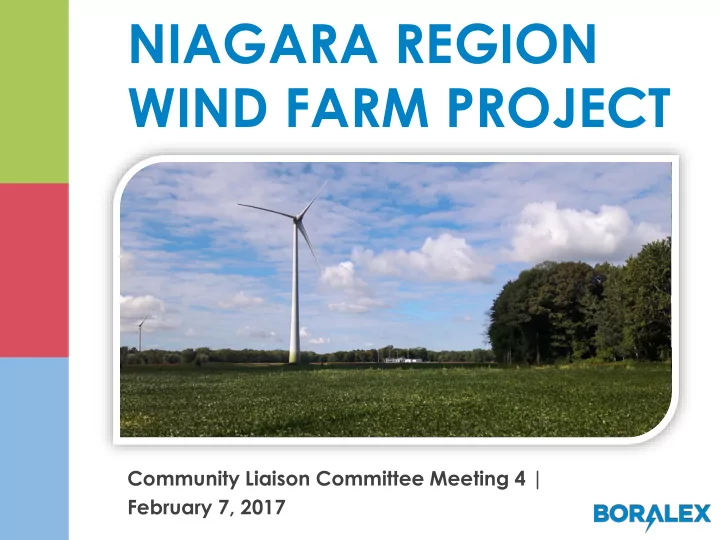
NIAGARA REGION WIND FARM PROJECT

Community Liaison Committee Meeting 4 | February 7, 2017
slide-2
SLIDE 2

AGENDA

Introductions & Meeting Structure Outline

Project Update

Topics of Community Interest

Review of Minutes – CLC Meeting #3

Moving Forward

slide-3
SLIDE 3

REVIEW OF MINUTES

CLC MEETING #3

slide-4
SLIDE 4

PROJECT UPDATE

  • Status - Operational
  • Meet the Operations Team
  • Guest experts
slide-5
SLIDE 5

Project Status - Operational

  • NRWF achieved its Commercial Operation Date

(COD) on November 2, 2016

  • Intro of Operations team:
  • Jason Weir, Site Manager
  • Michael Gaudet, Wind Site Technician
  • Stephanie Bujold, Environmental Manager
  • Current activities on site – Jason
slide-6
SLIDE 6

Contacting NRWF

To contact the Niagara Region Wind Farm:

  • Phone:

1-844-363-6491

  • Email:

info@nrwf.ca

  • Website: www.nrwf.ca
slide-7
SLIDE 7

Guest Presenters

  • Natural Resource Solutions Inc. (NRSI)
  • Charlotte Teat, Terrestrial and Wetland Biologist
  • Aercoustics
  • Payam Ashtiani,

Principal Aercoustics, Acoustical Engineer

slide-8
SLIDE 8

NRSI

  • Natural Resource Solutions Inc. (NRSI) is an

environmental consulting firm consisting of biologists specializing in aquatic, terrestrial, and wetland biology.

  • NRSI has extensive environmental monitoring experience
  • n wind power projects in all stages of development.
slide-9
SLIDE 9

NRSI

  • NRSI will be completing the following post-

construction surveys:

  • Avian and bat mortality monitoring,
  • Significant woodland and wetland hydrological

monitoring,

  • Amphibian woodland and wetland breeding

habitat surveys,

  • Migratory landbird stopover and staging area

surveys, and

  • Raptor wintering area surveys, including short-eared
  • wl surveys.
slide-10
SLIDE 10

NRSI

  • Bird and bat mortality monitoring
  • Monitoring is conducted in accordance with

requirements of the REA and MNRF Guidelines

  • Mortality monitoring began January 5th, 2017 at 2

turbines (T01 and T58)

  • These turbines will be monitored weekly from

December 1st to March 31st

  • A subset of 23 turbines will be selected for twice-

weekly monitoring, from mid-April through October 31st and once per week from November 1st through November 30th

  • All turbines will be searched once per month from

May 1st through October 31st

slide-11
SLIDE 11

NRSI

  • Correction factors are applied in order to calculate
  • verall estimated mortality rates across the project
  • An annual report will be prepared
  • 3 years of monitoring is required
  • Supplementary monitoring will be conducted at 10 of

the subset of 23 turbines

  • Search radius of 85m from the turbine base, instead
  • f the typical 50m radius
  • Twice-weekly monitoring from mid-April through

October 31st

  • An annual report will be prepared
slide-12
SLIDE 12

NRSI

  • Post-construction behavior monitoring
  • Pre-construction surveys completed by Stantec
  • Based on significance, post-construction surveys are

required to assess any potential changes in habitat use

  • Amphibian woodland and wetland breeding

habitat surveys (1 year)

  • Migratory landbird stopover and staging area

surveys (3 years)

  • Raptor wintering area surveys, including short-

eared owl surveys (3 years)

  • Significant woodland and wetland hydrological

monitoring (1 year)

  • Inspections of culverts within 30m of access roads
  • Ensure hydrological flows are maintained
slide-13
SLIDE 13

NRSI

  • Q&A
slide-14
SLIDE 14

NIAGARA REGION WIND FARM

slide-15
SLIDE 15
  • Experts in wind turbine acoustic measurement and

monitoring

  • Completed acoustic assessment and sound modelling

for over 1 GW of wind energy. Logged more than 100,000 hours of post construction noise measurements from wind turbine facilities

  • Accredited to measure wind turbine noise emissions as

per CAN/CSA Standard C61400-11:07 standard

  • Noise monitoring performed on behalf of Industry,

Regulators and Residents

  • Unbiased data and information

Who are Aercoustics?

slide-16
SLIDE 16
  • REA Requirements
  • Acoustic Audit Immission
  • Transformer Acoustic Audit
  • Receptor Acoustic Audit
  • Acoustic Audit Emission
  • Turbine Acoustic Testing (IEC 61400-11:07)

Acoustic Audit – Agenda

slide-17
SLIDE 17
  • Wind Turbine – Receptor Audit
  • Acoustic audit at five (5) receptor locations
  • Two separate audit periods (one spring, one fall)
  • Wind Turbine – Noise Emission
  • One test on each turbine type
  • 3.0 MW – 104.8 dBA
  • 2.9 MW – 102.9 dBA
  • Transformer Substation
  • Acoustic Audit of two (2) Transformers Sound Emissions
  • Nearby Receptor measurements

REA Requirements

slide-18
SLIDE 18
  • Noise emission
  • Testing in accordance with the IEEE Standard C57.12.90 and

NPC-233

  • Transformer sound power levels reported and compared to

maximum sound power levels specified in Schedule B of REA

  • Tonal audibility of transformer assessed
  • Nearby Receptor measurements
  • Near field and receptor based measurements, compliance

assessed at the receptor with regards to sound pressure level and tonal audibility

Transformer Acoustic Audit

slide-19
SLIDE 19
  • Five (5) locations to be monitored as required by the REA
  • Receptor locations chosen based on worst case impact

and prevailing downwind conditions

  • Measurement procedure and analysis based on MOECC

guideline - Compliance Protocol for Wind Turbine Noise

  • Measurement during night-time (10pm to 5am)
  • Data set
  • 120 one-minute intervals for Turbine ON. Between 4-7m/s (10m

height). Each bin (+/- 0.5m/s)

  • 60 one-minute intervals for Background. Between 4-7m/s
  • Placement of monitoring equipment (5 stations) for ~4

weeks

Receptor Acoustic Audit

slide-20
SLIDE 20
slide-21
SLIDE 21

Noise Emission Audit (IEC 61400-11)

  • Two (2) turbines to be tested as

required by the REA

  • One (1) test per each turbine type:
  • 3.0 MW – 104.8 dBA – T03
  • 2.9 MW – 102.9 dBA – T46
  • Acoustic emission measurements

performed in accordance with the CAN/CSA-C61400-11:07 National Standard.

  • Equivalent to IEC 61400-11 Edition

2.1

slide-22
SLIDE 22

Schedule

  • COD: November 2nd, 2016
  • Wind Turbine – Receptor Audit
  • Audit 1 – 12 months from COD – November 2, 2017
  • Planned start Spring 2017
  • Audit 2 – 18 months from COD – May 2, 2018
  • Planned start Fall 2017
  • Wind Turbine – Emission Audit
  • 12 months from COD – November 2, 2017
  • Start Spring 2017
  • Transformer Audit
  • 12 months from COD – November 2, 2017
  • Start Spring 2017
slide-23
SLIDE 23

Comments or questions? Payam Ashtiani PayamA@Aercoustics.com – 416-249-3361

Thank You

slide-24
SLIDE 24

NIAGARA REGION WIND FARM

slide-25
SLIDE 25

Topics of Community Interest

  • Questions & Concerns – Who to contact
  • Project Ownership & Community Investment
  • Technical Turbine Questions
  • Health-related Questions
  • Water Wells
  • Transmission Line
  • Guiderail Installation
  • Tree Replacement Plans
slide-26
SLIDE 26

Contacting NRWF with Questions & Concerns

Your Questions and Concerns are welcomed

  • Complaints are logged and tracked
  • NRWF must report all environmental complaints to the MOECC
  • Complainants will receive an acknowledgement within

48 hours

To contact the Niagara Region Wind Farm:

  • Phone:

1-844-363-6491

  • Email:

info@nrwf.ca

  • Website: www.nrwf.ca
slide-27
SLIDE 27

Project Ownership & Community Investment

  • NRWF is owned & operated by Boralex Inc.
  • As of January 18, Boralex Inc. completed the purchase of shares

previously owned by ENERCON Canada. Six Nations of the Grand River Development Corporation is also a project owner but is not involved in operating the Wind Farm

  • Community Investment
  • NRWF will spend in excess of $80 million during the lifetime of the

project on such items as taxes, local contractors, land lease agreements, etc.

  • Community Fund Agreements exist with West Lincoln, Wainfleet,

and Haldimand County and are payable annually on April 30

  • Long-term jobs are created through direct employment with the

Operations team including maintenance, monitoring and other support roles and indirect employment opportunities including jobs created at three tower and component manufacturing facilities

slide-28
SLIDE 28

Technical Turbine Questions

  • The 230MW capacity of the Niagara Region Wind Farm

is comprised of seventy seven (77) ENERCON E-101 turbines.

  • The nominal power rating of this turbine model is 3MW.

66 turbines operate at 3MW and 11 are de-rated to 2.9MW (T18, 33, 34, 45, 46, 47, 53, 55, 60, 74)

  • These turbines generate electricity at wind speeds of 2

metres per second or greater (up to 28-34m/s)

  • Turbines are lit according to Transport Canada
  • requirements. Not all turbines require lighting

depending on their location/proximity to other turbines.

slide-29
SLIDE 29

Health-related Questions

  • Health-related information about Wind Farms
  • Health Canada website www.hc-sc.gc.ca
  • CanWEA Website http://canwea.ca/wind-facts/your-health/
  • Ontario’s Chief Medical Officer of Health,

CMOH Report, May 2010:

  • “the scientific evidence available to date does not demonstrate

a direct causal link between wind turbine noise and adverse health effects. The sound level from wind turbines at common residential setbacks is not sufficient to cause hearing impairment

  • r other direct health effects, although some people may find it

annoying”.

slide-30
SLIDE 30

Water wells

  • As per the project’s REA approval, both pre- & post-

construction groundwater monitoring must be done and annual reports submitted to the MOECC District Manager

  • Home owners in prescribed zones were approached by mail and

door-to-door in 2015 and pre-construction samples taken and analyzed from those who elected to participate

  • Post-construction sampling has been completed proximal to the T-line

(and report submitted to and approved by NEC)

  • Post-construction sampling will commence in 2017 for homes proximal

to turbines.

  • Final samples will be taken in 2018 and reports submitted to MOECC
  • Any specific concerns or issues with water wells should be

raised directly with NRWF – please use email and phone contact information provided

slide-31
SLIDE 31

Transmission Line

  • Pole placement is closer to travelled

road surface on some roads than

  • thers – a multitude of factors

determined the location of poles including:

  • Sight lines & Clear zones
  • Setbacks from private land
  • Drainage
  • Other infrastructure (hydro, telecommunications, pipelines)
  • Section of underground T-line on Regional Road 45 is

the result of the need to avoid interference with other infrastructure in the right-of-way

slide-32
SLIDE 32

Transmission Line (continued)

  • Several comments about whining or pinging noises

from the transmission line were received prior to this meeting

  • Any noise-related concerns about the Transmission line

should be reported directly to NRWF – please use email and phone contact information provided

slide-33
SLIDE 33

Guiderail Installation

  • Guiderail installation is a safety measure to protect

motorists which is required by applicable guidelines and enforced by the Road Authority

  • The guiderail installed by the

project was designed, reviewed and stamped by a licensed Engineer in the province of Ontario

  • Upper Canada Consultants

(UCC) designed all installations and has reviewed and signed-off

  • n the safety and completeness
  • f the guiderail installed
slide-34
SLIDE 34

Tree Replacement Plans

  • Tree replacement commitments to each municipality

and region are set out in individual Road Usage Agreements (RUAs)

  • Implementation plans are being discussed with

municipalities and once finalized, NRWF will share details via the project’s website www.nrwf.ca

slide-35
SLIDE 35

DISCUSSION & QUESTIONS

slide-36
SLIDE 36

Moving forward

  • Meeting minutes will be available online in ‘Community

Liaison Committee Documents’ http://www.nrwf.ca/project/

  • Next CLC meeting timeframe
  • Boralex will continue to offer CLC meetings twice

yearly for as long as there is interest

slide-37
SLIDE 37

Thank you!

Your attendance and participation is valuable and appreciated. To contact the Niagara Region Wind Farm:

  • Phone:

1-844-363-6491

  • Email:

info@nrwf.ca

  • Website:

www.nrwf.ca

slide-38
SLIDE 38

NIAGARA REGION WIND FARM