Nguyen Thi Phuong GG Tau Ab1 ~ 0.38 M sun GG Tau Ab2 ~ 0.3 M sun - - PowerPoint PPT Presentation

nguyen thi phuong
SMART_READER_LITE
LIVE PREVIEW

Nguyen Thi Phuong GG Tau Ab1 ~ 0.38 M sun GG Tau Ab2 ~ 0.3 M sun - - PowerPoint PPT Presentation

OBSERVED CHEMISTRY IN THE GG TAU A GAS AND DUST DISK: The first detection of H 2 S in a protoplanetary disk Nguyen Thi Phuong GG Tau Ab1 ~ 0.38 M sun GG Tau Ab2 ~ 0.3 M sun GG Tau Aa Credit: Augusto Carballido ~ 0.6 M sun E. Chapillon, L.


slide-1
SLIDE 1

First TagKASI International Conference: Cosmic Dust and Magnetism, Oct 30-Nov 2, 2018

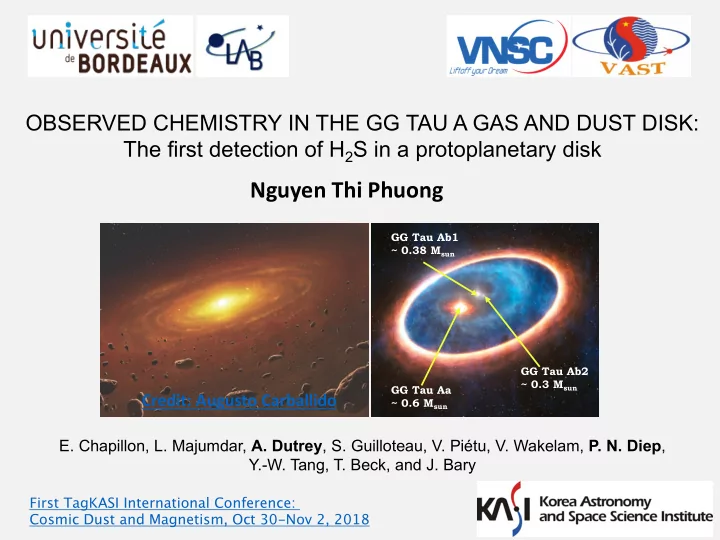
GG Tau Aa ~ 0.6 Msun GG Tau Ab2 ~ 0.3 Msun GG Tau Ab1 ~ 0.38 Msun

Credit: Augusto Carballido

Nguyen Thi Phuong

1

OBSERVED CHEMISTRY IN THE GG TAU A GAS AND DUST DISK: The first detection of H2S in a protoplanetary disk

  • E. Chapillon, L. Majumdar, A. Dutrey, S. Guilloteau, V. Piétu, V. Wakelam, P. N. Diep,

Y.-W. Tang, T. Beck, and J. Bary

slide-2
SLIDE 2

CONTENTS Introduction Observations and results Discussion Summary

2

slide-3
SLIDE 3

3

Introduction

GG TAU A , a typical T Tauri star Taurus-Auriga star forming region 140 pc, 2-3 Myr A triple system, Cavity of 180 au, i~ 37o, PA ~8o M✮=1.3 M⦿, Mdisk = 0.12 M⦿ Gas + dust disk out to 800 au Dust ring of 180 – 260 au Observed molecular lines in GG Tau A

Dutrey et al, 2016

Observed continuum emission in GG Tau A

Velocity map

at ~ 3–4 scale heights at midplane

slide-4
SLIDE 4

Observations and results (S-bearing species)

Other Sulfur-bearing species SO, SO2, which are expected to be in the warmer region

  • f the disk and C2S are not detected.

4

CS (3-2) and CS (7-6) are observed in the disk, with CS (3-2) is more extended and CS(7-6) mostly present in the dense ring region. Most of the H2S 1(1,0) –1(0,1) emission originates from the dense ring between 180 and 260 au (T ~25 K) and extends up to ~500 au.

In recent attempt to study molecular chemistry with focus on Sulfur-bearing species, we observed CS, H2S, SO, SO2 and CCS in the GG Tau A disk.

H2S

Phuong et al., 2018

slide-5
SLIDE 5

Observations and results (C-bearing species)

5

Some Carbon-bearing molecules were also observed. HCO+(1–0) is as extended as the CO emission out ~800 au H13CO+(2–1) isotopologe emission peaks in the eastern part of the ring. DCO+ (3–2) emission peaks outside of the dense ring.

H13CO+ DCO+ HCO+

The measured HCO+/H13CO+ ratio is ~30, suggesting partially optically thick emission for HCO+(1–0) line.

Phuong et al., 2018

slide-6
SLIDE 6

Observations and results (C-bearing species)

6

Precursors of DCO+ and HCO+ are H2D+, H3

+ and CO

H2D+ + CO à DCO+ + H2 H3

+ + CO à HCO+ +H2

H2D+ formed in the gas phase at low temperature, easily destroyed by CO, N2 H3

+ + HD ⇆ H2D+ + H2+232K

à H2D+ should be abundant in cold disk mid-plane and studing DCO+ may give evidence for the CO snow line in disk mid-plane. The measured DCO+/HCO+ ratio in disks: 0.03 over the GG Tau A disk – This work 0.04 in the disk of TW Hydra (0.06 M⦿) – van Dishoeck et al. 2003 0.024 in the disk of LkCa 15 (0.028 M⦿) – Huang et al. 2017 à This is consistent with other disks and gives clear evidence of ongoing deuterium enrichment in the GG Tau A disk.

slide-7
SLIDE 7

Observations and results

We use three-phase (i.e., gas phase, grain surface, and grain mantle, along with possible exchanges between the different phases) chemical model Nautilus to model the chemistry in the dense and cold ring of GG Tau A in order to explain the

  • bservations.

7

One grain size model of 0.1 𝜈m Stellar UV flux of fUV200AU = 375𝜓0 The standard C/O ratio of 0.7 Sulfur abundance of 8 10–8

Final compromised parameters For CS: CD(Observed) /CD(Predicted) ~ 2 For DCO+ and HCO+: CD(Observed) /CD(Predicted) ~ 5 –7

But over-predicted for H2S (grain surface formation species) : CD(Observed) /CD(Predicted) ~ 26

– C/O ratio affects the abundances of SO, SO2: Their column densities drop by factors

  • f 100 and 500, respectively, when C/O changes from 0.46 to 1.2 (Semenov et al. 2018)

– UV field has a negligible impact on the H2S desorption and mild affects to the SO/H2S ratio and small affects to the DCO+/HCO+ ratio. – 2 grain size model produces much higher H2S than observed.

slide-8
SLIDE 8

8

The H2S column density is about 3 times greater than the upper limits for DMTau, MWC480, GOTau, and LkCa 15 (Dutrey+2011), probably reflecting the larger disk mass of GG Tau A. The CS to H2S abundance ratio of 20 in GG Tau A may still be similar in all sources.

Discussion

The disks appear to have very similar relative abundances, suggesting similar chemical processes at play, while the dense core differs significantly. Comparison with other sources

Kraus & Ireland 2012

slide-9
SLIDE 9

9

Summary

§ We report the first detection of H2S in a protoplanetary disk and the detections of HCO+, H13CO+, DCO+. § Our three-phase chemical model fails to reproduce the observed column densities

  • f

S-bearing molecules, except for CS, suggesting that

  • ur

understanding of Sulfur chemistry is still incomplete. § Comparisons with other disks indicate that the detection of H2S appears to be facilitated by the large disk mass, but that the relative abundance ratios remain

  • similar. This indicates that GG Tau A could be a good test bed for chemistry in

disks.

Thank you for your attention!