
SLIDE 1
NFI:TSX INVESTOR PRESENTATION
March 2019
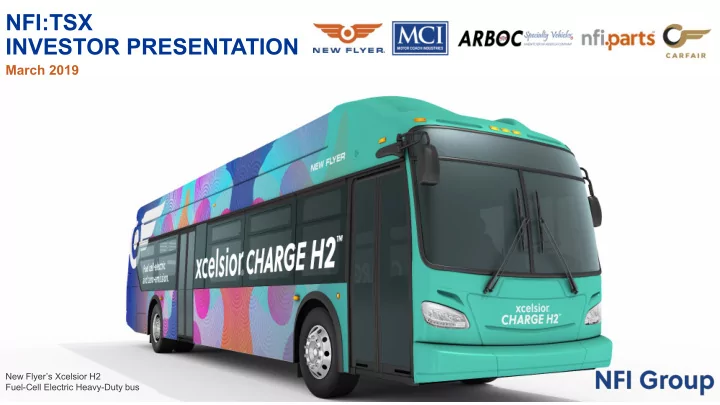
New Flyer’s Xcelsior H2 Fuel-Cell Electric Heavy-Duty bus
NFI:TSX INVESTOR PRESENTATION March 2019 New Flyers Xcelsior H2 - - PowerPoint PPT Presentation
NFI:TSX INVESTOR PRESENTATION March 2019 New Flyers Xcelsior H2 Fuel-Cell Electric Heavy-Duty bus Leader in Transit Buses, Motor Coach & Aftermarket FY2018 Equivalent Units (EUs) Deliveries FY2018 Revenue by Product 1,030 $584 Motor
March 2019
New Flyer’s Xcelsior H2 Fuel-Cell Electric Heavy-Duty bus
2
All figures are in U.S. dollars unless otherwise noted See Appendix for Forward Looking Statements and Financial Terms, Definitions and Conditions
2,781 1,030 502 $1,502 $584 $42 $377 $15
FY2018 Equivalent Units (EUs) Deliveries FY2018 Revenue by Product
4,313 EU $2,519M*
Heavy-duty transit bus Motor coach Low-floor cutaway and medium duty bus Fiberglass reinforced polymer Aftermarket parts Heavy-duty transit bus Motor coach Low-floor cutaway and medium duty bus
$984 $926 $865 $1,199 $1,451 $1,539 $2,274 $2,382 $2,519 $97 $80 $61 $95 $107 $151 $289 $318 $315
2010 2011 2012 2013 2014 2015 2016 2017 2018
Revenue ($M)
Acquired North America’s leading manufacturer of motor coach & parts/service Acquired US manufacturer of HD transit buses & parts distributor Acquired Orion (transit bus parts business) from Daimler Global bus body manufacturer equity investment in NFI Acquired Can/US FRP Supplier Acquired US part fabricator in 2010 NFI converted from IDS to Common Share Acquired assets of US Fiberglass supplier Acquired US OEM of low-floor cutaway and medium-duty buses
3
North American leader in heavy-duty transit, motor coach, low-floor cutaway and aftermarket parts Trusted business partner for over 87 years delivering and standing behind reliable products. Focused on total cost
Five year revenue compound annual growth rate of 16.0% driven by accretive acquisitions, organic growth and
vertical integration
Leading Adjusted EBITDA margin within its public company peer group(1) Peer leading dividend yield with history of growing dividends Vertically integrated fabrication processes (where NFI owns the drawings) to control Cost-Time-Quality Propulsion agnostic on proven common platforms: clean diesel, natural gas, hybrid and zero-emission (trolley,
battery and fuel-cell)
Solid backlog with multi-year visibility Track record of innovation – electric trolleys, low-floor transit buses, CNG propulsion, battery-electric, low-entry
motor coach, Vehicle Innovation Center, Infrastructure Solutions
Providing leading solutions to move groups of people safely, efficiently, responsibly, and in style
4
(1) Public company peer group includes: REV Group Inc., Spartan Motors Inc., Blue Bird Corporation, Grande West Transportation Group Inc., Oshkosh Corporation, Thor Industries Inc., Winnebago Industries Inc.
5
$57 $90 $181 $246 $242 $50 $61 $76 $72 $74 $107 $151 $289 $318 $315 7.4% 9.8% 12.7% 13.4% 12.5% 2014 2015 2016 2017 2018 Manufacturing Aftermarket
$1,132 $1,217 $1,891 $2,013 $2,142 $319 $322 $383 $369 $377 $1,451 $1,539 $2,274 $2,382 $2,519 2014 2015 2016 2017 2018 Manufacturing Aftermarket
Revenue by Segment 2014 - 2018 Adjusted EBITDA and Adjusted EBITDA Margin by Segment 2014 - 2018
6
Metropolitan
20 operators 39%
Urban
200 operators 33%
Municipal
900+operators 28%
Public Transit
19%
Line Haul/Fixed Route
27%
Tour & Charter
41%
Limo
6% * Sourced from New Flyer databases and Management estimates ** Sourced from MCI database and Management estimates
3,001 2,819 2,385 2,324 2,048 1,479 1,341 1,756 2,092 1,852 1,825 1,581 1,184 1,510 1,648 1,783 1,918 2,274 2,357 2,470 2,305 62% 63% 50% 63% 74% 69% 56% 60% 62% 57% 56% 51% 52% 38% 44% 46% 42% 37% 39% 43% 45%
2,000 3,000 4,000 5,000 6,000 7,000
Employee Shuttle
3%
5,347 5,816 6,236 5,388 5,009 4,723 5,212 4,333 4,047 5,055 5,284 6,032 5,933 5,154 5,109 5,010 5,128 5,373 5,795 6,336 6,504 20% 26% 30% 38% 25% 37%36%37%35% 42%41% 37% 34%35% 32% 37% 48% 44%44%43%43%
2,000 3,000 4,000 5,000 6,000 7,000
New Flyer’s Core Markets
HD Transit Bus Market – EUs delivered and New Flyer Market Share* Motor Coach Market – Units Delivered in Can/US and MCI Share*
20% 43% 29% 4% 4% 54% 31% 12% 3%
6,504 EU
Estimated active North America Transit Bus Fleet*
80,000 BUSES IN SERVICE
Orion Parts and NABI acquired by NFI in 2013
7
* Sourced from New Flyer database and Management estimates Others
Bids in Process Bids Submitted Operator Forecasted 5 year buy**
EUs 670 2,061 20,694
* Bid universe is primarily applicable to New Flyer, but MCI also sells to public transit agencies that would be included in totals above ** Management estimate of future expected industry procurement in the next five years based on discussions directly with individual U.S. and Canadian transit authorities ^ Sourced from APTA Public Transportation Factbook 2016
10,000 15,000 20,000 25,000 Q4 2011 Q1 2012 Q2 2012 Q3 2012 Q4 2012 Q1 2013 Q2 2013 Q3 2013 Q4 2013 Q1 2014 Q2 2014 Q3 2014 Q4 2014 Q1 2015 Q2 2015 Q3 2015 Q4 2015 Q1 2016 Q2 2016 Q3 2016 Q4 2016 Q1 2017 Q2 2017 Q3 2017 Q4 2017 Q1 2018 Q2 2018 Q3 2018 Q4 2018
HD Transit Bus Market Share – 2018 Deliveries Public Bid Universe & Active Opportunities (EUs)*
30% 45% 24% 2% 51% 24% 19% 6%
2,305 Units 55,000 UNITS
MCI Share increased by 2% in 2018
Spain US
Negligible Deliveries to date
8
* Source: MCI Database and Management estimates
Tour/Charter 35% Line Haul / Fixed Route 26% Employee Shuttle 9% Public/Transit 19% Limo 11%
2,305 Units
Motor Coach Market Share – 2018 Deliveries Motor Coach 2018 Market Deliveries By Segment Active North American Motor Coach Fleet
North American Cutaway Market (2018 ~16,000 units)*
64% 30% 4% 2%
75% 20% 5%
Overall Cutaway Market Low-Floor Cutaway Market
16,000 EU
~670 Units
9
High-floor with lift High-floor without lift Low-floor cutaway Low-floor – other
* Source: ARBOC Management estimates
Disruption opportunity for ARBOC 9,100 5,175 1,270 300
Small Cutaway Medium Cutaway Medium Duty Transit Trolley Vehicle Type Bus Life 4 year 5 to 7 year 7 to 10 year 7 years ARBOC Models Spirit of Independence Spirt of Freedom and Mobility Spirt of Liberty and Equess Spirit of America Competition Champion, StarCraft, Goshen, Ekhart Coach, Glaval Vicinity, ADL, El Dorado Hometown Trolley
ARBOC opportunity to gain share with customer transition to low-floor cutaway Equess targeting growth in this market North American Cutaway, Medium-Duty and Trolley Annual Demand ~16,000 Units*
Largest parts and service provider in the industry, providing nearly $400
million in parts annually to major U.S. transit agencies
Added value through unique offerings (Kits, Mid-life upgrade programs,
Vendor Managed Inventory (VMI), KanBan, etc.)
Secured six vendor managed inventory programs during 2018. Expected to
provide positive benefit to NFI Parts business in 2019 and beyond. Continuing to pursue other opportunities across North America
Expertise and direct access to over 250 bus and coach engineers, which is
critical to cost-effective and timely parts procurement, quality and availability
Website offering state of the art on-line sales and distribution features Best-in-class training and publications – MCI Academy accredited by the
Automotive Service Excellence (ASE) & recipient of Grand National Excellence in Training Award from ASE Training Managers Council (ATMC)
10
Firm = 3,649 EUs Options = 7,184 EUs
2,000 4,000 6,000 8,000 10,000 12,000
Firm Option
MCI Public backlog added in Q4-15
0% 20% 40% 60% 80% 100% 120% 140% 160% 180%
2,000 3,000 4,000 5,000 6,000 7,000 2014 2015 2016 2017 2018
LTM New Orders (EUs) LTM Deliveries (EUs) LTM Order Intake / Deliveries
Q4-18 LTM Book to Bill ratio
Total Backlog at Dec. 31, 2018 (Firm Orders and Options)
ARBOC Public backlog added in Q4-17
11
Total Backlog EUs to Annual Production
54% 73% 79% 81% 71%
1,000 1,500 2,000 2,500 2014 2015 2016 2017 2018 2019 2020 2021 2022 Options expired Options exercised Current option expiry Annual conversion rate
Book-to-Bill (new firm plus option orders divided by deliveries Total Backlog Firm and Option EUs Option History, Conversion and Current Status (EUs)
3.25 4.0 4.0 3.75 3.75 1.65 2.91 1.94 1.84 2.09 2014 2015 2016 2017 2018 Credit Covenant Total Leverage
^Under NFI Senior Credit Agreement, Total Leverage Ratio did not include Convertible Debentures as debt.
12
NFI Target leverage 2.0x – 2.5x
$65.5 $108.3 $216.3 $206.9 $210.5 $32.5 $33.8 $54.0 $76.1 $90.3 49.6% 31.2% 25.0% 36.8% 42.9% 2014 2015 2016 2017 2018 Free Cash Flow Dividends Payout Ratio
FY2018 Adjusted EBITDA to Free Cash Flow Reconciliation ($M) Total Leverage Ratio^ vs Credit Covenant Free Cash Flow and Dividends (C$M)
Invest in current business and growth Return capital to Shareholders
NCIB C$89 Dividends C$418 Acquistions $676 USD Capital Expenditures $245 USD
Dividends increased by 39.5% in May 2017, by 15.4% in May 2018 and 13.3% in March 2019. Now $1.70/share paid quarterly.
13
NCIB launched in June 2018 and amended in January 2019 allowing for repurchase
Maintenance capital, facility upgrades, LEAN implementation, IT harmonization, insourcing and parts fabrication
14 Battery-Electric Fuel Cell Electric Trolley Electric Electric Coach (testing)
emission electric technology
foot and 60-foot lengths
818kWh of electricity
15
Technology Part Fabrication
New MCI D Models
New Products
60’ fuel cell and battery electric Spirit of Equess webstore KMG Fabrication (Shepherdsville) Winnipeg / Anniston Expansion
Optimize Defend Diversify Grow
16
performance
17
FORWARD LOOKING STATEMENTS
“anticipates”, “plans”, “expects”, “intends”, “projects”, “forecasts”, “estimates” and similar expressions are intended to identify forward looking statements. These forward-looking statements reflect management's current expectations regarding future events and operating performance and speak only as of the date of the Financial Statements and associated Management’s Discussion and Analysis dated March 13, 2019. Forward-looking statements involve significant risks and uncertainties, should not be read as guarantees of future performance or results, and will not necessarily be accurate indications of whether or not or the times at or by which such performance or results will be achieved. A number of factors could cause actual results to differ materially from the results discussed in the forward- looking statements. Such differences may be caused by factors which include, but are not limited to, availability of funding to the Company's customers to purchase transit buses and coaches and to exercise options and to purchase parts or services at current levels or at all, aggressive competition and reduced pricing in the industry, material losses and costs may be incurred as a result of product warranty issues and product liability claims, changes in Canadian or United States tax legislation, the absence of fixed term customer contracts and the suspension or the termination of contracts by customers for convenience, the current U.S. federal "Buy-America" legislation may change and/or become more onerous, inability to achieve U.S. Disadvantaged Business Enterprise Program requirements, local content bidding preferences and requirements under Canadian content policies may change and/or become more onerous, trade policies in the United States and Canada (including USMCA, tariffs, duties, surtaxes and the Canadian federal Duties Relief Program) may undergo significant change, potentially in a manner materially adverse to the Company, production delays may result in liquidated damages under the Company's contracts with its customers, inability of the Company to execute its planned production targets as required for current business and operational needs, currency fluctuations could adversely affect the Company's financial results or competitive position in the industry, the Company may not be able to maintain performance bonds or letters of credit required by its existing contracts or
dividends and take certain other actions, interest rates could change substantially and materially impact the Company's profitability, the dependence on limited or unique sources of supply, the timely supply of materials from suppliers, the possibility of fluctuations in the market prices of the pension plan investments and discount rates used in the actuarial calculations will impact pension expense and funding requirements, the Company's profitability and performance can be adversely affected by increases in raw material and component costs, the availability of labor could have an impact on production levels, new products must be tested and proven in operating conditions and there may be limited demand for such new products from customers, the Company may have difficulty selling pre-owned coaches and realizing expected resale values, inability of the Company to successfully execute strategic plans and maintain profitability, development of competitive products or technologies, catastrophic events may lead to production curtailments or shutdowns, dependence on management information systems and risks related to cyber security, dependence on a limited number of key executives who may not be able to be adequately replaced if they leave the Company, employee related disruptions as a result of an inability to successfully renegotiate collective bargaining agreements when they expire, risks related to acquisitions and other strategic relationships with third parties, inability to successfully integrate acquired businesses and assets into the Company’s existing business and to generate accretive effects to income and cash flow as a result of integrating these acquired businesses and assets. NFI cautions that this list of factors is not exhaustive. These factors and other risks and uncertainties are discussed in NFI’s press releases and materials filed with the Canadian securities regulatory authorities which are available on SEDAR at www.sedar.com.
may be material. These forward-looking statements are made as of March 13, 2019 and NFI assumes no obligation to update or revise them to reflect new events or circumstances, except as required by applicable securities laws. FINANCIAL TERMS, DEFINITIONS AND CONDITIONS
including: gains or losses on disposal of property, plant and equipment, unrealized foreign exchange losses or gains on non-current monetary items, fair value adjustment for total return swap, non-recurring transitional costs or recoveries relating to business acquisitions, equity settled stock-based compensation, gain on bargain purchase of subsidiary company, fair value adjustment to acquired subsidiary company's inventory and deferred revenue, past service costs, costs associated with assessing strategic and corporate initiatives and proportion of the total return swap realized. “Free Cash Flow” means net cash generated by operating activities adjusted for changes in non-cash working capital items, interest paid, interest expense, income taxes paid, current income tax expense, effect of foreign currency rate on cash, defined benefit funding, non-recurring transitional costs relating to business acquisitions, past service costs, costs associated with assessing strategic and corporate initiatives, defined benefit expense, cash capital expenditures, proportion of the total return swap realized, proceeds on disposition of property, plant and equipment, gain received on total return swap settlement, fair value adjustment to acquired subsidiary company's inventory and deferred revenue and principal payments on capital leases. References to "ROIC" are to net operating profit after taxes (calculated as Adjusted EBITDA less depreciation of plant and equipment and income taxes at the expected effective tax rate) divided by average invested capital for the last twelve month period (calculated as to shareholders’ equity plus long-term debt, obligations under finance leases, other long-term liabilities, convertible debentures and derivative financial instrument liabilities less cash). References to "Adjusted Net Earnings" are to net earnings after adjusting for the after tax effects of certain non-recurring and/or non-operational related items that do not reflect the current ongoing cash operations of the Company including: gains or losses on disposal of property, plant and equipment, unrealized foreign exchange losses or gains on non-current monetary items, fair value adjustment for total return swap, non-recurring transitional costs or recoveries relating to business acquisitions, equity settled stock-based compensation, gain on bargain purchase of subsidiary company, fair value adjustment to acquired subsidiary company's inventory and deferred revenue, past service costs, costs associated with assessing strategic and corporate initiatives and proportion of the total return swap realized. References to "Adjusted Earnings per Share" are to Adjusted Net Earnings divided by the average number of Shares outstanding.
Adjusted Earnings per Share are not recognized earnings measures under IFRS and do not have standardized meanings prescribed by IFRS. Readers of this presentation are cautioned that ROIC, Adjusted Net Earnings and Adjusted EBITDA should not be construed as an alternative to net earnings or loss or cash flows from operating activities determined in accordance with IFRS as an indicator of NFI’s performance, and Free Cash Flow should not be construed as an alternative to cash flows from operating, investing and financing activities determined in accordance with IFRS as a measure of liquidity and cash flows. Reconciliations of net earnings and cash flows to Adjusted EBITDA, Free Cash Flow to cash flows from operations and net earnings to Adjusted Net Earnings are provided in the MD&A
future capital requirements, all of which are susceptible to a number of risks, as described in NFI’s public filings available on SEDAR at www.sedar.com.
18
$2,382 $2,519 2017 2018
Revenue ($M)
$318 $315 2017 2018
$3.09 $2.68 2017 2018
12,157 10,833 2017 2018
Backlog (EU)
Quarterly Analysis:
Revenue up $7.4M or 1.1% with growth in manufacturing from higher average transit bus selling price, offset by lower transit and coach volumes and lower aftermarket volumes
Adjusted EBITDA down $10.6M, or 11.7%, improved transit margins were offset by lower volumes, pricing pressure on new and pre-owned coach and startup losses incurred for Shepherdsville parts facility, also impacting EBITDA was the termination of the Setra Distribution Rights Agreement
Net earnings decreased by $33.3M, or 43.8% primarily from higher income tax expense, interest and depreciation. Tax variance impacted by U.S. tax reform in December 2017 which resulted in a $9 million income tax recovery in Q4 2017
Adjusted Earnings per Share down by $0.59 primarily from items impacting Net earnings
Total backlog down 1,324 EUs driven by slower bid activity in the second half of 2018 Fiscal 2018:
Revenue up $129.7M or 5.8%
Adjusted EBITDA down $2.6M or 0.8%
Adjusted EPS down $0.16 or 13.3%
+5.8%
19
Adjusted EBITDA per new EU delivered ($000 US) Aftermarket EBITDA Margin %
14.0 23.9 20.2 34.1 25.8 37.7 34.6 45.3 56.0 65.5 57.4 59.8 56.5 65.1 62.4 69.9 54.3 62.3 51.2 55.6
Adjusted EBITDA/EU 4 per. Mov. Avg. (Adjusted EBITDA/EU)
16.3% 16.2% 16.0% 14.2% 18.6% 18.8% 20.5% 18.6% 20.6% 20.6% 20.9% 20.3% 21.8% 21.9% 18.6% 17.3% 19.9% 19.5% 18.5% 20.2%
Adjusted EBITDA/Revenue 4 per. Mov. Avg. (Adjusted EBITDA/Revenue)
20
(1) (2) (1) MCI acquired in December 2015 (2) ARBOC acquired in December 2017 (1) (2)
Clean Diesel Natural Gas Electric Trolley Hybrid Electric Battery Electric/ Fuel Cell Xcelsior 35’, 40’, 60’ D Model 40’, 45’ J Model 45’ with 35’ launching Q1 2019
MCI eCoach Currently Testing
Low- Floor Cutaway Medium Duty Transit/Shuttle
21 New Flyer Leadership in Zero Emissions Buses (ZEB)
NF has delivered >6,900 transit buses powered by electric motors (including hybrids, trolleys, battery-electric and fuel cell-electric)
Battery-electric J Model motor coach currently undergoing testing in U.S. markets
22
Janice Harper Executive Vice President Human Resources Joined in 1998 Glenn Asham Executive Vice President and Chief Financial Officer Joined in 1992 David White Executive Vice President Supply Management Joined in 1996 Colin Pewarchuk Executive Vice President General Counsel Joined in 2006 Paul Soubry President and CEO Joined in 2009 Chris Stoddart President Transit Bus Joined in 2008 Ian Smart President Motor Coach Joined in 2011 Brian Dewsnup President NFI Parts Joined in 2006