New Signs of an old Problem: High Iron Concentrations, Corrosion of - - PowerPoint PPT Presentation

new signs of an old problem
SMART_READER_LITE
LIVE PREVIEW

New Signs of an old Problem: High Iron Concentrations, Corrosion of - - PowerPoint PPT Presentation

New Signs of an old Problem: High Iron Concentrations, Corrosion of Handpump Components in Aggressive Groundwater, and Lessons From WaterAids Recent Experiences in Uganda Authors: Vincent Casey (WaterAid), Lawrence Brown (Hafren Water), Jake


slide-1
SLIDE 1

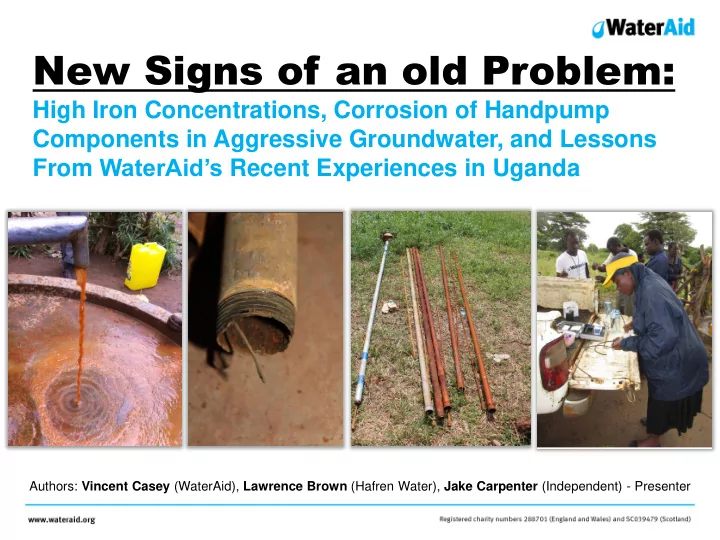
New Signs of an old Problem:

High Iron Concentrations, Corrosion of Handpump Components in Aggressive Groundwater, and Lessons From WaterAid’s Recent Experiences in Uganda

Authors: Vincent Casey (WaterAid), Lawrence Brown (Hafren Water), Jake Carpenter (Independent) - Presenter

slide-2
SLIDE 2

Scope of Handpumps

High Iron Concentrations, Corrosion of Hand-Pump Components in Aggressive Groundwater, and Lessons From WaterAid’s Recent Experiences in Uganda

  • ~184 million people relying on

handpumps in SSA1

  • ~1 million handpumps

installed in SSA and 60,000+ installed each year1

  • >4 million handpumps in India

Source: MacAurthor (2015)1

slide-3
SLIDE 3
  • WHO advisory2: 0.3 mg/L
  • Uganda Limit: 1 mg/L
  • Symptoms
  • Brown/red water
  • Iron/metal taste and

smell (often described to be similar to blood)

  • Stains food / clothes

when cooking / washing

High Iron Concentrations

High Iron Concentrations, Corrosion of Hand-Pump Components in Aggressive Groundwater, and Lessons From WaterAid’s Recent Experiences in Uganda

High iron is undesirable to users and can result in water point abandonment – users switch to traditional sources that were, often surface water (Health Risks!!!)

Color change after 30 minutes

Fe+3 Fe+2

slide-4
SLIDE 4

Sources of iron in handpump wells

High Iron Concentrations, Corrosion of Hand-Pump Components in Aggressive Groundwater, and Lessons From WaterAid’s Recent Experiences in Uganda

Iron in handpump water supplies Natural

Iron present in groundwater from soils/rocks in aquifer

Corrosion

Iron from susceptible* handpump components

*Galvanized steel (GI) is a very common material for handpump components and is susceptible to corrosion when used in wells with aggressive groundwater.

Aggressive GW = pH < 7

slide-5
SLIDE 5

Susceptible downhole components

High Iron Concentrations, Corrosion of Hand-Pump Components in Aggressive Groundwater, and Lessons From WaterAid’s Recent Experiences in Uganda

Galvanized (GI) Materials: Rising Mains (aka Riser Pipes) Pump Rods (aka Connecting Rods)

slide-6
SLIDE 6

High Iron Concentrations, Corrosion of Hand-Pump Components in Aggressive Groundwater, and Lessons From WaterAid’s Recent Experiences in Uganda Source: Furey, S. 2014. Handpumps: where now? - A synthesis of online discussions (2012-2014). Rural Water Supply Network/SKAT

  • Foundation. St. Gallen, Switzerland. www.rural-water-supply.net/en/resources/details/614

Recent reports of iron / corrosion problems

It is very likely that there are currently iron /corrosion problems in many other countries

slide-7
SLIDE 7

Literature on handpump corrosion

High Iron Concentrations, Corrosion of Hand-Pump Components in Aggressive Groundwater, and Lessons From WaterAid’s Recent Experiences in Uganda

1987 1995 1994

slide-8
SLIDE 8

Literature on handpump corrosion

High Iron Concentrations, Corrosion of Hand-Pump Components in Aggressive Groundwater, and Lessons From WaterAid’s Recent Experiences in Uganda

1981-1986 : “The World Bank / UNDP Handpumps Project”

  • 2,700 handpumps (of 76 types) in 17 countries, 5 years
  • Community Water Supply: The Handpump Option4
slide-9
SLIDE 9

Literature on handpump corrosion

High Iron Concentrations, Corrosion of Hand-Pump Components in Aggressive Groundwater, and Lessons From WaterAid’s Recent Experiences in Uganda

1981-1986 : “The World Bank / UNDP Handpumps Project”

  • 2,700 handpumps (of 76 types) in 17 countries, 5 years
  • Community Water Supply: The Handpump Option4
  • GI is not corrosion-resistant in aggressive GW
  • PVC, ABS, stainless steel, are common materials for

corrosion-resistant components

slide-10
SLIDE 10

Literature on handpump corrosion

High Iron Concentrations, Corrosion of Hand-Pump Components in Aggressive Groundwater, and Lessons From WaterAid’s Recent Experiences in Uganda

1981-1986 : “The World Bank / UNDP Handpumps Project”

  • 2,700 handpumps (of 76 types) in 17 countries, 5 years
  • Community Water Supply: The Handpump Option4
  • GI is not corrosion-resistant in aggressive GW
  • PVC, ABS, stainless steel, are common materials for

corrosion-resistant components

“Corrosive groundwater is much more widespread and much more damaging than previously suspected, in both Africa and Asia.”

slide-11
SLIDE 11

Literature on handpump corrosion

High Iron Concentrations, Corrosion of Hand-Pump Components in Aggressive Groundwater, and Lessons From WaterAid’s Recent Experiences in Uganda

The Impact of Handpump Corrosion on Water Quality (1987)5

  • Corrosion causes high iron and leads to pump

breakdowns

  • Pumping test method to identify the source of

iron in pumped groundwater

slide-12
SLIDE 12

Literature on handpump corrosion

High Iron Concentrations, Corrosion of Hand-Pump Components in Aggressive Groundwater, and Lessons From WaterAid’s Recent Experiences in Uganda

The Impact of Handpump Corrosion on Water Quality (1987)5

  • Corrosion causes high iron and leads to pump

breakdowns

  • Pumping test method to identify the source of

iron in pumped groundwater

“Corrosion is the main cause of the iron problem with handpump-equipped wells in West Africa and probably in many other parts of the World.”

slide-13
SLIDE 13

Literature on handpump corrosion

High Iron Concentrations, Corrosion of Hand-Pump Components in Aggressive Groundwater, and Lessons From WaterAid’s Recent Experiences in Uganda

66% of handpump breakdowns attributable to corrosion

“…in the 3000 Well Drilling Programme in Southern and Central Ghana, it has been found that 2/3 of the handpump breakdowns were directly or indirectly attributable to corrosion”

slide-14
SLIDE 14

Literature on handpump corrosion

High Iron Concentrations, Corrosion of Hand-Pump Components in Aggressive Groundwater, and Lessons From WaterAid’s Recent Experiences in Uganda

66% of handpump breakdowns attributable to corrosion

“…in the 3000 Well Drilling Programme in Southern and Central Ghana, it has been found that 2/3 of the handpump breakdowns were directly or indirectly attributable to corrosion”

30% of handpumps rarely used because of iron from corrosion

“Field experience suggests that up to 30% of handpump equipped water points are very little or not used mainly due to corrosion related water quality problems.”

slide-15
SLIDE 15

Literature on handpump corrosion

High Iron Concentrations, Corrosion of Hand-Pump Components in Aggressive Groundwater, and Lessons From WaterAid’s Recent Experiences in Uganda

66% of handpump breakdowns attributable to corrosion

“…in the 3000 Well Drilling Programme in Southern and Central Ghana, it has been found that 2/3 of the handpump breakdowns were directly or indirectly attributable to corrosion”

30% of handpumps rarely used because of iron from corrosion

“Field experience suggests that up to 30% of handpump equipped water points are very little or not used mainly due to corrosion related water quality problems.”

“it becomes more and more evident that the corrosion problem with handpumps is not only restricted to West Africa [where the research took place] but occurs all over the world.”

slide-16
SLIDE 16

Literature on handpump corrosion

High Iron Concentrations, Corrosion of Hand-Pump Components in Aggressive Groundwater, and Lessons From WaterAid’s Recent Experiences in Uganda

Groundwater Quality and Handpump Corrosion in West Africa (1994)7

  • Extensive resource - geological, chemical,

electrochemical, and biological factors associated with corrosion

  • Natural iron concentrations very rarely > 1 mg/L
  • Less handpump usage = more serious high-iron

problems

  • Stainless steel pump rods had corrosion rates 10x

less than GI

slide-17
SLIDE 17

Were the lessons learned?

High Iron Concentrations, Corrosion of Hand-Pump Components in Aggressive Groundwater, and Lessons From WaterAid’s Recent Experiences in Uganda Source: MacAurthor, Jess (2015) Handpump Standardisation in Sub-Saharan Africa: Seeking a champion. RWSN Publication 2015-1. St. Gallen, Switzerland. www.rural-water-supply.net/en/resources/details/652

  • Handpump standardization
  • Institutional Memory
  • Examples that the problem

continued and persists today3,8,9

slide-18
SLIDE 18

Perspectives on iron/corrosion

High Iron Concentrations, Corrosion of Hand-Pump Components in Aggressive Groundwater, and Lessons From WaterAid’s Recent Experiences in Uganda

“The water is very red and not good when I come to pick water early in the

  • morning. Many jerrycans must be filled before the water becomes clear”
  • Young girl using a handpump

“The people here have stopped using the borehole because of the red water. They have gone back to open well” (referring to a traditional unprotected spring)

  • Village Leader

“This borehole is too expensive – we must replace leaking pipes very often”

  • Water User Committee Chairperson

“The people complain of high iron, but what can we do?”

  • Local Government Worker

“Iron is common in groundwater… we should find a way to treat the water for iron”

  • National Government Engineer

“We should educate these people so they know that iron is not a health problem”

  • Expatriate Water Quality Specialist
slide-19
SLIDE 19

RWSN: What is needed now?

(From Furey (2014) Handpumps: where now? - A synthesis of online discussions (2012-2014)3

High Iron Concentrations, Corrosion of Hand-Pump Components in Aggressive Groundwater, and Lessons From WaterAid’s Recent Experiences in Uganda

  • Avoiding the problem: mechanisms

to ensure that galvanised iron (GI) pump components are not installed in aggressive groundwater (pH);

slide-20
SLIDE 20

RWSN: What is needed now?

(From Furey (2014) Handpumps: where now? - A synthesis of online discussions (2012-2014)3

High Iron Concentrations, Corrosion of Hand-Pump Components in Aggressive Groundwater, and Lessons From WaterAid’s Recent Experiences in Uganda

  • Avoiding the problem: mechanisms

to ensure that galvanised iron (GI) pump components are not installed in aggressive groundwater (pH);

  • Identifying the problem: a clearer

understanding of whether high iron levels are caused by natural conditions or by pump corrosion, and;

slide-21
SLIDE 21

RWSN: What is needed now?

(From Furey (2014) Handpumps: where now? - A synthesis of online discussions (2012-2014)3

High Iron Concentrations, Corrosion of Hand-Pump Components in Aggressive Groundwater, and Lessons From WaterAid’s Recent Experiences in Uganda

  • Avoiding the problem: mechanisms

to ensure that galvanised iron (GI) pump components are not installed in aggressive groundwater (pH);

  • Identifying the problem: a clearer

understanding of whether high iron levels are caused by natural conditions or by pump corrosion, and;

  • Addressing the problem: replacing
  • f GI pipes and pump rods in all

existing pumps in aggressive groundwater.

slide-22
SLIDE 22

Uganda Context

High Iron Concentrations, Corrosion of Hand-Pump Components in Aggressive Groundwater, and Lessons From WaterAid’s Recent Experiences in Uganda

Standardized handpumps

  • U2 (India Mark II) - Most Common Handpump
  • 32mm rising mains
  • Standard with GI components
  • Can be fitted with Stainless Steel (SS) components
  • Special specifications for depths > 50m up to 90m
  • U3 (India Mark III)
  • “Open-top” (OTC) handpump - 65mm rising mains
  • Typically with GI components
  • Can be fitted with Stainless Steel (SS) components
  • Limited to 50m
  • U3-Modified (U3M)
  • “Open-top” (OTC) handpump - 65mm rising mains
  • Specified with PVC rising mains and SS pump rods
  • Limited to ~32m depths
slide-23
SLIDE 23

Uganda Context

High Iron Concentrations, Corrosion of Hand-Pump Components in Aggressive Groundwater, and Lessons From WaterAid’s Recent Experiences in Uganda

Existing pH data? Chain-of-custody… storage / delays “No water, no pay”

slide-24
SLIDE 24

WaterAid Testing in Uganda

Partners

  • Amuria and Katakiwi District Governments
  • Church of Uganda-Teso Diocese Planning

Development Office (CoU-TEDDO)

  • Wera Development Agency (WEDA)

Steps taken

pH testing

  • 34 boreholes in Amuria and Katakwi
  • 91% < 6.5 and 38% < 6.0

Langenegger pumping tests

  • 8 boreholes in Amuria and Katakwi
  • 5 with GI components
  • 3 with PVC components

High Iron Concentrations, Corrosion of Hand-Pump Components in Aggressive Groundwater, and Lessons From WaterAid’s Recent Experiences in Uganda

slide-25
SLIDE 25

Pumping Test (Langenegger, 1989)

High Iron Concentrations, Corrosion of Hand-Pump Components in Aggressive Groundwater, and Lessons From WaterAid’s Recent Experiences in Uganda

Groundwater Quality - An Important Factor for Selecting Handpumps (1989)6

slide-26
SLIDE 26

Pumping Test (Langenegger, 1989)

High Iron Concentrations, Corrosion of Hand-Pump Components in Aggressive Groundwater, and Lessons From WaterAid’s Recent Experiences in Uganda

slide-27
SLIDE 27

WaterAid Testing in Uganda

Pumping Tests

  • Pumps locked overnight to ensure no use
  • Iron assessed with Palintest comparator test
  • Filtered samples to preclude solid corrosion (rust)

particles from introducing error to iron tests

  • Duplicate unfiltered samples and duplicate samples

for analysis at MWE Lab for quality control

High Iron Concentrations, Corrosion of Hand-Pump Components in Aggressive Groundwater, and Lessons From WaterAid’s Recent Experiences in Uganda

slide-28
SLIDE 28

Testing in Uganda

High Iron Concentrations, Corrosion of Hand-Pump Components in Aggressive Groundwater, and Lessons From WaterAid’s Recent Experiences in Uganda

slide-29
SLIDE 29

Testing Results

High Iron Concentrations, Corrosion of Hand-Pump Components in Aggressive Groundwater, and Lessons From WaterAid’s Recent Experiences in Uganda

pH=7.00 pH=6.30 pH=6.10 pH=7.10 pH=6.63 pH=6.41

slide-30
SLIDE 30

Observations

High Iron Concentrations, Corrosion of Hand-Pump Components in Aggressive Groundwater, and Lessons From WaterAid’s Recent Experiences in Uganda

slide-31
SLIDE 31

Observations

High Iron Concentrations, Corrosion of Hand-Pump Components in Aggressive Groundwater, and Lessons From WaterAid’s Recent Experiences in Uganda

slide-32
SLIDE 32

Observations

High Iron Concentrations, Corrosion of Hand-Pump Components in Aggressive Groundwater, and Lessons From WaterAid’s Recent Experiences in Uganda

Abwanget – U3M Pump pH= 5.96 – 6.00 Aggressive!! No change in iron concentration during pumping test – likely natural level at 0.5 mg/L

slide-33
SLIDE 33

Conclusions

High Iron Concentrations, Corrosion of Hand-Pump Components in Aggressive Groundwater, and Lessons From WaterAid’s Recent Experiences in Uganda

  • Palintest Iron kit
  • Filtration of

samples

  • GI components
  • U3M
  • U2 with PVC
  • More research
slide-34
SLIDE 34

Recommendations

High Iron Concentrations, Corrosion of Hand-Pump Components in Aggressive Groundwater, and Lessons From WaterAid’s Recent Experiences in Uganda

  • Policies / Planning
  • Coordination / Communication
  • Existing handpumps with high iron
  • Implementation
  • Contracts – handpump selection
  • On-site testing / Supervision
  • Pumps in Uganda: U3M, U2 w/ SS, U2

w/ PVC

  • Challenges
  • Awareness, training, supply chains,

pump limitations,

slide-35
SLIDE 35

Forthcoming Publications

High Iron Concentrations, Corrosion of Hand-Pump Components in Aggressive Groundwater, and Lessons From WaterAid’s Recent Experiences in Uganda

slide-36
SLIDE 36

References

1. MacAurthor, Jess (2015) Handpump Standardisation in Sub-Saharan Africa: Seeking a champion. RWSN Publication 2015-1. St. Gallen, Switzerland. www.rural-water-supply.net/en/resources/details/652 2. WHO (2011) Guidelines for drinking-water quality – 4th ed. Geneva. www.who.int/water_sanitation_health/dwq/guidelines/en/ 3. Furey, Sean (2014) Handpumps: where now? - A synthesis of online discussions (2012-2014). RWSN / SKAT Foundation. St. Gallen, Switzerland. www.rural-water-supply.net/en/resources/details/614 4. Arlosoroff, S., G. Tschannerl, D. Grey, W. Journey, A. Karp, O. Langenegger, and R.Roche (1987) Community Water Supply: The Handpump Option. The World Bank. Washington, D.C. www.rural-water-supply.net/en/resources/details/409 5. Langenegger, O. 1987. The Impact of Handpump Corrosion on Water Quality. The World Bank / UNDP.

  • Abidjan. http://www.ircwash.org/resources/impact-handpump-corrosion-water-quality

6. Langenegger, Otto (1989) Groundwater Quality - An Important Factor for Selecting Handpumps. Developments in Water Science. Volume 39, Pages 531-541. http://www.ircwash.org/resources/groundwater-quality-important-factor-selecting-handpumps 7. Langenegger, Otto. (1994) Groundwater Quality and Handpump Corrosion in West Africa. Washington, D.C.: UNDP-World Bank Water and Sanitation Program. http://www.rural-water-supply.net/en/resources/details/604 8. IBE Sr., K.M., U.U. Egereonu, and A.H.O. Sowa. (2002) The Impact of Handpump Corrosion on Water Quality in Rural Areas of West African Sub-Region. Environmental Monitoring and Assessment. Volume 78, Pages 31–43. http://link.springer.com/article/10.1023%2FA%3A1016128404928#page-1

9. Fader, C.T. 2011. Retrofitting Boreholes Contaminated With Iron in Rural Uganda. MSc thesis. Michigan Technological University. Houghton, Michigan, USA. www.geo.mtu.edu/~jsgierke/student_theses/FaderC_MSCEReport_RetrofittingWellsContaminate dWithIRB.pdf
slide-37
SLIDE 37

For further information:

www.wateraid.org

High Iron Concentrations, Corrosion of Hand-Pump Components in Aggressive Groundwater, and Lessons From WaterAid’s Recent Experiences in Uganda

Vincent Casey, Technical Support Manager - Water Security, WaterAid UK vincentcasey@wateraid.org Lawrence Brown, Senior Hydrogeologist, Hafren Water (UK) lawrence.brown@hafrenwater.com Jake Carpenter, Independent WASH / Engineering Consultant (USA) jcarpenter@mail.usf.edu

slide-38
SLIDE 38

Literature on handpump corrosion

High Iron Concentrations, Corrosion of Hand-Pump Components in Aggressive Groundwater, and Lessons From WaterAid’s Recent Experiences in Uganda

Groundwater Quality - An Important Factor for Selecting Handpumps (1989)6 Aggressivity has many factors, but pH is an indicative and simple measure

EC also a useful indicator for galvanic (bimetal) corrosion, but related more to pump failures than to heavy iron-inducing corrosion

slide-39
SLIDE 39

Testing Results

High Iron Concentrations, Corrosion of Hand-Pump Components in Aggressive Groundwater, and Lessons From WaterAid’s Recent Experiences in Uganda

pH=6.49 pH=6.29 pH=6.38 pH=6.60 pH=6.5 pH=6.50