Prepared f d for: June 26, 2018
New Jersey Department of Transportation Extreme Weather Asset - - PowerPoint PPT Presentation
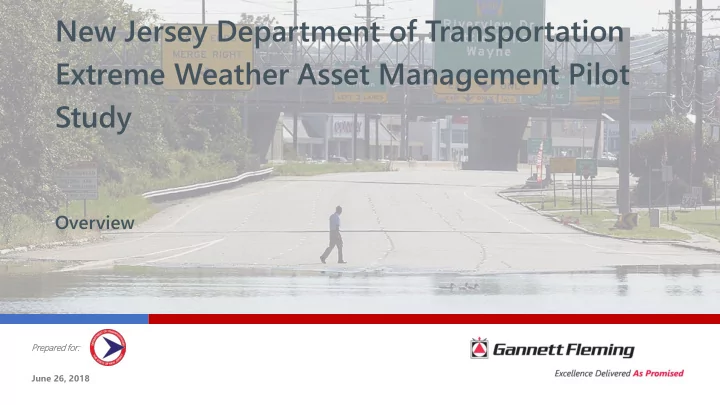
New Jersey Department of Transportation Extreme Weather Asset Management Pilot Study Overview Prepared f d for: June 26, 2018 Introduction Overview of Pilot Study New Jerseys Climate New Jerseys Transportation Assets New
Introduction
- Overview of Pilot Study
- New Jersey’s Climate
- New Jersey’s Transportation Assets
- New Jersey Challenges
- Summarize study approach & findings
- Next Steps
Hurricane Sandy approaching the New Jersey coastline on October 29, 2012
New Jer erse sey’s C s Climate
- 41 emergency declarations in the last 10 years
(State and Federal Declarations )
- 16 associated with flooding or tropical storms (Hurricane Sandy
in 2012, and Tropical Storm Irene the most damaging)
- 18 winter storm related
- Average annual temperatures have increased by 3
degrees F over the past century
- Highly variable precipitation with wetter than average
conditions in the last decade (Average annual precipitation = 46.01 inches, projected to increase)
- Sea level along New Jersey’s coast has risen by more
than 16 inches since 1911, double the global average (projected to rise 1 to 4 feet by 2100)
Passaic River fills street in Paterson, NJ – Hurricane Irene
New Jer erse sey’s T s Transp sportation
- 8,543 lane miles of pavement in the State Highway System (35% considered good
condition, 32% fair, 33% poor)
- 2,676 lane miles of Interstates (61% good, 38% fair, 1% poor)
- 6,702 bridges
- 2,582 NJDOT owned/maintained bridges (29%,, 59%, 12%)
- 6,096 minor bridges
- 956 NJDOT owned/maintained minor bridges (26% good, 69% fair, 5% poor)
- 4 major airports
- 3 major water ports including the largest seaport in the US in Elizabeth
- Home of 3rd largest commuter service provider (NJ Transit, bus, rail & light rail) with
weekday daily ridership totaling 928,494 (2015)
- 981 miles of freight railroad
- 360 miles of waterway
New Jersey Victory Bridge over Route 35
New Jer erse sey’s C s Cha hallenges es
- Coastal area presents its own unique challenges
(impacts from storm surges, tidal flooding, projected sea level rise, plus Tourism and associated land use development challenges - the need to “rebuild” in flood prone areas to maintain economic stability, value of “beach front property”
- Varying weather stressors
- Winter storm events are growing concern
- Inland flooding
- How to account for extreme weather considerations in
analytical tools used to predict asset performance over time (rate of deterioration)
Linking g Extrem eme Weather er a and nd Asse set M Mana nagem emen ent
- NJDOT currently establishing an Asset Management Plan/Program
and has identified extreme weather as an external environmental factor in assessing risks
- TAMP – Risk Management Process
- Identifying, assessing, evaluating risks, developing a mitigation plan and
monitoring top priority risks
- Extreme weather currently 3rd highest risk in NJDOT’s Risk Register
- Using results of pilot program to develop a strategy to implement in
TAMP Process
- 23 CFR Part 667 Evaluation
Pilot
- t O
Overview ew
2017 selected with 5 other states - Arizona, Kentucky, Massachusetts, Maryland, & Texas, to participate in a Pilot Program focused on extreme weather, climate risks, and asset management
Aerial View of Study Area: I-80
Pilot
- t O
Overview ew
- Originally selected culverts as the “asset class” to investigate impacts
- f extreme weather
- Focused on “noncoastal” areas
- Could not study entire state so selected a specific study area to see
what could be learned and applied state wide
- Study refocused on identifying “root causes” of flooding in the target
area to then develop cost-effective mitigation strategies
Compile & I e & Integ egrate Da e Data
2016 DMS Rankings Snapshot
Internal Sources: External Sources: Other:
- Drainage Management System (DMS)
- Maintenance Management System (MMS)
- Culvert Inspection Reports (Bureau of Structural Evaluation
and Bridge Management, SEBM)
- Operations Region’s Input
- Crash Data (Bureau of Transportation Data and Safety, BTDS)
- Concept Development Reports from Design Team (Louis Berger)
- NOAA
- GIS
Case se Study A Area ea
New I Ini nitiatives: es: Linking E Extreme e Weather er a and nd A Asse set Managemen ent
- Asset Management, Extreme
Weather, and Proxy Indicators Pilot
- The research is aimed at identifying the
root cause of flooding to target the most cost-effective risk management mitigation to incorporate in lifecycle planning STRESSOR: WEATHER-RELATED RISK: IMPACT PRECIPITATION FLOODING MOBILITY SAFETY INFRASTRUCTURE PRESERVATION Understanding The Problem
Prel eliminary Da Data Ana nalysi sis R Resu sults: s: I I-80 M 0 MP 5 56.43 t 43 to MP 58.22 22
EB WB Total Number of Incidents Recorded 50 Westbound 41 82% Eastbound 9 18%
Number o
- f R
Recorded F Flooding I Incidents b by Y Year
Month 2012 2013 2014 2015 2016 2017 Month Total January 1 1 February 2 2 March 2 2 April 3 1 4 May 1 1 2 June 3 1 4 July 1 1 2 5 1 10 August 1 2 3 September 2 2 2 6 October 2 3 2 7 November 3 4 7 December 1 1 2 Year Total 7 4 17 8 12 2
- 2014 experienced the highest
number of recorded flooding incidents between the five- year period (2012-2017)
- 2016 experienced the second
highest number of recorded flooding incidents between the five-year period (2012- 2017)
2 4 6 8 10 12 14 16 18 2012 2013 2014 2015 2016 2017 Incident Maintenance Activity
I-80 80 N Num umber er o
- f I
Inc nciden ents vs.
- vs. M
Mainten enanc nce A Activities es (Clea eaning) b by Year (201 2012-2017) 017)
Prel eliminary Da Data Ana nalysi sis R Resu sults: s: R
- Rt. 23 M
3 MP 4 4 to M MP 7 7
NB SB Total Number of Incidents Recorded 17 Northbound 1 6% Southbound 16 94%
- One extra incident recorded (not flooding).
- Number of incidents noting “clogged storm drain” = 7.
Route e 23 N 3 Num umber er o
- f I
Inc nciden ents vs.
- vs. M
Mainten enance A e Activities es (Clea eaning) b by Year (201 2012-2017) 017)
1 2 3 4 5 6 7 8 9 10 2012 2013 2014 2015 2016 2017 Incident Maintenance Activity (Cleaning)
Compariso son of Case S se Study A Area eas ( (201 2012-2017 Y 017 Yr. Period) d)
I-80 Route 23 Study area location:
- MP. 56.43 to MP 58.22 (1.79 miles)
- MP. 4.0 to MP 7.0 (3 miles)
DMS ranking (2016 data): #1 #14 AADT in one direction: 62,515 29,092 Number of recorded incidents: 50 17 Critical areas: WB between MP 57 – 57.5 SB between MP 6.8 – 62.82 Total number of maintenance activities in 5-yr. period: 18 42
- Cleaning activities
(inlets/manholes/channels ditches/pipes): 11 27
Ho How a about t the c culverts ts ? ??
- As builts and inspection reports noted
culverts were not contributing factors to flooding, drainage issues, not culverts….inlet spacing,
- Although designed and constructed
some time ago without “extreme weather” considerations, function ok today, as long as they are maintained
- Reaffirms need to identify possible
root causes of flooding, before strategies are developed to address risks of extreme weather
I-80 Culvert (located at MP 57.35 on Westbound direction)
Incorporating S Study Results i into Asset M t Management
- Root cause analysis identifies a method to evaluate and develop risk mitigation actions
- Better understanding of relationship between stressor, roadway system performance and
cause of problem
- Incorporate study’s recommendations into lifecycle planning in the planning,
design/engineering, and maintenance/operations phases
- Enhance/implement the use of GIS as a “Resiliency Management System” to be
incorporated into NJDOT’s current process
Develo lopin ing a a “Res esil ilience M Management Tool
- ol/System” – How t
to iden entify v vulner erabil ilit ities es GIS ca S can h help
- Use various digital layers to give an indication of what areas could be subject to flooding
- Project case study areas and culverts within these locations. (System can be used for any Assets)
- National flood hazard layer from FEMA.
- Soil hydrologic group layer.
- In progress: precipitation historical data and projections, and maintenance activities.
- Data shows:
- Project case study areas are in low terrain (between 50’ – 200’).
- Case study area soil group = low permeability.
- Route 23 within 100-yr flood zone.