SLIDE 1
Neural networks (Ch. 12)
SLIDE 2
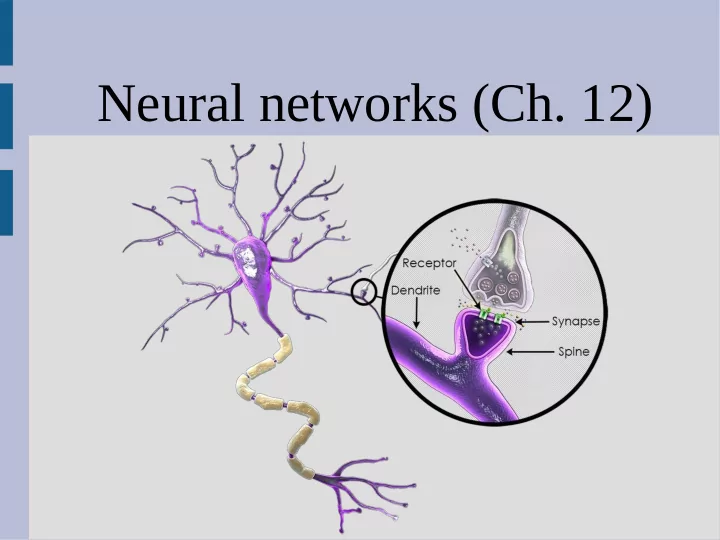
Biology: brains
Computer science is fundamentally a creative process: building new & interesting algorithms As with other creative processes, this involves mixing ideas together from various places Neural networks get their inspiration from how brains work at a fundamental level (simplification... of course)
SLIDE 3
Biology: brains
(Disclaimer: I am not a neuroscience-person) Brains receive small chemical signals at the “input” side, if there are enough inputs to “activate” it signals an “output”
SLIDE 4
Biology: brains
An analogy is sleeping: when you are asleep, minor sounds will not wake you up However, specific sounds in combination with their volume will wake you up
SLIDE 5
Biology: brains
Other sounds might help you go to sleep (my majestic voice?) Many babies tend to sleep better with “white noise” and some people like the TV/radio on
SLIDE 6
Neural network: basics
Neural networks are connected nodes, which can be arranged into layers (more on this later) First is an example of a perceptron, the most simple NN; a single node on a single layer
SLIDE 7 Neural network: basics
Neural networks are connected nodes, which can be arranged into layers (more on this later) First is an example of a perceptron, the most simple NN; a single node on a single layer inputs
activation function
SLIDE 8
Mammals
Let's do an example with mammals... First the definition of a mammal (wikipedia): Mammals [posses]: (1) a neocortex (a region of the brain), (2) hair, (3) three middle ear bones, (4) and mammary glands
SLIDE 9 Mammals
Common mammal misconceptions: (1) Warm-blooded (2) Does not lay eggs Let's talk dolphins for one second.
http://mentalfloss.com/article/19116/if-dolphins-are-mammals-and-all-mammals-have-hair-why-arent-dolphins-hairy
Dolphins have hair (technically) for the first week after birth, then lose it for the rest of life ... I will count this as “not covered in hair”
SLIDE 10 Perceptrons
Consider this example: we want to classify whether or not an animal is mammal via a perceptron (weighted evaluation) We will evaluate on:
- 1. Warm blooded? (WB) Weight = 2
- 2. Lays eggs? (LE) Weight = -2
- 3. Covered hair? (CH) Weight = 3
SLIDE 11
Perceptrons
Consider the following animals: Humans {WB=y, LE=n, CH=y}, mam=y Bat {WB=sorta, LE=n, CH=y}, mam=y What about these? Platypus {WB=y, LE=y, CH=y}, mam=y Dolphin {WB=y, LE=n, CH=n}, mam=y Fish {WB=n, LE=y, CH=n}, mam=n Birds {WB=y, LE=y, CH=n}, mam=n
SLIDE 12
Perceptrons
But wait... what is the general form of:
SLIDE 13
Perceptrons
But wait... what is the general form of: This is simply one side of a plane in 3D, so this is trying to classify all possible points using a single plane...
SLIDE 14
Perceptrons
If we had only 2 inputs, it would be everything above a line in 2D, but consider XOR on right There is no way a line can possibly classify this (limitation of perceptron)
SLIDE 15
Neural network: feed-forward
Today we will look at feed-forward NN, where information flows in a single direction Recurrent networks can have outputs of one node loop back to inputs as previous This can cause the NN to not converge on an answer (ask it the same question and it will respond differently) and also has to maintain some “initial state” (all around messy)
SLIDE 16 Neural network: feed-forward
Let's expand our mammal classification to 5 nodes in 3 layers (weights on edges): WB LE CH N1 N2 N4 N3 N5 2
3 1
1 2 1 2 if Output(Node 5) > 0, guess mammal
SLIDE 17 Neural network: feed-forward
You try Bat on this:{WB=0, LE=-1, CH=1} WB LE CH N1 N2 N4 N3 N5 2
3 1
1 2 1 2 if Output(Node 5) > 0, guess mammal Assume (for now) output = sum input
SLIDE 18 Neural network: feed-forward
Output is -7, so bats are not mammal... Oops...
1 1 4 5
2
3 1
1 2 1 2 if Output(Node 5) > 0, guess mammal
SLIDE 19
Neural network: feed-forward
In fact, this is no better than our 1 node NN This is because we simply output a linear combination of weights into a linear function (i.e. if f(x) and g(x) are linear... then g(x)+f(x) is also linear) Ideally, we want a activation function that has a limited range so large signals do not always dominate
SLIDE 20
Neural network: feed-forward
One commonly used function is the sigmoid:
SLIDE 21 Back-propagation
The neural network is as good as it's structure and weights on edges Structure we will ignore (more complex), but there is an automated way to learn weights Whenever a NN incorrectly answer a problem, the weights play a “blame game”...
- Weights that have a big impact to the wrong
answer are reduced
SLIDE 22 Back-propagation
To do this blaming, we have to find how much each weight influenced the final answer Steps:
- 1. Find total error
- 2. Find derivative of error w.r.t. weights
- 3. Penalize each weight by an amount
proportional to this derivative
SLIDE 23 Back-propagation
Consider this example: 4 nodes, 2 layers N1 N2 N4 N3 in2 in1 w1 w2 w3 w4 w5 w6 w7 w8 1 This node as a constant bias of 1
b1 b2
SLIDE 24 Back-propagation
0.506 N2 N4 N3 in2 in1 .15 .2 .25 .3 .4 .45 .5 .55 1 Node 1: 0.15*0.05 + 0.2*0.1 = 0.35 as input thus it outputs (all edges) S(0.35)=0.59327
0.35 0.6 0.05 0.1
SLIDE 25 Back-propagation
0.506 0.510 0.630 0.606 in2 in1 .15 .2 .25 .3 .4 .45 .5 .55 1 Eventually we get: out1= 0.606, out 2= 0.630 Suppose wanted: out1= 0.01, out 2= 0.99
0.35 0.6 0.05 0.1
SLIDE 26
Back-propagation
We will define the error as: (you will see why shortly) Suppose we want to find how much w5 is to blame for our incorrectness We then need to find: Apply the chain rule:
SLIDE 27
Back-propagation
SLIDE 28
Back-propagation
In a picture we did this: Now that we know w5 is 0.08217 part responsible, we update the weight by: w5 ←w5 - α * 0.0645 = 0.374 (from 0.4) α is learning rate, set to 0.5
SLIDE 29
Back-propagation
Updating this w5 to w8 gives: w5 = 0.3589 w6 = 0.4067 w7 = 0.5113 w8 = 0.5614 For other weights, you need to consider all possible ways in which they contribute
SLIDE 30
Back-propagation
For w1 it would look like: (book describes how to dynamic program this)
SLIDE 31
Back-propagation
Specifically for w1 you would get: Next we have to break down the top equation...
SLIDE 32
Back-propagation
SLIDE 33
Back-propagation
Similarly for Error2 we get: You might notice this is small... This is an issue with neural networks, deeper the network the less earlier nodes update