
SLIDE 1
Network Tomography for Fault Diagnosis
Renata Teixeira CNRS and UPMC Paris Universitas with Italo Scota Cunha (LIP6, Thomson) Nick Feamster (Georgia Tech) Christophe Diot (Thomson)
1
Network Tomography for Fault Diagnosis Renata Teixeira CNRS and - - PDF document
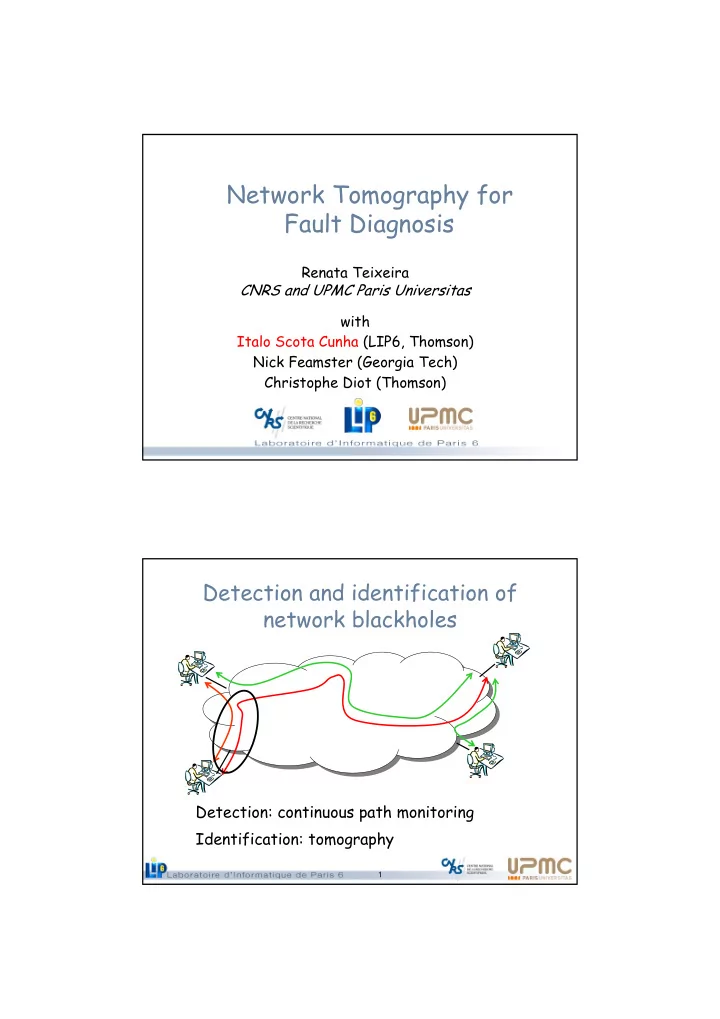
Network Tomography for Fault Diagnosis Renata Teixeira CNRS and UPMC Paris Universitas with Italo Scota Cunha (LIP6, Thomson) Nick Feamster (Georgia Tech) Christophe Diot (Thomson) Detection and identification of network blackholes
1
2
– PlanetLab: one alarm per minute – Thomson VPN: one alarm every two minutes
– Loss can be transient, topology can change – Different monitors see different conditions
Congestion Routing changes Persistent failures
3
4
Upon detection of a failure, trigger extra probes Goal: minimize detection errors
5
Which probing process?
– Assume link losses follow a Gilbert process – Periodic probing minimizes detection errors
How many probes?
– Confirm failures with a target detection-error rate – Assume independence and a given a loss rate
How much time between probes?
– Reduce chance that probes fall on the same loss burst
Tradeoff: detection error and detection time
6
Given: topology and end-to-end path statuses Find the smallest set of links that explain observations
– Waits for one cycle
– Waits for n cycles with identical path statuses
– Only considers paths that are down for n cycles
9
Evaluation is challenging
– Need ground truth and realistic environment
Analytic modeling – Understand limits of the system Controlled Experiments: Emulab testbed – Realistic environment – Control over failures Wide-area Experiments: PlanetLab, Thomson
– Real losses and failures, but no ground truth
10
12
13
Thomson
– 56 paths – Cycles: 5 seconds
PlanetLab
– 39,800 paths – Cycles: 60 seconds
– Failure confirmation
– Aggregation
14
15