Network from a High End Car Today: Wired embedded networks - - PDF document

network from a high end car
SMART_READER_LITE
LIVE PREVIEW

Network from a High End Car Today: Wired embedded networks - - PDF document

Network from a High End Car Today: Wired embedded networks Characteristics and requirements Some embedded LANs SPI I2C LIN Ethernet Next lecture: CAN bus Then: 802.15.4 wireless embedded network Embedded


slide-1
SLIDE 1

1

Today: Wired embedded networks

Characteristics and requirements Some embedded LANs

  • SPI
  • I2C
  • LIN
  • Ethernet

Next lecture: CAN bus Then: 802.15.4 – wireless embedded network

Network from a High End Car Embedded Networking

In the non-embedded world TCP/IP over Ethernet,

SONET, WiFi, 3G, etc. dominates

No single embedded network or network protocol

dominates

Why not?

Embedded vs. TCP/IP

Many TCP/IP features unnecessary or undesirable in

embedded networks

In embedded networks…

Stream abstraction seldom used

  • Embedded networks more like UDP than TCP
  • Why?

Reliability of individual packets is important

  • As opposed to building reliability with retransmission

No support for fragmentation / reassembly

  • Why?

No slow-start and other congestion control

  • Why?

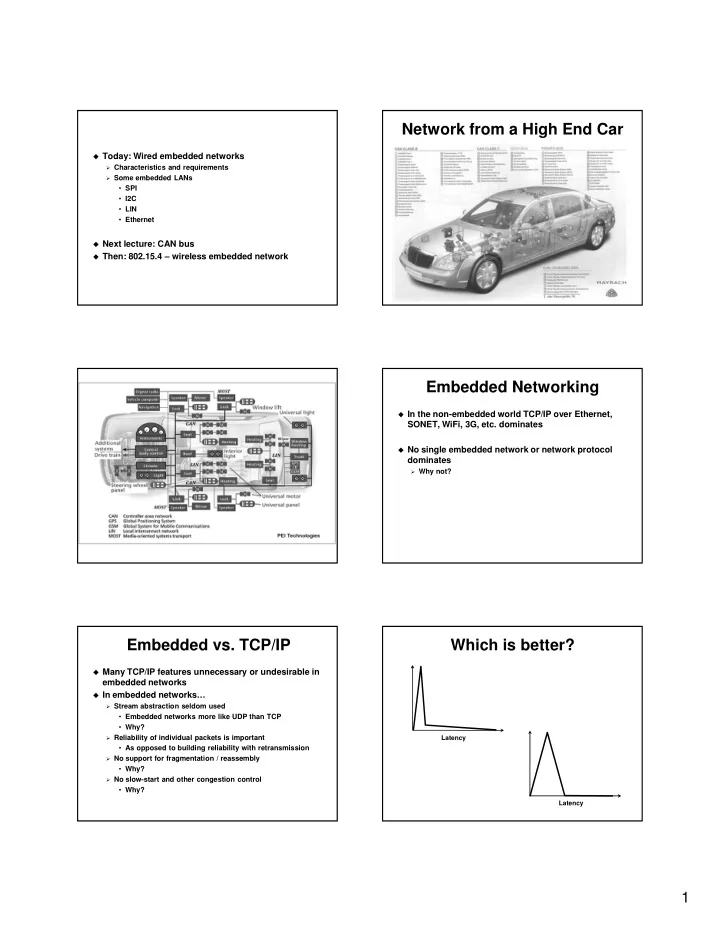
Which is better?

Latency Latency

slide-2
SLIDE 2

2

Characteristics and Requirements

Determinism more important than latency Above a certain point throughput is irrelevant Prioritized network access is useful Security important only in some situations Resistance to interference may be important Reliability is often through redundancy Cost is a major factor Often master / slave instead of peer to peer

A Few Embedded Networks

Low-end

SPI I2C LIN RS-232

Medium-end

CAN MOST USB

High-end

Ethernet IEEE-1394 (Firewire) Myrinet

How do you choose one?

Does it give the necessary guarantees in…

Error rate Bandwidth Delivery time – worst case and average case Fault tolerance

Is it affordable in…

PCB area Pins Power and energy $$ for wiring, adapter, transceiver, SW licensing Software resource consumption: RAM, ROM, CPU Software integration and testing effort

Most Basic Embedded Network

“Bit banged” network:

Implemented almost entirely in software Only HW support is GPIO pins Send a bit by writing to output pin Receive a bit by polling a digital input pin

Can implement an existing protocol or roll your own Advantages

Cheap Flexible: Support many protocols w/o specific HW support

Disadvantages

Lots of development effort Imposes severe real-time requirements Fast CPU required to support high network speeds

SPI

Serial Peripheral Interface

Say “S-P-I” or “spy”

Characteristics:

Very local area – designed for communicating with other

chips on the same PCB

  • NIC, DAC, flash memory, etc.

Full-duplex Low / medium bandwidth Master / slave

Very many embedded systems use SPI but it is

hidden from outside view

Originally developed by Motorola

Now found on many MCUs

SPI Signals

Four wires:

SCLK – clock SS – slave select MOSI – master-out / slave-in MISO – master-in / slave-out

Single master / single slave configuration:

slide-3
SLIDE 3

3

Multiple Slaves

Each slave has its own select line: Addressing lots of slaves requires lots of I/O pins on

the master, or else a demultiplexer

CPOL and CPHA

Clock polarity and clock phase

Both are 1 bit Configurable via device registers

Determine when:

First data bit is driven Remaining data bits are driven Data is sampled

Details are not that interesting… However: All nodes must agree on these or else SPI

doesn’t work

SPI Transfer

1.

Master selects a slave

2.

Transfer begins at the next clock edge

3.

Eight bits transferred in each direction

4.

Master deselects the slave

Typical use of SPI from the master side:

1.

Configure the SPI interface

2.

Write a byte into the SPI data register This implicitly starts a transfer

3.

Wait for transfer to finish by checking SPIF flag

4.

Read SPI status register and data register

Contrast this with a bit-banged SPI

More SPI

SPI is lacking:

Sophisticated addressing Flow control Acknowledgements Error detection / correction

Practical consequences:

Need to build your own higher-level protocols on top of SPI SPI is great for streaming data between a master and a few

slaves

Not so good as number of slaves increases Not good when reliability of link might be an issue

I2C

Say “I-squared C”

Short for IIC or Inter-IC bus

Originally developed by Philips for communication

inside a TV set

Main characteristics:

Slow – generally limited to 400 Kbps Max distance ~10 feet

  • Longer at slower speeds

Supports multiple masters Higher-level bus than SPI

I2C Signals and Addressing

Two wires:

SCL – serial clock SDA – serial data These are kept high by default

Addressing:

Each slave has a 7-bit address

  • 16 addresses are reserved
  • One reserved address is for broadcast
  • At most 112 slaves can be on a bus

10-bit extended addressing schemes exist and are

supported by some I2C implementations

slide-4
SLIDE 4

4

I2C Transaction

Master issues a START condition

First pulls SDA low, then pulls SCL low

Master writes an address to the bus

Plus a bit indicating whether it wants to read or write Slaves that don’t match address don’t respond A matching slave issues an ACK by pulling down SDA

Either master or slave transmits one byte

Receiver issues an ACK This step may repeat

Master issues a STOP condition

First releases SCL, then releases SDA At this point the bus is free for another transaction

Multiple-Master I2C

One master issues a START

All other masters are considered slaves for that transaction Other masters cannot use the bus until they see a STOP

What happens if a master misses a START?

When a master pulls a wire high, it must check that the wire

actually goes high

If not, then someone else is using it – need to back off until

a STOP is seen

LIN Bus

Very simple, slow bus for automotive applications

Master / slave, 20 Kbps maximum Single wire Can be efficiently implemented in software using existing

UARTs, timers, etc.

  • Target cost $1 per node, vs. $2 per node for CAN

Ethernet

Characteristics

1500-byte frames Usually full-duplex 48-bit addresses Much more complicated than SPI, I2C Often requires an off-chip Ethernet controller

Can be used with or without TCP or UDP Hubs, switches, etc. support large networks Random exponential backoff has bad real-time

properties

No guarantees are possible under contention

Embedded TCP/IP

This is increasing in importance

Remember that TCP/IP can run over any low-level transport

  • Even I2C or CAN

TCP/IP stacks for very small processors exist

Drawbacks

TCP/IP is very generic – contains features that aren’t

needed

TCP/IP targets WANs – makes many design tradeoffs that

can be harmful in embedded situations

Good usage: Car contains a web server that can be

used to query mileage, etc.

Bad usage: Engine controller and fuel injector talk

using TCP/IP

Networks on MCF52233

3 UARTs I2C QSPI

Can queue up 16 transfers – these happen in the

background until queue is empty

16 bytes of dedicated command memory 32 bytes of dedicated receive buffer 32 bytes of dedicated transmit buffer

Fast Ethernet
slide-5
SLIDE 5

5

Summary

Embedded networks

Usually packet based Usually accessed using low-level interfaces

SPI, I2C

Simple and cheap Often used for an MCU to talk to non-MCU devices

CAN

Real-time, fault tolerant LAN

Ethernet

More often used for communication between MCUs

Subsequent lectures:

CAN bus 802.15.4 – low-power wireless embedded networking