SLIDE 1 Network Core Mechanisms of Exponence Meeting 16-17 January, 2009, Meertens Institute Amsterdam Construction morphology Geert Booij (University of Leiden),
http://website.leidenuniv.nl/~booijge/
- 1. Basic ingredients of Construction Morphology (Booij, in preparation).
- 2. Non-compositional properties of complex words
- 3. Mismatches between form and meaning: the role of paradigmatic relations
- 4. Allomorph selection
- 5. Inflection (multiple exponence and periphrasis).
- 1. Basic ingredients of CM
1.1. Word-based morphology: morphological schemas express generalizations over sets
- f existing words, and are recipes for forming new words.
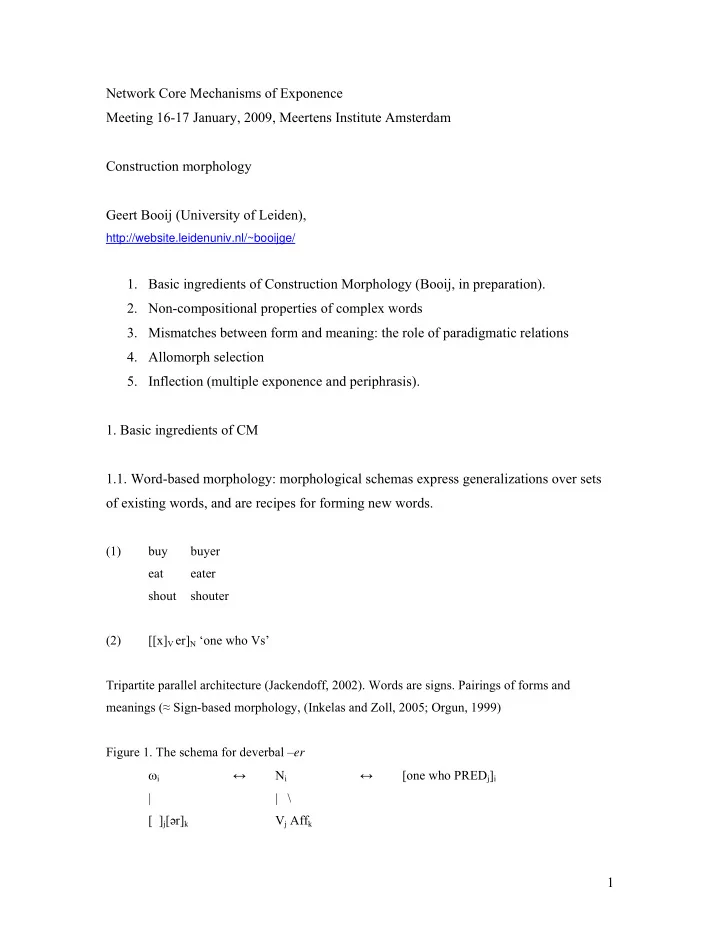
(1) buy buyer eat eater shout shouter (2) [[x]V er]N ‘one who Vs’ Tripartite parallel architecture (Jackendoff, 2002). Words are signs. Pairings of forms and meanings (≈ Sign-based morphology, (Inkelas and Zoll, 2005; Orgun, 1999) Figure 1. The schema for deverbal –er ωi ↔ Ni ↔ [one who PREDj]i | | \ [ ]j[ər]k Vj Affk
1
SLIDE 2
“Pieces of syntactic structure can be listed in the lexicon with associated meanings, just as individual words are; these are the MEANINGFUL CONSTRUCTIONS of the language.” “Construction grammar makes no principled distinction between words and rules: a lexical entry is more word-like to the extent that it is fully specified, and more rule-like to the extent that it contains variables [...].” “L]exical entries are arranged in an inheritance hierarchy.” (Jackendoff, 2008), p. 15. Compounding schema for English: (3) [[a]Xk [b]Ni ]Nj ↔ [SEMi with relation R to SEMk]j [αF] [αF] 1.2. Hierarchical lexicon with subpatterns and default inheritance (Booij, 2005) (4) Noun: example ber-e ‘bear’ bere-sterk ‘very strong’, bere-aardig ‘very kind’ bloed ‘blood’ bloed-serieus ‘very serious’, bloed-link ‘very risky’ dood ‘death’ dood-eng ‘very scary’, dood-gewoon ‘very ordinary’ kei ‘boulder’ kei-goed ‘very good’, kei-gaaf ‘very nice’ pis ‘piss’ pis-nijdig ‘very angry’, pis-woedend ‘very angry’ poep ‘shit’ poep-heet ‘very hot’, poep-lekker ‘very pleasant’ ret-e ‘ass’ rete-leuk ‘very nice’, rete-spannend ‘very exciting’ reuz-e ‘giant’ reuze-leuk ‘very nice’, reuze-tof ‘very good’ [[bere]N [x]A]A ‘very A’ Reduplication in Afrikaans (Botha, 1988) (5) Die kinder drink bottels-bottels limonade The children drink bottles-bottles lemonade ‘The children drink bottles and bottles of lemonade’ Bakke-bakke veldblomme versier die tafels Bowl-bowls veldblomme versier die tafels ‘The tables are decorated with wild flowers by the bowlful’
2
SLIDE 3 [[x]Npl,i [x]Npl,i]Nj ↔ [CONSIDERABLE NUMBER OF OBJECTSi]j The two subconstituents are co-indexed which indicates their identity. The phonological make up
- f the two constituents is also identical but there are los of cases in which reduplication triggers
additional phonological operations (Inkelas and Zoll, 2005). 1.3. Schema unification: co-occurrence of word formation patterns (6) verb deverbal adjective
bedwing ‘suppress’ bedwing-baar ‘suppressable’
‘unsuppressable’ bestel ‘deliver’ bestel-baar ‘deliverable’
‘undeliverable’ blus ‘extinguish’ blus-baar ‘extinguishable’
‘unextinguishable’ (7) [on-A]A + [V-baar]A = [on[[V-baar]A]A (8) noun verb caffeine decaffeinate moral demoralize mythology demythologize nuclear denuclearize Stalin destalinize (9) [de [[x]N ate]V]V [de [[x]N ize]V]V [de [[x] A ize]V]V 1.4. Schemas can also be used for multi-word lexical units. French N à N (10) moulin à poivre ‘pepper mill’ verre à vin ‘wine glas’ bois à feu ‘firewood’
3
SLIDE 4 fruit à confiture ‘jam fruit’ moteur à essence ‘petrol engine’ Particle verbs in Germanic languages are separable, yet lexical units
- 2. Non-compositional properties of complex words
2.1. Exocentric compounds (11) French chauffe-eau ‘water heater’ coupe-ongles ‘nail clipper’ garde-barrière ‘gate keeper’ grill-pain ‘toaster’ Italian lava-piatti ‘dish washer’ mangia-patate ‘potato eater’ porta-lettere ‘postman’ rompi scatole ‘brain breaker, puzzle’ Spanish lanza-cohetes ‘rocket launcher’ come-curas ‘lit. eat priests, anti-clerical’ mata-sanes ‘lit. kill healthy people, quack doctor’ limpia-botas ‘lit. clean boots, boot black’ (12) [[Vk][Ni]Nj ↔ [AGENT / INSTRUMENTj OF ACTIONk ON OBJECTI]j Spanish exocentric adjectives (13) pell-i-rojo hair-LINKING VOWEL- red ‘red-haired’
cabiz-bajo head-low ‘with low head, crest-fallen’ 4
SLIDE 5 (14) [[x]Ni [y]Aj]Ak ↔ [PROPERTY OF HAVING OBJECTi WITH PROPERTYj]k
Dutch: gender of nouns derived from verbs by conversion: (15) verb stem noun with common gender bouw ‘to build’ bouw ‘building’ loop ‘to walk’ loop ‘walk’ trap ‘to kick’ trap ‘kick’ val ‘to fall’ val ‘fall’ was ‘to wash’ was ‘wash’ zet ‘to put’ zet ‘move’ (16) [[x]Vj]N[-neuter],i ↔ [ACTIONj]i Verbs with prefixes like be-, ge-, ont- and ver- do allow for conversion, but in this case the converted noun has neuter gender: (17) verb derived neuter noun ge-bruik ‘to use’ gebruik ‘use’ ge-loof ‘to believe’ geloof ‘belief’ ver-bruik ‘to consume’ verbruik ‘consumption’ ver-zuim ‘to omit’ verzuim ‘omission’ ver-lang ‘to desire’ verlangen ‘desire’ be-derf ‘to spoil’ bederf ‘decay’ be-gin ‘to begin’ begin ‘beginning’ be-heer ‘to manage’ beheer ‘management’
- nt-bijt ‘to breakfast’
- ntbijt ‘breakfast’
- nt-werp ‘to design’
- ntwerp ‘design’
- nt-zet ‘to relieve’
- ntzet ‘relief’
(18) [[Prefix-x]Vj]N[+neuter], i ↔ [ACTIONj]i’ (Prefix = be-, ge-, ont-, ver-)
5
SLIDE 6
- 3. Mismatches between form and meaning: the role of paradigmatic relations
(19) alpin-ism alpin-ist altru-ism altru-ist aut-ism aut-ist bapt-ism bapt-ist commun-ism commun-ist pacif-ism pacif-ist (20) < [x-ism]Ni ↔ SEMi > ↔ < [x-ist]Nj ↔ [person involved in SEMi]j > (21) alloc-eer ‘to allocate’ alloc-atie ‘allocation’ communic-eer ‘communicate’ communic-atie ‘communication’ reden-eer ‘to reason’ reden-atie ‘reasoning’ stabilis-eer ‘to stabilize’ stabilis-atie ‘stabilization’ (22) < [x –eer]Vi ↔ [SEM]i> ↔ <[x-atie]Nj ↔ [action of SEMi]j > (23) toponym inhabitative toponymic adjective Provençe Provenç-aal Provenç-aal-s Amerika Amerik-aan Amerik-aan-s Catalonië Catal-aan Catal-aan-s Guatemala Guatemalt-eek Guatemalt-eek-s Chili Chil-een Chil-een-s Madrid Madril-een Madril-een-s Portugal Portug-ees Portug-ees Ambon Ambon-ees Ambon-ees Rome Rom-ein Rom-ein-s Palestina Palest-ijn Palest-ijn-s Bretagne Breton Breton-s Azië Azi-aat Azi-at-isch Monaco Moneg-ask Moneg-ask-isch Israel Israel-iet Israel-it-isch Moskou Moskov-iet Moskov-it-isch
6
SLIDE 7 (24) < [x]Ni ↔ [inhabitant of j]i > ↔ < [[x]Ni-s]Ak ↔ [relating to j]k > (25) inhabitative toponymic adjective female inhabitative Provençaal Provençaal-s Provençaal-s-e Amerikaan Amerikaan-s Amerikaan-s-e Catalaan Catalaan-s Catalaan-s-e Guatemalteek Guatemalteek-s Guatemalteek-s-e Chileen Chileen-s Chileen-s-e Madrileen Madrileen-s Madrileen-s-e Portugees Portugees Portuge-s-e Ambonees Ambonees Ambone-s-e Romein Romein-s Romein-s-e Palestijn Palestijn-s Palestijn-s-e Breton Breton-s Breton-s-e Aziaat Aziat-isch Aziat-isch-e Monegask Monegask-isch Monegask-isch-e Israeliet Israelit-isch Israelit-isch-e Moskoviet Moskovit-isch Moskovit-isch-e (26) < [[x]Ni-s]Ak ↔ [relating to j]k > ↔ < [[[x]Ni-s]Ake]Nl ↔ [female inhabitant of j]i where j is the index for the geographical entity involved also mentioned in schema (24).
- 4. Hierarchical lexicon and allomorph selection
4.1. Subpatterns of compounding can be expressed in a hierarchical lexicon. Japanese suru- compounding, formation of verbs from verbal nouns (constructional idiom) (Kageyama, 1982): (27) a. yama-nobori-suru mountain-climbing-do ‘to do mountain climbing’ b. kenyuu-suru research-do ‘to do research’
7
SLIDE 8
c. hoo-bei-suru visit-USA-do d. saikuringu-suru cycling-do ‘to cycle’ (28) [[VN] [suru]V]V ‘to perform the act denoted by VN’ 4.2. Allomorph selection in Dutch: governed by morphological structure. (29) preposition: met [mεt] postposition and particle: mee [me:] first part of a compound: mede [me:də] (30) [ [mede]ADV N]N ‘N shared with other persons’ mede-beslissing ‘co-decision mede-bewoner ‘fellow occupant’ mede-broeder ‘fellow brother’ mede-lander ‘fellow countryman’ mede-weten ‘(shared) knowledge’ (31) mee-bidden ‘to join in praying’ [mee-V] ‘to join in V-ing’ mee-denken ‘to join in thinking’ mee-drinken ‘to join in drinking’ mee-eten ‘to join in eating’ (32) mede-bewoner / *mee-bewoner ‘co-occupant’ mede-gelovige / *mee-gelovige ‘fellow believer’ mede-klinker / *mee-klinker ‘consonant’ (33) a. eind-examen / *einde-examen ‘end-exam, final exam’ eind-gesprek / *einde-gesprek ‘end-interview, final interview’ eind-station / *einde-station ‘end-station, final station’ eind-spel / *einde-spel ‘end-game, final game’ b. aard-appel / *aarde-apppel ‘earth-apple, potato’ aard-atmosfeer / *aarde-atmosfeer ‘earth-atmosphere’ aard-schok / *aarde-schok ‘earth-quake’
8
SLIDE 9
aard-worm/ *aarde-worm ‘earth-worm’ (exception: aarde-werk ‘earthenware, pottery’, in which aarde has a specialized meaning). Compare: chocolade-reep (chocola), lade-kastje (la) with long forms in compounds. (34) [[eind]N [x]N]N ‘final [x]N’ [[aard]N[x]N]N ‘[x]N related to earth’ (35) stem allomorphy in Dutch verbs glijd /glij ‘to glide’ rijd /rij ‘to ride / drive’ snijd /snij ‘to cut’ wijd / wij ‘to dedicate’ Long allomorph appears in derived words, and the short allomorph is used in compounds: (36) compound derived word glij-baan ‘slide-track, slide’ glijd-er ‘slid-er’ glij-middel ‘slide-means, lubricant’ rij-baan ‘ride-track, lane’ rijd-er ‘rid-er’ rij-bewijs ‘ride-license, driving license’ rij-wiel’ride-wheel, bike’ snij-biet ‘cut-beet, spinach beet’ snijd-er ‘cutt-er’ snij-gras ‘cut-grass, cutting gras’ snijd-baar ‘slice-able’ snij-vlak ‘cut-edge, cutting edge snijd-sel ‘cutt-ing’ wij-water ‘holy water’ wijd-ing ‘consecration’ (37) [[glij]V [x]N]N [[rij]V [x]N]N [[snij]V [x]N]N [[wij]V [x]N]N
9
SLIDE 10 (38) a. eer-wraak ‘honour-revenge, revenge for the protection of family honour’ eer-betoon ‘honour-show, tribute’ b. ere-lid ‘honorary member’ /*eer-lid ere-voorzitter ‘honorary chairman’ / *eer-voorzitter ere-doctor ‘honorary doctor’/ *eer-doctor (39) [[ere]N[x]N]N ‘honorary x’
5.1. Multiple exponence cf. (Gurevich, 2006) The cells of a paradigm are morphological schemas that are paradigmatically related. Latin mensae -mens-as <[x –ae] ↔ N [+nom, +pl] > ↔ <[x –as] ↔ N [+acc, +pl] > 5.2. Periphrasis = phrasal, multi word construction (Blevins, 2008; Booij, 2002; Börjars et al., 1997; Sadler and Spencer, 2001). (39) Paradigm of 3rd pers. sg. forms of laudare 'to praise' IMPERFECTIVE Active Passive Present laudat laudatur Past laudabat laudabantur Future laudabit laudabitur PERFECTIVE Active Passive Present laudavit laudatus/a/um est Past laudaverat laudatus/a/um erat Future laudaverit laudatus/a/um erit Deponentia have the same pattern: loquor / locutus est ‘speaks / has spoken’ (40) 3rd pers. sg. forms of the Dutch verb doden 'to kill' IMPERFECTIVE Active Passive Present doodt wordt gedood Past doodde werd gedood PERFECTIVE Present heeft gedood is gedood Past had gedood was gedood
10
SLIDE 11
[[x]V0-Part [word]V0]V0 ↔ Pass [ PRED] (Pass = argument suppression) Subtype of the raising construction: Syntactic compound, accessible for movement operations, no violation of lexical integrity. Progressive construction (Booij, 2008) (41) Jan is aan het fiets-en / *Jan is fietsend / De fietsende professor John is at the cycle-INF /John is cycling / The cycling professor 'John is cycling' Jan is de aardappels aan het schillen John is the potatoes at the peel-INF John is peeling the potatoes’ (42) [[aan]P [[het]Det [V-INF]N]]NP]PP ' V-ing continuously'
11
SLIDE 12 References BLEVINS, JAMES P. 2008. Periphrasis as syntactic exponence. Patterns in paradigms, ed. by Farrell Ackerman, James P. Blevins and Gregory S. Stump. Stanford: CSLI. BOOIJ, GEERT. 2002. Constructional idioms, morphology, and the Dutch lexicon. Journal
- f Germanic Linguistics, 14.301-27.
—. 2005. Compounding and derivation: evidence for construction morphology. Morphology and its demarcations, ed. by Wolfgang U. Dressler, Dieter Kastovsky, Oskar E. Pfeiffer and Franz Rainer, 109-32. Amsterdam / Philadelphia: John Benjamins. —. 2008. Constructional idioms as products of language change: the aan het + INFINITIVE construction in Dutch. Construction grammar and language change,
- ed. by Alexander Bergs and Gabriele Diewald, 79-104. Berlin: Mouton de
Gruyter. —. in preparation. Construction morphology. Oxford: Oxford University Press. BÖRJARS, KERSTI, VINCENT, NIGEL and CHAPMAN, CAROL. 1997. Paradigms, periphrases, and pronominal inflection. Yearbook of Morphology 1996, ed. by Geert Booij and Jaap Van Marle, 155-80. Dordrecht: Kluwer. BOTHA, RUDOLF P. 1988. Form and meaning in word formation. A study of Afrikaans
- reduplication. Cambridge: Cambridge University Press.
GUREVICH, OLGA. 2006. Constructional morphology: the Georgian version. Stanford: Ph.
- D. diss. Stanford University.
INKELAS, SHARON and ZOLL, CHERYLL. 2005. Reduplication. Doubling in morphology. Cambridge: Cambridge University Press. JACKENDOFF, RAY. 2002. Foundations of language. Oxford: Oxford University Press. —. 2008. Construction after construction and its theoretical challenge. Language, 84.8- 28. KAGEYAMA, TARO. 1982. Word formation in Japanese. Lingua, 57.215-58. ORGUN, C.O. 1999. Sign-based morphology: a declarative theory of phonology- morphology interleaving. The derivational residue in phonological Optimality Theory, ed. by Ben Hermans and Mac van Oostendorp, 247-67. Amsterdam / Philadelphia: Benjamins. SADLER, LOUISA and SPENCER, ANDREW. 2001. Syntax as an exponent of morphological
- features. Yearbook of Morphology 2000, ed. by Geert Booij and Jaap Van Marle,
71-96. Dordrecht: Kluwer. 12