Neglect childs health or development. Neglect may occur during - - PDF document

neglect
SMART_READER_LITE
LIVE PREVIEW

Neglect childs health or development. Neglect may occur during - - PDF document

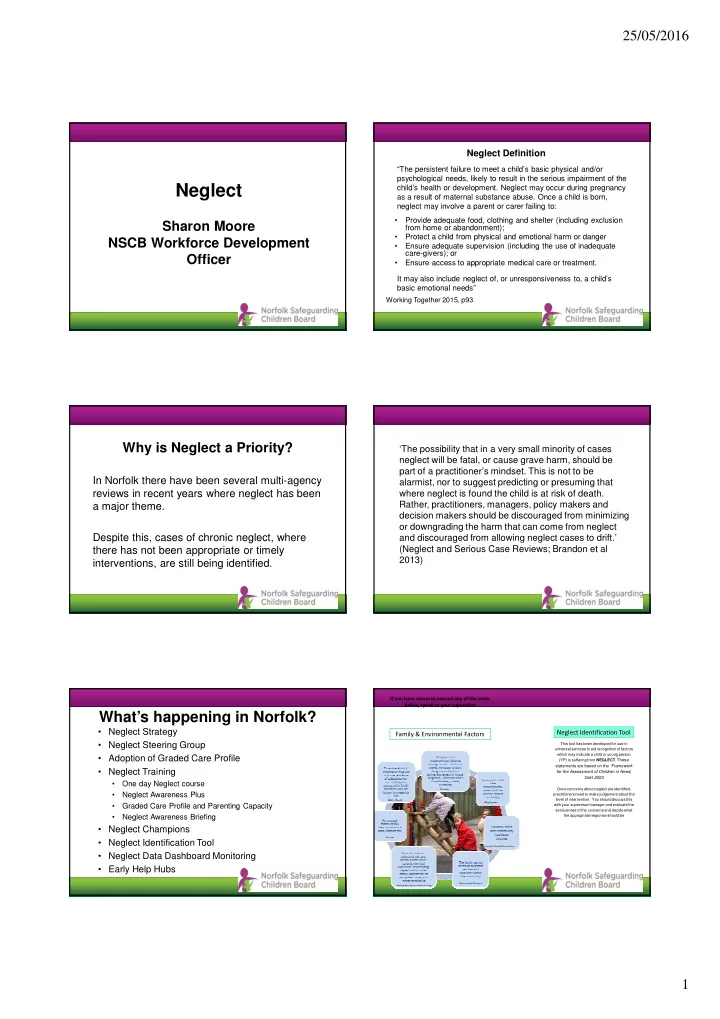
25/05/2016 Neglect Definition The persistent failure to meet a childs basic physical and/or psychological needs, likely to result in the serious impairment of the Neglect childs health or development. Neglect may occur during pregnancy


slide-1
SLIDE 1

25/05/2016 1

Neglect

Sharon Moore NSCB Workforce Development Officer

“The persistent failure to meet a child’s basic physical and/or psychological needs, likely to result in the serious impairment of the child’s health or development. Neglect may occur during pregnancy as a result of maternal substance abuse. Once a child is born, neglect may involve a parent or carer failing to:

  • Provide adequate food, clothing and shelter (including exclusion

from home or abandonment);

  • Protect a child from physical and emotional harm or danger
  • Ensure adequate supervision (including the use of inadequate

care-givers); or

  • Ensure access to appropriate medical care or treatment.

Working Together 2015, p93

It may also include neglect of, or unresponsiveness to, a child’s basic emotional needs”

Neglect Definition

Why is Neglect a Priority?

In Norfolk there have been several multi-agency reviews in recent years where neglect has been a major theme. Despite this, cases of chronic neglect, where there has not been appropriate or timely interventions, are still being identified.

‘The possibility that in a very small minority of cases neglect will be fatal, or cause grave harm, should be part of a practitioner’s mindset. This is not to be alarmist, nor to suggest predicting or presuming that where neglect is found the child is at risk of death. Rather, practitioners, managers, policy makers and decision makers should be discouraged from minimizing

  • r downgrading the harm that can come from neglect

and discouraged from allowing neglect cases to drift.’ (Neglect and Serious Case Reviews; Brandon et al 2013)

What’s happening in Norfolk?

  • Neglect Strategy
  • Neglect Steering Group
  • Adoption of Graded Care Profile
  • Neglect Training
  • One day Neglect course
  • Neglect Awareness Plus
  • Graded Care Profile and Parenting Capacity
  • Neglect Awareness Briefing
  • Neglect Champions
  • Neglect Identification Tool
  • Neglect Data Dashboard Monitoring
  • Early Help Hubs

This tool has been developed for use in universal services to aid recognition of factors which may indicate a child or young person (YP) is suffering from NEGLECT. These statements are based on the ‘Framework for the Assessment of Children in Need, DoH 2000 Once concerns about neglect are identified, practitioners need to make judgement about the level of intervention. You should discuss this with your supervisor/manager and evaluate the seriousness of the concerns and decide what the appropriate response should be

Neglect Identification Tool Family & Environmental Factors

If you have concerns around any of the areas below, speak to your supervisor

slide-2
SLIDE 2

25/05/2016 2

Where a child/young person as a disability the additional factors below may be indicators of neglect:

  • Not getting enough help with feeding
  • Poor toileting arrangements
  • Lack of stimulation
  • Unjustified and/or excessive use of restraint
  • Rough handling, extreme behaviour modification e.g. deprivation of liquid, medication, food or clothing
  • Unwillingness to try to learn a child’s means of communication
  • Ill-fitting equipment e.g. calipers, sleep boards, inappropriate splinting

If you have concerns around any of the areas below, speak to your supervisor

The Assessment of Neglect Graded Care Profile

Based on an approach by Drs Polnay and Shrivastava

Graded Care Profile

  • A single and multi-agency assessment tool for

situations where neglect is known or suspected

  • An objective measure of care across all areas of

need

  • Does not diagnose neglect but rather highlights

strengths and weaknesses

  • Provides a unique reference point against which to

measure the impact of interventions

  • Is completed with the parents/carers as part of an
  • pen honest conversation

It is a descriptive scale. The grades indicate quality of care and are recorded using the same 1-5 scale in all areas. Instead of giving a diagnosis of neglect it defines the care showing both strengths and weaknesses as the case may be. It provides a unique reference point. Changes after intervention can demonstrably be monitored in both positive and negative directions. It can be used to improve understanding about the level of concern and to target areas for work as it highlights areas of greater risk of poorer

  • utcomes. It should be used in all cases where

neglect is identified as an issue. The profile can be used with the family by individual workers, or groups of workers, to inform Family Support meetings, Children in Need meetings and Child Protection meetings.

slide-3
SLIDE 3

25/05/2016 3

The Graded Care Profile (GCP)

  • Child focussed
  • Enables level of neglect and progress to be

measured and evidenced

  • Evaluates strengths as well as weaknesses
  • Involves the family in partnership
  • Allows help to be targeted where needed
  • Cross cultural

How does the Graded Care Profile fit with Signs of Safety?

  • Both are child focused
  • GCP should be completed with parents
  • GCP can be used to evidence
  • What is working well as well
  • What are we worried about
  • What needs to happen
  • Provides a snapshot of a period of time that can

be used to evidence change

Thank you