Nearest Neighbor Classification Seed classification by area and - - PDF document

nearest neighbor classification
SMART_READER_LITE
LIVE PREVIEW

Nearest Neighbor Classification Seed classification by area and - - PDF document

Nearest Neighbor Classification Seed classification by area and What should we compactness predict for unlabeled Lecture 6 KNN and Decision Trees test points (stars)? Nearest neighbor classification: predict CS 335 label of


slide-1
SLIDE 1

Lecture 6 – KNN and Decision Trees

CS 335 Dan Sheldon

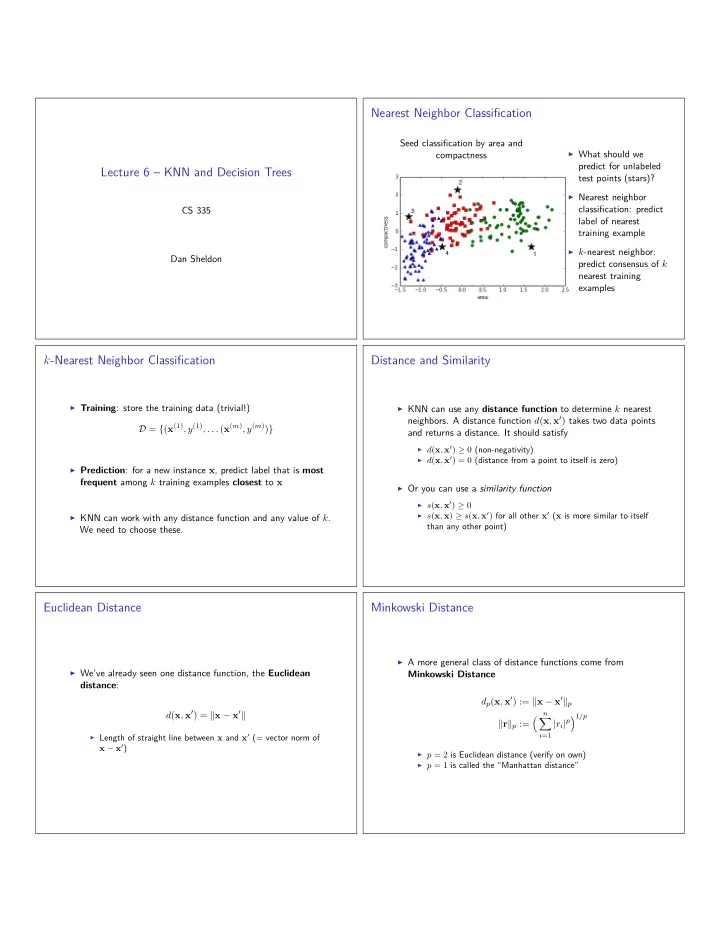
Nearest Neighbor Classification

Seed classification by area and compactness

◮ What should we

predict for unlabeled test points (stars)?

◮ Nearest neighbor

classification: predict label of nearest training example

◮ k-nearest neighbor:

predict consensus of k nearest training examples

k-Nearest Neighbor Classification

◮ Training: store the training data (trivial!)

D = {(x(1), y(1), . . . (x(m), y(m))}

◮ Prediction: for a new instance x, predict label that is most

frequent among k training examples closest to x

◮ KNN can work with any distance function and any value of k.

We need to choose these.

Distance and Similarity

◮ KNN can use any distance function to determine k nearest

  • neighbors. A distance function d(x, x′) takes two data points

and returns a distance. It should satisfy

◮ d(x, x′) ≥ 0 (non-negativity) ◮ d(x, x′) = 0 (distance from a point to itself is zero)

◮ Or you can use a similarity function

◮ s(x, x′) ≥ 0 ◮ s(x, x) ≥ s(x, x′) for all other x′ (x is more similar to itself

than any other point)

Euclidean Distance

◮ We’ve already seen one distance function, the Euclidean

distance: d(x, x′) = x − x′

◮ Length of straight line between x and x′ (= vector norm of

x − x′)

Minkowski Distance

◮ A more general class of distance functions come from

Minkowski Distance dp(x, x′) := x − x′p rp :=

  • n
  • i=1

|ri|p1/p

◮ p = 2 is Euclidean distance (verify on own) ◮ p = 1 is called the “Manhattan distance”

slide-2
SLIDE 2

Examples

◮ Jupyter Demo 1: different distance functions

KNN Implementation

◮ The “brute force” version of KNN is very straightforward:

◮ Given test point x, compute distances d(i) := d(x, x(i)) to each

training example

◮ Sort training examples by distance ◮ k-nearest neighbors = first k examples in this sorted list. ◮ Now, making the prediction is straightforward. ◮ Running time: O(m log m) for one prediction

◮ In practice, clever data structures (e.g., KD-trees) can be

constructed to find k nearest neighbors and make predictions more quickly.

KNN Trade-Offs

◮ Strengths

◮ Simple ◮ Converges to the correct decision surface as data goes to infinity

◮ Weaknesses

◮ Lots of variability in the decision surface when amount of data

is low

◮ Curse of dimensionality: everything is far from everything else in

high dimensions

◮ Running time and memory usage: store all training data and

perform neighbor search for every prediction → use a lot of memory / time

◮ Jupyter Demo 2: KNN in action

◮ Effect of k ◮ KNN convergence as data goes to infinity

Decision Trees

Example: Flu decision tree Temp%>%100% Sore%Throat%=Y% Healthy% Cold% Runny%Nose=Y% Flu% Other%

T" F" T" F" T" F"

Decision Trees

◮ Classical model for making a decision or classfication using

“splitting rules” organized into tree data structure

◮ Data instance x is routed from the root to leaf

◮ Nodes = “splitting rules” ◮ Continuous variables: test if (xj < c) or (xj ≥ c) (2 branches) ◮ Discrete variables: test (xj = 1), (xj = 2), . . . for k possible

values of xj (k branches)

◮ x goes down branch corresponding to result of test ◮ Leaf nodes are assigned labels → prediction for x

Decision Tree Intution

◮ Board work

◮ Geometric illustration of decision tree: recursive axis-aligned

partitioning

◮ Intuition for how to partition to fit a dataset (= learning a

decision tree)

slide-3
SLIDE 3

Decision Tree Learning

◮ How do we fit a decision tree to training data? We won’t give

details here, just some intuition. . .

◮ Idea: recursive splitting of training set

None Some Full

Patrons?

French Italian Thai Burger

Type? ◮ Start with all training examples at root of tree ◮ Find “best” splitting rule at root ◮ Recurse on each branch

Decision Tree Learning

None Some Full

Patrons?

French Italian Thai Burger

Type?

◮ “Best” splitting rule? Which of these is better?

◮ Ideally, split the examples into subsets that are all the same class ◮ Design heuristics based on this principle to choose the best split

◮ When to stop? Recusively split training examples until:

◮ All examples have same class ◮ Too few data training examples ◮ Maximum depth exceeded

Decision Tree Learning

◮ Jupyter Demo 3: visualize decision trees to fit to seeds dataset

Decision Tree Trade-Offs

◮ Strengths

◮ Interpretability: the learned model is easy to understand ◮ Running time for predictions: shallow trees can be extremely

fast classifiers

◮ Weaknessees

◮ Running time for learning: finding the optimal trees is

computationally intractable (NP-complete), so we need to design greedy heuristics.

◮ Representation: we may need very large trees to accurately

model geometry of our problem with axis-aligned splits

◮ General advice: decision trees are very competitive

“out-of-the-box” machine learning models for lots of problems!