NCAA v. NFHS SIGNIFICANT DIFFERENCES (2012) SCCFOA Boot Camp II - - PDF document

ncaa v nfhs significant differences 2012
SMART_READER_LITE
LIVE PREVIEW

NCAA v. NFHS SIGNIFICANT DIFFERENCES (2012) SCCFOA Boot Camp II - - PDF document

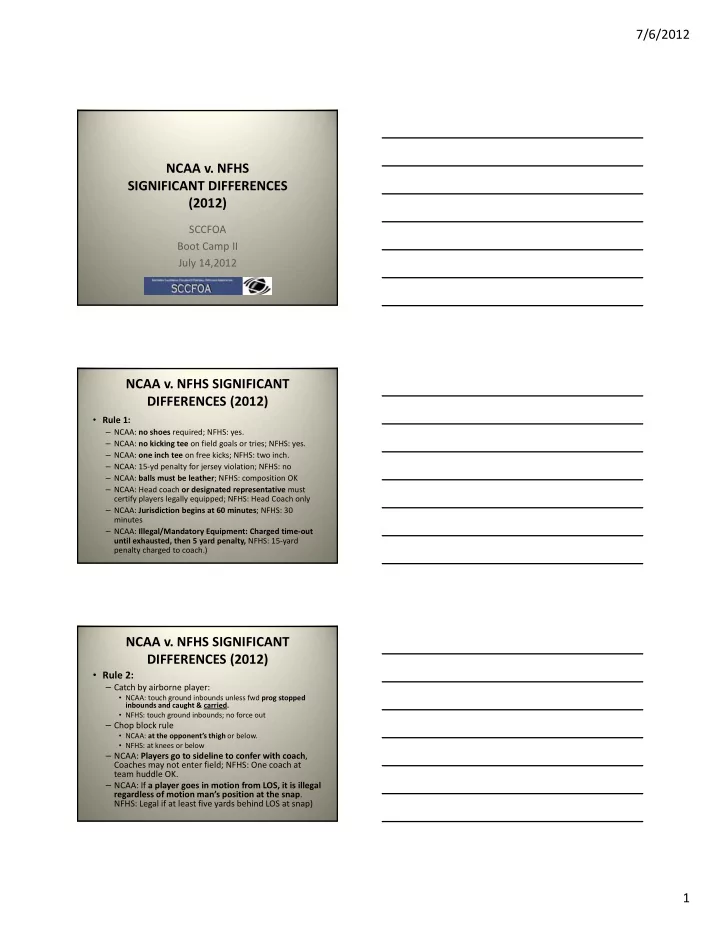
7/6/2012 NCAA v. NFHS SIGNIFICANT DIFFERENCES (2012) SCCFOA Boot Camp II July 14,2012 NCAA v. NFHS SIGNIFICANT DIFFERENCES (2012) Rule 1: NCAA: no shoes required; NFHS: yes. NCAA: no kicking tee on field goals or tries; NFHS: yes.


slide-1
SLIDE 1

7/6/2012 1 NCAA v. NFHS SIGNIFICANT DIFFERENCES (2012)

SCCFOA Boot Camp II July 14,2012

NCAA v. NFHS SIGNIFICANT DIFFERENCES (2012)

  • Rule 1:

– NCAA: no shoes required; NFHS: yes. – NCAA: no kicking tee on field goals or tries; NFHS: yes. – NCAA: one inch tee on free kicks; NFHS: two inch. – NCAA: 15‐yd penalty for jersey violation; NFHS: no – NCAA: balls must be leather; NFHS: composition OK – NCAA: Head coach or designated representative must certify players legally equipped; NFHS: Head Coach only – NCAA: Jurisdiction begins at 60 minutes; NFHS: 30 minutes – NCAA: Illegal/Mandatory Equipment: Charged time‐out until exhausted, then 5 yard penalty, NFHS: 15‐yard penalty charged to coach.)

NCAA v. NFHS SIGNIFICANT DIFFERENCES (2012)

  • Rule 2:

– Catch by airborne player:

  • NCAA: touch ground inbounds unless fwd prog stopped

inbounds and caught & carried.

  • NFHS: touch ground inbounds; no force out

– Chop block rule

  • NCAA: at the opponent’s thigh or below.
  • NFHS: at knees or below

– NCAA: Players go to sideline to confer with coach, Coaches may not enter field; NFHS: One coach at team huddle OK. – NCAA: If a player goes in motion from LOS, it is illegal regardless of motion man’s position at the snap. NFHS: Legal if at least five yards behind LOS at snap)

slide-2
SLIDE 2

7/6/2012 2 NCAA v. NFHS SIGNIFICANT DIFFERENCES (2012)

  • Rule 3:

– NCAA: 15 min quarters; NFHS: 12 min. – NCAA: no stopping clock for equipment repair. – NCAA: 40/25 sec play clock; NFHS: 25 – NCAA: clock starts on R signal (RFP) for Team A runner OOB except last 2 min – NCAA: option for 30‐second timeout – 12 or more players on field: NCAA: 5 yds, Illegal Substitution NFHS: 15 yds, Ill Participation, – Overtime ‐ NCAA: 25 yard line, – no kick try after second OT period; NFHS: 10 yd line.

NCAA v. NFHS SIGNIFICANT DIFFERENCES (2012)

  • Rule 3:

– NCAA: During coin toss each team is to remain in the area between the nine yards marks; else five yard penalty; NFHS: must stay in team box; else fifteen yard penalty. – NCAA: Possible 10 second runoff for fouls in last 1 minute of each half that cause clock to stop; NFHS: no such provision. – NCAA: DOG starts on ready except when by Team A while in a scrimmage‐kick formation. NFHS: on the snap – no exceptions)

NCAA v. NFHS SIGNIFICANT DIFFERENCES (2012)

  • Rule 3:

– NCAA: Obvious errors in timing may be corrected anytime during the period in which they occur; NFHS: only if discovered prior to the 2nd live ball following the error unless the period has

  • fficially ended.

– Halftime: NCAA: 20 minutes; NFHS: 15 (+ 3 minute warm‐up) – NCAA: Period extension criteria apply only during a down in which time expires; NFHS: Period extension criteria apply during the last timed down. Period is not extended if the penalty is a safety. – NCAA: Replaced player must depart immediately (3 seconds), but A cannot break huddle with 12 players. NFHS: Replaced player must depart within 3 seconds of arrival of substitute. Breaking the huddle with 12 or more players is not a foul – NCAA: While in the process of substitution, Team A is prohibited from rushing quickly to the line of scrimmage and snapping.

slide-3
SLIDE 3

7/6/2012 3 NCAA v. NFHS SIGNIFICANT DIFFERENCES (2012)

  • Rule 4:

– The ball becomes dead by rule when:

NCAA:

  • (1) An official signals the ball dead without blowing his whistle
  • (2) the fourth‐down fumble rule applies
  • (3) when a runner simulates putting his knee on the ground
  • (4) when a scrimmage kick is made beyond the neutral zone
  • (5) any free kick untouched by Team B or a scrimmage kick that is untouched by Team B

beyond the neutral zone, touches the ground in Team B's end zone

  • (6) a kicking team player catches or recovers any free or scrimmage kick that has

crossed the neutral zone

– NFHS:

  • (1) During a try when Team B gains possession or it is apparent a kick will fail
  • (2) When a kick breaks the plane of the receiving team’s goal line
  • (3) a scoring kick touches a kicking team player in the end zone or has failed

after breaking the plane of the receiving team’s goal line

  • (4) a kicking team player catches or recovers any free kick or a scrimmage kick

which is beyond the neutral zone.

NCAA v. NFHS SIGNIFICANT DIFFERENCES (2012)

  • Rule 4:

– NCAA: fumble OOB in advance of spot of fumble is returned to spot of fumble – start clock on the ready; NFHS: at OOB spot – start clock on the snap. – NCAA: A placekick holder need not rise before handing off or passing. NFHS: Must rise before trying to advance, hand or pass the ball else the ball is immediately dead.

NCAA v. NFHS SIGNIFICANT DIFFERENCES (2012)

  • Rule 5:

– If Team A is given an extra ("fifth") down:

  • NCAA: Must be corrected before the ball is legally snapped or free kicked for

a down after the one in which the error occurred, or the second or fourth period has ended. If replay is being in used, the correction can be made before the ball is legally snapped for the next series.

  • NFHS: That is discovered before the ball becomes live (snapped or free kicked)

for the down after the "fifth‐down" play, the extra down is canceled and play reverts to what should have been the fourth down play. That means Team B will always take over at that spot.

– If Team A is shorted a down:

  • NCAA: Same a above.
  • NFHS: The down marker can be adjusted to reflect the correct down at any

time during that series of downs. The down cannot be adjusted after a change

  • f possession or when the referee signals a first down for either team. If

either occurs, no correction can be made and the down shortage is ignored.

slide-4
SLIDE 4

7/6/2012 4 NCAA v. NFHS SIGNIFICANT DIFFERENCES (2012)

  • Rule 6:

– NCAA: Free Kick from 35 / Touchback 25 ; NFHS: 40 / 20. – NCAA: all kicks stay alive in EZ if touched by R before touching ground in EZ. – NCAA: KOF is a live ball foul – option to enforce a previous or dead ball spot – Free Kick OOB: Penalty if untouched by R (NCAA: 30 yards beyond option; NFHS: 25 yards). – NCAA: FK ‐ 4 player min on either side of kicker – NCAA: FK – After RFP all K players must be within 5 yds of kick line – NCAA: Defensive formation on place kicks ‐ Illegal for three players to line up shoulder‐to‐shoulder and move forward with primary contact against a single player.

NCAA v. NFHS SIGNIFICANT DIFFERENCES (2012)

  • Rule 6:

– NCAA: no penalty for invalid or illegal Fair Catch signal; NFHS: 5 yds. – NCAA: no option for Free Kick after Fair Catch; NFHS: yes. – Kick Catch Interference (15 yard penalty in all cases)

  • NCAA: R must be in position to catch.
  • NCAA: One yard box in front of receiver
  • NCAA: Protection applies on Free Kicks directly into turf
  • NFHS – Free Kick ‐ K can't touch before ball touches ground.
  • NFHS: Scrimmage Kick ‐ R must be in position to catch

– NCAA: ‐ B not attempt to block a punt by jumping over Team A player behind neutral zone inside the tackle box.

NCAA v. NFHS SIGNIFICANT DIFFERENCES (2012)

  • Rule 6:

– NCAA: It is illegal for three or more members of the receiving team to intentionally form a wedge for the purpose of blocking for the ball carrier after the ball has been kicked, except when the kick is from an

  • bvious onside kick formation (or kick results in

touchback); NFHS: It is legal to block from a wedge formation during any down.

slide-5
SLIDE 5

7/6/2012 5 NCAA v. NFHS SIGNIFICANT DIFFERENCES (2012)

  • Rule 7:

– NCAA: No restriction on locking legs: NFHS: Only guards & snapper. – NCAA: DOF is live ball foul unless it causes false start. – NCAA: shift involves two players. (FST if all 11 fail to set after RFP) – NCAA: on fwd pass ineligibles can't cross NZ prior to pass – NCAA: PI must be on catchable ball. – NCAA: face guarding not PI, must be contact. – Pass Crossing NZ (impacts PI & ineligible receivers)

  • NCAA: Determined by where touched first; NFHS: by where it ends up.

– NCAA: Direction of pass determined by where touched first; NFHS: determined by initial direction. – NCAA: For IFP, passer must be completely beyond NZ ; NFHS: if foot is beyond

NCAA v. NFHS SIGNIFICANT DIFFERENCES (2012)

  • Rule 7:

– NCAA: Forward Pass (Spike to Conserve Time) Hand to hand snap not required. NFHS: Only immediately from hand to hand snap. – NCAA: Grounding is loss of down at the spot of pass, no yardage assessed. Passer may avoid grounding when outside the normal position of the tackle by throwing the ball beyond neutral zone. NFHS: Loss of down and 5‐yard penalty from spot of pass (end of run).

NCAA v. NFHS SIGNIFICANT DIFFERENCES (2012)

  • Rule 8:

– Try for Point: – NCAA: The ball remains live as on any try attempt. B may

  • score. Prior to change of possession, the try ends if A1 fumbles

and a teammate recovers (Same as 4th down). Not attempted following touchdown on last timed down if game decided. NFHS: Ball dead when kick fails or when B secures possession. B cannot score. Ball remains alive on fumble if Team A recovers. Not attempted following touchdown on last timed down if game decided and playoff qualification is not a factor. – NCAA: If an unsuccessful field goal attempt crosses the neutral zone… and is untouched by Team B beyond the NZ, it is returned to the previous spot (or 20 yard line); NFHS: touchback if inside 20 yard line, treated the same as a punt if from beyond.

slide-6
SLIDE 6

7/6/2012 6 NCAA v. NFHS SIGNIFICANT DIFFERENCES (2012)

  • Rule 9:

– NCAA: blocking below waist:

  • Off players in motion (if outside Tackle Box while in motion)
  • Backs outside tackle box or Lineman >7 yds from snap
  • Can't BBW toward non‐adj sideline.

– No BBW: during kick downs or after a change of possession. – Defense can only BBW in blocking zone extended.

  • NCAA: legal clipping zone (6 x 10)

– Only offensive linemen. – May not leave zone and return. – Exists until ball is touched outside zone or fumble/muff leaves zone.

– Chop Block: any combo block, low‐high or high‐low

  • NCAA: at thigh or below; NFHS: at knee or below

NCAA v. NFHS SIGNIFICANT DIFFERENCES (2012)

  • Rule 9:

– NCAA: contact foul on eligible receiver beyond NZ when pass crosses NZ is automatic first down – NCAA: Facemask foul ‐ always 15 yards ‐ no 5 yard foul – NCAA: Horse collar tackle must be immediate; NFHS: no exceptions – NCAA: No blocking OOB – Protection for snapper: NCAA: ‐ one second; NFHS: ‐ looks up – NCAA: no warning for sideline interference (5 yards ‐5yards‐ 15 yards) NFHS: Warn – 5 yards – 15 yards. – Players OOB:

  • NCAA: Team A on kicks can't return, otherwise legal except to be first

to touch a pass. ( 5 yard penalty kick play – LOD on touching pass)

  • NFHS: A or K can't return during down. (15 yards – illegal

participation)

NCAA v. NFHS SIGNIFICANT DIFFERENCES (2012)

  • Rule 9:

– NCAA: No defensive player inside the tackle box may try to block a punt by leaving his feet in an attempt to leap directly over an opponent. (LEAP OVER THE PUNT SHIELD); NFHS: There is no leaping restriction. – NCAA: For disconcerting signals, penalty is five yard delay

  • f game (DOG); NFHS: 15 yard UNS

– NCAA: no RTK if kicker carries ball outside tackle box (Note; other personal fouls are possible); NFHS: no similar rule

– NCAA: Batting a grounded loose ball is legal (except in the end zone) illegal batting or kicking is 10‐yard penalty; NFHS: 15 yard penalty

slide-7
SLIDE 7

7/6/2012 7 NCAA v. NFHS SIGNIFICANT DIFFERENCES (2012)

  • Rule 9:

– Fighting:

  • NCAA: Disqualified. First half fight ‐ for game. Second‐half fight ‐

for second half and first half of next game. Second fight –players / substitutes /coaches for season;

  • NFHS: Disqualified from the game.

NCAA v. NFHS SIGNIFICANT DIFFERENCES (2012)

  • Rule 10:

– NCAA: All 9‐1‐2 personal fouls carry automatic first down. – NCAA: no Loss of Down on offensive PI. – NCAA: UNS by player enforced as live‐ball foul – NCAA: 10‐sec runoff for certain fouls in last min of each half – Roughing the Passer:

  • NCAA: End of last run (beyond LOS or no COP during

down); NFHS: Dead‐ball spot.

– Basic spot for run ending behind NZ:

  • NCAA: Previous spot; NFHS: End of run

NCAA v. NFHS SIGNIFICANT DIFFERENCES (2012)

  • Rule 10:

– NCAA: Team A fouls against the opponent (hold, clip, etc.) behind NZ are enforced from PS (except in EZ = Safety) – NCAA: dead‐ball fouls may cancel – NCAA: – kick plays except FG, Team A penalties (except KCI) may be enforced from pervious or succeeding spot – Fouls by opponents on scoring play:

  • NCAA: – PF’s and UNS only carry over on TD plays
  • NFHS: ‐ all may carry over if after any COP.

– Fouls by opponents on try

  • NCAA: – PF may carry over
  • NFHS: – can carry over on all tries
slide-8
SLIDE 8

7/6/2012 8 NCAA v. NFHS SIGNIFICANT DIFFERENCES (2012)

  • Extra Periods (NCAA) / Overtime Periods (NFHS)

– Mandatory for all NCAA games in which the score is tied. – Only one coin toss

  • Team winning the toss has the option to start the overtime on
  • ffense or on defense, or select the end of the field
  • The team losing the coin toss has the remaining option.
  • The coin‐toss winner cannot defer making a choice.

– First overtime begins:

  • NCAA: Teams are allowed to go to its team areas while officials

review timeouts, etc. If there is more than one overtime, the following overtime should begin as soon as the officials are ready.

  • NFHS: There is a three‐minute break during which teams may confer

with coaches. If there is more than one overtime, the break between each period is two minutes, during which the captains' options are exercised

NCAA v. NFHS SIGNIFICANT DIFFERENCES (2012)

  • Extra Periods (NCAA) / Overtime Periods (NFHS)

– The coin toss is conducted:

  • NCAA: As soon as the officials are ready; no specific time

limitation is involved.

  • NFHS: After the between‐periods break.

– An overtime period starts with the ball being snapped from:

  • NCAA: Team B's 25 yard line, first and 10.
  • NFHS: Team B's 10 yard line, always first and goal.
  • BOTH: Certain fouls may carryover from regulation to
  • vertime, from one overtime series to the next or from
  • ne overtime period to the next, affecting the beginning

location.

NCAA v. NFHS SIGNIFICANT DIFFERENCES (2012)

  • Extra Periods (NCAA) / Overtime Periods (NFHS)

– If there is a change of possession:

  • NCAA: The ball remains live essentially in the same ways it

remains live during regulation play. As a result, the defense can score in overtime in exactly the same ways it can score during regulation play. (If there is more than one change of possession during a down and Team A is in possession when the down ends, Team A's series is over; Team A does not receive a "new" series.)

  • NFHS: The ball becomes dead immediately whenever the

defensive team gains possession. Effect: In all but the rarest circumstances (a series of penalties or other yardage losses followed by a Team A ball carrier fumbling or getting tackled in his own end zone), it is ‘impossible’ for the defense to score.

slide-9
SLIDE 9

7/6/2012 9 NCAA v. NFHS SIGNIFICANT DIFFERENCES (2012)

  • Extra Periods (NCAA) / Overtime Periods (NFHS)

– Fouls after change of possession:

  • NCAA:

– penalties for live‐ball fouls by either team are declined by rule – any score by the fouling team is canceled – if both teams commit fouls during the down, and Team B's foul occurs after they gain possession, the penalties offset, neither team can score and the down is not replayed – dead‐ball fouls, live‐ball fouls enforced as dead‐ball fouls, and flagrant fouls that occur after a change of possession are enforced to start the next series, but any score by the fouling team is canceled. A flagrant foul is defined as an infraction of a rule so extreme or deliberate that it places an opponent in danger of catastrophic injury

  • NFHS: The ball is dead as soon as the defense gains possession of
  • it. Therefore, it is impossible to have a live‐ball foul committed

after a change of team possession.

NCAA v. NFHS SIGNIFICANT DIFFERENCES (2012)

  • Extra Periods (NCAA) / Overtime Periods (NFHS)

– One team timeout during each overtime period. Timeouts not used during regulation do not carry

  • ver to overtime. A timeout not used in one
  • vertime period does not carry over to a following
  • vertime period.
  • NCAA: Timeouts granted between periods are charged

to the succeeding (following) period.

  • NFHS: Timeouts granted between periods are charged to

the previous period. If there were no time outs remaining in the previous period, the timeout request is denied.

NCAA v. NFHS SIGNIFICANT DIFFERENCES (2012)

  • Extra Periods (NCAA) / Overtime Periods (NFHS)

– The rules that apply to a try during regulation play also apply during a try following a Team A touchdown scored in overtime.

  • NCAA: Beginning with the third overtime period, the try

must be attempted for two points. It is not a foul to attempt a kick, but it cannot score

  • NFHS: No additional rules.
  • BOTH: If a touchdown is scored that determines the

winner, the try is canceled.

slide-10
SLIDE 10

7/6/2012 10