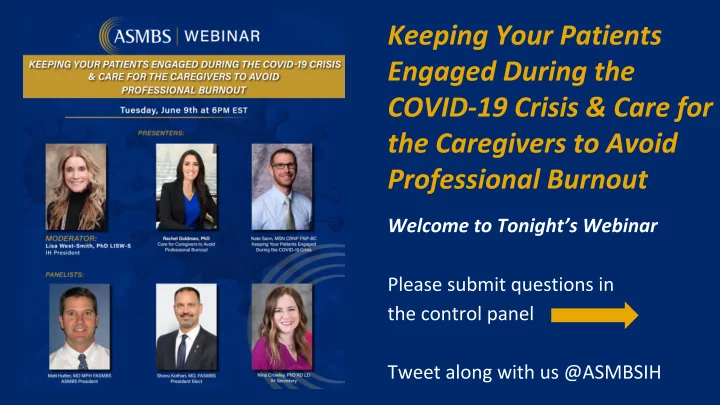
Nate Sann, MSN CRNP FNP-BC Health Outcomes Fear and anxiety - - PowerPoint PPT Presentation

nate sann msn crnp fnp bc health outcomes fear and
SMART_READER_LITE
LIVE PREVIEW

Nate Sann, MSN CRNP FNP-BC Health Outcomes Fear and anxiety - - PowerPoint PPT Presentation

Nate Sann, MSN CRNP FNP-BC Health Outcomes Fear and anxiety Disconnected Financial Uncertain about their upcoming bariatric surgery status Online seminars Telehealth visits Online patient education


slide-1
SLIDE 1
slide-2
SLIDE 2
slide-3
SLIDE 3
slide-4
SLIDE 4

Nate Sann, MSN CRNP FNP-BC

slide-5
SLIDE 5
  • Health Outcomes
  • Fear and anxiety
  • Disconnected
  • Financial
  • Uncertain about their upcoming bariatric surgery status
slide-6
SLIDE 6
  • Online seminars
  • Telehealth visits
  • Online patient education modules
  • Online support groups
  • Online social media platforms
slide-7
SLIDE 7
  • Accessibility
  • Privacy
slide-8
SLIDE 8
  • New patient consults
  • Preoperative insurance mandated supervised weight management visits
  • Nutrition consults and follow up
  • Behavioral health visits
  • Postoperative visits
slide-9
SLIDE 9
  • Reproduce the same education as in-person education
  • Increased accessibility
  • Education video modules
  • Printable materials
  • Education around COVID
slide-10
SLIDE 10
  • Accessibility and Efficiency for patients
  • Anonymity
  • Connect patients and providers in a time of being disconnected
slide-11
SLIDE 11
  • #KeepWalkingFromObesity campaigns
  • Facebook live or pre-taped messages
  • Instagram posts
  • Cooking videos and other life hacks focused on COVID challenges
  • Physical fitness and exercise in the absence of gym accessibility
slide-12
SLIDE 12
  • ASMBS launched a Telehealth Taskforce
  • COVID 19 Webinar Series
  • ASMBS Facebook Groups
  • ASMBS Corporate Council company responses to COVID-19
slide-13
SLIDE 13
slide-14
SLIDE 14

June 9, 2020 ASMBS COVID-19 Webinar Series

Care for Caregivers to Avoid Professional Burnout

Rachel Goldman, PhD, FTOS

Licensed Psychologist and Consultant, Private Practice Clinical Assistant Professor, Department of Psychiatry NYU Grossman School of Medicine

DrRachelNYC@gmail.com

slide-15
SLIDE 15
  • For the past few months, we have been worried about a world where hundreds of thousands were dying.
  • We were worried about getuing sick and worried about others getuing sick.
  • So much about life as we knew it became uncertain.
  • Maybe if you were a working parent, you also became a full time employee and full time home school

teacher, while protecting your family (and perhaps your patients) from the pandemic

  • Then in the past few weeks, millions of people around the world have been protesting police brutality in

the wake of George Floyd’s death.

  • The Covid pandemic continues, states are starting to lift restrictions
  • It is being said that the multiple stresses people are experiencing “will result in secondary epidemic of

burnouts and stress-related absenteeism in the latuer half of 2020.”

(According to Elke Van Hoof, a professor of health psychology)

to exhaustion, and with no real end in sight added stress and exhaustion

slide-16
SLIDE 16
  • Even before the COVID-19 pandemic, there was a high prevalence of burnout and mental health

concerns with healthcare providers Panagioti M et al., 2017

  • Recent review and meta analysis in the British Medical Journal tells us that in the past 20 years,
  • ther viral epidemics have raised psychological problems for healthcare workers

Kisely S et al., 2020

  • Data from previous pandemics, suggest that healthcare workers are at risk of developing

symptoms of PTSD, depression, and substance use disorders. Brooks S et al., 2020

  • The first research about quarantine in China found that quarantine can bring on insomnia, stress,

anxiety, depression, anger, emotional exhaustion, and post traumatic stress symptoms. Brooks S et a., 2020

  • Preliminary data from China during the COVID-19 pandemic show 50.3% of healthcare workers

reported depression, 44.6% anxiety, 34.0% insomnia, and 71.5% distress. Lai J et al. 2020

slide-17
SLIDE 17
  • Online survey that was conducted in April 2020 included approx. 1000 respondents from a random

sample of employees across the US and looked at burnout in light of the Pandemic

(Eagle Hill Consulting)

  • US employees are less engaged, less productive, and less positive about their career
  • 45% of US employees are feeling burnout with 1 in 4 of them reported feeling that way due

to COVID-19.

  • We are all feeling this “Pandemic Fatigue” or “Covid Fatigue”
  • Describes the intense tiredness, weariness that many of us feel, and the irritability and

disorientation of not knowing which day of the week it is.

  • This is being experienced by not just frontline workers, but sometimes even more so for those

working from home

  • Why is this taking such a toll on us?
  • For MANY reasons, but if you are working from home you also…
  • don’t have mental breaks built into your day
  • don’t have commuting time or “transitions” built into your day
  • maybe you and your self-care is on the backburner
slide-18
SLIDE 18
  • What is OUT of our control?

– Daily stressors – Other people’s behaviors – How other people react

  • What is IN our control?

– Our behaviors – Our reactions – How we cope Creating boundaries

  • Checking-in with ourselves
  • Disengaging from social media or media in general
  • Our self-care
slide-19
SLIDE 19

The practice of taking action to preserve or improve one’s own health.” “The practice of taking an active role on protecting one’s own well-being and happiness, in particular during periods of stress.”

  • Oxford Dictionary
  • It is a broad term that encompasses just about ANYTHING you do to

be good to yourself

  • It’s about being kind to yourself.
slide-20
SLIDE 20
slide-21
SLIDE 21
slide-22
SLIDE 22
  • We are busy and stressed

– We are currently juggling a lot--- work, home life, home schooling, and MORE – Maybe we don’t even realize we are running on low

  • We end up putuing everyone else first, including our patients, and we

end up on the back burner

  • We feel guilty about taking the time required to care for ourselves
slide-23
SLIDE 23

It allows us to de-stress, refocus, be productive, and accomplish our goals OR

  • We will eventually burn out and not be productive, in any aspect of
  • ur life, personal or professional.
  • We will eventually get sick
slide-24
SLIDE 24

An oxymoron?

  • Knowing what you need to do and allowing yourself to do it.
  • The behaviors that we participate in everyday that contribute to our

survival are acts of selfishness. The act of eating or sleeping is selfish — but if we didn’t, we wouldn’t survive.

  • We need to participate in these behaviors, as well as others to be

healthy, such as taking time out of our day for us, for “me time,” and to relax or de-stress.

  • These behaviors allow us to be healthy so we can be healthy and

available for others

slide-25
SLIDE 25
  • Look at your daily routine and create some structure that

includes:

– Sleep

– Water – Physical Activity

– Diet

– Stress Management

slide-26
SLIDE 26
  • Coping strategies

– Strategies we use to manage problems and emotions in our lives

  • Have a toolbox full of tools that you can pull from
  • Recommendation:

– Have at least 3 and 1 of the 3 is something internal that you don’t need anyone else or anything else for

slide-27
SLIDE 27
  • Check in with yourself on a regular basis.

– Ask yourself “What do I need right now to be the best me?” – Ask yourself how you are you doing with the your health behaviors

  • Set boundaries.

– It’s okay to say NO in order to say YES to you and your health

  • Create breaks throughout the day to rest or recharge.
  • Think of micropractices which only require a few seconds or a few minutes to

implement. – Examples

  • Take a moment to focus on your breath when washing your hands
  • Write down something you are grateful for each day

S l e e p

√ Water √ Physical Activity √ Diet √ Stress

Management

slide-28
SLIDE 28
  • The oxygen mask and you can’t pour from an empty cup.
  • Taking care of YOU and YOUR health is NOT selfish.
  • What is IN your control and OUT of your control.
  • Have a toolbox full of tools that you can use.
  • Check in with yourself on a regular basis- what do YOU need now to be the

best you?

  • Schedule daily ‘Me Time’ and make it part of your daily routine.
  • Be kind to yourself and practice self-compassion.
  • REMEMBER: This is tough but you don’t need to be doing it alone.

– Ask for support or seek professional help if you need to.

slide-29
SLIDE 29

Brooks SK, Webster RK, Smith LE, etal. The psychological impact of quarantine and how to reduce it: rapid review of the evidence. Lancet. 2020;395:912-20. Gold J. Covid-19: adverse mental health outcomes for healthcare workers. BMJ. 2020;369:m1815. Kisely, S, Warren, N, McMahon L, Dalais C, Henry I, Siskind D. Occurrence, prevention, and management of the psychological effects of emerging virus outbreaks on healthcare workers: rapid review and meta-analysis. BMJ. 2020; 369:m 1642. Lai J, Ma S, Wang Y, et al. Factors Associated With Mental Health Outcomes Among Health Care Workers Exposed to Coronavirus Disease 2019. JAMA Netw Open2020;3:e203976. Panagioti M, Panagopoulou E, Bower P. Controlled interventions to reduce burnout in physicians: a systematic review and meta-analysis. JAMA Intern Med. 2017; 77:195-205.

.

slide-30
SLIDE 30

Thank You!

Rachel Goldman, PhD, FTOS

DrRachelNYC@gmail.com IG: @DrRachelNYC Twituer: @AskDr_Rachel

slide-31
SLIDE 31
slide-32
SLIDE 32
slide-33
SLIDE 33